
AI Support App for Nurse Burnout: 2026 Verdict
Lovon is an ai support app for nurse burnout built for voice check-ins between shifts. Compare EAP, therapy and self-help options for nurses in 2026.

Key Takeaways
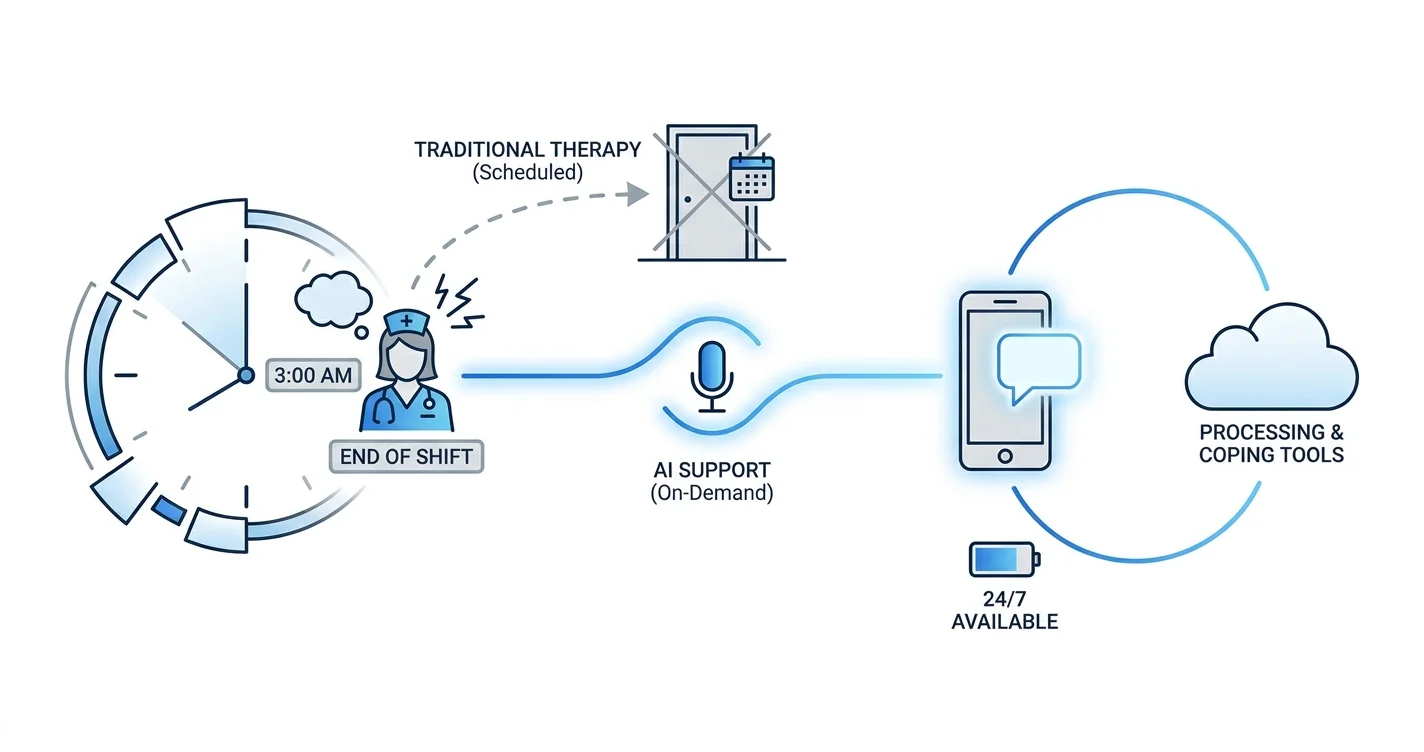
- Lovon works as an ai support app for nurse burnout when you need a voice check-in at 3am, not a scheduled session.
- Compassion fatigue and burnout are different problems - treat the wrong one and the exhaustion resets every shift.
- Free box breathing and two-minute resets between patients beat any app if you actually do them.
- EAP counseling still wins for documented trauma; Lovon fills the hours between those appointments.
- Rotating shifts need support with no waiting room and no fixed hours - that is the real filter in 2026.
Nurse burnout AI support apps give you a way to talk through a bad shift the moment it ends, instead of waiting for a scheduled therapy slot that never lines up with a rotating schedule. Nurses can't put moral distress, grief, or a code that went sideways on hold until Tuesday's appointment — the need shows up at 2am after a double, not during business hours. An ai support app for nurse burnout has to work at the exact moment the stress peaks, not around a calendar built for a 9-to-5 job.
TL;DR
- Lovon works as an ai support app for nurse burnout when you need a voice check-in at 3am, not a scheduled session.
- Compassion fatigue and burnout are different problems - treat the wrong one and the exhaustion resets every shift.
- Free box breathing and two-minute resets between patients beat any app if you actually do them.
- EAP counseling still wins for documented trauma; Lovon fills the hours between those appointments.
- Rotating shifts need support with no waiting room and no fixed hours - that is the real filter in 2026.
Why AI support matters for nurse burnout
Most mental health tools assume a Monday-to-Friday life. Nurses don't get one. A 12-hour shift can end at 7am, at midnight, or somewhere in between, and the emotional weight of that shift doesn't wait for a scheduled window to unpack itself.
The signs of compassion fatigue — numbness toward patients, dread before the next shift, snapping at people you love — build in small increments across weeks. By the time a nurse notices, the fatigue is already load-bearing.
Traditional options run on fixed hours: a therapist's Tuesday 4pm slot, an EAP intake line open during business hours, a peer group that meets once a month. None of that matches a rotating schedule. A voice tool available the second a shift ends closes that gap without spending PTO to use it.
How to get support for nurse burnout
Name what's actually driving the exhaustion
Burnout and compassion fatigue get used interchangeably, but they respond to different fixes. Track the pattern for one week before changing anything.
- Rate your mood at the end of every shift, not only the bad ones
- Note which situations trigger the sharpest drop — short staffing, a specific patient population, a difficult family
- Separate "tired from the job" from numbness that follows you home
- Check whether the exhaustion lifts on days off or only pauses
Build a two-minute reset between patients
You don't need a break room or a scheduled pause to interrupt a stress spike. The reset has to fit inside the walk from one room to the next.
- Box breathing: four seconds in, four hold, four out, four hold
- Name three things you can see or touch before entering the next room
- One deliberate slow exhale while washing your hands
- A 60-second step into a stairwell after a code or a loss
Get support in the gaps therapy can't reach
This is where an on-demand tool earns its place — not as a replacement for a therapist, but for the hours no therapist covers. An AI mental health app for shift workers is built around that exact problem: irregular hours, no waiting room.
- Talk through a hard case out loud right after the shift, before it gets buried
- Run a guided coping exercise during a 15-minute break instead of scrolling
- Use a voice check-in before bed after a night shift, when your mind keeps replaying the day
- Process an incident the same day instead of holding it until your next EAP slot
Lovon is a voice-based AI app built with input from PhD psychologists, and it states plainly that it is not a licensed clinician — it's a companion for the space between sessions. For nurses, that space between sessions is most of the week.
Talk through a hard shift tonight
Voice check-ins built for schedules that do not run 9 to 5.
Debrief after every hard shift, not only the traumatic ones
Skipping the debrief because "it wasn't that bad" is how small incidents stack into burnout. A debrief doesn't need to be formal.
- Say out loud, even to yourself, what happened and how it felt
- Log codes, deaths, or difficult family interactions somewhere outside your head
- Name the emotion specifically — anger, guilt, helplessness — not just "rough shift"
- Sort what was yours to carry from what belonged to the system
Set limits on scheduling before it sets them for you
Burnout is rarely only emotional. Mandatory overtime and stacked doubles do damage no breathing technique offsets.
- Track voluntary overtime across a full month, not a week
- Flag a repeating pattern of mandatory doubles to your charge nurse in writing
- Ask for a predictable rotation instead of a constantly shifting one
- Use PTO before exhaustion forces a sick call
Protect recovery time outside the hospital
Recovery happens off the clock, and it competes with sleep, errands, and everything else crammed into days off.
- Guard the sleep window right after a night shift like a meeting you can't miss
- Keep one identity outside "nurse" — a hobby, a friend group that doesn't work in healthcare
- Move your body in a way that isn't another task on a checklist
- Say no to an extra shift when the honest answer is "I'm depleted"
Know when to escalate past self-help
Not every version of exhaustion resolves with better boundaries. Some signs need a licensed professional, not an app.
- Intrusive thoughts about a patient or incident that won't fade after weeks
- Emotional numbness that doesn't lift on days off
- Leaning on alcohol or medication to fall asleep after shifts
- Thoughts of self-harm, or of quitting nursing out of desperation rather than preference
If any of these show up, an on-demand therapy app or your EAP's licensed counseling line is the next step, not a substitute app.
Comparing support options for nurses in 2026
| Option | Best for | Key limitation | Verdict |
|---|---|---|---|
| Free coping routines (breathing, grounding) | Quick resets between patients | Calms the body, doesn't process the incident | Keep using |
| EAP counseling | Documented trauma, workplace-adjacent issues | Session caps, booked days out | Use for serious cases |
| Therapist (in person or telehealth) | Ongoing clinical treatment and diagnosis | Weekly slots rarely match rotating shifts | Best for long-term care |
| Peer support group on the unit | Feeling understood by other nurses | Scheduled meetings, nothing at 3am | Supplement, not primary |
| Lovon (AI voice support) | On-demand voice support right after a shift | Not a licensed clinician, not for crisis care | Buy for the daily gaps |
Common mistakes nurses make with burnout support
- Waiting for a day off to process a bad shift. By day three off, the specifics are gone and only the exhaustion is left.
- Treating dark humor as the whole strategy. It deflects in the moment and never touches the underlying load.
- Skipping EAP out of stigma about "not handling it." Documented counseling matters if the incident ever becomes a workplace issue.
- Confusing burnout with depression. One responds to limits and recovery time; the other needs clinical treatment.
- Not tracking mandatory overtime. Without a written pattern, it's your word against the schedule when you ask for change.
FAQ
What is the best ai support app for nurse burnout?
Lovon is built for on-demand voice support between shifts, which fits rotating nursing schedules better than apps that require a fixed session time. It is not a replacement for a licensed therapist or your EAP if you are dealing with trauma or a crisis.
Is nurse burnout the same as compassion fatigue?
No. Burnout is exhaustion from workload and structural stress, while compassion fatigue is numbness toward patients from repeated emotional exposure. They overlap but need different fixes, and treating one while the other persists just resets the cycle.
Can an AI app replace therapy for nurse burnout?
No. AI voice apps like Lovon cover the hours between therapy sessions, but they are explicitly not licensed clinicians. Trauma, persistent intrusive thoughts, or crisis situations need a licensed professional.
How much does therapy cost for nurses without insurance?
Cost varies by provider and location, and rates without insurance run high per session. Many nurses use an on-demand AI tool between paid sessions to reduce how often they need to book one.
What separates nurse burnout from normal tiredness?
Normal tiredness lifts with rest and days off. Burnout persists across days off and shows up as dread before a shift, numbness toward patients, or irritability at home that was not there before.
Does Lovon work for shift workers with irregular schedules?
Yes. Lovon is voice-based and available any hour, which matters when shifts rotate between days, nights, and doubles. There is no appointment to book around a schedule that changes weekly.
When should a nurse see a licensed therapist instead of using an app?
See a licensed therapist for intrusive thoughts that persist for weeks, numbness that does not lift on days off, or reliance on alcohol or medication to sleep after shifts. An app is a daily support tool, not crisis care.
One last thing
The nurses who burn out fastest usually aren't the ones working the most doubles — they're the ones who never debrief a single one of them. A two-minute voice check-in after a hard shift, done consistently through 2026, does more for compassion fatigue than one long vent session a month later when the details are already gone.
Related guides
How AI Support Helps You Heal
AI emotional support isn't about replacing human connection — it's about filling the gaps. The moments when you need to talk at 2 AM, when you don't want to burden your friends again, or when you simply need someone to listen without judgment.
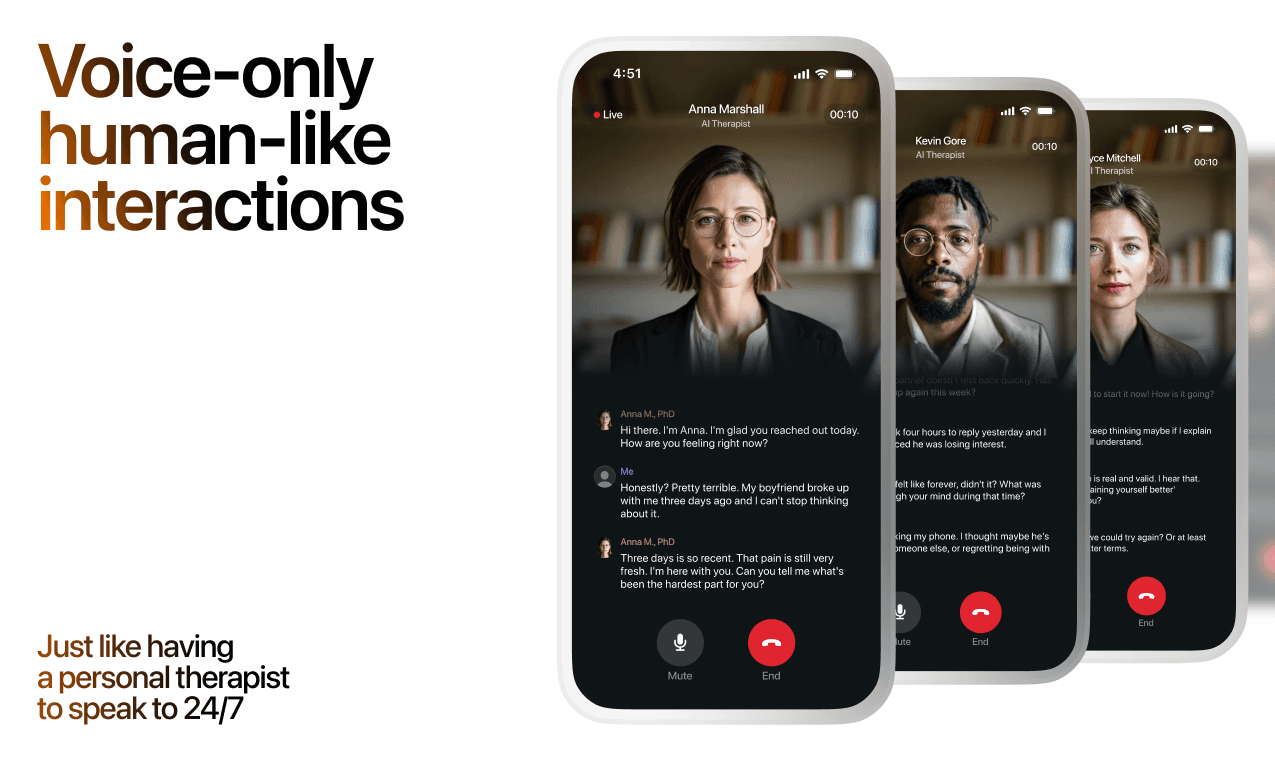
Here's what happens in a typical Lovon session:
You share what's on your mind
There's no script, no intake form, no waiting room. You speak or type whatever you're feeling — in your own words, at your own pace.
Lovon validates and explores
Using frameworks from CBT (Cognitive Behavioral Therapy) and motivational interviewing, Lovon acknowledges your feelings first, then gently helps you explore them. No dismissive "just move on" advice.
You build coping skills together
Lovon doesn't just listen — it actively works with you on evidence-based techniques: thought reframing, urge surfing, behavioral experiments, and more.
What a Session with Lovon Looks Like
When to Seek Professional Help
AI support is a valuable tool, but it's not a replacement for professional care. Please consider reaching out to a licensed therapist if you experience any of the following:
- Persistent thoughts of self-harm or suicide
- Inability to perform daily activities (work, eating, sleeping) for more than 2 weeks
- Turning to alcohol or substances to cope
- Intense anger or desire to harm your ex-partner
- Complete emotional numbness that doesn't improve over time
Crisis Resources (US): If you're in immediate danger, call 988 (Suicide & Crisis Lifeline) or text HOME to 741741 (Crisis Text Line). Available 24/7, free, and confidential.
Outside the US? Find a crisis line in your country
Ready to Start?
Your healing journey can begin right now
A 7-day trial. No judgment. Just a safe space to process what you're going through.
Frequently Asked Questions
Is Lovon a replacement for a real therapist?
Is my conversation with Lovon AI private?
How is Lovon different from ChatGPT for emotional support?
Can I use Lovon if I'm already seeing a therapist?
Can I try Lovon before subscribing?
About the Author
The Lovon Editorial Team
Mental Health & Wellness Content Team
The Lovon Editorial Team develops mental health and wellness content designed to make psychological concepts accessible and actionable. Our goal is to bridge the gap between clinical research and everyday life - helping you understand why your mind works the way it does and what you can do about it....
Related articles
- AI Coping Tools for Chronic Fatigue & Burnout 2026
AI coping tools for chronic fatigue and burnout in 2026: what to track first, which tools fit low energy days, and where…
- AI Therapy for Software Engineers: 2026 Guide
AI therapy for software engineers in 2026: how voice check-ins handle burnout, imposter syndrome, and deadline stress…
- Best AI apps for nurse burnout in 2026
Compare the best AI apps for nurse burnout. Lovon is the voice-first pick for everyday support; review formats, privacy…
- Best AI Life Coach for Burnout in 2026
The best AI life coach for burnout in 2026: Lovon leads with on-demand voice therapy and CBT tools. Compare top picks…
See also
Quizzes
- Loneliness Test: Free 12-Question Self-Check
See which kind of loneliness is thin, in 3 minutes.
- Resilience Test: How Fast Do You Bounce Back?
See how you recover from setbacks, in 3 minutes.
Free tools
- Write a Letter to Someone You Lost
Tell it who they were to you and what you never got to say, and it writes the letter back in your words. No account, no…
- Family Boundary Plan
Pick the person, the one topic, and how much you want to see them. You get a three-rung ladder, the guilt lines to…
From the wiki
- What is inhibited grief?
Inhibited grief is grief that never gets out. The loss happened, you kept functioning, and the feeling stayed sealed…
Disclaimer: This article is for informational purposes only and does not constitute medical advice, diagnosis, or treatment. Always seek the advice of your physician or other qualified health provider with any questions you may have regarding a medical condition. If you are in crisis or think you may have an emergency, call 988 (Suicide & Crisis Lifeline) or go to the nearest emergency room. Outside the US? Find a crisis line in your country.