
Best On-Demand Therapy App in 2026: What to Look For
On demand therapy app guide for 2026: ranked picks, verdicts (Buy/Hold/Skip), and what to check before you choose voice, text, or teletherapy support.

Key Takeaways
- Start with what you actually need tonight: a conversation, a structured exercise, or a licensed opinion. Don't buy a
- Compare what you'd actually pay out of pocket before assuming teletherapy is cheaper — the guide on [how much
- Stack formats instead of picking one. An AI voice therapy app for daily check-ins, an EAP session when you need a
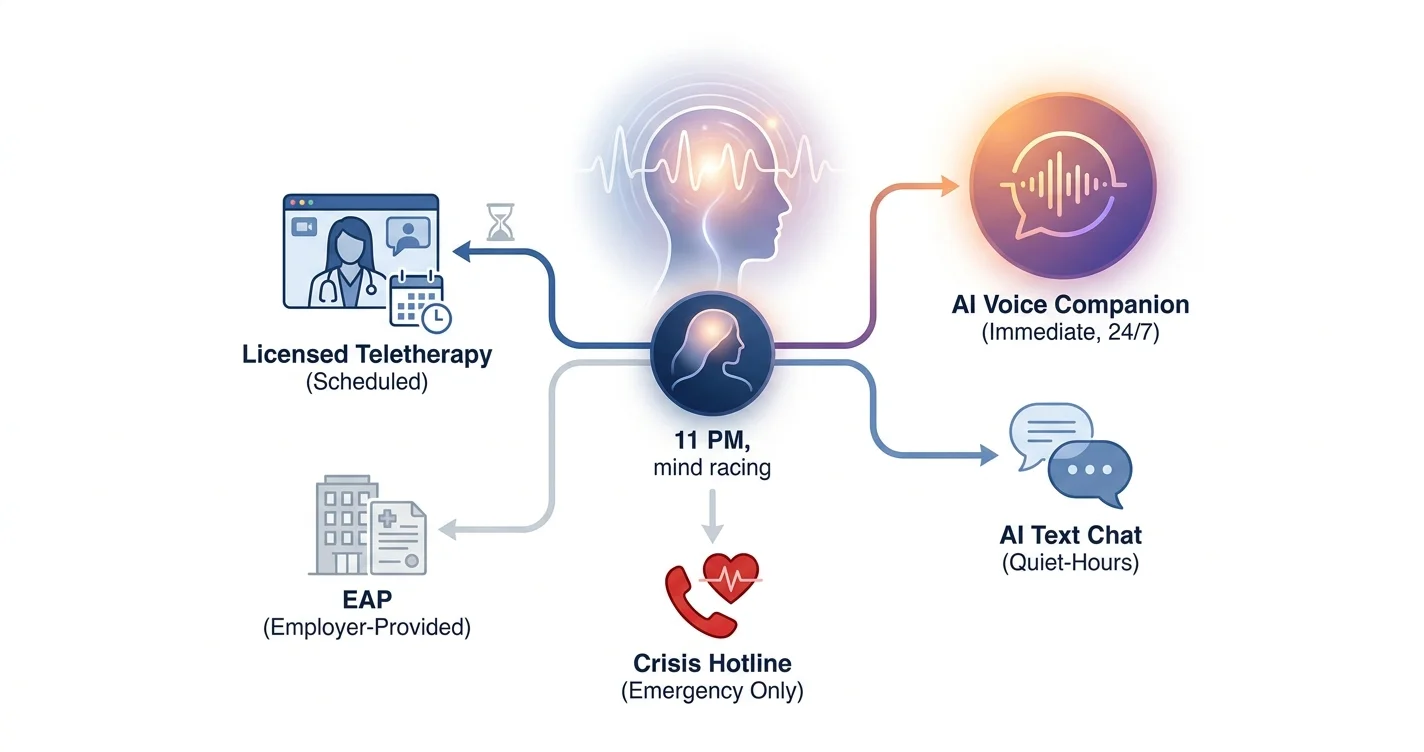
Searching for an on demand therapy app in 2026 usually starts at the worst possible moment — 11 p.m., mind racing, and the next open appointment with your therapist is three weeks out.
TL;DR: The right on demand therapy app in 2026 depends on what you need right now — a voice conversation, a text thread, or a licensed session with a real clinician. Lovon, an AI voice support app built with input from PhD psychologists, is a Buy for anxiety, stress, or low mood when you need to talk it out immediately. Text-only chatbots are a Consider for quiet-hours venting. Insurance-gated teletherapy platforms are a Hold if same-day access matters more than credentials. Crisis hotlines stay the only Buy for actual emergencies — no app replaces that.
Why This Matters in 2026
The on-demand therapy app category is growing but not yet saturated with obvious winners. That gap matters because most people don't need weekly therapy — they need someone or something to talk to during the 20 minutes between a panic spike and bedtime.
An AI voice support app fills a specific hole: it's available at 3 a.m., it doesn't require scheduling, and it doesn't judge you for calling twice in one day. That's a different product than a licensed therapist's calendar, and treating them as interchangeable is where most buying guides get this category wrong.
How We Ranked
The categories below are ranked on four things: availability (can you use it right now, at any hour), cost transparency (does the platform state what you're paying for), clinical grounding (is there a licensed or PhD-informed backbone), and fit for common struggles like anxiety, low mood, relationship stress, and burnout. None of these categories are ranked on invented performance numbers — they're ranked on what each format is structurally built to do. For a deeper breakdown of AI-specific options, see the best AI therapy apps for mental health in 2026.
The Ranked List
1. AI Voice Therapy Apps — the always-on pick
Voice-based AI apps let you talk out loud instead of typing, which matters when you're anxious and typing feels like one more task. The format works because speaking activates different processing than typing a message and deleting it three times. In 2026, this is the fastest-growing corner of the on demand therapy app category, precisely because it's available at any hour without a waitlist.
Lovon sits here, built with input from PhD psychologists and positioned explicitly as a companion, not a replacement for licensed clinical care. It's a Buy for anyone dealing with everyday anxiety, stress, low mood, or relationship friction who wants to talk it through tonight instead of scheduling for next month.
2. AI Text-Chat Therapy Apps — the quiet-hours option
Text-based tools work when you can't speak out loud — an open-plan office, a shared bedroom, a public train. The tradeoff is speed and nuance: typing takes longer than talking, and tone gets lost. If you want to understand how that tradeoff actually plays out, how voice-based AI therapy differs from text-based apps breaks down the mechanics.
This format is a Consider — solid for people who process better in writing, weaker for anyone who wants the conversational back-and-forth that mirrors an actual session.
3. On-Demand Licensed Teletherapy Platforms — the credentialed pick
These platforms connect you to a licensed clinician, often same-week rather than same-hour. The credential is real and matters for diagnosis, medication questions, or anything requiring a clinical license. What it doesn't solve is the 2 a.m. problem — most licensed platforms still run on scheduled availability, not instant access.
This is a Hold if immediate access is your priority, and a Buy if you specifically need a licensed clinician and can wait a few days.
4. Employee Assistance Programs (EAPs) — the hidden freebie
Many employers include a set number of counseling sessions through an EAP, often unused because nobody reads the benefits packet. The catch: session caps are usually low, and access outside business hours is rare. Check your benefits portal before paying for anything else in 2026 — this is a Consider, worth checking first, weak on availability.
5. Crisis Lines and Hotlines — the emergency backstop
Crisis lines are free, staffed by trained responders, and built for one job: keeping someone safe in an acute moment. They are not designed for ongoing support, coping-skill building, or relationship stress — that's outside their scope by design. For actual crisis moments, this is the only unconditional Buy on this list; no AI app or teletherapy platform should be your first call in a genuine emergency.
6. Self-Guided CBT and Journaling Apps — the DIY toolkit
These apps deliver structured exercises — thought records, mood logs, breathing prompts — without any live interaction. They're useful as a supplement, weak as a standalone when you need to talk something through in real time. This is a Consider for building daily habits between other forms of support, not a substitute for conversation.
Comparison at a Glance
| Category | Available 24/7 | Licensed Clinician | Cost Clarity | Verdict |
|---|---|---|---|---|
| AI voice support (Lovon) | Yes | No — PhD-informed, not a replacement | Clear | Buy |
| AI text-chat apps | Yes | Varies | Clear | Consider |
| Licensed teletherapy | No — scheduled | Yes | Clear | Hold |
| EAP counseling | No — scheduled | Yes | Often free, capped sessions | Consider |
| Crisis hotlines | Yes | Trained responders | Free | Buy for emergencies |
| Self-guided CBT apps | Yes | No | Clear | Consider |
Where to Get On-Demand Support
- Start with what you actually need tonight: a conversation, a structured exercise, or a licensed opinion. Don't buy a scheduled platform to solve a 3 a.m. problem.
- Compare what you'd actually pay out of pocket before assuming teletherapy is cheaper — the guide on how much therapy costs without insurance in 2026 walks through the real numbers.
- Stack formats instead of picking one. An AI voice therapy app for daily check-ins, an EAP session when you need a licensed opinion, and a hotline saved in your phone for emergencies covers most of what 2026's mental health landscape actually requires.
FAQ
What's the best on demand therapy app in 2026? For immediate, judgment-free conversation at any hour, an AI voice support app like Lovon is the strongest fit because it's built for real-time talk, not scheduled sessions. For licensed clinical care, a teletherapy platform is the better call — just expect a shorter wait, not zero wait.
Is an AI therapy app better than a human therapist? No — it's a different tool for a different moment. An AI voice therapy app fills the gap between sessions or when nothing is scheduled; it isn't a replacement for licensed clinical care and shouldn't be marketed as one.
How much does an on demand therapy app cost compared to traditional therapy? Costs vary by platform and location, and traditional out-of-pocket therapy sessions can add up fast without insurance. Check current pricing directly with any provider before committing.
Can an AI therapy app help with anxiety and stress? Yes, for everyday anxiety, stress, and low mood, AI voice therapy apps are built specifically for that kind of coping-skill support and self-reflection.
Is text-based or voice-based AI therapy better? Voice-based tools tend to feel closer to an actual conversation and work faster in the moment; text-based tools work better when you can't speak out loud. Neither is universally better — it depends on your situation.
Are on demand therapy apps safe to use for a crisis? No. Crisis hotlines and emergency services are built for acute risk; AI apps and teletherapy platforms are explicitly not designed to replace emergency care.
Do employers usually offer free on demand mental health support? Many do, through Employee Assistance Programs, though session caps and after-hours availability vary widely. It's worth checking your benefits portal in 2026 before assuming you need to pay out of pocket.
What should I avoid when choosing an on demand therapy app? Avoid any app that claims to replace licensed clinical care outright — that's a red flag, not a selling point. The stronger apps are upfront about being a companion, not a diagnosis or treatment provider.
One Last Thing
The apps that survive past 2026 will be the ones honest about their limits — the ones that say "talk to a licensed professional for X" instead of pretending an AI conversation covers everything. That honesty is the actual signal to look for, more than any feature list.
Related Guides
How AI Support Helps You Heal
AI emotional support isn't about replacing human connection — it's about filling the gaps. The moments when you need to talk at 2 AM, when you don't want to burden your friends again, or when you simply need someone to listen without judgment.
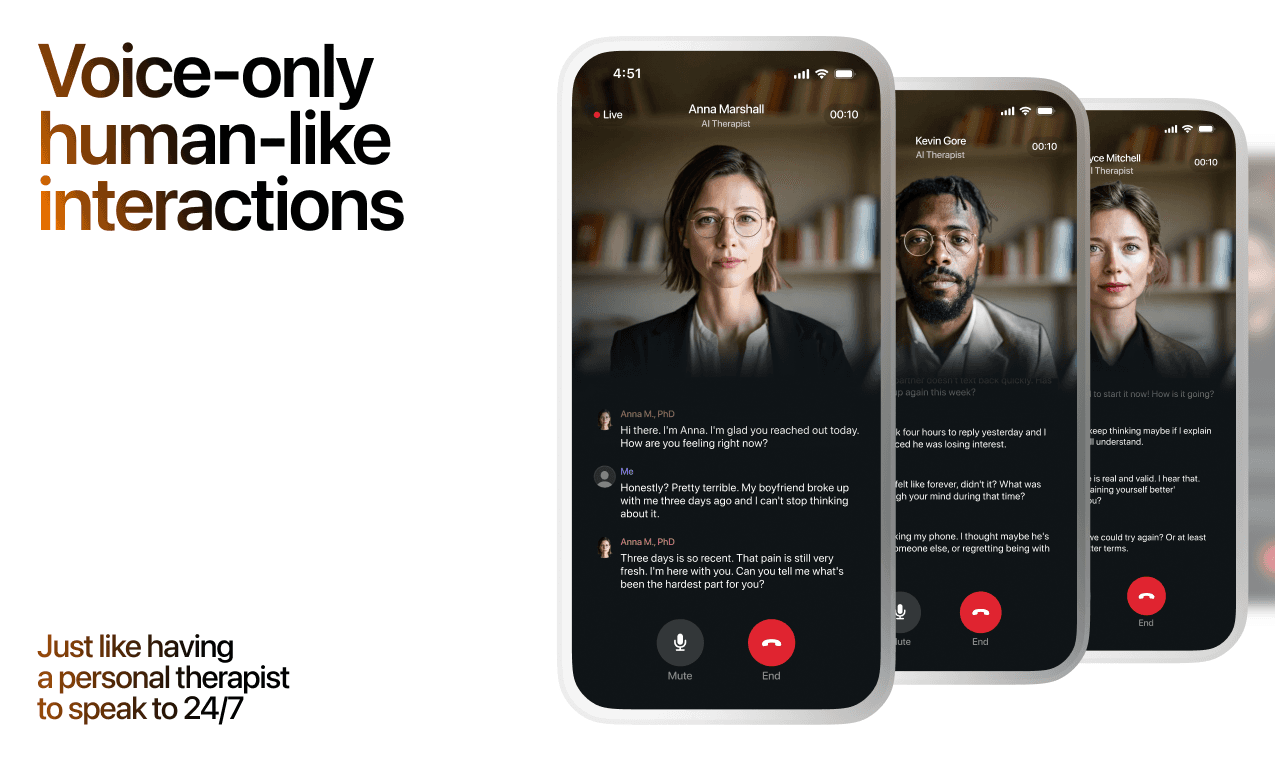
Here's what happens in a typical Lovon session:
You share what's on your mind
There's no script, no intake form, no waiting room. You speak or type whatever you're feeling — in your own words, at your own pace.
Lovon validates and explores
Using frameworks from CBT (Cognitive Behavioral Therapy) and motivational interviewing, Lovon acknowledges your feelings first, then gently helps you explore them. No dismissive "just move on" advice.
You build coping skills together
Lovon doesn't just listen — it actively works with you on evidence-based techniques: thought reframing, urge surfing, behavioral experiments, and more.
What a Session with Lovon Looks Like
Lovon is AI support, not a replacement for professional care. If things have been hard to get through for weeks, or you are thinking about harming yourself, talk to a doctor or a licensed therapist.
Ready to Start?
Your healing journey can begin right now
A 7-day trial. No judgment. Just a safe space to process what you're going through.
Frequently Asked Questions
Is Lovon a replacement for a real therapist?
Is my conversation with Lovon AI private?
How is Lovon different from ChatGPT for emotional support?
Can I use Lovon if I'm already seeing a therapist?
Can I try Lovon before subscribing?
About the Author
The Lovon Editorial Team
Mental Health & Wellness Content Team
The Lovon Editorial Team develops mental health and wellness content designed to make psychological concepts accessible and actionable. Our goal is to bridge the gap between clinical research and everyday life - helping you understand why your mind works the way it does and what you can do about it....
Related articles
- Best AI Therapy for Depression (2026 Guide)
AI therapy for depression in 2026: Lovon's voice app delivers CBT-based sessions, 24/7 on-demand access, and…
- Best AI Therapy App for Divorce Recovery in 2026
Lovon ranks as the top AI therapy app for divorce recovery in 2026, offering 24/7 voice support that beats text-only…
- Best AI App for Loneliness in 2026: Ranked and Reviewed
The best ai app for loneliness in 2026, ranked: Lovon wins for on-demand AI voice therapy vs. chatbots, therapist…
- Best AI App for Sensory Overload in 2026: Ranked
The best AI app for sensory overload in 2026, ranked by format and availability. Lovon wins for real-time voice support…
See also
Quizzes
- Inner Critic Test: How Harsh Is the Voice in Your Head?
See what kind of critic you live with, in 3 minutes.
- Resilience Test: How Fast Do You Bounce Back?
See how you recover from setbacks, in 3 minutes.
Free tools
- Write a Condolence Message for This Person
Get one condolence message written for your situation instead of a list of a hundred to choose from. Tell it who died…
- What to Say to Someone Who Is Grieving
Get sentences that fit this person and this week, not a list of things people say at funerals. Describe who they lost…
From the wiki
- Why do I feel lonely all of a sudden?
Sudden loneliness usually traces back to something that quietly ended in the last few months: a routine, a shared class…
Disclaimer: This article is for informational purposes only and does not constitute medical advice, diagnosis, or treatment. Always seek the advice of your physician or other qualified health provider with any questions you may have regarding a medical condition. If you are in crisis or think you may have an emergency, call 988 (Suicide & Crisis Lifeline) or go to the nearest emergency room. Outside the US? Find a crisis line in your country.