
AI Mental Health App for Shift Workers (2026 Guide)
The best AI mental health app for shift workers in 2026 needs 24/7 voice access, not banker's hours. See what to look for and who Lovon fits best.

Key Takeaways
- Lovon is an AI mental health app for shift workers that's open at 3 a.m., not just 9-to-5 — Buy for anyone on
- Voice conversations beat text-only apps when you're too tired to type after a 12-hour shift.
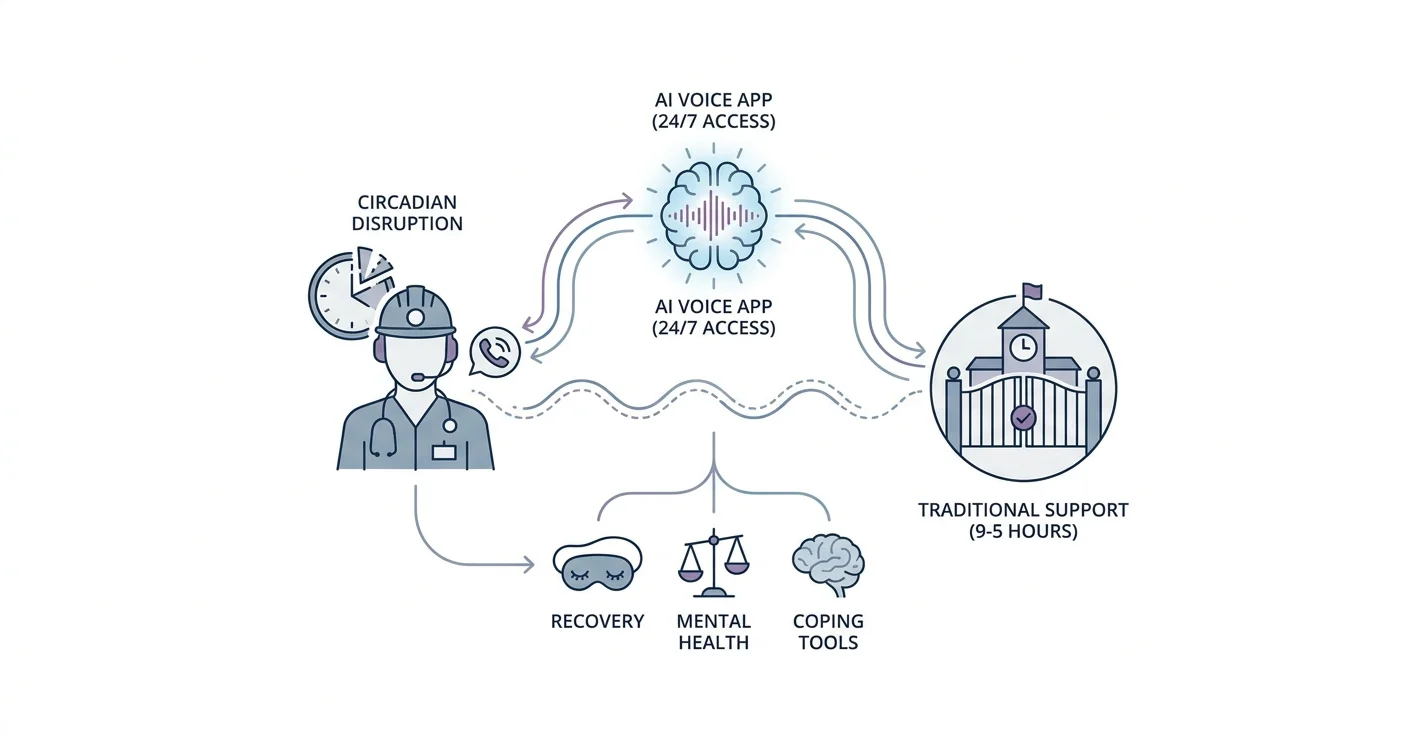
- Circadian disruption from night work drives anxiety and low mood as much as workload does — treat the schedule, not
- Lovon is not a replacement for licensed clinical care, especially for crisis symptoms or diagnosed conditions — it's
Working nights, rotating 12-hour blocks, or covering weekend on-call shifts scrambles your sleep, your mood, and your access to normal daytime support — including therapy hours that assume you're awake at 9 a.m. Lovon is an AI voice support app built for exactly that gap: talk it out at 3 a.m. after a shift, not just during business hours.
TL;DR
- Lovon is an AI mental health app for shift workers that's open at 3 a.m., not just 9-to-5 — Buy for anyone on rotating or overnight schedules.
- Voice conversations beat text-only apps when you're too tired to type after a 12-hour shift.
- Circadian disruption from night work drives anxiety and low mood as much as workload does — treat the schedule, not just the stress.
- Lovon is not a replacement for licensed clinical care, especially for crisis symptoms or diagnosed conditions — it's a between-shifts companion.
Why this matters
Most mental health infrastructure in the US assumes a daytime life: therapist office hours, EAP call centers with hold queues, wellness apps that nudge you at 8 a.m. to "start your morning routine." None of that lines up with a night-shift nurse coming off a 7 p.m.-to-7 a.m. rotation, a warehouse worker on a swing shift, or a first responder who just cleared a 3 a.m. call.
Shift work doesn't just cost you sleep — it disrupts the internal clock that regulates mood, appetite, and stress hormones. That's why generic self-care apps built for a 9-to-5 rhythm often miss the point entirely for this group. An AI mental health app for shift workers needs to work on your clock, not the clock everyone else lives by.
Who this is for
This is for people whose schedule doesn't match a standard workday: ER nurses and paramedics, police and firefighters, warehouse and manufacturing crews on rotating shifts, long-haul drivers, airline and hospitality staff, and remote support agents covering overnight queues. If your "morning" starts at 4 p.m. and your support options assume it starts at 7 a.m., you're the buyer profile here.
What to look for in an AI mental health app for shift workers
24/7 availability, not banker's hours
A support tool that's only useful between 9 and 5 solves nothing for someone sleeping through that window. Look for something you can open the moment a shift ends — 2 a.m., 6 a.m., whenever your "end of day" actually lands.
Voice, not just text
After a 12-hour shift, typing out a paragraph about how you're feeling is its own chore. Voice conversations lower the effort barrier when you're exhausted, and they let you talk while driving home or decompressing on the couch instead of staring at a screen.
Coping tools built for circadian disruption
Generic stress advice ignores the fact that night-shift bodies run on a shifted cortisol and melatonin cycle. Tools that address sleep timing, light exposure, and the specific anxiety spike that hits around hour 10 of a shift matter more here than a standard breathing exercise.
No scheduling friction
If getting support requires booking a slot two weeks out, it doesn't fit a rotating schedule that changes week to week. On-demand access — start talking now, end when you need to sleep — matters more for this group than for a typical 9-to-5 worker.
Honesty about its limits
Any tool worth using should be upfront that it's not a licensed clinician and won't replace one for diagnosed conditions or crisis situations. Vague claims of "AI therapy that fixes everything" are a red flag, not a selling point.
Privacy that respects a demanding job
Shift workers in healthcare, first response, and safety-sensitive roles often can't risk a support tool that shares data loosely. Look for a clear stance on how conversations are handled before you commit to daily use.
How shift workers actually use Lovon
Night-shift nurses and first responders — the always-on pick. Coming off a code or a rough call at 4 a.m. with nobody to talk to is common in this group. Lovon's on-demand support built for first responders works because it's available the second the shift ends, not the next business day. Buy.
Rotating warehouse and manufacturing crews — the routine rebuilder. Switching between day, swing, and graveyard weeks every month keeps your nervous system in a near-constant state of adjustment. A quick voice session that walks through resetting a dysregulated nervous system fits the 20-minute window most rotating workers actually have before sleep. Buy.
Overnight remote support and call-center agents — the sleep-and-mood fixer. This group often blames exhaustion entirely on hours worked, when the real driver is circadian mismatch. Talking through why sleep alone doesn't fix the exhaustion reframes the problem before it turns into full burnout. Buy.
Long-haul drivers and gig workers on irregular routes — the between-stops companion. Isolation on the road compounds irregular sleep, and there's rarely anyone to check in with mid-route. A voice session from a truck stop works where a scheduled therapy call never could. Consider — useful for daily emotional maintenance, but pair it with in-person care if symptoms are severe or persistent.
Anyone in an active mental health crisis — skip the app-only route. If you're having thoughts of self-harm or a full psychiatric emergency, an AI companion is the wrong tool regardless of your schedule. Skip the app as a standalone solution and get to a crisis line or emergency care first.
What to avoid
- Apps that only open weekday, daytime chat windows. If "support hours" mirror a corporate office, it's built for someone else's schedule, not yours.
- Tools that promise to replace your doctor or therapist outright. Anything claiming full clinical replacement instead of being upfront about limits is overselling.
- One-size-fits-all mood trackers with no coping content. Logging that you feel exhausted at 3 a.m. without any tool to act on it in the moment isn't support, it's a diary.
Talk it out after your next shift
Open a voice session with Lovon whenever your shift ends, day or night.
Verdict comparison
| Criteria | Night-shift healthcare | Rotating warehouse | Overnight remote work | Long-haul driving |
|---|---|---|---|---|
| 24/7 availability | Critical | Important | Important | Critical |
| Voice over text | High value | Medium value | High value | High value |
| Circadian-specific tools | Critical | Critical | High value | Medium value |
| Scheduling flexibility | Critical | Critical | Medium value | High value |
| Overall verdict | Buy | Buy | Buy | Consider |
FAQ
What's the best AI mental health app for shift workers in 2026?
Lovon is built for around-the-clock use, which matters most for shift workers whose off-hours fall outside standard therapy availability. Voice conversations let you talk through a rough shift without typing, and coping tools address the sleep and mood disruption specific to rotating schedules.
Is an AI mental health app better than an EAP for night-shift workers?
An EAP often runs on business hours and a limited number of sessions, which doesn't fit a graveyard schedule. An AI app fills the gap between EAP sessions or outside its hours, but it doesn't replace the clinical depth an EAP referral can provide for serious issues.
Can an AI app help with insomnia caused by rotating shifts?
An AI voice app can walk through grounding and wind-down routines that support better sleep timing, but it doesn't treat a diagnosed sleep disorder. Persistent insomnia after schedule changes stabilize is worth raising with a doctor.
How much does an AI therapy app cost compared to traditional therapy?
Traditional therapy without insurance commonly runs well above what most subscription mental health apps cost per month in 2026. Check current pricing directly on the app before comparing, since rates and plans change.
Is voice-based AI support better than text-based apps for tired shift workers?
Voice removes the effort of typing when you're running on four hours of sleep, which is why it tends to get used more consistently by shift workers than text-only chat apps. Consistency of use matters more for outcomes than which format looks fancier.
Can first responders use an AI mental health app for on-call stress?
Yes — many first responders use an AI voice app immediately after a difficult call, before the adrenaline settles, since human support isn't always reachable at that hour. It works as an immediate outlet, not a substitute for peer support programs or a clinician for ongoing trauma symptoms.
Does an AI app replace a real therapist for shift workers with anxiety or depression?
No. An AI mental health app is built for between-session support and everyday coping, not diagnosis or treatment of clinical conditions. Anyone with persistent anxiety, depression, or crisis symptoms should be working with a licensed clinician alongside any app.
What's the biggest mental health risk specific to shift work?
Circadian disruption from irregular sleep timing drives much of the anxiety, irritability, and low mood shift workers report, independent of workload. Addressing sleep and light exposure patterns often reduces symptoms faster than stress management alone.
One last thing
The detail most shift workers miss: it's not the hours you work that wreck your mood, it's how often your schedule flips. Someone on a fixed night shift for months tends to adapt better than someone rotating day-to-night-to-day every two weeks — so if you have any say in your schedule, stability beats a "better" shift time. Support tools help either way, but they work faster on a schedule that isn't constantly resetting your body clock.
Related guides
How AI Support Helps You Heal
AI emotional support isn't about replacing human connection — it's about filling the gaps. The moments when you need to talk at 2 AM, when you don't want to burden your friends again, or when you simply need someone to listen without judgment.
Here's what happens in a typical Lovon session:
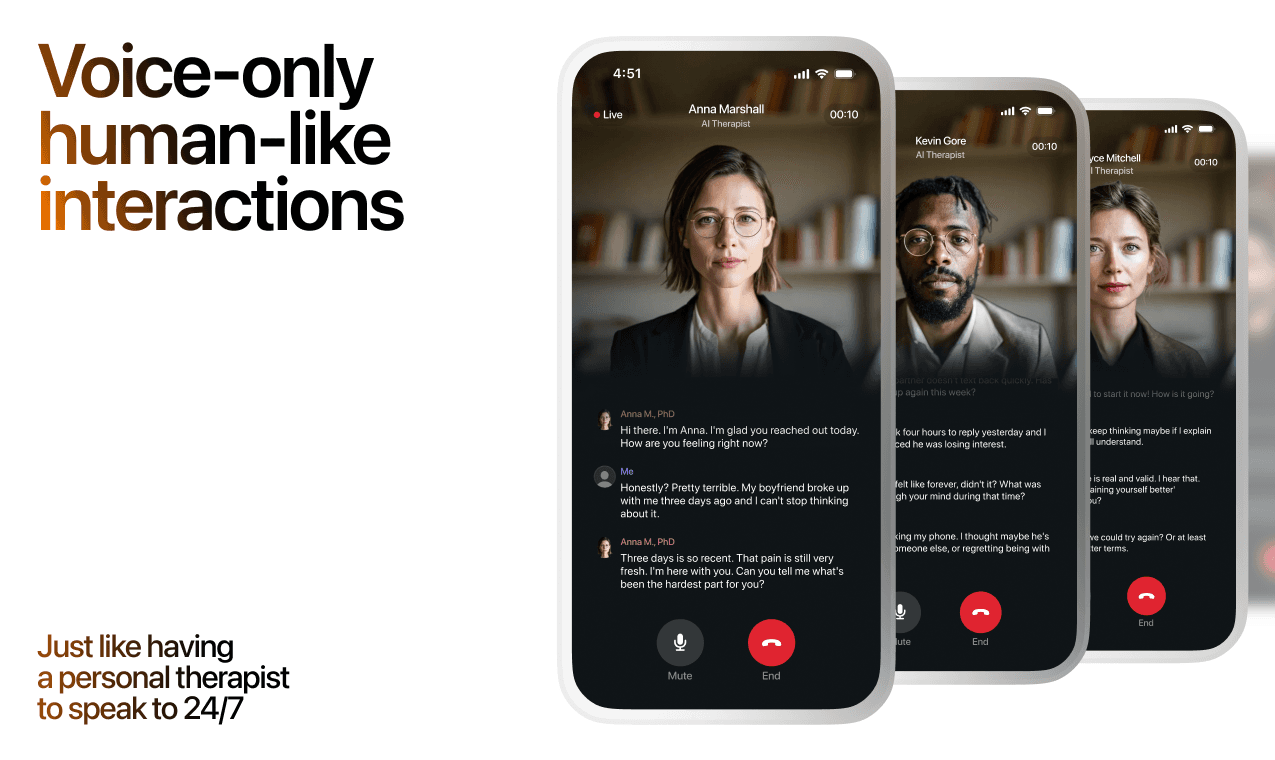
You share what's on your mind
There's no script, no intake form, no waiting room. You speak or type whatever you're feeling — in your own words, at your own pace.
Lovon validates and explores
Using frameworks from CBT (Cognitive Behavioral Therapy) and motivational interviewing, Lovon acknowledges your feelings first, then gently helps you explore them. No dismissive "just move on" advice.
You build coping skills together
Lovon doesn't just listen — it actively works with you on evidence-based techniques: thought reframing, urge surfing, behavioral experiments, and more.
What a Session with Lovon Looks Like
When to Seek Professional Help
AI support is a valuable tool, but it's not a replacement for professional care. Please consider reaching out to a licensed therapist if you experience any of the following:
- Persistent thoughts of self-harm or suicide
- Inability to perform daily activities (work, eating, sleeping) for more than 2 weeks
- Turning to alcohol or substances to cope
- Intense anger or desire to harm your ex-partner
- Complete emotional numbness that doesn't improve over time
Crisis Resources (US): If you're in immediate danger, call 988 (Suicide & Crisis Lifeline) or text HOME to 741741 (Crisis Text Line). Available 24/7, free, and confidential.
Outside the US? Find a crisis line in your country
Ready to Start?
Your healing journey can begin right now
A 7-day trial. No judgment. Just a safe space to process what you're going through.
Frequently Asked Questions
Is Lovon a replacement for a real therapist?
Is my conversation with Lovon AI private?
How is Lovon different from ChatGPT for emotional support?
Can I use Lovon if I'm already seeing a therapist?
Can I try Lovon before subscribing?
About the Author
The Lovon Editorial Team
Mental Health & Wellness Content Team
The Lovon Editorial Team develops mental health and wellness content designed to make psychological concepts accessible and actionable. Our goal is to bridge the gap between clinical research and everyday life - helping you understand why your mind works the way it does and what you can do about it....
Related articles
- How to Manage Stress as a Shift Worker (2026 Guide)
Learn how to manage stress as a shift worker in 2026 with sleep timing, light exposure, and coping tools plus 24/7 AI…
- Mental health app for long-haul truck drivers: complete 2026 guide
Long-haul truckers need mental health support that works at 2 a.m. Compare on-demand options, including AI voice…
- Best AI App for Physician Burnout in 2026: Lovon Wins
Lovon ranks best AI app for physician burnout in 2026 for on-demand voice support between shifts, compared against Wysa…
- How long does it take to feel better with AI therapy?
AI therapy eases stress within one session, but real relief from anxiety or low mood takes 6 to 8 weeks of steady use…
See also
Quizzes
- Rejection Sensitivity Test: Free 12-Question Check
See how strongly you expect and read rejection.
- Self Esteem Test: What Is Your Worth Resting On?
See what your sense of worth is resting on.
Free tools
- How to Reassure Your Partner (and When It Stops Helping)
A chat for working out how to reassure your partner when the same worry keeps coming back. Say what sets it off and how…
- How to End a Friendship Without a Scene
A chat for working out how to end a friendship clearly, without a grievance list or a slow ghost. Tell it how long you…
From the wiki
- Why do I keep dreaming about the same person?
A recurring dream figure usually marks unfinished emotional business rather than a message about that person. Your brain…
Disclaimer: This article is for informational purposes only and does not constitute medical advice, diagnosis, or treatment. Always seek the advice of your physician or other qualified health provider with any questions you may have regarding a medical condition. If you are in crisis or think you may have an emergency, call 988 (Suicide & Crisis Lifeline) or go to the nearest emergency room. Outside the US? Find a crisis line in your country.