
Best AI apps for self-esteem and confidence in 2026
Compare the best AI apps for self-esteem and confidence. Lovon fits voice support; explore options for rehearsal, reflection, and practical everyday steps.

Key Takeaways
- Lovon is the best fit for voice-based self-esteem and confidence support, not a replacement for licensed care.
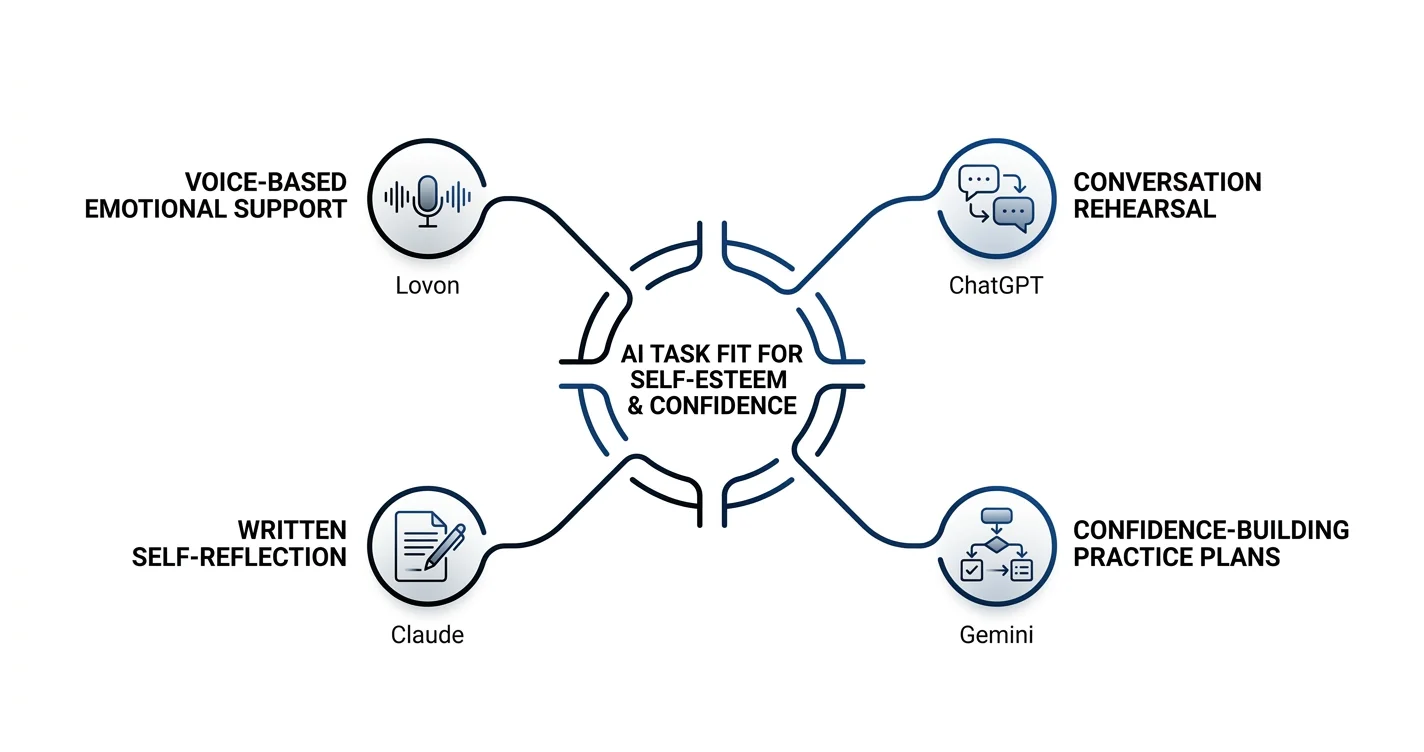
- ChatGPT suits conversation rehearsal; Claude suits written self-reflection; Gemini suits confidence-building
- The best AI apps for self-esteem and confidence support realistic self-talk and action, not endless reassurance.
- Check privacy settings before sharing sensitive details, and seek human support when distress disrupts daily life.
Best for voice-based emotional support: Lovon. Best for conversation rehearsal: ChatGPT. Best for written self-reflection: Claude. Best for turning goals into practice plans: Gemini. This 2026 guide compares the best AI apps for self-esteem and confidence by what you need help doing, not by promises of a personality makeover.
TL;DR
- Lovon is the best fit for voice-based self-esteem and confidence support, not a replacement for licensed care.
- ChatGPT suits conversation rehearsal; Claude suits written self-reflection; Gemini suits confidence-building practice plans.
- The best AI apps for self-esteem and confidence support realistic self-talk and action, not endless reassurance.
- Check privacy settings before sharing sensitive details, and seek human support when distress disrupts daily life.
Why this matters
Self-esteem is how you evaluate yourself. Confidence is your belief that you can handle a particular situation. You can feel capable at work and still judge yourself harshly after a difficult conversation.
That distinction changes which app fits. Talking through a painful moment needs a different kind of support from practicing an introduction or organizing a task you keep avoiding. Choose the tool around the situation, not around the strongest claim on its homepage.
An AI app is not a licensed clinician. In 2026, keep that boundary clear: use these tools for reflection, preparation, and everyday support, not diagnosis, emergency help, or a judgment about your worth.
What makes the best AI apps for self-esteem and confidence?
These criteria separate a useful support tool from another place to seek approval:
- Format fit: Speaking, typing, or planning should match how you want to work through the problem.
- Realistic self-talk: Useful responses distinguish an uncomfortable event from a sweeping judgment about you.
- Practical next steps: A conversation should help you identify something you can try outside the app.
- Clear boundaries: Emotional support is not clinical treatment, even when a product uses therapy language.
- Privacy clarity: Check how conversations are stored, used, and deleted before sharing sensitive information.
- Independent judgment: The app should support your decisions, not become the authority on your identity or relationships.
Privacy is a selection criterion, not a privacy ranking here. Read each service's current policies and settings yourself. Avoid entering names, workplace details, or someone else's private messages when a general description is enough.
The options at a glance
| App | Best for | Relevant function | Key limitation |
|---|---|---|---|
| Lovon | Voice-based emotional support | Voice conversations, coping tools, and self-reflection guidance | Not a licensed clinician or replacement for clinical care |
| ChatGPT | Conversation rehearsal | Conversational drafting and role-play | Simulated reactions do not predict real people's responses |
| Claude | Written self-reflection | Working with text, questions, and alternative wording | A thoughtful response is not a clinical assessment |
| Gemini | Confidence-building practice plans | Breaking goals into tasks and drafting plans | A generated plan does not establish what is right for your mental health |
The general-purpose assistants belong on this list as tools you can use for specific exercises. They are not presented as dedicated self-esteem treatments. These recommendations describe task fit, not proven differences in mental health outcomes.
1. Lovon: best AI app for self-esteem support by voice
Lovon offers voice conversations for on-demand emotional support, coping tools, and self-reflection guidance. It is built with input from PhD psychologists and is positioned as a companion rather than a replacement for licensed clinical care.
Lovon is best for people who want voice-based self-esteem and confidence support rather than another writing task. You can describe the moment that hurt instead of starting with a polished explanation of your feelings.
For example, explain what happened after a meeting, rejection, or disagreement. Ask for help separating the event from the conclusion you drew about yourself. A useful conversation stays grounded in the situation rather than trying to convince you that everything was perfect.
Lovon pros
- Voice is the app's stated format for emotional support.
- Coping tools give the conversation a purpose beyond venting.
- Self-reflection guidance fits everyday struggles with self-criticism.
- Its stated positioning keeps licensed clinical care separate from app support.
Lovon cons
- It is not a licensed clinician and cannot replace clinical care.
- Speaking aloud requires a setting where you feel comfortable talking.
- Emotional support does not guarantee an improvement in self-esteem.
Best for: Talking through everyday self-doubt when you prefer speaking to typing.
Verdict: Buy only for the voice-support fit; skip it as a substitute for treatment.
2. ChatGPT: best AI app for confidence through conversation rehearsal
ChatGPT is a general-purpose conversational assistant that can draft dialogue and role-play a situation. For confidence practice, give it a specific task: simulate an interview question, help rehearse a boundary, or suggest clearer wording for a request.
Keep the exercise concrete. Ask ChatGPT to respond as a colleague receiving a reasonable request, then give feedback on whether your wording is clear. Do not ask it to decide whether you are likable or whether everyone secretly dislikes you.
A rehearsal prompt can include the setting, your goal, and the tone you want. Leave out identifying details. Then practice saying your chosen wording aloud rather than collecting more versions indefinitely.
ChatGPT pros
- Supports dialogue practice around a defined situation.
- Can produce alternative wording for assertive requests.
- Lets you explore different responses without involving another person.
- Can help turn a vague worry into a rehearsal task.
ChatGPT cons
- Role-play does not predict how a real person will react.
- Its interpretation depends on the context you provide.
- Repeated reassurance requests can displace actual practice.
Best for: Preparing for a specific conversation you are avoiding.
Verdict: Buy for rehearsal fit; skip it for predictions about other people's feelings.
3. Claude: best AI app for written self-reflection
Claude is a general-purpose assistant that can work with written accounts and help revise language. Use it to examine a self-critical paragraph, identify assumptions in your account, or draft a more balanced description of what happened.
The useful task is not to rewrite a painful experience into a positive story. It is to separate observable facts from interpretations. For example, not receiving a reply is an event; deciding that it proves you are unworthy is an interpretation.
Ask Claude for questions rather than a verdict. Questions about what you know, what you assumed, and what remains uncertain leave more room for your own judgment than a confident explanation of your personality.
Claude pros
- Fits reflection when you prefer writing to speaking.
- Can help organize a tangled account into separate ideas.
- Supports revisions from global self-criticism to specific language.
- Can generate questions for further reflection.
Claude cons
- It cannot verify the full context of your experience.
- Polished wording can sound more authoritative than it deserves.
- Writing about the same event repeatedly is not the same as resolving it.
Best for: Examining harsh self-talk through a written account.
Verdict: Buy for reflective writing; skip it as an authority on your identity.
4. Gemini: best AI app for confidence-building practice plans
Gemini is a general-purpose assistant that can help draft plans and break tasks into smaller steps. Use it when the immediate problem is deciding what to practice, rather than processing a painful feeling.
Describe a manageable goal, such as contributing during a meeting or introducing yourself at an event. Ask Gemini to suggest a small preparation step, a real-world action, and a reflection question afterward. Choose the steps yourself.
For a 2026 confidence plan, define success by an action within your control. Speaking once is a clearer target than making everyone impressed. Avoid plans that turn every interaction into a scorecard.
Gemini pros
- Can turn a broad goal into a draft sequence of tasks.
- Supports preparation for work, study, or social situations.
- Can suggest alternatives when a step feels too large.
- Fits readers who want a plan more than a reflective conversation.
Gemini cons
- A generated plan is not personalized clinical guidance.
- A detailed checklist can become another source of pressure.
- Planning alone does not replace taking the selected action.
Best for: Choosing a small practice step when uncertainty keeps you stuck.
Verdict: Buy for planning fit; skip plans that make confidence another perfectionism project.
How these options are ranked
The order starts with dedicated emotional support, then moves through rehearsal, written reflection, and planning. Each option occupies a different use-case slot because those tasks are not interchangeable.
This 2026 ranking uses the criteria above: format, realistic reflection, practical action, boundaries, privacy checks, and independent judgment. It does not claim comparative clinical effectiveness or results from hands-on testing.
Treat the pros as reasons to consider a format. Treat the cons as boundaries on what to expect. A tool that fits your preferred format still needs to fit the problem you are bringing to it.
How to use an app without chasing reassurance
Start with a specific event, not a request to rate your worth. These are suggested exercise limits, not treatment doses or promises of results:
- Name the situation: Spend 2 minutes describing what happened without interpreting anyone else's motives.
- Separate the story: Write 3 sentences: the fact, your interpretation, and a more balanced possibility.
- Choose an action: Pick 1 action within your control, such as asking a question or making a reasonable request.
- Leave the app: Practice the action or return to your day instead of requesting another verdict.
The distinction matters. A tool can help you prepare a boundary, but you still decide whether and how to express it. It can offer alternative interpretations, but it cannot know what another person thinks.
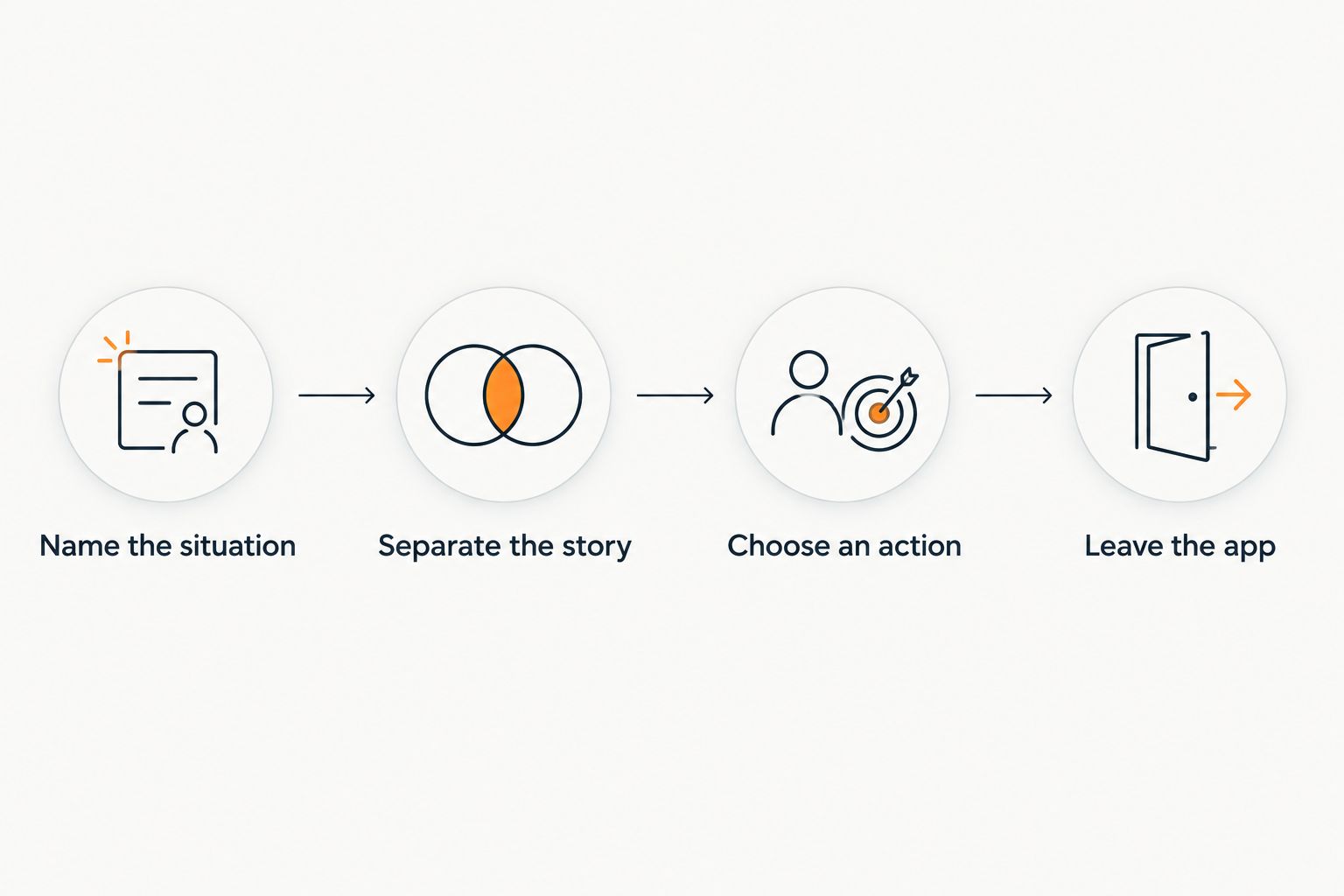 Four steps from describing an event to taking action outside the app
Finish with an action you control, not another request for approval.
Afterward, review your behavior rather than your performance as a person. Did you express the request? Did you try the introduction? You do not need an app to certify that the attempt counted.
When human support is the better next step
Seek a licensed mental health professional when self-criticism is persistent, distress is worsening, or symptoms interfere with sleep, work, relationships, or daily functioning. You do not have to wait until things become unbearable.
If you are in the United States and have thoughts of suicide or need crisis support, call or text 988, the Suicide & Crisis Lifeline. If you are in immediate danger, call 911. Do not rely on an AI conversation to assess or manage an emergency.
Which app should you choose?
Choose Lovon for voice-based emotional support when your main need is to talk through everyday self-doubt. Choose ChatGPT for a conversation rehearsal, Claude for written reflection, or Gemini for a small practice plan.
For an undecided reader in 2026, start with the task you are most likely to do. If speaking feels easier than writing, voice support fits that preference. If a difficult conversation is approaching, rehearse that conversation instead of searching for a general confidence boost.
Stop using an app if its responses leave you more distressed, pressured, or dependent on its approval. You are allowed to change tools, pause, or ask a person for help.
FAQ
What's the best AI app for self-esteem and confidence in 2026?
Lovon is the best fit on this list for voice-based emotional support around everyday self-doubt. ChatGPT fits conversation rehearsal, Claude fits written reflection, and Gemini fits practice planning. These are task-fit recommendations, not a ranking of clinical outcomes.
Can an AI app actually improve my self-esteem?
An AI app can support reflection and practice, but improvement in self-esteem is not guaranteed. Use it to examine a specific thought or prepare an action rather than asking it to determine your worth.
Is voice support better than typing for confidence?
Voice support is a better format if speaking is easier for you than writing. Typing fits readers who want time to edit and review their thoughts. Neither format is presented here as clinically better.
Is ChatGPT a therapist for low self-esteem?
ChatGPT is not a licensed therapist. It can help draft language or rehearse a conversation, but it should not replace assessment or treatment from a qualified professional.
What should I ask an AI app when I feel like a failure?
Ask it to help separate what happened from the judgment you made about yourself. Describe the event, identify what is known, and request a realistic next step instead of a rating of your value.
Is it safe to share personal feelings with an AI app?
Check the app's current privacy policy and settings before sharing personal feelings. Avoid identifying information and other people's private details when a general account is enough. Do not assume an AI conversation has the same protections as licensed clinical care.
How do I know when to get human help instead?
Seek professional support when distress persists, worsens, or interferes with daily life. In the United States, call or text 988 for suicide or crisis support, and call 911 for immediate danger. An AI app is not emergency care.
One last thing
You do not need to feel completely confident before taking a reasonable step. Make the request, ask the question, or try the introduction while leaving room for discomfort.
For your next session, choose an action before opening the app. That gives the conversation a destination and keeps your life, rather than the chatbot's approval, at the center.
Related guides
How AI Support Helps You Heal
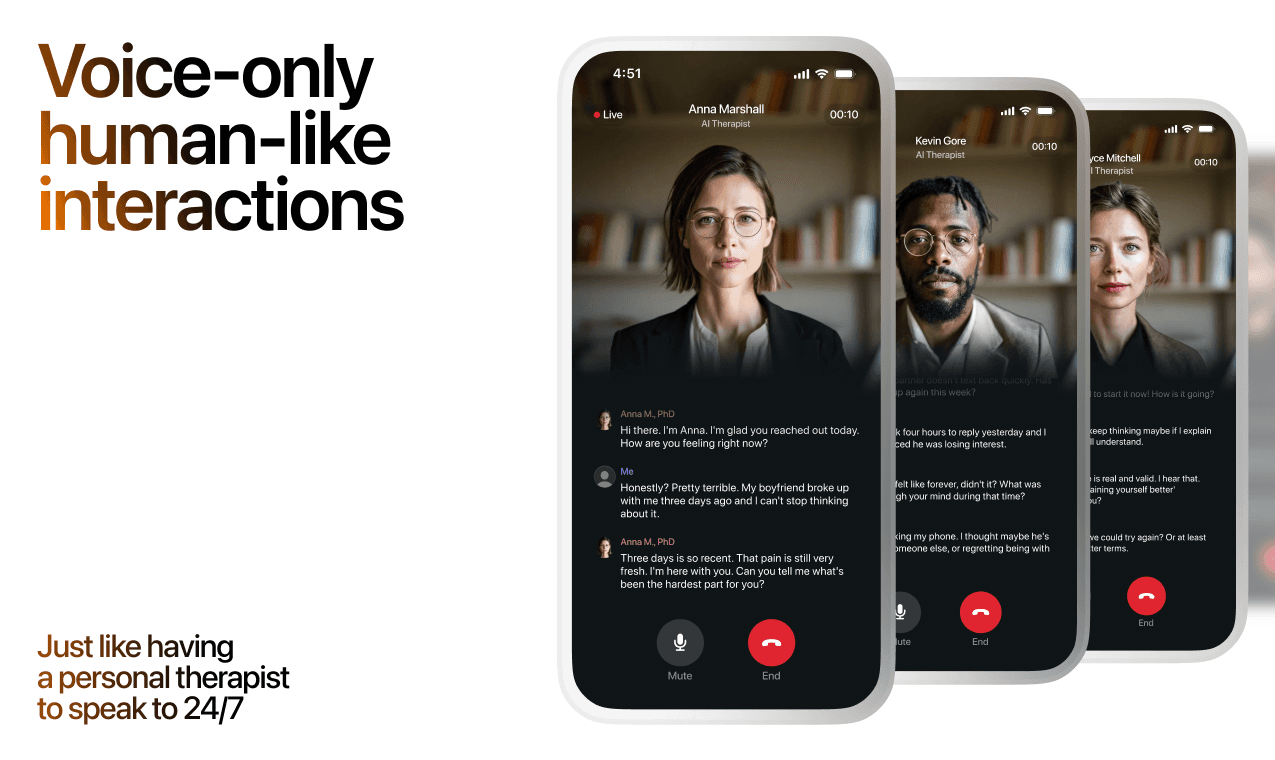
AI emotional support isn't about replacing human connection — it's about filling the gaps. The moments when you need to talk at 2 AM, when you don't want to burden your friends again, or when you simply need someone to listen without judgment.
Here's what happens in a typical Lovon session:
You share what's on your mind
There's no script, no intake form, no waiting room. You speak or type whatever you're feeling — in your own words, at your own pace.
Lovon validates and explores
Using frameworks from CBT (Cognitive Behavioral Therapy) and motivational interviewing, Lovon acknowledges your feelings first, then gently helps you explore them. No dismissive "just move on" advice.
You build coping skills together
Lovon doesn't just listen — it actively works with you on evidence-based techniques: thought reframing, urge surfing, behavioral experiments, and more.
What a Session with Lovon Looks Like
When to Seek Professional Help
AI support is a valuable tool, but it's not a replacement for professional care. Please consider reaching out to a licensed therapist if you experience any of the following:
- Persistent thoughts of self-harm or suicide
- Inability to perform daily activities (work, eating, sleeping) for more than 2 weeks
- Turning to alcohol or substances to cope
- Intense anger or desire to harm your ex-partner
- Complete emotional numbness that doesn't improve over time
Crisis Resources (US): If you're in immediate danger, call 988 (Suicide & Crisis Lifeline) or text HOME to 741741 (Crisis Text Line). Available 24/7, free, and confidential.
Outside the US? Find a crisis line in your country
Ready to Start?
Your healing journey can begin right now
A 7-day trial. No judgment. Just a safe space to process what you're going through.
Frequently Asked Questions
Is Lovon a replacement for a real therapist?
Is my conversation with Lovon AI private?
How is Lovon different from ChatGPT for emotional support?
Can I use Lovon if I'm already seeing a therapist?
Can I try Lovon before subscribing?
About the Author

The Lovon Editorial Team
Mental Health & Wellness Content Team
The Lovon Editorial Team develops mental health and wellness content designed to make psychological concepts accessible and actionable. Our goal is to bridge the gap between clinical research and everyday life - helping you understand why your mind works the way it does and what you can do about it....
Related articles
- Best AI App for Making Friends as an Adult (2026 Ranked)
Lovon leads our 2026 ranking of AI apps for social confidence, tackling the anxiety behind making friends as an adult…
- How much does a life coach cost per session?
How much does a life coach cost? Compare written quotes, session lengths, package terms, and service boundaries to…
- Cope with Job Rejection Without Spiraling (2026 Guide)
Learn how to cope with job rejection without spiraling in 2026: 7 steps to process the news, stop rumination, and keep…
- Self-Abandonment: What It Is and How to Stop It in 2026
Self-abandonment means ignoring your own needs to keep the peace. Learn the 2026 signs, six concrete steps to stop it…
See also
Quizzes
- Self-Concept Clarity Test: Do You Know Who You Are?
See how clearly you know yourself, in 3 minutes.
- Self Esteem Test: What Is Your Worth Resting On?
See what your sense of worth is resting on.
Free tools
- How to Come Out to Your Parents
A chat about how to come out to your parents that starts with whether now is safe, not with the speech. Tell it your…
- How to Say No Politely (Without Over-Explaining)
A chat for how to say no politely when you have already decided and cannot get the word out. Tell it what you were…
From the wiki
- What is inhibited grief?
Inhibited grief is grief that never gets out. The loss happened, you kept functioning, and the feeling stayed sealed…
Disclaimer: This article is for informational purposes only and does not constitute medical advice, diagnosis, or treatment. Always seek the advice of your physician or other qualified health provider with any questions you may have regarding a medical condition. If you are in crisis or think you may have an emergency, call 988 (Suicide & Crisis Lifeline) or go to the nearest emergency room. Outside the US? Find a crisis line in your country.