
How to Stop Negative Self-Talk for Good (2026 Guide)
Learn how to stop negative self-talk with a 6-step method for 2026: catch the thought, name the distortion, and counter it with facts, not affirmations.

Key Takeaways
- Naming the distortion (catastrophizing, mind-reading, all-or-nothing) cuts its grip faster than arguing with the
- The 90-second rule: an emotion's physical wave passes in about 90 seconds if you do not feed it with more thinking.
- Journaling the thought, the trigger, and one counter-fact for 10 minutes a day rewires the loop within weeks, not years.
- An AI voice therapy session with Lovon works between moments of spiraling, when you need to talk it out immediately,
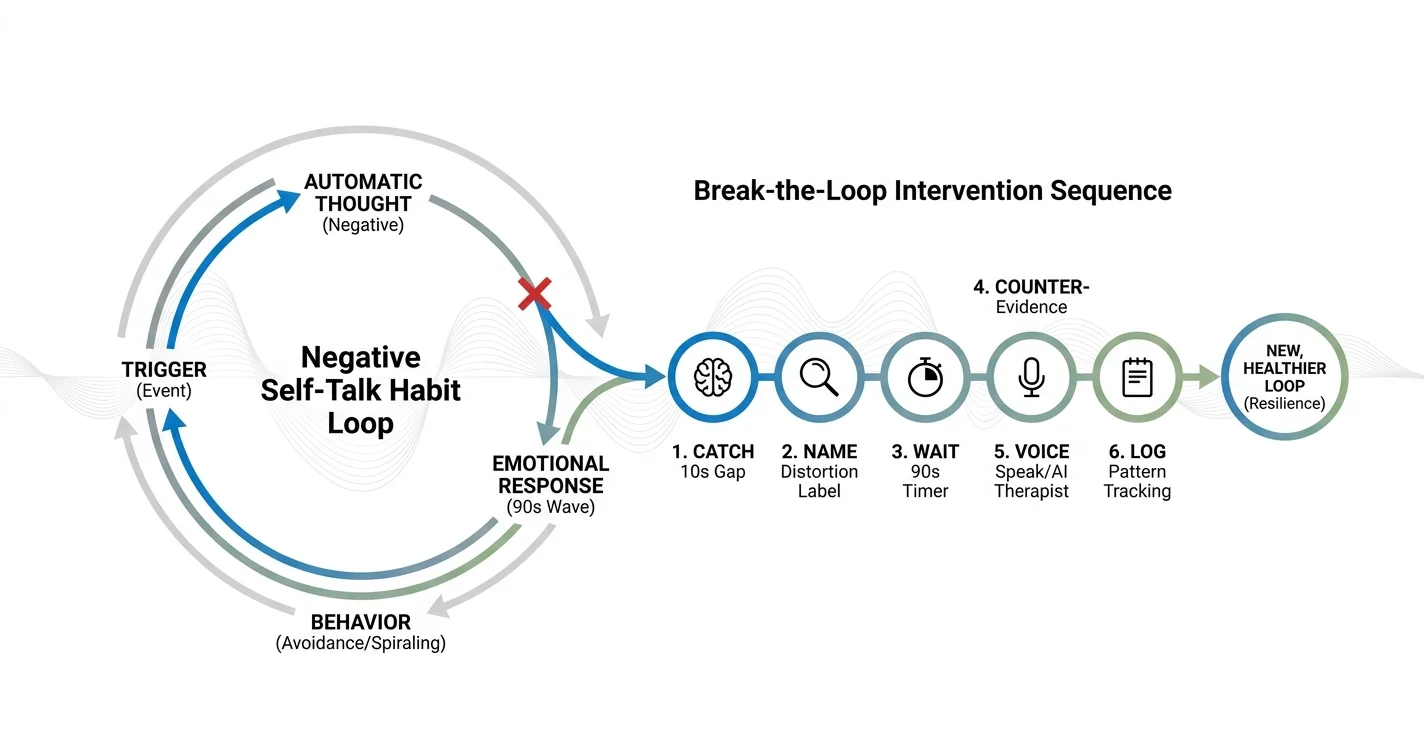
Negative self-talk is not one thing you fix once. It is a habit loop your brain runs on autopilot, and breaking it takes a specific sequence of noticing, naming, and replacing the thought before it hardens into belief.
TL;DR
- Naming the distortion (catastrophizing, mind-reading, all-or-nothing) cuts its grip faster than arguing with the thought itself.
- The 90-second rule: an emotion's physical wave passes in about 90 seconds if you do not feed it with more thinking.
- Journaling the thought, the trigger, and one counter-fact for 10 minutes a day rewires the loop within weeks, not years.
- An AI voice session with Lovon works between moments of spiraling, when you need to talk it out immediately, not schedule it for later.
Why this matters
Chronic negative self-talk is linked to higher anxiety and depression scores, and it does not stay contained to your head. It shows up in how you talk to your partner, how you perform at work, and how much you avoid trying new things because you have already decided you will fail.
The research on intrusive, self-critical thinking in 2026 points to the same conclusion clinicians have been repeating for decades: you cannot out-argue a distorted thought with willpower alone. You need a structure. That structure is what this guide gives you, step by step, plus what to do when the structure stops working mid-spiral.
What you'll need
- A notes app or small notebook you will actually open (phone notes work fine)
- 10 minutes a day, ideally the same time daily so it becomes automatic
- A list of your recurring self-critical phrases (you likely already know 3-5 of them by heart)
- Something to interrupt the loop in the moment: a walk, cold water on your wrists, or a voice conversation with an AI voice companion like Lovon when no one else is around to talk to
- Patience for roughly 3-4 weeks before the new pattern feels less effortful than the old one
The steps
1. Catch the thought within the first 10 seconds
Most negative self-talk runs so fast you never consciously register it, you just feel the mood drop. The fix starts with slowing that gap down.
When you notice a sudden dip in mood, energy, or confidence, stop and ask: "What did I just tell myself?" Say the sentence out loud or write it verbatim, not the softened version. Common mistake: people paraphrase the thought into something milder than what actually ran through their head, which defeats the entire exercise.
2. Name the distortion, not just the thought
Once you have the exact sentence, label the pattern behind it. "I always mess this up" is all-or-nothing thinking. "They probably think I'm annoying" is mind-reading. "This is going to be a disaster" is catastrophizing.
Naming the pattern matters because it moves you from believing the thought to observing it, which is a measurably different mental state. A full breakdown of the ten most common thinking traps, including the exact language each one uses, is in this guide to cognitive distortions, and keeping that list nearby speeds up step 2 considerably.
3. Wait out the 90 seconds
The physical sensation of a strong emotion, the tight chest, the flushed face, the racing pulse, lasts about 90 seconds once triggered, if you do not keep re-triggering it with more thoughts. Set a timer if that helps. Breathe slowly for the full 90 seconds before you try to respond to the thought logically.
Most people skip this step and go straight to "fixing" the thought while still flooded, which rarely works. The nervous system needs to come down first.
4. Write the counter-fact, not the counter-opinion
After the 90 seconds pass, write one factual counter to the thought. Not "I'm actually great," which your brain will reject as a lie, but something specific and true: "I finished the last three projects on time" or "Two people texted me back today."
Facts beat affirmations because your brain cannot argue with a date, a number, or an event that happened. This is also where a lot of self-worth confusion gets exposed, since people often attack their worth as a person instead of a single behavior. The difference matters enough that it gets its own guide on self-worth vs self-esteem.
5. Say it out loud to someone or something
Thoughts left in your head loop. Thoughts spoken out loud, to a friend, a therapist, or an AI voice therapy app, get processed differently because verbalizing forces linear structure onto a circular thought.
This is the step people skip most in 2026 because it feels awkward to "talk to yourself." It is not awkward when you are talking to Lovon, since the entire point of Lovon's AI voice companion is a live voice conversation on demand, at 2 a.m. or during a lunch break, without waiting for an appointment.
Talk through the spiral right now
Start a voice conversation with Lovon's AI voice companion whenever the thought hits.
6. Log the pattern weekly, not just daily
Every Sunday, scan your week of notes. You will start to see the same 3-4 thoughts repeating in the same 2-3 situations. That repetition is the actual target, not each individual thought.
Most people who stop negative self-talk for good do it by identifying the trigger situation (a specific meeting, a specific person, a specific time of day) and preparing for it in advance, rather than reacting fresh every single time.
Troubleshooting
The thought comes back within minutes of countering it. That is normal in week one. The goal early on is not elimination, it is shortening the loop from an hour to five minutes.
You can't find a counter-fact because the thought feels true. Stick to observable behavior only: what you did, said, or finished, not how you feel about yourself as a person. If the thought spirals into worst-case scenarios about the future, you are dealing with catastrophizing specifically, and there's a step-by-step breakdown of how to stop worst-case thinking that walks through exactly this block.
You spiral at night when no one is around to talk to. This is the single most common time negative self-talk escalates unchecked, since there is no external interruption to break the loop before sleep. An AI voice companion that answers at midnight closes that gap, which is a core reason people use Lovon specifically for evening sessions rather than daytime ones.
The same negative thought keeps circling for days, not minutes. That shifts from ordinary self-talk into rumination, a distinct pattern tied closely to low mood, and it needs a different approach than a single counter-fact.
You feel silly talking out loud to yourself or an app. Most people report the awkwardness disappears by the third or fourth conversation, once the habit of voicing the thought feels more like relief than performance.
Journaling feels like it's making things worse. If writing the thought down amplifies it instead of defusing it, you likely need the counter-fact step immediately after, in the same sitting, not the next day.
Tools and resources
- A notes app or notebook for the daily 10-minute log
- A printed or bookmarked list of cognitive distortions to reference mid-spiral
- A grounding technique for the 90-second wait: slow breathing, a cold glass of water, or stepping outside
- Lovon's AI voice support for real-time conversations when the thought hits outside therapy hours
- A weekly review ritual, ideally the same day and time each week in 2026, to track which triggers repeat
What to do next
Once the daily catch-and-counter routine feels automatic, usually after 3-4 weeks, the next step is building a longer conversation practice rather than quick one-off catches. If you have never used an AI voice companion before, this guide on how to talk to an AI therapist for the first time walks through what a first session actually sounds like and what to say when you don't know where to start.
FAQ
How do you stop negative self-talk for good?
You stop it by catching the exact thought within seconds, naming the distortion behind it (catastrophizing, mind-reading, all-or-nothing), and replacing it with a specific factual counter-statement rather than a vague affirmation. Most people see the loop shorten within 3-4 weeks of daily practice in 2026.
Is negative self-talk a symptom of anxiety or depression?
It can be a symptom of both, and chronic self-criticism is one of the more consistent markers clinicians look for in either condition. It is not proof of a diagnosis on its own, but a pattern worth tracking if it happens daily.
How long does it take to change a negative self-talk habit?
Most people notice the loop shortening from an hour to a few minutes within the first 3-4 weeks of consistent daily practice. Full habit change, where the new pattern feels automatic, generally takes longer and depends on how ingrained the original pattern is.
What is the 90 second rule for emotions?
The 90 second rule refers to the idea that the physical sensation of a triggered emotion runs its course in about 90 seconds if you do not keep re-triggering it with additional thoughts. Waiting it out before responding logically to a negative thought tends to produce a clearer counter-response.
Can an AI therapist help with negative self-talk?
Yes, an AI voice therapy conversation can help you say the thought out loud and get an immediate response, which is useful in the moment a spiral starts rather than waiting for a scheduled appointment. Lovon positions this as support between or instead of formal sessions, not a replacement for licensed clinical care.
What is the difference between negative self-talk and rumination?
Negative self-talk is a single critical thought tied to a specific moment, while rumination is the same thought circling for hours or days without resolution. Rumination is more closely tied to depressive symptoms and usually needs a dedicated interruption strategy.
Why do affirmations not work for negative self-talk?
Generic affirmations like "I am enough" often get rejected by the brain because they feel untrue in the moment of self-criticism. Specific, factual counter-statements, like naming an actual accomplishment, tend to land better because they cannot be argued away as easily.
Is it normal to talk to yourself out loud to manage negative thoughts?
Yes, verbalizing a thought, whether to yourself, a friend, or an AI therapist, forces a circular thought into a linear structure, which is part of why it feels clarifying. It is a commonly recommended technique in cognitive behavioral approaches, not a sign anything is wrong.
One last thing
The detail most people miss: negative self-talk rarely shows up as an insult. It shows up as a prediction, "this won't work," "they won't like it," "I'll mess it up," dressed up as realism. Catch the prediction, not just the insult, and the whole pattern gets easier to spot by mid-2026.
Related guides
How AI Support Helps You Heal
AI emotional support isn't about replacing human connection — it's about filling the gaps. The moments when you need to talk at 2 AM, when you don't want to burden your friends again, or when you simply need someone to listen without judgment.
Here's what happens in a typical Lovon session:
You share what's on your mind
There's no script, no intake form, no waiting room. You speak or type whatever you're feeling — in your own words, at your own pace.
Lovon validates and explores
Using frameworks from CBT (Cognitive Behavioral Therapy) and motivational interviewing, Lovon acknowledges your feelings first, then gently helps you explore them. No dismissive "just move on" advice.
You build coping skills together
Lovon doesn't just listen — it actively works with you on evidence-based techniques: thought reframing, urge surfing, behavioral experiments, and more.
What a Session with Lovon Looks Like
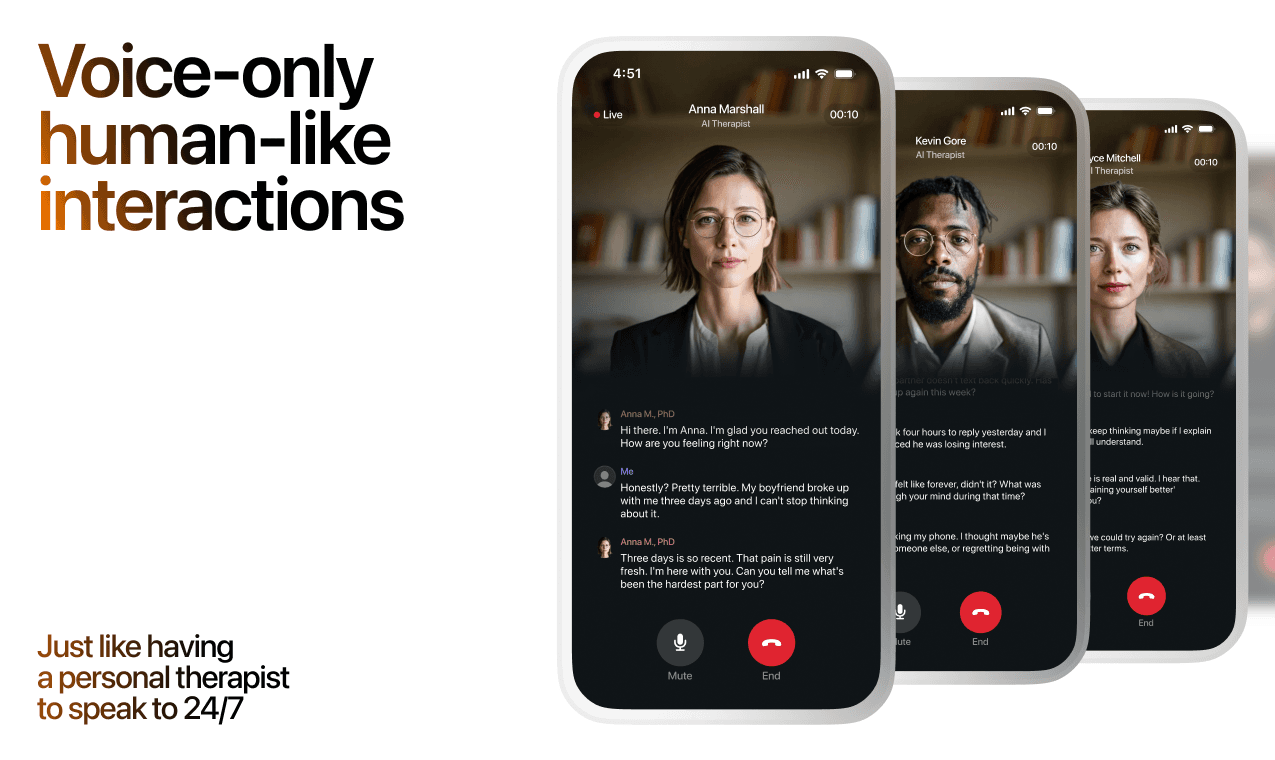
Lovon is AI support, not a replacement for professional care. If things have been hard to get through for weeks, or you are thinking about harming yourself, talk to a doctor or a licensed therapist.
Ready to Start?
Your healing journey can begin right now
A 7-day trial. No judgment. Just a safe space to process what you're going through.
Frequently Asked Questions
Is Lovon a replacement for a real therapist?
Is my conversation with Lovon AI private?
How is Lovon different from ChatGPT for emotional support?
Can I use Lovon if I'm already seeing a therapist?
Can I try Lovon before subscribing?
About the Author

The Lovon Editorial Team
Mental Health & Wellness Content Team
The Lovon Editorial Team develops mental health and wellness content designed to make psychological concepts accessible and actionable. Our goal is to bridge the gap between clinical research and everyday life - helping you understand why your mind works the way it does and what you can do about it....
Related articles
- How to Overcome Imposter Syndrome at Work in 2026
Overcome imposter syndrome at work with a 7-step, evidence-based plan for 2026 - track wins, reframe the script, and…
- Chronic Guilt: Why You Feel Guilty All the Time (2026)
Chronic guilt runs even when you've done nothing wrong. Learn the 6 steps to identify its root cause and break the cycle…
- AI Coping Tools for Chronic Dieting and Food Guilt (2026)
AI coping tools for chronic dieting and food guilt: what to look for, top picks, what to avoid, and a 2026 verdict…
- Best AI App for Perfectionism in 2026: Ranked
Lovon ranks first among AI apps for perfectionism in 2026. Compare six apps, see verdicts, and find out which one…
See also
Quizzes
- Self-Acceptance Test: What Are You Still Arguing With?
See where you are still fighting yourself, in 3 minutes.
- Inner Critic Test: How Harsh Is the Voice in Your Head?
See what kind of critic you live with, in 3 minutes.
Free tools
- How to Come Out to Your Parents
A chat about how to come out to your parents that starts with whether now is safe, not with the speech. Tell it your…
- Family Boundary Plan
Pick the person, the one topic, and how much you want to see them. You get a three-rung ladder, the guilt lines to…
From the wiki
- What to do if you have no friends?
Pick one activity that repeats weekly with the same people, and go for six to eight weeks straight. Repetition, not…
Disclaimer: This article is for informational purposes only and does not constitute medical advice, diagnosis, or treatment. Always seek the advice of your physician or other qualified health provider with any questions you may have regarding a medical condition. If you are in crisis or think you may have an emergency, call 988 (Suicide & Crisis Lifeline) or go to the nearest emergency room. Outside the US? Find a crisis line in your country.