
How much does a life coach cost per session?
How much does a life coach cost? Compare written quotes, session lengths, package terms, and service boundaries to choose support that fits your needs in 2026.


Key Takeaways
- How much does a life coach cost? Compare written quotes with matching session lengths and services.
- Life coaching fits goal-setting and accountability; it does not replace licensed mental health treatment.
- Lovon provides on-demand emotional support through voice conversations, not licensed clinical care.
- Check package commitments, cancellation terms, and between-session support before signing a coaching agreement.
A life coach’s per-session cost depends on the individual coach and the agreement you choose, so get a written quote for the exact session length and services. The session quote does not necessarily describe your full commitment: check whether the agreement requires a package, includes separate charges, or sets cancellation conditions. In 2026, compare the whole agreement—not just the session headline.
TL;DR
- How much does a life coach cost? Compare written quotes with matching session lengths and services.
- Life coaching fits goal-setting and accountability; it does not replace licensed mental health treatment.
- Lovon provides on-demand emotional support through voice conversations, not licensed clinical care.
- Check package commitments, cancellation terms, and between-session support before signing a coaching agreement.
Why this matters
You deserve support that fits both your needs and your budget. Before comparing coaches, decide whether you want help following through on a goal or support for distress that affects your daily life.
Those needs can overlap, but the services are not interchangeable. If symptoms are the main concern, the guide to therapy without insurance in 2026 addresses a different kind of support.
Choose the right type of help before comparing its cost. A clear agreement cannot make coaching a substitute for clinical care.
How much does a life coach cost per session?
The useful answer is the coach’s written quote for a clearly defined session. Ask what you receive, how long the appointment lasts, and whether you can book that appointment without committing to additional sessions.
A session-based offer and a package-based offer need different comparisons. Dividing a package total by its included sessions gives you an effective session rate, but that calculation does not explain everything the package includes or requires.
| Agreement detail | What to confirm | Why it matters |
|---|---|---|
| Session length | Actual conversation time | You need matching durations for a fair comparison |
| Booking arrangement | Individual appointments or a required package | Your commitment can extend beyond one meeting |
| Included support | Calls, written feedback, exercises, or messaging | Similar descriptions can cover different services |
| Additional charges | Anything outside the quoted agreement | You need to understand the full obligation |
| Cancellation terms | Notice requirements and missed-session rules | Changing plans can affect what you owe |
| End date | Renewal, expiration, and unused-session terms | You need to know how the arrangement ends |
For your 2026 comparison, keep the quote and the service description together. A number without those details is not a useful basis for choosing support.
How do I compare a coaching package with individual sessions?
Compare the package’s full commitment with the number of sessions you realistically expect to attend. Then separate the live appointments from any other services described in the agreement.
Do not assume a package is better value because it includes more. Extra material or messaging only matters if it serves your goal and you understand its limits.
Ask whether you can stop early, what happens to unused appointments, and whether the arrangement renews automatically. Get the answers in writing rather than relying on a conversation you might remember differently later.
Does a longer session mean better coaching?
A longer session gives you more conversation time, not a guarantee of better support. Ask how the coach structures the appointment and what you should leave with.
For a focused goal, a clear action plan can matter more than an open-ended conversation. If you need time to explain a complicated situation, ask whether the proposed format allows that without rushing you.
Is a more expensive coach necessarily a better fit?
A higher quote does not establish that a coach understands your needs. Look for relevant experience, a clear working method, realistic expectations, and respectful boundaries.
You should be able to describe what the coach will help you do. If the explanation stays vague, ask for a concrete description of the work before agreeing.
Why life coach quotes vary
Coaching agreements differ in their structure and scope. Use these factors to understand what each quote covers rather than treating them as reasons to accept a higher commitment.
- Session length: Confirm the actual appointment duration, including whether introductions or administrative tasks use that time.
- Individual or group format: Ask who attends and how much direct attention the format gives you.
- Relevant experience: Ask about training and experience with the goal you want to work on. A coaching credential is not a clinical license.
- Scope of work: Clarify whether the work centers on habits, career decisions, personal goals, or another defined area.
- Between-session contact: Ask whether messaging or feedback is included, what it covers, and when responses happen.
- Commitment terms: Check the number of required appointments, renewal conditions, and rules for ending the agreement.
Compare like with like. A group program with exercises and an individual conversation are different arrangements, even when both use the label life coaching.
For any agreement you consider in 2026, ask the provider to explain unclear terms in ordinary language. You do not need to understand sales language to make an informed decision.
What should you ask before agreeing to coaching?
You do not need a polished life plan before contacting a coach. You do need enough clarity to judge whether the service matches what you want.
Define your goal
Write down the change you want in concrete terms. Preparing for a career decision or following through on a routine gives the conversation a clearer direction than wanting to improve everything at once.
Also name what gets in the way. If distress, exhaustion, or persistent low mood is the main barrier, tell the provider rather than treating it as a simple motivation problem.
Check the scope
Ask what the coach works on and what falls outside their role. A clear answer should distinguish goal-setting and accountability from diagnosing or treating mental health conditions.
If someone has both coaching training and a clinical license, ask which role they would hold in your agreement. Do not assume that a coaching appointment includes clinical treatment.
Request written terms
Ask for a service description you can read without pressure. It should explain appointments, included contact, payment obligations, cancellation rules, and the process for ending the arrangement.
You can ask for clarification before deciding. A conversation about your goals is not a reason to skip the written agreement.
Review the fit
Decide what useful progress would look like before you start. That might mean making a decision, completing a planned task, or understanding what keeps disrupting a routine.
Agree on how you will revisit the goal. Coaching should have a purpose you can describe, not just an expectation that you will keep booking.
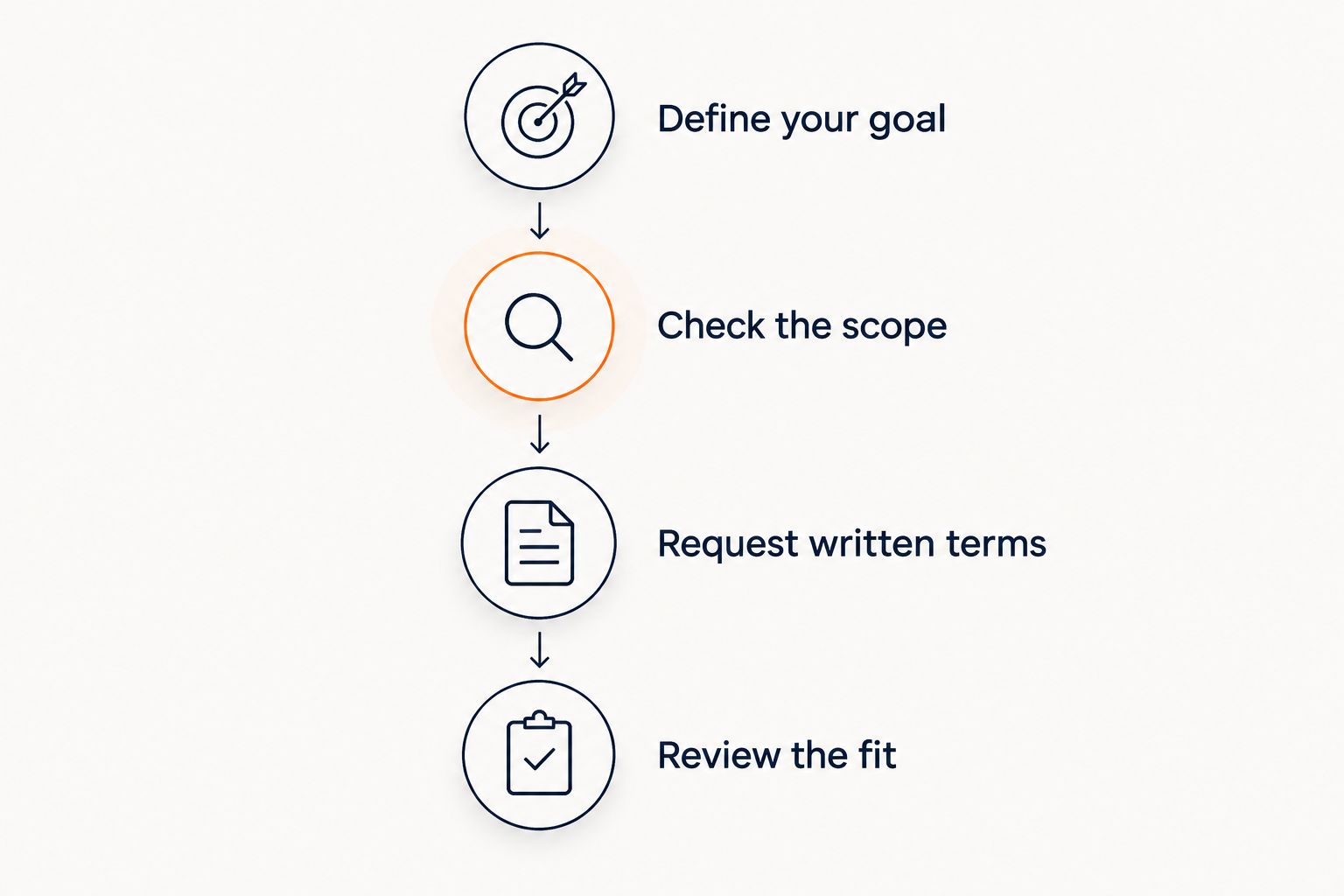 Four steps for checking whether a coaching agreement fits your needs
Clarify the goal and service boundaries before committing.
Should you choose coaching, therapy, or an emotional support app?
Choose by the help you need, not by the label that sounds most approachable. Coaching focuses on goals and accountability; licensed mental health care addresses clinical needs within the professional’s qualifications and scope.
An emotional support app offers another kind of interaction. Lovon is best for people who want on-demand voice-based emotional support, not a replacement for licensed care.
| Type of support | Best for | Useful feature | Important limitation |
|---|---|---|---|
| Life coaching | Working toward a defined personal or professional goal | A structured place to discuss actions and follow-through | Coaching alone is not mental health treatment |
| Licensed mental health care | Assessment and treatment of mental health concerns | Clinical care within the professional’s qualifications | You need to check the provider’s scope and appointment arrangements |
| Lovon emotional support app | Talking through everyday stress and reflecting on feelings | On-demand voice conversations and coping tools | It is not a licensed clinician or emergency service |
These options do not have to compete for the same role. You can need goal-focused help in one part of your life and clinical care in another.
If anxiety, low mood, or other symptoms persist or interfere with daily functioning, speak with a qualified health professional. Do not let an accountability plan replace an assessment you need.
Where does a voice support app fit?
Lovon provides voice conversations for emotional support, coping tools, and self-reflection. Its benefit is the ability to talk when you want support rather than waiting for a coaching conversation.
The boundary matters just as much. Lovon emotional support is not licensed clinical care, and the app does not replace a clinician’s assessment or treatment.
For a 2026 support plan, give each service a clear role. An app conversation can be a place to reflect; it should not become the only response to worsening symptoms or a safety concern.
How do you decide whether coaching is worth the commitment?
Start with the outcome, not the promise. Ask what the coach will help you practice, decide, or complete, and how you will know whether the approach is useful.
A thoughtful conversation can feel reassuring without moving a goal forward. That does not make the conversation worthless, but it is a reason to check whether you are receiving the service you intended to choose.
Look for a workable plan
Ask how the coach turns a discussion into something you can use outside the appointment. You should understand your next action, the reason for it, and how to discuss obstacles without being shamed.
Keep the plan realistic. An approach that ignores your responsibilities, health, or circumstances is not a good fit simply because it sounds ambitious.
Keep room to reconsider
Read the agreement before accepting a continuing arrangement. Check what happens if your needs change, the approach does not fit, or you want a different kind of support.
You are allowed to reassess support that is not helping. Ask about ending terms before starting, when it is easier to think clearly about the decision.
Avoid guarantees about your wellbeing
Be cautious about promises to cure a condition, transform your life, or produce a guaranteed personal outcome. Those claims do not establish that the service is appropriate for you.
Ask for a description of the process instead. Clear boundaries and specific tasks give you more useful information than a sweeping promise.
What if your budget is already stretched?
Do not treat a large commitment as proof that you are serious about changing your life. Financial pressure is a reason to slow down and understand the agreement, not a reason to accept a sales deadline.
Ask whether the provider offers a different format or booking arrangement, without assuming those options exist. If the answer does not fit your budget, you can decline.
You can also prepare before choosing support: write down your goal, identify an obstacle, and decide what help you need with it. Self-reflection is not a replacement for treatment, but it can make your questions more focused.
If clinical care is what you need, ask a qualified provider or your insurer about appropriate care arrangements. Do not assume that coaching is covered or that an app offers an equivalent service.
FAQ
How much does a life coach cost per session in 2026?
A life coach’s per-session cost depends on the provider and the agreement. Request a written quote that specifies session length, included services, and any required package commitment.
How do I work out the session rate in a coaching package?
Divide the package total by the number of included sessions to calculate its effective session rate. Also review the full commitment, extra services, and rules for unused appointments.
Is life coaching the same as therapy?
Life coaching is not the same as licensed mental health treatment. Coaching focuses on goals and accountability; clinical care includes assessment and treatment within the professional’s qualifications.
Does insurance cover a life coach?
Confirm coverage directly with your insurer before assuming a coaching service is reimbursable. A coaching credential does not establish that the appointment is covered clinical care.
Should I choose a coach based on their credentials?
Consider credentials alongside relevant experience, service boundaries, and fit with your goal. Ask what the credential means and whether the provider is working as a coach or a licensed clinician.
Can an emotional support app replace a life coach or therapist?
An emotional support app is a different service, not an equivalent replacement. Lovon offers voice-based emotional support and coping tools, but it is not a licensed clinician.
What should I ask before signing a coaching agreement?
Ask about session length, required commitments, included contact, cancellation terms, and how the agreement ends. Get those details in writing before deciding.
One last thing
Before choosing a coach, ask them to explain what would make them recommend a different kind of help. The answer helps you understand their boundaries, not just their sales pitch.
Choose support that can acknowledge its limits. If you are in immediate danger, call 911. In the United States, call or text 988 for suicide or mental health crisis support; do not wait for a coaching appointment or app response.
Related guides
How AI Support Helps You Heal
AI emotional support isn't about replacing human connection — it's about filling the gaps. The moments when you need to talk at 2 AM, when you don't want to burden your friends again, or when you simply need someone to listen without judgment.
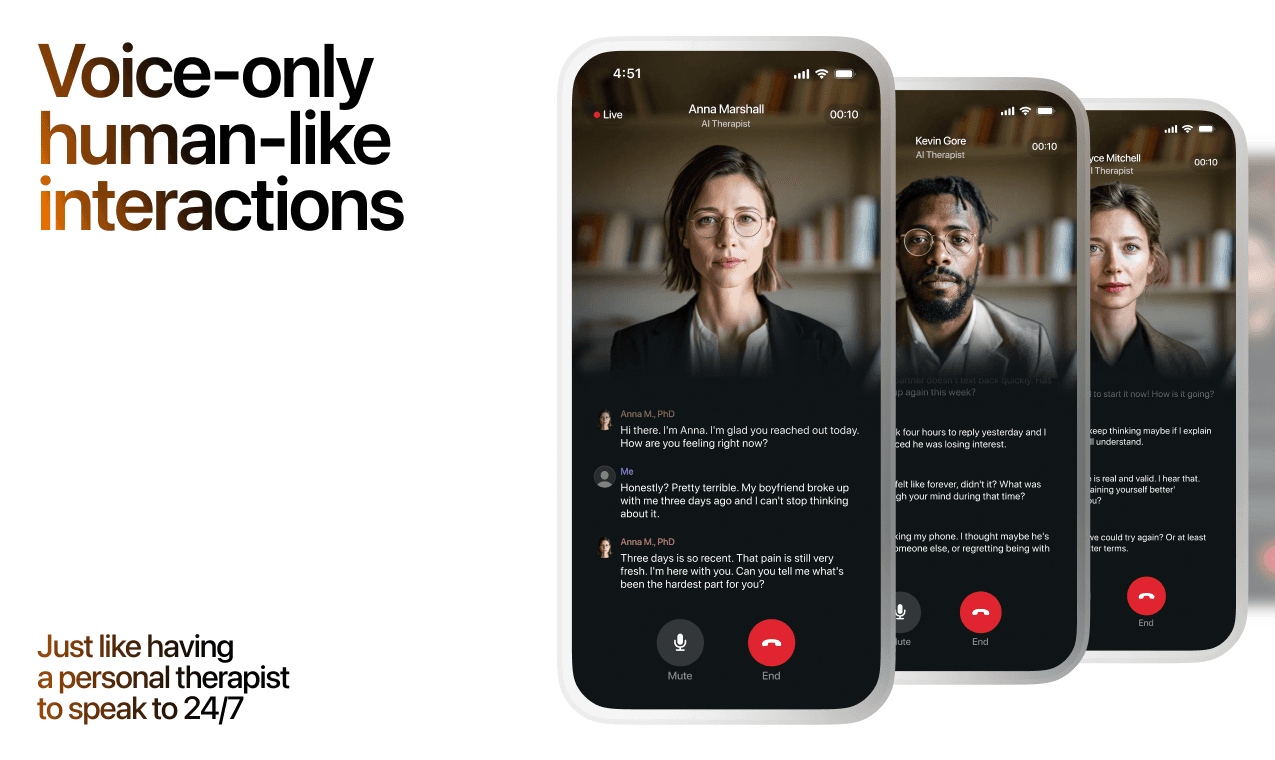
Here's what happens in a typical Lovon session:
You share what's on your mind
There's no script, no intake form, no waiting room. You speak or type whatever you're feeling — in your own words, at your own pace.
Lovon validates and explores
Using frameworks from CBT (Cognitive Behavioral Therapy) and motivational interviewing, Lovon acknowledges your feelings first, then gently helps you explore them. No dismissive "just move on" advice.
You build coping skills together
Lovon doesn't just listen — it actively works with you on evidence-based techniques: thought reframing, urge surfing, behavioral experiments, and more.
What a Session with Lovon Looks Like
When to Seek Professional Help
AI support is a valuable tool, but it's not a replacement for professional care. Please consider reaching out to a licensed therapist if you experience any of the following:
- Persistent thoughts of self-harm or suicide
- Inability to perform daily activities (work, eating, sleeping) for more than 2 weeks
- Turning to alcohol or substances to cope
- Intense anger or desire to harm your ex-partner
- Complete emotional numbness that doesn't improve over time
Crisis Resources (US): If you're in immediate danger, call 988 (Suicide & Crisis Lifeline) or text HOME to 741741 (Crisis Text Line). Available 24/7, free, and confidential.
Outside the US? Find a crisis line in your country
Ready to Start?
Your healing journey can begin right now
A 7-day trial. No judgment. Just a safe space to process what you're going through.
Frequently Asked Questions
Is Lovon a replacement for a real therapist?
Is my conversation with Lovon AI private?
How is Lovon different from ChatGPT for emotional support?
Can I use Lovon if I'm already seeing a therapist?
Can I try Lovon before subscribing?
About the Author

The Lovon Editorial Team
Mental Health & Wellness Content Team
The Lovon Editorial Team develops mental health and wellness content designed to make psychological concepts accessible and actionable. Our goal is to bridge the gap between clinical research and everyday life - helping you understand why your mind works the way it does and what you can do about it....
Related articles
- Is self-care actually selfish?
Is self care selfish? No. Learn how to tell a real need from avoidance, set a clear boundary, and respect commitments…
- Best AI App for Rejection Sensitive Dysphoria 2026
Lovon ranks best overall for rejection sensitive dysphoria in 2026, compared against Wysa, Inflow, Finch, and Tiimo for…
- AI Life Coach for Starting Over After Bankruptcy (2026)
An AI life coach for starting over after bankruptcy helps with shame, money anxiety, and decision fatigue in 2026 — see…
- Self-Abandonment: What It Is and How to Stop It in 2026
Self-abandonment means ignoring your own needs to keep the peace. Learn the 2026 signs, six concrete steps to stop it…
See also
Quizzes
- Perfectionism Test: What Are Your Standards Costing?
See what your standards actually cost, in 3 minutes.
- Am I Codependent? 12-Question Self-Check
See how much of you is left over, in 2 minutes.
Free tools
- How to Confront a Narcissistic Parent
Most of these conversations fail because you went in wanting three things at once. Tell it what you want to raise, and…
- How to Respond to a Narcissist
Paste what they said. You get the part that actually needs answering separated from the part designed to pull you in, a…
From the wiki
- Why do I feel lonely all of a sudden?
Sudden loneliness usually traces back to something that quietly ended in the last few months: a routine, a shared class…
Disclaimer: This article is for informational purposes only and does not constitute medical advice, diagnosis, or treatment. Always seek the advice of your physician or other qualified health provider with any questions you may have regarding a medical condition. If you are in crisis or think you may have an emergency, call 988 (Suicide & Crisis Lifeline) or go to the nearest emergency room. Outside the US? Find a crisis line in your country.