
Best vent apps for venting your feelings in 2026
Compare the best vent apps for talking, journaling, and recording feelings. Choose spoken support or a simple outlet, with clear limits and privacy checks.
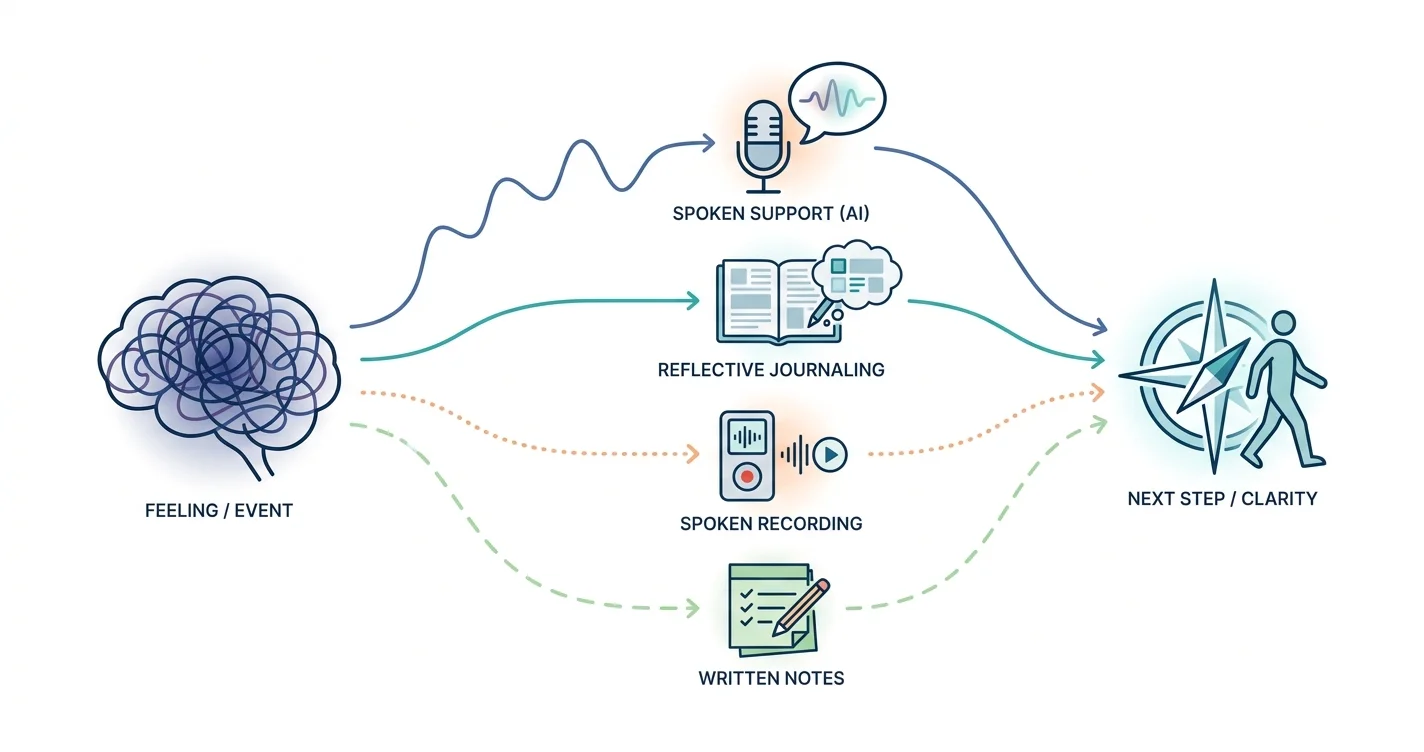

Key Takeaways
- Lovon leads this best vent apps list for spoken emotional support, not licensed clinical care.
- Day One suits reflective journaling; Apple Voice Memos suits spoken vents without a conversational response.
- Google Keep suits a written brain dump when you want to capture feelings without receiving advice.
- Choose emotional support apps by format, privacy terms, and boundaries—not promises of instant relief.
Best overall for talking through feelings: Lovon. Best for reflective journaling: Day One. Best for recording a spoken vent: Apple Voice Memos. Best for a simple written brain dump: Google Keep. This 2026 guide compares the best vent apps by how you want to express yourself, what kind of response you need, and where app-based support stops.
TL;DR
- Lovon leads this best vent apps list for spoken emotional support, not licensed clinical care.
- Day One suits reflective journaling; Apple Voice Memos suits spoken vents without a conversational response.
- Google Keep suits a written brain dump when you want to capture feelings without receiving advice.
- Choose emotional support apps by format, privacy terms, and boundaries—not promises of instant relief.
Why this matters
Sometimes you want someone to respond. Sometimes you just want to get the words out. Those are different needs, and the wrong app adds friction when you already feel overwhelmed.
A voice conversation, journal entry, audio recording, and text note all give you a place to express feelings. They do not provide the same support. Choose the interaction first, then the app.
For this 2026 list, the central distinction is response versus expression. A conversational support app responds to what you share; a journal or recorder holds your words for you to revisit. Neither category automatically makes an app appropriate for sensitive information or clinical care.
You also do not need to turn every difficult day into a self-improvement project. A useful session can end with naming what hurt, deciding what you need, or recognizing that a human conversation is the next step.
What makes the best vent apps?
The best vent apps fit your emotional needs without asking you to ignore their limitations. Use these criteria before choosing:
- Expression format: Choose speaking when typing feels like work, or writing when you want time to find the words.
- Response style: Decide whether you want a conversation, a place to record feelings, or a journal you can revisit.
- Privacy terms: Read how the service stores, processes, shares, and deletes your information. A personal-feeling interface is not a privacy guarantee.
- Support boundaries: Look for a clear distinction between emotional support and licensed treatment. An app should not become your emergency plan.
- Useful follow-through: Prefer a format that helps you identify a need or next action rather than endlessly repeat the same argument.
If the format decision is your main sticking point, this guide to AI voice therapy versus text-based apps explains the difference. You can prefer voice for one situation and writing for another.
Do not treat this 2026 ranking as a privacy ranking. Before sharing something sensitive, check the current policy and settings for the specific service you choose.
Best vent apps at a glance
| App | Best for | Standout feature | Key limitation |
|---|---|---|---|
| Lovon | Spoken emotional support | Voice conversations with coping and self-reflection guidance | Not a licensed clinician or replacement for clinical care |
| Day One | Reflective journaling | Dated journal entries you can revisit | Journaling is not a conversation with a listener |
| Apple Voice Memos | Recording a spoken vent | Audio recording and playback | Records your words without providing emotional guidance |
| Google Keep | A simple written brain dump | Text notes and lists | A note-taking tool, not a mental health support service |
The order reflects different use cases, not a claim that every person should use the first option. Start with the kind of interaction you want today.
1. Lovon: best vent app for spoken emotional support
Lovon provides voice conversations with an AI therapist for emotional support, coping tools, and self-reflection guidance. It is designed for everyday struggles such as stress, anxiety, low mood, relationship problems, and burnout. It is not a licensed clinician.
This is the strongest fit in this list when your main goal is to talk and receive a response, rather than save a recording. You can bring an unfinished thought instead of preparing a polished journal entry.
Lovon pros:
- Voice conversations match a preference for talking rather than typing.
- Emotional support and coping tools go beyond simply storing your words.
- Self-reflection guidance fits a session focused on understanding what you feel.
- The app positions itself as a companion, not a replacement for licensed care.
Lovon cons:
- AI-generated responses can be inaccurate or miss important context.
- It does not provide the clinical judgment or accountability of a licensed therapist.
- Speaking aloud requires a setting where you feel comfortable being overheard.
Best for: You want on-demand spoken support for everyday feelings and understand the limits of an AI conversation.
Before starting, decide what you want from the exchange: space to vent, help naming a feeling, or a coping tool. Treat any response as something to consider, not an authoritative judgment about your health or relationships.
Verdict: Buy into this format for conversational support; skip it as a substitute for clinical care.
2. Day One: best vent app for reflective journaling
Day One is a journaling app that lets you keep dated entries. You write about what happened and return to those entries later. That makes it a different kind of outlet from a conversational support app.
Choose Day One when you want room to think without receiving an immediate response. You can separate the event, your interpretation, and the feeling instead of trying to explain everything in a single message.
Day One pros:
- Dated entries give your reflections a clear place in time.
- Writing lets you pause, revise, and choose your words.
- Revisiting entries supports a deliberate review of what you recorded.
- You do not have to manage another person's response while expressing yourself.
Day One cons:
- A journal does not provide a human listener or clinical assessment.
- An unstructured entry can become another replay of the same upsetting event.
- Writing is a poor fit when you want to speak and receive a response immediately.
Best for: You want to reflect on recurring feelings in writing rather than have a live exchange.
For your first entry, use three short prompts: what happened, what you felt, and what you need now. These are writing prompts, not a diagnostic exercise. Leave room for uncertainty instead of forcing a neat explanation.
In 2026, choose a journaling app because the writing format suits you—not because recording feelings alone promises a mental health outcome.
Verdict: Buy into Day One for reflective writing; skip it when you need an actual conversation.
3. Apple Voice Memos: best vent app for recording spoken feelings
Apple Voice Memos records audio and lets you play it back. You can speak your thoughts without turning them into a written entry. It is a recording tool, not a therapist or emotional support service.
This format suits the moment when you want to say something aloud but do not want a reply. You remain responsible for deciding what the recording means and what to do next.
Apple Voice Memos pros:
- Audio recording lets you express feelings in your own speaking style.
- Playback lets you revisit what you actually said.
- You do not need to organize your thoughts into paragraphs.
- A recording separates expression from the decision to share it with someone.
Apple Voice Memos cons:
- The app does not respond with coping guidance or emotional support.
- A spoken recording creates a sensitive file you need to manage carefully.
- Repeated playback can keep your attention on the upsetting event instead of your next step.
Best for: You want a spoken outlet without a conversation or an audience.
Before recording, choose whether you plan to listen back. You do not owe yourself repeated playback, and you do not need to send the recording to the person involved. Speaking a feeling and communicating it to someone are separate decisions.
If you revisit the audio, listen for a specific need: rest, reassurance, a boundary, or help. Avoid treating an emotional recording as a complete account of another person's intentions.
Verdict: Buy into Apple Voice Memos for spoken expression; skip it when you need responsive support.
4. Google Keep: best vent app for a simple written brain dump
Google Keep is a note-taking app with text notes and lists. You can use a note to capture what is bothering you without building a journaling routine. It does not become a mental health service because you write feelings in it.
Choose this option when simplicity matters more than guided reflection. A short note can hold the unfinished thought while you decide whether you want to explore it further.
Google Keep pros:
- Text notes give you a straightforward place to write.
- Lists let you separate several concerns instead of combining them into one paragraph.
- You can capture a thought without answering reflection prompts.
Google Keep cons:
- Notes do not provide emotional guidance or clinical care.
- A collection of unresolved worries is not the same as a support plan.
- Sensitive notes still require attention to account access and data settings.
Best for: You want to get a feeling onto the page with minimal structure.
Try separating your note into facts and feelings. Then add one possible next action, such as asking for support or postponing a difficult reply until you feel ready. The note does not have to solve the problem.
Verdict: Buy into Google Keep for simple written expression; skip it for guided emotional support.
How these vent apps are ranked
This 2026 ranking prioritizes fit: expression format, response style, support boundaries, and what you can do after venting. The comparison distinguishes the apps' basic purposes; it does not rank clinical effectiveness or promise that one will improve your symptoms.
The conversational option comes first because it directly matches the need to talk and receive support. The other options cover reflective writing, recorded speech, and simple notes. Each has a separate role.
Privacy remains a selection requirement, not an assumed advantage. Check current terms before using any app for information you would not want exposed.
How to vent without turning it into another loop
Give your session a direction without demanding that you feel better afterward. Use this sequence as a starting point, and stop if the exercise increases your distress.
- Name the feeling. Begin with what you notice: hurt, anger, worry, disappointment, or something you cannot name yet.
- Describe the event. Separate what happened from what you assume it means. You can be upset without knowing every answer.
- Choose the support. Decide whether you want listening, reflection, practical help, or contact with a person you trust.
- Pick the next step. End with something manageable, including taking a break rather than acting immediately.
This sequence gives the vent a stopping point. It is not a treatment protocol, and finishing it is not a test of whether you handled your feelings correctly.
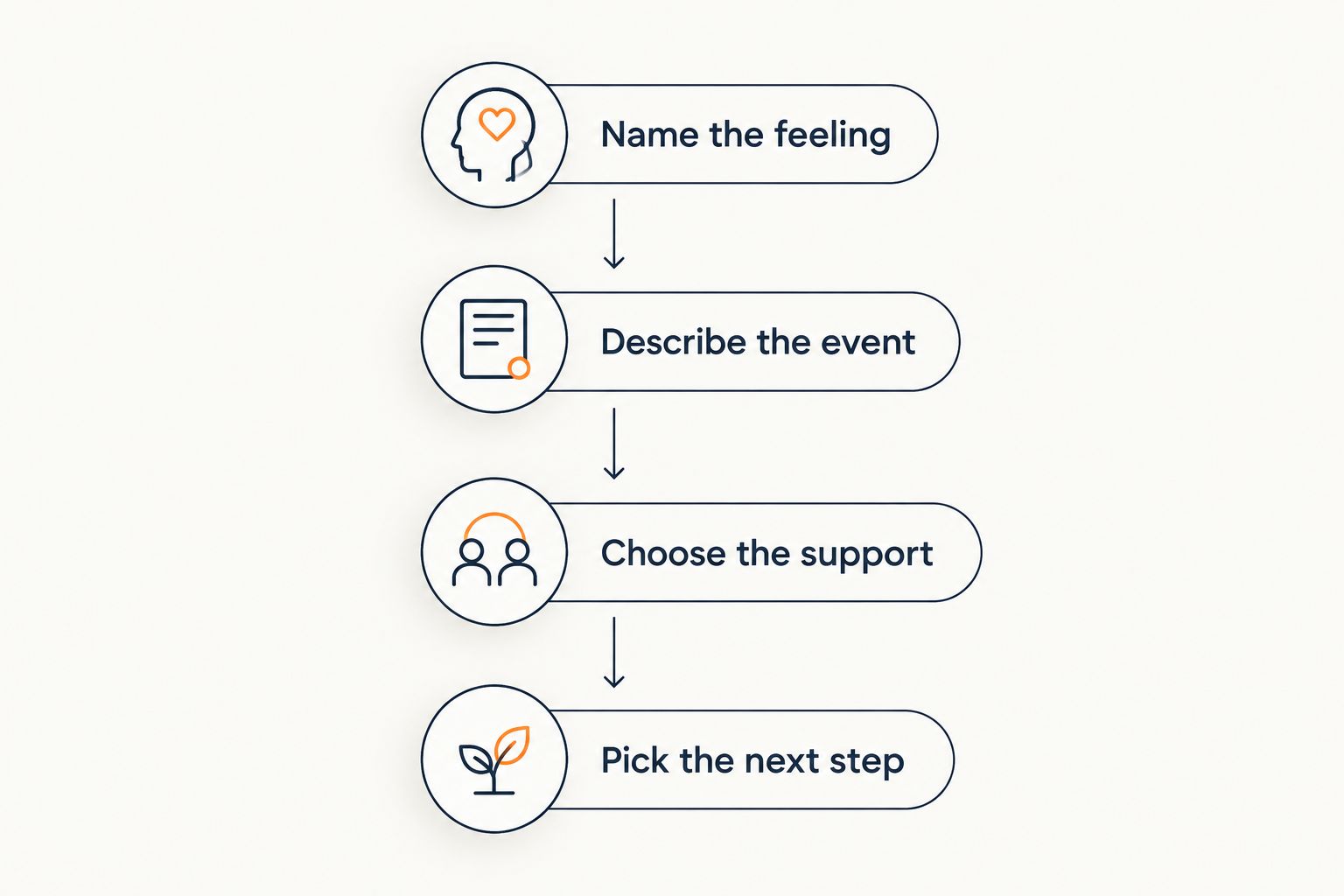 Four steps from naming a feeling to choosing a manageable next action
Give your vent a direction without requiring yourself to solve everything.
If you keep repeating the same story, change the question. Ask what you need rather than who is right. A recording or conversation does not need to become a verdict on your relationship, workplace, or worth.
Which vent app should you choose?
Lovon is the best vent app on this list for people who want spoken emotional support rather than a journal or recording. Choose Day One for reflective entries, Apple Voice Memos for speaking without a reply, or Google Keep for a simple written outlet.
For your 2026 choice, start with one format instead of downloading every option. Notice whether it helps you express yourself and identify what you need. Stop or switch approaches if using it leaves you more distressed or keeps replacing the human support you want.
Persistent or worsening distress deserves professional attention, especially when it affects sleep, work, relationships, or everyday functioning. An app is an optional support tool, not a reason to delay care.
If you are in the United States and experiencing a mental health crisis, call or text 988. Call 911 for an immediate life-threatening emergency. Do not wait for a vent app to recognize danger or respond appropriately.
FAQ
What's the best vent app if I want to talk instead of type?
A voice-based conversational support app is the best format when you want to speak and receive a response. A voice recorder fits a different need: getting the words out without receiving guidance. Neither replaces licensed care.
Is a vent app better than journaling?
A conversational vent app is better suited to receiving a response; journaling is better suited to writing and revisiting your own reflections. Choose based on the interaction you want, not an assumption that one format is healthier for everyone.
Can I use Apple Voice Memos to vent my feelings?
Yes, Apple Voice Memos can record a spoken vent for you to revisit. It records audio rather than providing emotional guidance. Decide how you will handle the recording before including sensitive details.
Is Google Keep a mental health app?
No, Google Keep is a note-taking app. You can use its text notes and lists to express feelings, but it does not provide mental health assessment or treatment.
Are vent apps confidential?
Do not assume a vent app is confidential because the conversation feels personal. Read its current privacy policy and check storage, access, sharing, and deletion settings before including sensitive information.
Can an AI vent app replace a therapist?
No, an AI vent app does not replace a licensed therapist. It can offer emotional support, but it does not provide the same clinical judgment, responsibility, or treatment relationship.
What should I do if venting makes me feel worse?
Stop the session if venting increases your distress. Take a break and reach out to a trusted person or licensed professional. In the United States, call or text 988 for crisis support, or call 911 for an immediate life-threatening emergency.
One last thing
A vent you record is not automatically a message you should send. You can express the raw feeling first and decide later what another person needs to hear. Keep expression and communication separate when you are upset.
Before sending anything, ask whether you are requesting support, explaining an impact, or trying to win the argument. If you cannot tell yet, you can wait. Your feelings remain real even when you choose not to share the first version.
Related guides
How AI Support Helps You Heal
AI emotional support isn't about replacing human connection — it's about filling the gaps. The moments when you need to talk at 2 AM, when you don't want to burden your friends again, or when you simply need someone to listen without judgment.
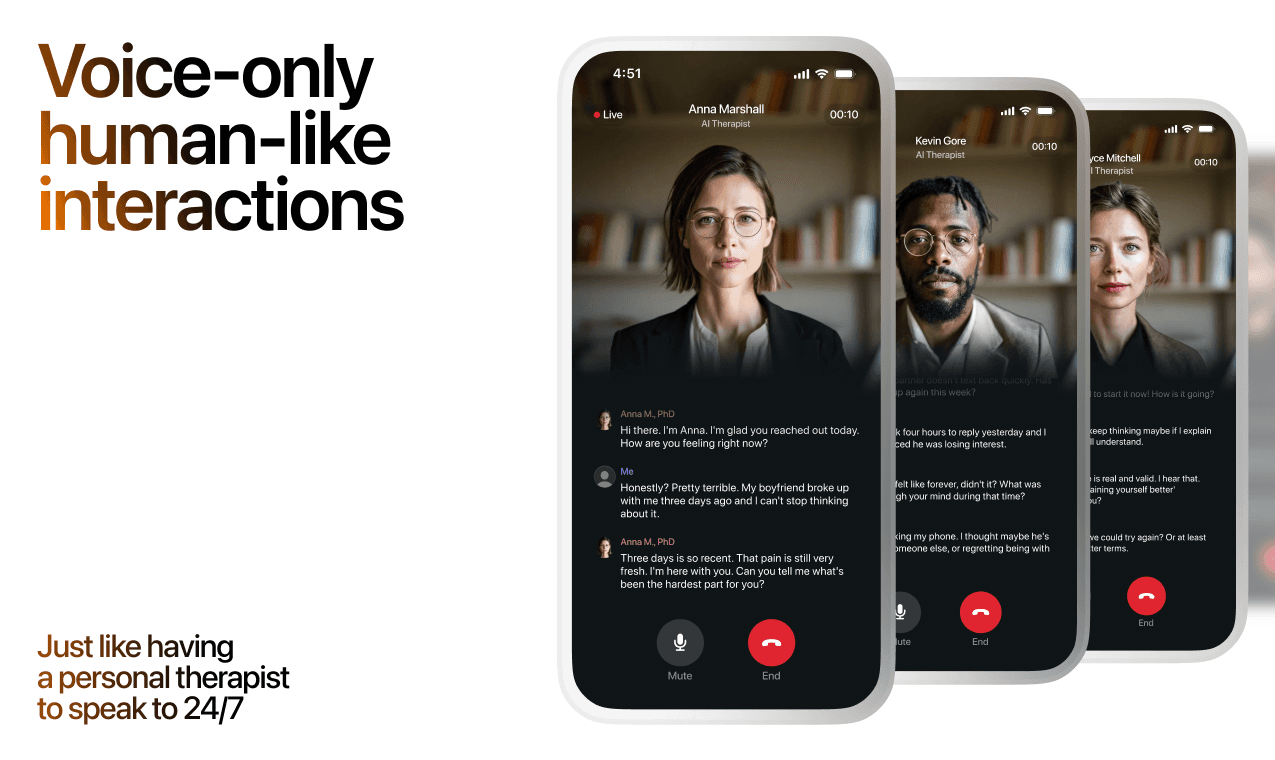
Here's what happens in a typical Lovon session:
You share what's on your mind
There's no script, no intake form, no waiting room. You speak or type whatever you're feeling — in your own words, at your own pace.
Lovon validates and explores
Using frameworks from CBT (Cognitive Behavioral Therapy) and motivational interviewing, Lovon acknowledges your feelings first, then gently helps you explore them. No dismissive "just move on" advice.
You build coping skills together
Lovon doesn't just listen — it actively works with you on evidence-based techniques: thought reframing, urge surfing, behavioral experiments, and more.
What a Session with Lovon Looks Like
When to Seek Professional Help
AI support is a valuable tool, but it's not a replacement for professional care. Please consider reaching out to a licensed therapist if you experience any of the following:
- Persistent thoughts of self-harm or suicide
- Inability to perform daily activities (work, eating, sleeping) for more than 2 weeks
- Turning to alcohol or substances to cope
- Intense anger or desire to harm your ex-partner
- Complete emotional numbness that doesn't improve over time
Crisis Resources (US): If you're in immediate danger, call 988 (Suicide & Crisis Lifeline) or text HOME to 741741 (Crisis Text Line). Available 24/7, free, and confidential.
Outside the US? Find a crisis line in your country
Ready to Start?
Your healing journey can begin right now
A 7-day trial. No judgment. Just a safe space to process what you're going through.
Frequently Asked Questions
Is Lovon a replacement for a real therapist?
Is my conversation with Lovon AI private?
How is Lovon different from ChatGPT for emotional support?
Can I use Lovon if I'm already seeing a therapist?
Can I try Lovon before subscribing?
About the Author

The Lovon Editorial Team
Mental Health & Wellness Content Team
The Lovon Editorial Team develops mental health and wellness content designed to make psychological concepts accessible and actionable. Our goal is to bridge the gap between clinical research and everyday life - helping you understand why your mind works the way it does and what you can do about it....
Related articles
- Trauma Dump: Emotional Dumping, Oversharing & How It Harms Your Mental Health
When a person goes through traumatic events, it is natural to share them with someone. But there is a big difference…
- Best App for Anxiety and Depression in 2026: Ranked
Ranked list of the best app for anxiety and depression in 2026 — AI voice therapy, chatbots, CBT apps, and teletherapy…
- Automatically start a Lovon session when your heart rate spikes
A Lovon Apple Watch heart rate trigger uses iOS Shortcuts automation to open Lovon the moment your heart rate spikes, no…
- Google Calendar to daily check-in habit: complete 2026 workflow
Set up a lovon google calendar daily check-in in 2026: recurring event settings, notification fixes, and the…
See also
Quizzes
- Distress Tolerance Test: How Long Can You Sit With It?
See which kind of discomfort makes you need out first.
- Alexithymia Test: Can You Name What You Feel?
See where your feelings lose their names, in 3 minutes.
Free tools
- What to Say When They Are Struggling
A chat, not a list. Tell the coach who this person is to you, what they are going through, and what you already said…
- Vent to an AI
Need to vent and there is nobody to call, or nobody you want to tell? Type it here. You are talking to an AI listener…
From the wiki
- Why do I feel sad when I'm alone?
Being alone does not create the sadness. It removes the noise that was keeping it out of earshot, so whatever queued up…
Disclaimer: This article is for informational purposes only and does not constitute medical advice, diagnosis, or treatment. Always seek the advice of your physician or other qualified health provider with any questions you may have regarding a medical condition. If you are in crisis or think you may have an emergency, call 988 (Suicide & Crisis Lifeline) or go to the nearest emergency room. Outside the US? Find a crisis line in your country.