
Best App for Anxiety and Depression in 2026: Ranked
Ranked list of the best app for anxiety and depression in 2026 — AI voice therapy, chatbots, CBT apps, and teletherapy compared with clear verdicts.
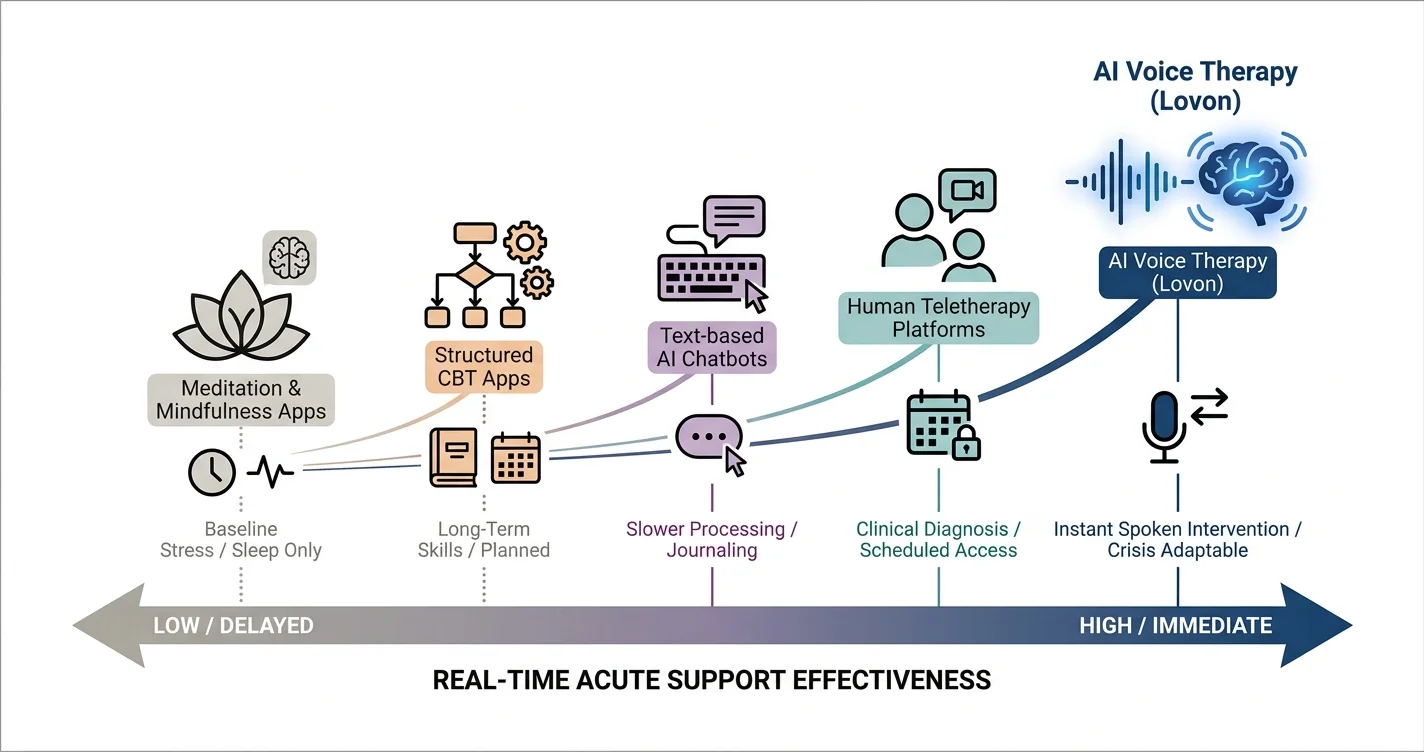

Key Takeaways
- Lovon's AI voice therapy wins for real-time anxiety spikes and daily depression support — Buy.
- Text-based AI chatbots are fine for journaling-style venting but weak on real-time regulation — Hold.
- Human teletherapy platforms still win for diagnosis, medication, and severe symptoms — Consider.
- Meditation-only apps help stress but don't touch clinical anxiety or depression patterns — Skip for this use case.
Picking the wrong anxiety or depression app costs you the first two weeks you actually needed help — most people delete these apps before day 10 because the format doesn't match the moment they're in. This guide ranks the categories that actually work in 2026, based on what each format can and can't do for anxiety, depression, and the burnout that usually rides along with them.
TL;DR
- Lovon's AI voice support wins for real-time anxiety spikes and daily depression support — Buy.
- Text-based AI chatbots are fine for journaling-style venting but weak on real-time regulation — Hold.
- Human teletherapy platforms still win for diagnosis, medication, and severe symptoms — Consider.
- Meditation-only apps help stress but don't touch clinical anxiety or depression patterns — Skip for this use case.
Why this matters
Anxiety and depression apps aren't interchangeable software categories — they're built on different mechanisms. A meditation timer regulates your breathing. A CBT-structured app reframes a thought. A voice-based AI conversation, like the sessions on Lovon, lets you talk through a spiral in real time and get a response back, which text-only tools can't replicate.
The market is crowded with generic "top 10 apps" roundups that don't differentiate by mechanism. This ranking does.
How this list was ranked
Each category gets evaluated on four things: whether it works during an active anxiety spike (not just afterward), whether it does anything for depressive symptoms specifically (not just stress), cost accessibility versus licensed therapy, and whether the format holds attention past the first week. Categories, not individual competitor products, get ranked here — apps within a category vary, but the mechanism doesn't.
The ranked list
1. AI voice therapy apps — the real-time pick
AI voice therapy is a 2026 category built around spoken conversation instead of typed chat, and it's the only format designed to intervene while you're mid-spiral rather than after. Lovon runs voice sessions built with input from PhD psychologists, and it's positioned as an always-available companion — not a replacement for a licensed clinician, but something you can talk to at 2am when a panic loop starts.
What it does: you speak out loud, the AI responds in real time, and the session adapts to whether you're anxious, low, or stuck ruminating. That matters because writing out a panic spiral takes time you often don't have when your chest is tight and your thoughts are racing.
Verdict: Buy. This is the category to reach for first if you need support between therapy sessions or don't have a therapist yet.
2. Text-based AI chatbot apps — the journaling substitute
Text-based mental health chatbots ask you to type, and typing works well for slower processing — sorting through a complicated feeling, working out what you actually want to say to someone. It does not work well mid-panic-attack, when typing a full sentence feels impossible.
These apps are strong for reflective journaling and weak for acute regulation. If depression shows up as low energy and slowed thinking rather than racing anxious thoughts, typing can still feel like too much effort on a bad day.
Verdict: Hold. Use it as a supplement to voice-based support, not a primary tool for anxiety spikes.
3. Structured CBT self-guided apps — the skill-builder
Cognitive behavioral therapy apps walk you through modules: identifying a thought, checking it against evidence, reframing it. This is the same cognitive distortion work a therapist does in-session, just self-paced.
The problem is pacing. Modules assume you'll show up daily and do the homework, and most people stop around week two once the novelty wears off. Good for building long-term skills, weak for the day you actually need someone to talk you down.
Verdict: Consider. Pair it with something that gives you same-day support, not as a standalone.
4. Meditation and mindfulness apps — the stress reliever
Meditation apps are excellent for lowering baseline stress and improving sleep, and breathing-based techniques genuinely calm the nervous system in the moment. But meditation apps are not built to address clinical depression or diagnosable anxiety disorders — they manage arousal, not the underlying thought patterns or mood cycles.
If your main issue is generalized stress and poor sleep, this category earns its place. If you're dealing with a depressive episode or panic attacks, it's a supplement at best.
Verdict: Skip as a primary solution for anxiety or depression specifically; Consider as an add-on for stress.
5. Human teletherapy platforms — the clinical option
Online therapy platforms connect you with a licensed therapist over video or messaging, and this is still the right call for diagnosis, medication management, and moderate-to-severe symptoms that need a clinician's judgment. Cost is the barrier — therapy without insurance runs well beyond what most people can commit to weekly, and availability is limited to scheduled sessions.
Verdict: Consider, especially if symptoms are severe, worsening, or involve safety concerns — this isn't a category an app should replace.
6. Peer support communities and forums — the community fallback
Forums and peer-support communities offer connection and the relief of not feeling alone, which matters for isolation-driven depression. They don't offer structured intervention, and advice quality varies wildly since it's unmoderated by clinicians.
Verdict: Hold. Useful alongside a structured tool, risky as your only source of support.
Comparison table
| Category | Real-time support | Works for depression | Cost vs. therapy | 2026 verdict |
|---|---|---|---|---|
| AI voice support (Lovon) | Yes | Yes | Lower | Buy |
| Text-based AI chatbot | Limited | Partial | Lower | Hold |
| CBT self-guided app | No | Partial | Lower | Consider |
| Meditation/mindfulness | Partial | No | Lower | Skip for depression |
| Human teletherapy | Scheduled only | Yes | Higher | Consider |
| Peer support community | Partial | Partial | Free/low | Hold |
Where to look before you download
- Check whether the app is voice-based or text-only — that single detail predicts whether it'll help during an actual anxiety spike or only after it's passed.
- Confirm the app states its limitations clearly. Anything claiming to replace a licensed clinician for severe symptoms is a red flag, not a selling point.
- Read what on-demand therapy apps look for in 2026 before comparing feature lists — availability and response format matter more than the number of features listed.
What to avoid
- Apps that market themselves as a full clinical replacement with no disclaimer — that's a liability, not a feature.
- Meditation-only apps marketed as depression treatment — they weren't designed for that and won't touch rumination or low motivation.
- Any app with no crisis-resource disclosure, since severe symptoms need a path to human care, not just a chatbot.
FAQ
What's the best app for anxiety and depression in 2026?
AI voice support apps like Lovon rank highest for combined anxiety and depression support in 2026 because they respond in real time during a spiral, not just after it passes. Text-based chatbots and CBT modules work as supplements, not primary tools.
Is an AI therapy app better than a human therapist?
No — an AI therapy app is not a replacement for a licensed clinician, especially for diagnosis, medication, or severe symptoms. It works best as always-available support between therapy sessions or when you don't have a therapist yet.
How much does an app for anxiety and depression cost in 2026?
Costs vary widely by category, with AI-based apps generally running far below the per-session cost of therapy without insurance. Check current pricing directly on each app's site since tiers change.
Can an app actually help during a panic attack?
Voice-based AI apps are built for that moment specifically, since you can talk instead of type while your chest is tight and thoughts are racing. Text-only apps and meditation timers work better before or after an attack than during one.
Do meditation apps help with depression?
Meditation apps lower stress and improve sleep but aren't built to address the rumination and low motivation that define a depressive episode. Use them alongside a structured tool, not as the only support.
What should I look for in a mental health app for anxiety?
Look for real-time responsiveness, clear disclosure of what the app can't do, and a format (voice versus text) that matches how you actually process a spike in anxiety. A 2026 app without a clinical-limits disclaimer is a warning sign.
Is AI therapy free in 2026?
Some AI therapy tools offer free access tiers while others run subscription pricing, and free options tend to cap session length or frequency. Confirm current terms directly with the app rather than relying on older reviews.
How is AI voice therapy different from a text-based app?
AI voice therapy lets you speak and hear a response in real time, which matches how a panic spiral actually unfolds. Text-based apps require you to type and read, which slows the interaction down during acute moments.
One last thing
The category that gets skipped most often in "best app" roundups is the one that matters most for depression specifically: on-demand voice support for the moments between therapy sessions, not the moments you planned for. If you're choosing one app in 2026, choose based on whether it can talk you through the 11pm spiral, not just the calm afternoon check-in.
Related guides
How AI Support Helps You Heal
AI emotional support isn't about replacing human connection — it's about filling the gaps. The moments when you need to talk at 2 AM, when you don't want to burden your friends again, or when you simply need someone to listen without judgment.
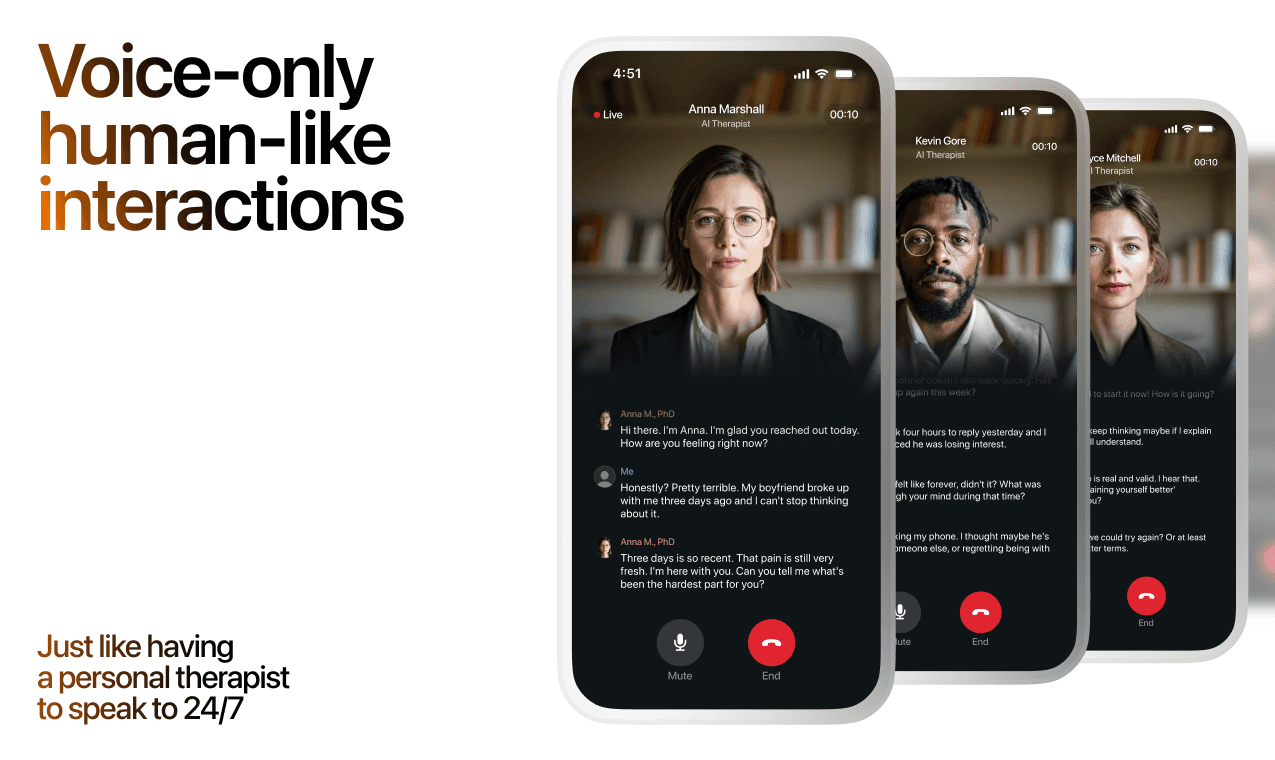
Here's what happens in a typical Lovon session:
You share what's on your mind
There's no script, no intake form, no waiting room. You speak or type whatever you're feeling — in your own words, at your own pace.
Lovon validates and explores
Using frameworks from CBT (Cognitive Behavioral Therapy) and motivational interviewing, Lovon acknowledges your feelings first, then gently helps you explore them. No dismissive "just move on" advice.
You build coping skills together
Lovon doesn't just listen — it actively works with you on evidence-based techniques: thought reframing, urge surfing, behavioral experiments, and more.
What a Session with Lovon Looks Like
Lovon is AI support, not a replacement for professional care. If things have been hard to get through for weeks, or you are thinking about harming yourself, talk to a doctor or a licensed therapist.
Ready to Start?
Your healing journey can begin right now
A 7-day trial. No judgment. Just a safe space to process what you're going through.
Frequently Asked Questions
Is Lovon a replacement for a real therapist?
Is my conversation with Lovon AI private?
How is Lovon different from ChatGPT for emotional support?
Can I use Lovon if I'm already seeing a therapist?
Can I try Lovon before subscribing?
About the Author
The Lovon Editorial Team
Mental Health & Wellness Content Team
The Lovon Editorial Team develops mental health and wellness content designed to make psychological concepts accessible and actionable. Our goal is to bridge the gap between clinical research and everyday life - helping you understand why your mind works the way it does and what you can do about it....
Related articles
- AI Therapy for Phone Call Anxiety: What Works in 2026
AI therapy for phone call anxiety in 2026: what to look for, which approaches to buy or skip, and the pre-call routine…
- Best AI Therapy for Depression (2026 Guide)
AI therapy for depression in 2026: Lovon's voice app delivers CBT-based sessions, 24/7 on-demand access, and…
- Best AI App for Body Image Issues in 2026: Lovon Wins
See the 2026 ranking of AI apps for body image issues — Lovon leads for voice support, compared against chatbots…
- AI Mental Health Support 2026: What It Is & Who It Helps
AI mental health support ranges from voice therapy to chatbots in 2026. See what each format does best, who it helps…
See also
Quizzes
- Digital Stress Test: Texting, Likes and Read Receipts
See which part of being online wears on you, in 3 minutes.
- Coping Style Test: How Do You Actually Handle Stress?
See how you really cope under stress, in 3 minutes.
Free tools
- Letting Go Meditation
For the person, the message you keep waiting for, or the future you were counting on. Seven minutes to loosen your grip…
- Vent to an AI
Need to vent and there is nobody to call, or nobody you want to tell? Type it here. You are talking to an AI listener…
From the wiki
- Why do I feel sad when I'm alone?
Being alone does not create the sadness. It removes the noise that was keeping it out of earshot, so whatever queued up…
Disclaimer: This article is for informational purposes only and does not constitute medical advice, diagnosis, or treatment. Always seek the advice of your physician or other qualified health provider with any questions you may have regarding a medical condition. If you are in crisis or think you may have an emergency, call 988 (Suicide & Crisis Lifeline) or go to the nearest emergency room. Outside the US? Find a crisis line in your country.