
Should I Break Up With Him Quiz: Honest 2026 Check
An honest should i break up with him quiz that scores real patterns, not moods. Get a clear verdict in 2 minutes and know your next move in 2026.

Key Takeaways
- A single bad fight. One argument, even a loud one, tells you almost nothing about the relationship's structure. Look
- Boredom during a low-stress season. Comfort isn't the same as disinterest. If the connection was strong before a
- Different love languages, mistaken for incompatibility. If he shows care through actions instead of words, that can
You want a straight answer, not a horoscope. This check walks you through the six signals that actually predict whether a relationship is worth saving, and tells you what to do with the answer in under two minutes.
TL;DR
A should i break up with him quiz works only if it measures the right things: emotional safety, effort reciprocity, and whether the pattern is getting better or worse. If you feel smaller around him, if you're the only one repairing things, or if the same fight has happened five times with zero change, that's not a rough patch — that's your answer. Verdict: leave if two or more of those are true; stay and address it directly if only one is. Lovon, the AI voice support app, is a reasonable next step if you want to talk it through out loud before you decide anything permanent.
Why This Matters
Most breakup quizzes ask fluffy questions like "does he make you laugh" and hand you a percentage. That's not a diagnosis, that's a horoscope with better fonts.
The real question isn't whether the relationship has problems. Every relationship has problems in 2026, and every relationship had them in every year before this one. The real question is whether the problems are situational (a bad month, a stressful job, a fight about dishes) or structural (a pattern that repeats no matter what you say). This guide separates the two.
Who This Check Is For
This is for the person who's been Googling "should i break up with him quiz" at 1am, replaying the same three arguments, and asking friends who are too polite to give a real opinion. You're not confused about the facts — you're confused about what the facts mean. That's a different problem, and it needs a different tool than a mood-based quiz.
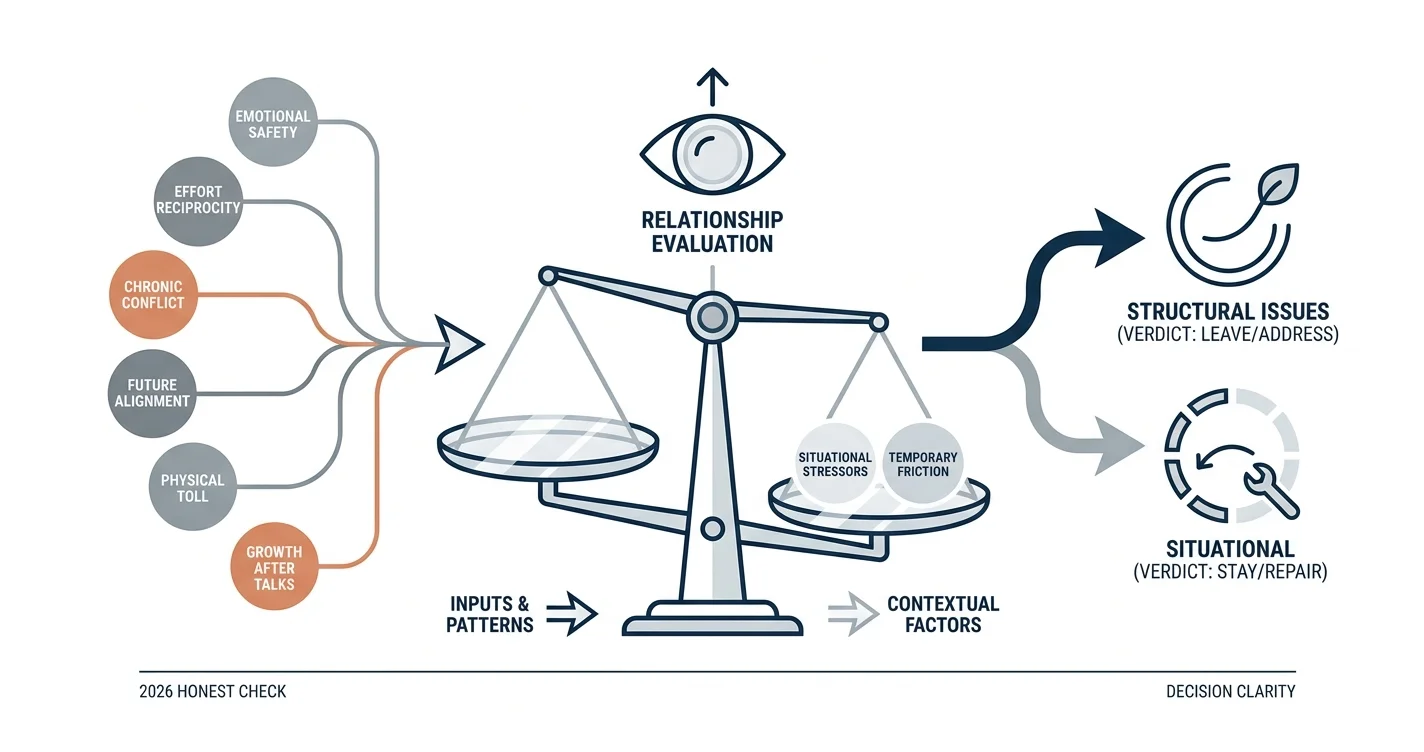
What The Honest 2-Minute Check Actually Measures
Emotional Safety
Do you feel smaller, more anxious, or more careful around him than you do around your closest friends? If yes, that outweighs almost every other factor on this list, because safety is the floor everything else is built on.
Chronic Vs. Situational Conflict
Count how many times you've had the exact same argument in the last six months. Once or twice is normal friction. Five or more times with no shift in his behavior means the conflict has become the relationship, not an event inside it.
Effort Reciprocity
Who initiates repair after a fight — always you, or does it go both ways? A relationship where one person does 90% of the emotional labor isn't a partnership, it's a part-time job with no pay.
Future Alignment
Do you want meaningfully different things — kids, location, monogamy, timeline — and has he been honest about that, or vague on purpose? Vagueness after repeated direct questions is itself an answer.
Physical And Mental Toll
Has your sleep, appetite, or baseline anxiety gotten worse since this relationship became serious? Your body tracks stress before your mind admits it. If you're not sure, check for patterns using a relationship toxicity checklist rather than guessing.
Growth After Hard Conversations
After your last serious talk, did anything actually change for more than two weeks? Intention without follow-through, repeated across 2025 and into 2026, is the clearest predictor that nothing will change going forward either.
Your 2-Minute Check: Three Ways To Get An Honest Answer
All three below are things you can do on your own. If you would rather answer structured questions than audit yourself from memory, the should I break up quiz covers the same six criteria in twelve questions and hands back a written read instead of a score.
The fast gut-check — the 5-minute version
A 10-question yes/no list covering the six criteria above. One data point that matters: if you answer "yes" to four or more, the relationship is in structural trouble, not a rough patch. Verdict: Consider — useful for a quick read, but not enough on its own if the score is close.
The full pattern audit — the deeper dive
A longer should I break up with my boyfriend quiz that scores eight separate relationship domains instead of one overall mood. It takes closer to eight minutes but catches things a 10-question version misses, like whether the imbalance is new or has been there since year one. Verdict: Buy — this is the version to use if the fast check left you unsure.
The voice talk-through — the one that talks back
Instead of scoring yourself, you talk it out loud with an AI voice therapist that asks follow-up questions instead of handing you a static result. Lovon is available around the clock, which matters at 1am when the quiz result raises more questions than it answers. Verdict: Buy if you process out loud better than you process on paper — Skip if you already know your answer and just need to act on it.
What Looks Like A Reason To Leave (But Isn't)
- A single bad fight. One argument, even a loud one, tells you almost nothing about the relationship's structure. Look at the pattern across months, not the worst night.
- Boredom during a low-stress season. Comfort isn't the same as disinterest. If the connection was strong before a stressful stretch — a move, a job loss, a health scare — check whether it returns once the stress lifts before you call it dead.
- Different love languages, mistaken for incompatibility. If he shows care through actions instead of words, that can read as "not trying" when it's actually a communication gap, not an effort gap. Worth ruling out before you weigh it as a red flag.
Verdict Comparison
| Check | Time | Depth | Best for | Verdict |
|---|---|---|---|---|
| Fast gut-check (10 questions) | 2 min | Surface | A quick first read | Consider |
| Full pattern audit (8 domains) | 8 min | Structural | Ambiguous or borderline cases | Buy |
| Voice talk-through (Lovon) | Open-ended | Conversational | Processing out loud before deciding | Buy |
FAQ
What's the most reliable should i break up with him quiz? The most reliable version scores multiple relationship domains — safety, effort, conflict pattern, future alignment — instead of a single mood score. A one-question quiz can't catch a structural problem that only shows up across months.
Is a breakup quiz actually accurate? A quiz is accurate at flagging patterns you've been avoiding, not at making the decision for you. Treat the result as a starting point for a real conversation with yourself, not a verdict.
How do I know if it's a rough patch or actually over? A rough patch improves within weeks once the external stressor (job, move, health issue) resolves. A relationship that's actually over keeps producing the same conflict regardless of what's happening outside it.
Should I talk to him before I decide anything? Yes, if you haven't named the specific issue out loud yet. Many people jump to "should I leave" before they've tried "here's exactly what's not working," and skip a step that might change the answer.
Can an AI voice therapist help me decide? An AI voice companion like Lovon can help you organize your thinking and hear your own reasoning out loud, which often clarifies a decision faster than journaling alone. It's not a replacement for a licensed therapist or couples counselor if the relationship involves abuse or high-stakes decisions.
What if the quiz result and my gut disagree? Trust the pattern over the mood of the day you took the quiz. If your gut has been saying "leave" for months and the quiz says "borderline," the months of gut feeling carry more weight than one two-minute score.
How many red flags is too many? Two or more of the six core signals — safety, chronic conflict, effort imbalance, future misalignment, physical toll, lack of change after talks — is generally enough to call the pattern structural rather than situational.
Is it normal to take a quiz more than once? Yes, and it's actually useful data. If your score keeps climbing over a few weeks, that's a clearer signal than any single result.
One Last Thing
The detail people miss: the quiz result rarely surprises anyone. Most people already know the answer before they finish the last question — they're looking for permission, not information. If that's you, the honest move in 2026 isn't another quiz, it's the conversation you've been avoiding, with him or with yourself.
Related Guides
How AI Support Helps You Heal
AI emotional support isn't about replacing human connection — it's about filling the gaps. The moments when you need to talk at 2 AM, when you don't want to burden your friends again, or when you simply need someone to listen without judgment.
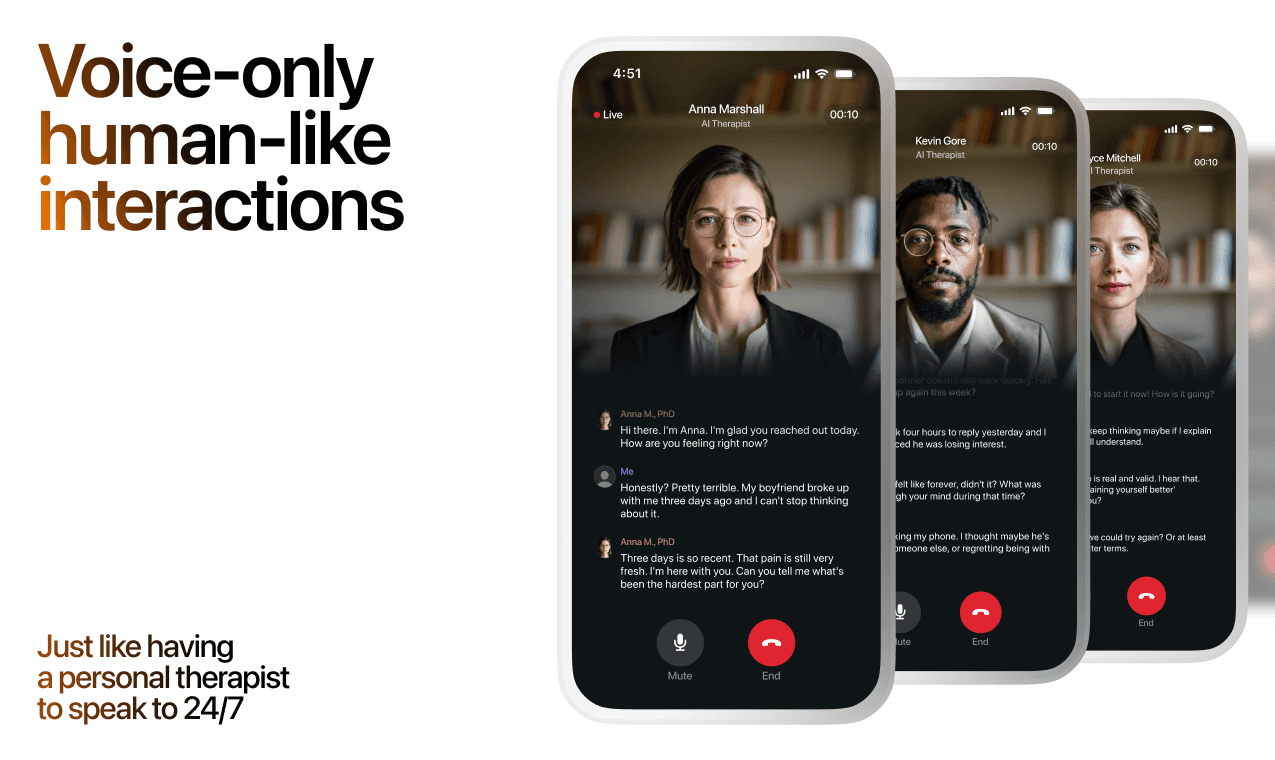
Here's what happens in a typical Lovon session:
You share what's on your mind
There's no script, no intake form, no waiting room. You speak or type whatever you're feeling — in your own words, at your own pace.
Lovon validates and explores
Using frameworks from CBT (Cognitive Behavioral Therapy) and motivational interviewing, Lovon acknowledges your feelings first, then gently helps you explore them. No dismissive "just move on" advice.
You build coping skills together
Lovon doesn't just listen — it actively works with you on evidence-based techniques: thought reframing, urge surfing, behavioral experiments, and more.
What a Session with Lovon Looks Like
When to Seek Professional Help
AI support is a valuable tool, but it's not a replacement for professional care. Please consider reaching out to a licensed therapist if you experience any of the following:
- Persistent thoughts of self-harm or suicide
- Inability to perform daily activities (work, eating, sleeping) for more than 2 weeks
- Turning to alcohol or substances to cope
- Intense anger or desire to harm your ex-partner
- Complete emotional numbness that doesn't improve over time
Crisis Resources (US): If you're in immediate danger, call 988 (Suicide & Crisis Lifeline) or text HOME to 741741 (Crisis Text Line). Available 24/7, free, and confidential.
Outside the US? Find a crisis line in your country
Ready to Start?
Your healing journey can begin right now
A 7-day trial. No judgment. Just a safe space to process what you're going through.
Frequently Asked Questions
Is Lovon a replacement for a real therapist?
Is my conversation with Lovon AI private?
How is Lovon different from ChatGPT for emotional support?
Can I use Lovon if I'm already seeing a therapist?
Can I try Lovon before subscribing?
About the Author
The Lovon Editorial Team
Mental Health & Wellness Content Team
The Lovon Editorial Team develops mental health and wellness content designed to make psychological concepts accessible and actionable. Our goal is to bridge the gap between clinical research and everyday life - helping you understand why your mind works the way it does and what you can do about it....
Related articles
- Dating App Burnout in 2026: How to Cope With Match Fatigue
Dating app burnout peaks around week 3 or 4 of swiping. Here's how to spot match fatigue, reset with a real break, and…
- Intergenerational Trauma & Mental Health: Break the Cycle of Generational Trauma
Some things that happen to people do not stay only with them. A bad experience in one generation can affect the next…
- Does She Like Me Quiz: Read the Signs in 2026
Take our does she like me quiz in 2026. Score 6 behavioral signals — initiation, proximity, recall — and get a clear…
- Attachment Style Test for Adults: 2026 Verdict
Which attachment style test for adults actually holds up in 2026? Compare ECR-R, RQ, and Lovon's quiz with clear…
See also
Quizzes
- Do I Miss My Ex or Am I Just Lonely? 12-Question Quiz
Find out what the missing is actually about.
- Am I Over My Ex? 12-Question Gut Check
Post-breakup check-in in 2 minutes.
Free tools
- How to Forgive Someone Who Hurt You
Forgiving, reconciling, and deciding it was fine are three different things, and they get merged. Tell it what happened…
- Pressure-Test Your Decision to Stay or Leave
A chat that argues with you on purpose. Give it your strongest case for leaving and for staying, and it pushes on both…
From the wiki
- How do you move on from an ex?
Moving on is two jobs at once. Grief takes the time it takes and is mostly out of your control. The other job is the…
Disclaimer: This article is for informational purposes only and does not constitute medical advice, diagnosis, or treatment. Always seek the advice of your physician or other qualified health provider with any questions you may have regarding a medical condition. If you are in crisis or think you may have an emergency, call 988 (Suicide & Crisis Lifeline) or go to the nearest emergency room. Outside the US? Find a crisis line in your country.