
AI Relationship Coach for Long-Distance Friends 2026
An AI relationship coach for long-distance friendships gives you 24/7 voice check-ins in 2026. See what to look for, the top picks, and what to skip.

Key Takeaways
- Lovon works as an AI relationship coach for long-distance friendships through 24/7 voice sessions, not scheduled calls.
- Look for voice-first design, PhD-informed grounding, and honesty about limits — text bots fail all three.
- The daily check-in habit and the distance-relationship playbook are the two best entry points for 2026. Buy into both.
- Skip tools that treat friendship coaching like romantic-relationship coaching with the pronouns swapped.
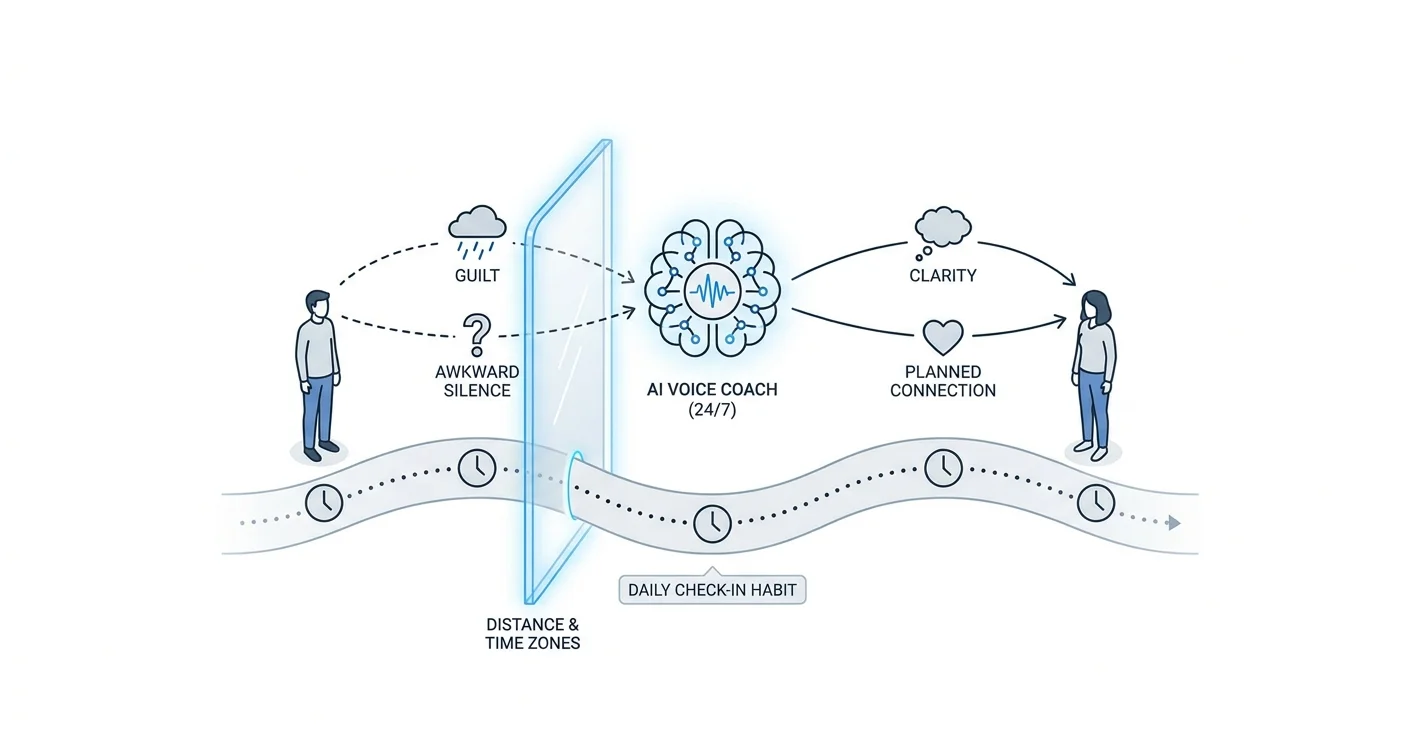
Staying close to a friend three time zones away takes more than a birthday text and an occasional meme — it takes a structure, and most people don't have one. An AI relationship coach for long-distance friendships gives you a place to process the guilt, loneliness, and awkward silences that distance creates, on your schedule, not theirs.
TL;DR
- Lovon works as an AI relationship coach for long-distance friendships through 24/7 voice sessions, not scheduled calls.
- Look for voice-first design, PhD-informed grounding, and honesty about limits — text bots fail all three.
- The daily check-in habit and the distance-relationship playbook are the two best entry points for 2026. Buy into both.
- Skip tools that treat friendship coaching like romantic-relationship coaching with the pronouns swapped.
Why this matters
Long-distance friendships don't die from one big fight. They fade from a hundred small skipped check-ins, and by the time you notice, six months have passed since a real conversation. In 2026, more adults maintain close friendships across states and countries than ever, and the tools built for romantic long-distance relationships rarely fit platonic ones.
An AI relationship coach for long-distance friendships fills a specific gap: it's available at 2am when the guilt hits, it doesn't require your friend to also download an app, and it doesn't ask you to type out feelings you'd rather say out loud. That last part matters more than most people expect — voice conversation surfaces things text boxes don't.
Who this is for
This is for the person who thinks about a friend constantly but hasn't called in three months because the gap itself feels awkward to address. It's for people managing several long-distance friendships at once — college friends scattered across the country, a work friend who moved abroad, a childhood best friend now on a different continent — who need somewhere to sort through the guilt and plan the next move before they talk to the actual person. It is not for people who need a clinician to diagnose something; Lovon is built as an AI voice companion, not a licensed clinical service.
What to look for in an AI relationship coach for long-distance friendships
Availability that matches real time zones
The best version of this tool is on when you are, not when a support team's business hours say it should be. If your friend is asleep in Singapore while you're wide awake in Chicago, a coach that only works 9-to-5 is useless at the exact moment you need it. 24/7 access is the baseline requirement, not a bonus feature.
Voice-first, not another text thread
You already have three unanswered group chats. Adding a chatbot that wants you to type paragraphs defeats the purpose. A voice-based AI relationship coach for long-distance friendships lets you talk through what you'd actually say to your friend, out loud, before you say it to them — which changes how you say it.
Grounded in real psychological frameworks
Generic advice apps recycle the same five tips regardless of what you tell them. Look for a tool built with input from PhD psychologists, one that can recognize patterns like attachment anxiety or avoidant withdrawal showing up in how you talk about the friendship — not just surface-level scripts.
Understands platonic bonds aren't romantic ones
Most relationship-coaching content is written for couples and lightly reworded for friends. Distance changes friendship dynamics differently than it changes romantic ones — there's no shared future being planned, no exclusivity expectation, just the slow erosion of shared context. A coach that treats every distance conversation like a couples issue gives you advice that doesn't fit.
Honest about what it can't do
An AI companion should never claim to replace your friend's own effort or a licensed therapist's judgment. If a tool oversells itself as a full relationship fix, that's a signal to walk away, not a selling point.
Talk it through before you call them
Start a voice session with Lovon and sort out what you want to say.
Top picks for staying close across distance
The daily check-in habit — the safe pick. Ten minutes of voice conversation, most days, beats one long guilt-driven phone call every few months. It works because it removes the pressure of a single perfect conversation and replaces it with a low-stakes habit. See how to use an AI relationship coach daily for the mechanics. Verdict: Buy.
The distance-relationship playbook — the borrowed framework. Built for long-distance couples, but the core tactics — scheduled communication, managing time-zone friction, handling the ache of missed milestones — transfer to friendships almost unchanged. The AI relationship advice for long-distance couples guide is worth reading in 2026 even if you're not dating the person you miss. Verdict: Consider.
The friendship-loss recovery track — the one people skip until it's too late. If the friendship has already gone quiet for a long stretch, this is where you work out whether it's fading naturally or actively breaking. The friendship breakups guide names the grief most people don't expect to feel over a friend. Verdict: Buy if contact has already dropped off.
The boundary-line clarity check — the wildcard. Distance sometimes blurs what a friendship even is, especially when one person wants more contact than the other. The platonic friendship line piece helps you name the mismatch before it turns into resentment. Verdict: Consider if the effort feels one-sided.
What to avoid
- Generic scheduling apps rebranded as relationship tools. A shared calendar doesn't process the guilt of a missed call; it just tracks the miss.
- Text-only chatbots running couples-therapy scripts. Friendship advice copy-pasted from romantic-relationship content misreads the actual dynamic.
- Tools that guilt you into more contact. Pressure-based streak nudges make the avoidance worse, not better, because shame is what stalled the call in the first place.
Verdict comparison
| Pick | Voice-based | Built for friendship | Availability | Verdict |
|---|---|---|---|---|
| Daily check-in habit | Yes | Yes | 24/7 | Buy |
| Distance-relationship playbook | Yes | Adapted from couples content | 24/7 | Consider |
| Friendship-loss recovery track | Yes | Yes | 24/7 | Buy if contact has lapsed |
| Boundary-line clarity check | Yes | Yes | 24/7 | Consider |
FAQ
What is an AI relationship coach for long-distance friendships?
It is a voice-based AI companion, like Lovon, that helps you process feelings about a distant friendship and plan real conversations before you have them. It is not a substitute for the friendship itself, just a place to prepare and decompress.
Is an AI relationship coach better than just texting my friend?
It is not a replacement for texting or calling. It is what happens before those conversations, when you need to sort out guilt or figure out what to actually say, and most people in 2026 use both together.
Can Lovon replace a friend I have lost touch with?
No. Lovon is built as an AI voice companion for emotional support, not a stand-in for the actual relationship. It helps you process and prepare, but rebuilding contact still requires reaching out to the person.
How much does an AI relationship coach cost in 2026?
Pricing varies by app and plan, so check the current pricing on the provider's site before committing. Compare it against what a single therapy session costs without insurance to judge the value.
Is talking to an AI relationship coach private?
Reputable AI companion apps state their data handling in a privacy policy, so read it before your first session. Voice-based tools should let you review or delete your session history.
How often should I check in about a long-distance friendship?
A short daily or every-other-day session works better than one long monthly session, because it catches guilt and avoidance early. Ten minutes a few times a week is a realistic cadence.
Does this work for platonic friendships or just romantic couples?
The underlying skills — communication, boundary-setting, managing distance guilt — apply directly to friendships. Look for content that names platonic dynamics specifically rather than generic couples advice.
What is the difference between AI voice therapy and an AI relationship coach?
AI voice therapy focuses on broader emotional and mental health support, while relationship coaching narrows in on a specific bond or conflict. Lovon covers both, since friendship strain often shows up alongside anxiety or low mood.
One last thing
The friendships that survive distance aren't the ones with dramatic reunions — they're the ones with boring, repeated small contact. A 10-minute voice check-in three times a week outperforms a two-hour catch-up call once a quarter, because it keeps the shared context alive instead of forcing you to rebuild it from scratch every time you talk. That's the whole trick in 2026, and an AI relationship coach for long-distance friendships is mostly a way to make that habit stick.
Related guides
How AI Support Helps You Heal
AI emotional support isn't about replacing human connection — it's about filling the gaps. The moments when you need to talk at 2 AM, when you don't want to burden your friends again, or when you simply need someone to listen without judgment.
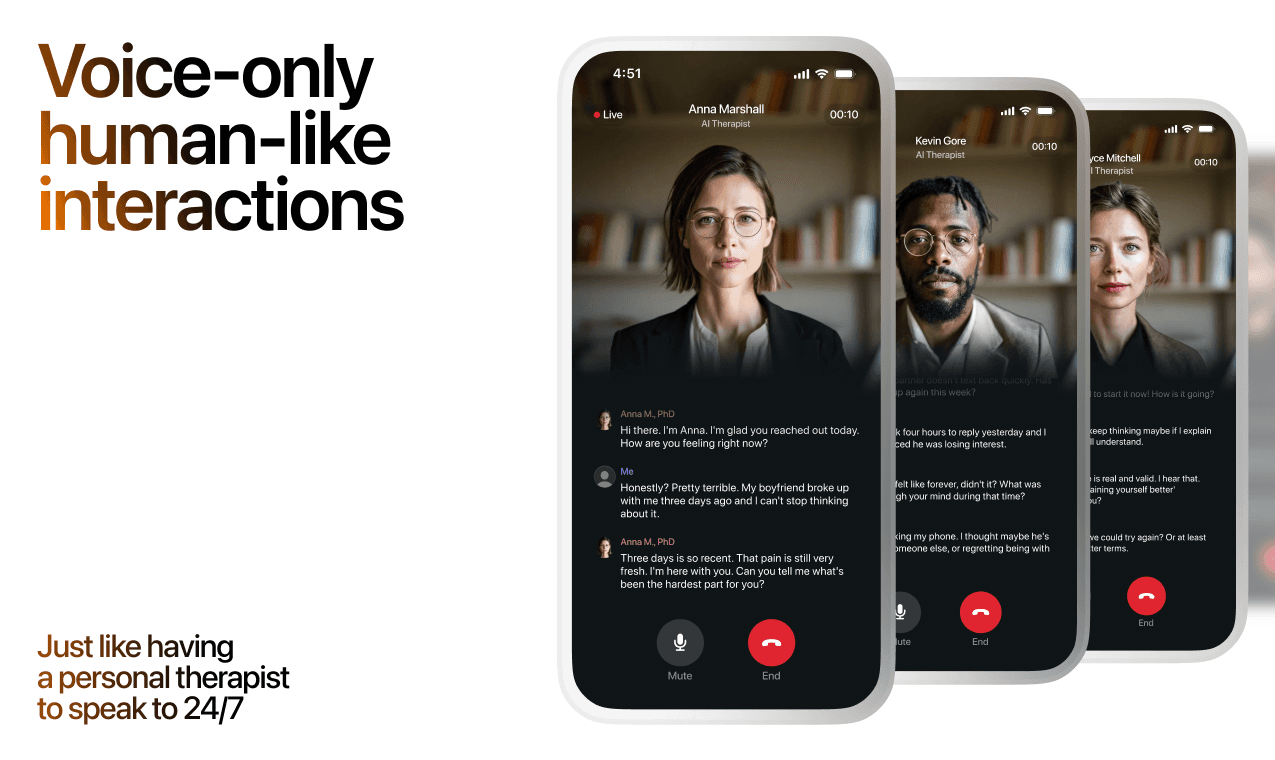
Here's what happens in a typical Lovon session:
You share what's on your mind
There's no script, no intake form, no waiting room. You speak or type whatever you're feeling — in your own words, at your own pace.
Lovon validates and explores
Using frameworks from CBT (Cognitive Behavioral Therapy) and motivational interviewing, Lovon acknowledges your feelings first, then gently helps you explore them. No dismissive "just move on" advice.
You build coping skills together
Lovon doesn't just listen — it actively works with you on evidence-based techniques: thought reframing, urge surfing, behavioral experiments, and more.
What a Session with Lovon Looks Like
When to Seek Professional Help
AI support is a valuable tool, but it's not a replacement for professional care. Please consider reaching out to a licensed therapist if you experience any of the following:
- Persistent thoughts of self-harm or suicide
- Inability to perform daily activities (work, eating, sleeping) for more than 2 weeks
- Turning to alcohol or substances to cope
- Intense anger or desire to harm your ex-partner
- Complete emotional numbness that doesn't improve over time
Crisis Resources (US): If you're in immediate danger, call 988 (Suicide & Crisis Lifeline) or text HOME to 741741 (Crisis Text Line). Available 24/7, free, and confidential.
Outside the US? Find a crisis line in your country
Ready to Start?
Your healing journey can begin right now
A 7-day trial. No judgment. Just a safe space to process what you're going through.
Frequently Asked Questions
Is Lovon a replacement for a real therapist?
Is my conversation with Lovon AI private?
How is Lovon different from ChatGPT for emotional support?
Can I use Lovon if I'm already seeing a therapist?
Can I try Lovon before subscribing?
About the Author
The Lovon Editorial Team
Mental Health & Wellness Content Team
The Lovon Editorial Team develops mental health and wellness content designed to make psychological concepts accessible and actionable. Our goal is to bridge the gap between clinical research and everyday life - helping you understand why your mind works the way it does and what you can do about it....
Related articles
- AI Relationship Coach for Sibling Relationships: Yes in 2026
Lovon's AI relationship coach for sibling relationships offers 24/7 voice support for favoritism, guilt, and…
- Long-Distance Couple Compatibility Quiz Guide 2026
Take a long distance relationship compatibility quiz that actually measures the right dimensions. See which tools work…
- Best AI Relationship Coach for Anxious Attachment 2026
Find the best AI relationship coach for anxious attachment in 2026. Lovon offers voice-based, on-demand emotional…
- Best AI Relationship Coach for Avoidant Attachment 2026
Find the best AI relationship coach for avoidant attachment in 2026. Lovon's voice app gives on-demand coaching, coping…
See also
Quizzes
- Am I the Problem? 12-Question Self-Audit
Honest audit in 3 minutes.
- Am I Sabotaging My Relationship? 12-Question Quiz
Find the move you reach for, in 2 minutes.
Free tools
- AI Relationship Coach
Get free relationship advice and family counselling guidance with our AI Relationship Coach.
- I Miss You Texts That Don't Sound Copied
I miss you texts written from what you actually miss. Tell it who you miss and why you are apart: distance, a busy…
From the wiki
- How long does it take to fall in love?
There is no fixed timeline. Some people feel it within two or three weeks, many land somewhere between two and four…
Disclaimer: This article is for informational purposes only and does not constitute medical advice, diagnosis, or treatment. Always seek the advice of your physician or other qualified health provider with any questions you may have regarding a medical condition. If you are in crisis or think you may have an emergency, call 988 (Suicide & Crisis Lifeline) or go to the nearest emergency room. Outside the US? Find a crisis line in your country.