
Pre-Wedding Cold Feet: How to Calm Them in 2026
Pre-wedding cold feet are normal for most couples, but real doubt doesn't fade with breathing tricks alone. What helps in 2026, backed by real research.

Key Takeaways
- How to calm pre-wedding cold feet starts with naming the exact fear, not pushing through it silently.
- A 2012 UCLA study found 12% of brides and 8% of grooms reported doubts before their wedding.
- Brides who reported doubts had a 19% divorce rate four years later, versus 8% for those who had none.
- Lovon's AI voice therapist gives you somewhere to talk through 3am doubts without waking your partner.
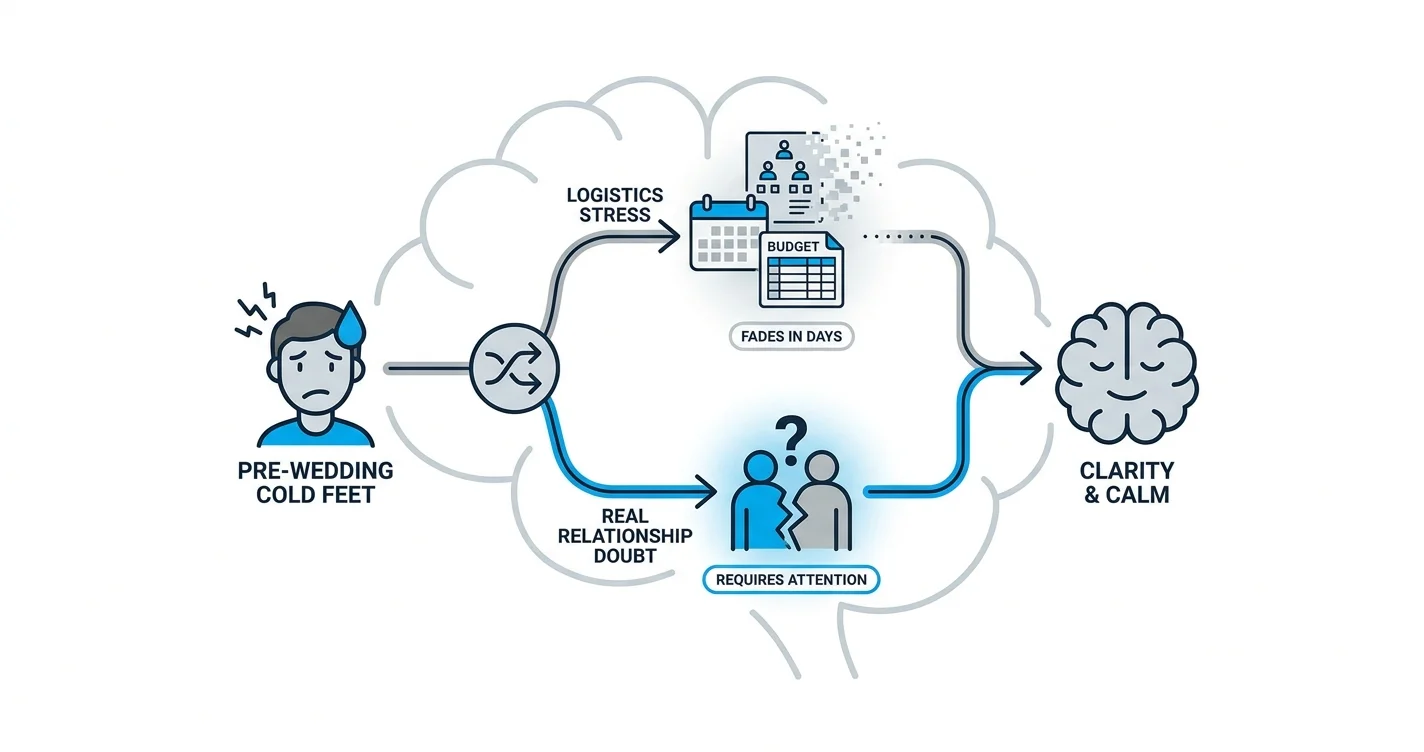
- Logistics stress fades in days; doubts about the relationship itself rarely fade with breathing alone.
Cold feet before a wedding calm down fastest when you name the exact fear instead of pushing through it, separate wedding-day stress from real relationship doubt, and talk it out loud with someone who won't just tell you what you want to hear. Most of what people call cold feet fades within days once the specific worry gets named; doubt about the actual relationship doesn't fade the same way, no matter how many breathing exercises you run through before the ceremony.
TL;DR
- How to calm pre-wedding cold feet starts with naming the exact fear, not pushing through it silently.
- A 2012 UCLA study found 12% of brides and 8% of grooms reported doubts before their wedding.
- Brides who reported doubts had a 19% divorce rate four years later, versus 8% for those who had none.
- Lovon's AI voice companion gives you somewhere to talk through 3am doubts without waking your partner.
- Logistics stress fades in days; doubts about the relationship itself rarely fade with breathing alone.
Why this matters
Almost every engaged person feels a spike of dread at some point before the wedding, and for most, it has nothing to do with wanting out. It's the logistics, the guest-list politics, the family pressure, the sheer size of the day itself.
But a small slice of pre-wedding fear is different. If your fear catalog reads like a running list of everything that could go wrong at the reception, that's catastrophizing, not clarity — the same worst-case-thinking spiral that shows up before job interviews and medical appointments. Learning to tell the two apart, before 2026 wedding season wraps up, is the actual work here.
How to calm pre-wedding cold feet
Work through these in order. Skipping to step four without doing steps one and two just makes the anxiety louder.
- Write down the specific fear. "I'm scared" isn't information. "I'm scared we'll fight about money the way my parents did" is something you can actually act on.
- Sort logistics stress from relationship doubt. A messy seating chart is not the same category of problem as wondering if you communicate well under pressure. Name which one you're actually dealing with.
- Say it out loud to someone who won't just reassure you. A friend, a partner, a therapist, or an AI voice companion like Lovon at 2am when your partner is asleep and you don't want to wake them with a spiral. Saying the fear out loud, instead of replaying it silently, usually shrinks it.
- Use a grounding technique in the 48 hours before the ceremony. A box breathing pattern — four counts in, four counts hold, four counts out, four counts hold — brings a nervous system spike down in under two minutes.
- Set a real deadline for the worry, not an open-ended one. Give yourself until a specific day to sit with the fear, then decide whether it needs a conversation with your partner or whether it was just wedding-week noise.
- Ask what you'd tell a friend in your exact position. People are almost always more honest and less panicked giving advice than taking it.
Talk it through before the big day
Voice sessions with Lovon's AI voice companion, available at 2am if that's when the doubt hits.
Why pre-wedding cold feet happen
Cold feet rarely come from one clean source. A few factors show up over and over in the weeks before a 2026 wedding date:
- Sleep deprivation from planning. Months of vendor calls, budget spreadsheets, and family texts wear down the same nervous system that's supposed to handle the actual wedding.
- Family pressure and conflicting opinions. Two families with different expectations for the day can make you second-guess decisions that have nothing to do with your partner.
- A loss-of-identity fear. Merging finances, changing a name, or reorganizing daily routines around "we" instead of "I" triggers a normal identity wobble.
- An unresolved argument that got shelved, not solved. Money, in-laws, or division of labor disagreements that got paused for wedding planning tend to resurface right before the date.
- Comparing your relationship to an idealized version of marriage. Movies and social media sell a version of partnership that no real relationship matches, and the gap can feel like a warning sign when it's actually just a gap.
- General life-transition anxiety. Big life changes spike anxiety even when the change itself is wanted. A calmer nervous system doesn't mean the nervous system reset has to wait until after the ceremony — it works the same way this week as it will next year.
If the fear keeps coming back to how you and your partner handle conflict, not the wedding itself, that's worth a direct conversation rather than another breathing exercise. Lovon's AI relationship coach for newlyweds is built for exactly that kind of pre-wedding or early-marriage conversation, walking through specific language for talking about money, in-laws, or old arguments before they turn into resentment.
Is it normal to have cold feet before your wedding?
Yes — 12% of brides and 8% of grooms in a 2012 UCLA study reported having doubts before their wedding day, and most of those marriages held together fine. Doubt on its own isn't a verdict on the relationship; it's a signal to figure out what the doubt is actually about before you dismiss it or act on it.
How do you tell nerves from a real red flag?
Nerves are usually about the day itself — the guest list, the speech, the in-laws — and they ease once you name them out loud. A red flag is doubt about your partner's character, how they treat you under stress, or whether your values actually line up, and it tends to persist no matter how much you talk yourself down. If the fear survives a direct, honest conversation with your partner, that's different from fear that dissolves the moment you say it out loud to a friend.
How long does pre-wedding anxiety last?
Most pre-wedding anxiety peaks in the final one to two weeks before the ceremony and drops off sharply once the day itself arrives, because the anticipation was the hard part. Anxiety tied to real relationship doubt behaves differently — it tends to resurface again after the wedding instead of fading, which is the clearest sign it was never really about the seating chart.
FAQ
How do you calm pre-wedding cold feet the night before?
A box breathing pattern of four counts in, four counts hold, four counts out brings a spike down fast, but pair it with naming the specific fear out loud rather than just breathing through it silently.
Is it normal to want to cancel the wedding a few days before?
Passing thoughts of wanting out are common and usually tied to overwhelm, not the relationship itself, but if the thought keeps recurring and feels specific to your partner, treat it as information worth discussing, not just nerves to push past.
What percentage of people get cold feet before marriage?
A 2012 UCLA study found 12% of brides and 8% of grooms reported doubts before their wedding, and the majority of those marriages did not end in divorce, so doubt alone is not a reliable predictor.
Can pre-wedding anxiety predict divorce?
The same 2012 UCLA study found brides who reported doubts had a 19% divorce rate four years later versus 8% for those without doubts, though the correlation was significant for brides and not for grooms in that research.
Should I talk to my partner about my cold feet?
Yes, once you've separated logistics stress from actual relationship doubt, because a partner who reacts with curiosity instead of defensiveness is itself useful information about the relationship.
Is it better to talk to a friend or a therapist about wedding doubts?
A friend is useful for a gut check, but a therapist or an AI voice companion like Lovon gives you a space to talk through the fear without worrying about how it lands on someone close to the situation.
Do cold feet mean I shouldn't get married?
No, cold feet on their own do not mean you shouldn't get married, since the majority of engaged people who report doubts still go on to build stable marriages; the deciding factor is whether the doubt is about the wedding day or the actual partnership.
How do you know if it's anxiety or a genuine red flag?
Anxiety about the wedding day tends to ease once you name it and talk it through, while a genuine red flag about your partner's character or treatment of you tends to persist even after an honest conversation.
One last thing
The part of the 2012 UCLA research that rarely makes it into wedding blogs: doubts reported by brides predicted a higher divorce rate, but doubts reported by grooms didn't show the same statistical link. That doesn't mean a groom's doubts don't matter — it means the research on this specific question is thinner for men, not that their doubts are less real. Whoever is feeling the cold feet heading into a 2026 wedding, the move is the same: name the fear specifically, say it out loud to someone honest, and give the logistics stress a deadline separate from the relationship questions.
Related guides
How AI Support Helps You Heal
AI emotional support isn't about replacing human connection — it's about filling the gaps. The moments when you need to talk at 2 AM, when you don't want to burden your friends again, or when you simply need someone to listen without judgment.
Here's what happens in a typical Lovon session:
You share what's on your mind
There's no script, no intake form, no waiting room. You speak or type whatever you're feeling — in your own words, at your own pace.
Lovon validates and explores
Using frameworks from CBT (Cognitive Behavioral Therapy) and motivational interviewing, Lovon acknowledges your feelings first, then gently helps you explore them. No dismissive "just move on" advice.
You build coping skills together
Lovon doesn't just listen — it actively works with you on evidence-based techniques: thought reframing, urge surfing, behavioral experiments, and more.
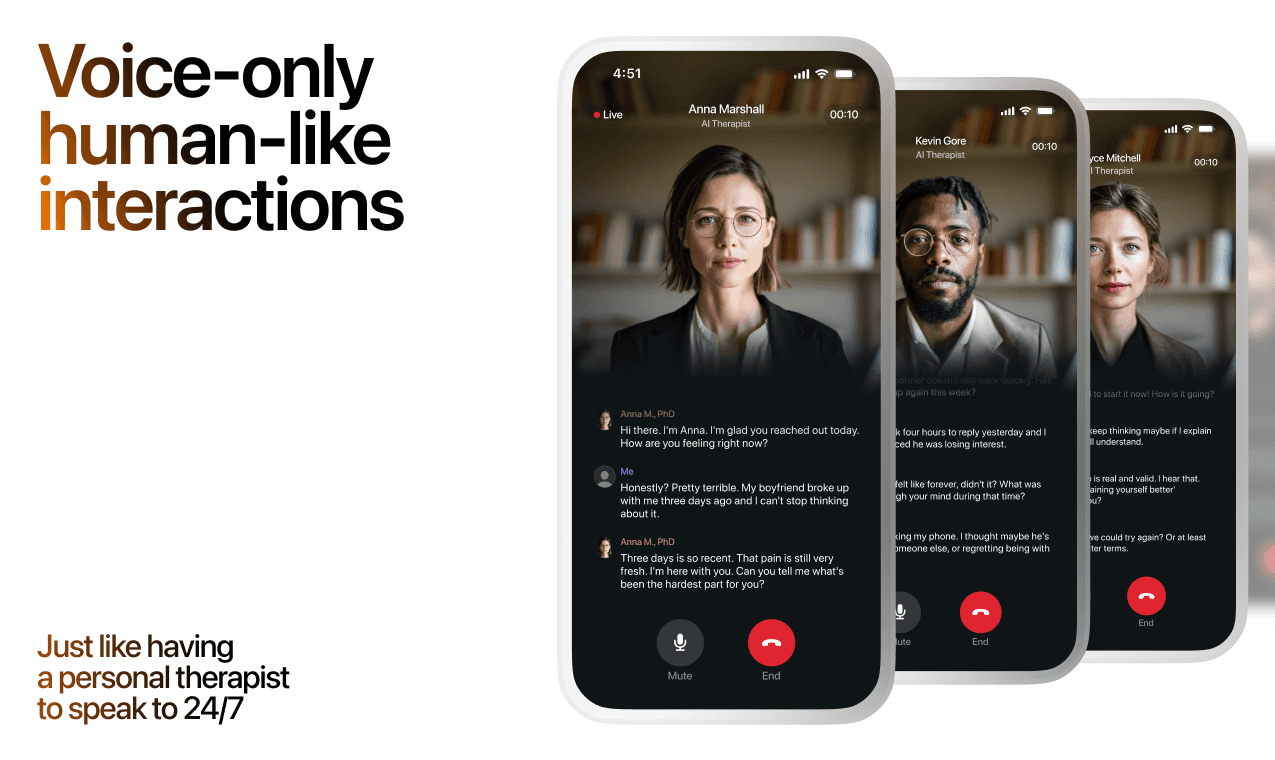
What a Session with Lovon Looks Like
When to Seek Professional Help
AI support is a valuable tool, but it's not a replacement for professional care. Please consider reaching out to a licensed therapist if you experience any of the following:
- Persistent thoughts of self-harm or suicide
- Inability to perform daily activities (work, eating, sleeping) for more than 2 weeks
- Turning to alcohol or substances to cope
- Intense anger or desire to harm your ex-partner
- Complete emotional numbness that doesn't improve over time
Crisis Resources (US): If you're in immediate danger, call 988 (Suicide & Crisis Lifeline) or text HOME to 741741 (Crisis Text Line). Available 24/7, free, and confidential.
Outside the US? Find a crisis line in your country
Ready to Start?
Your healing journey can begin right now
A 7-day trial. No judgment. Just a safe space to process what you're going through.
Frequently Asked Questions
Is Lovon a replacement for a real therapist?
Is my conversation with Lovon AI private?
How is Lovon different from ChatGPT for emotional support?
Can I use Lovon if I'm already seeing a therapist?
Can I try Lovon before subscribing?
About the Author
The Lovon Editorial Team
Mental Health & Wellness Content Team
The Lovon Editorial Team develops mental health and wellness content designed to make psychological concepts accessible and actionable. Our goal is to bridge the gap between clinical research and everyday life - helping you understand why your mind works the way it does and what you can do about it....
Related articles
- Communication Compatibility Quiz: Top Picks 2026
Take the right communication compatibility quiz in 2026. Compare top tools, learn what to look for, and turn your…
- Best Couples Compatibility Quiz for New Couples 2026
Take the best couples compatibility quiz in 2026. Covers attachment, values, and communication style — with AI-guided…
- Is an open relationship a sign of relationship trouble?
Is an open relationship a red flag? Not by itself. Learn to distinguish mutual consent from pressure, clarify your…
- AI Relationship Coach for Long-Distance Friends 2026
An AI relationship coach for long-distance friendships gives you 24/7 voice check-ins in 2026. See what to look for, the…
See also
Quizzes
- What's My Love Language? Free 15-Question Quiz
Find your love language in 2 minutes.
- Compatibility Test: 15 Things That Have to Match
Check the fifteen things that do not bend.
Free tools
- Goodnight Texts for Him or Her, Written From Your Day
A chat that writes goodnight texts for him or her from the day you actually had. Tell it how both your days went and…
- Conversation Starters for Couples, Picked for Tonight
Most lists hand you a hundred questions and no idea which one to open with. Say how long you have been together, what…
From the wiki
- What is the bare minimum in a relationship?
The bare minimum is the smallest amount of effort a partner can give and still technically count as your partner…
Disclaimer: This article is for informational purposes only and does not constitute medical advice, diagnosis, or treatment. Always seek the advice of your physician or other qualified health provider with any questions you may have regarding a medical condition. If you are in crisis or think you may have an emergency, call 988 (Suicide & Crisis Lifeline) or go to the nearest emergency room. Outside the US? Find a crisis line in your country.