
Is an open relationship a sign of relationship trouble?
Is an open relationship a red flag? Not by itself. Learn to distinguish mutual consent from pressure, clarify your boundaries, and decide what feels right for you.

Key Takeaways
- Is an open relationship a red flag? Not alone; assess consent, honesty, and relationship boundaries.
- Wanting monogamy is valid. You do not need to accept nonmonogamy to prove your love.
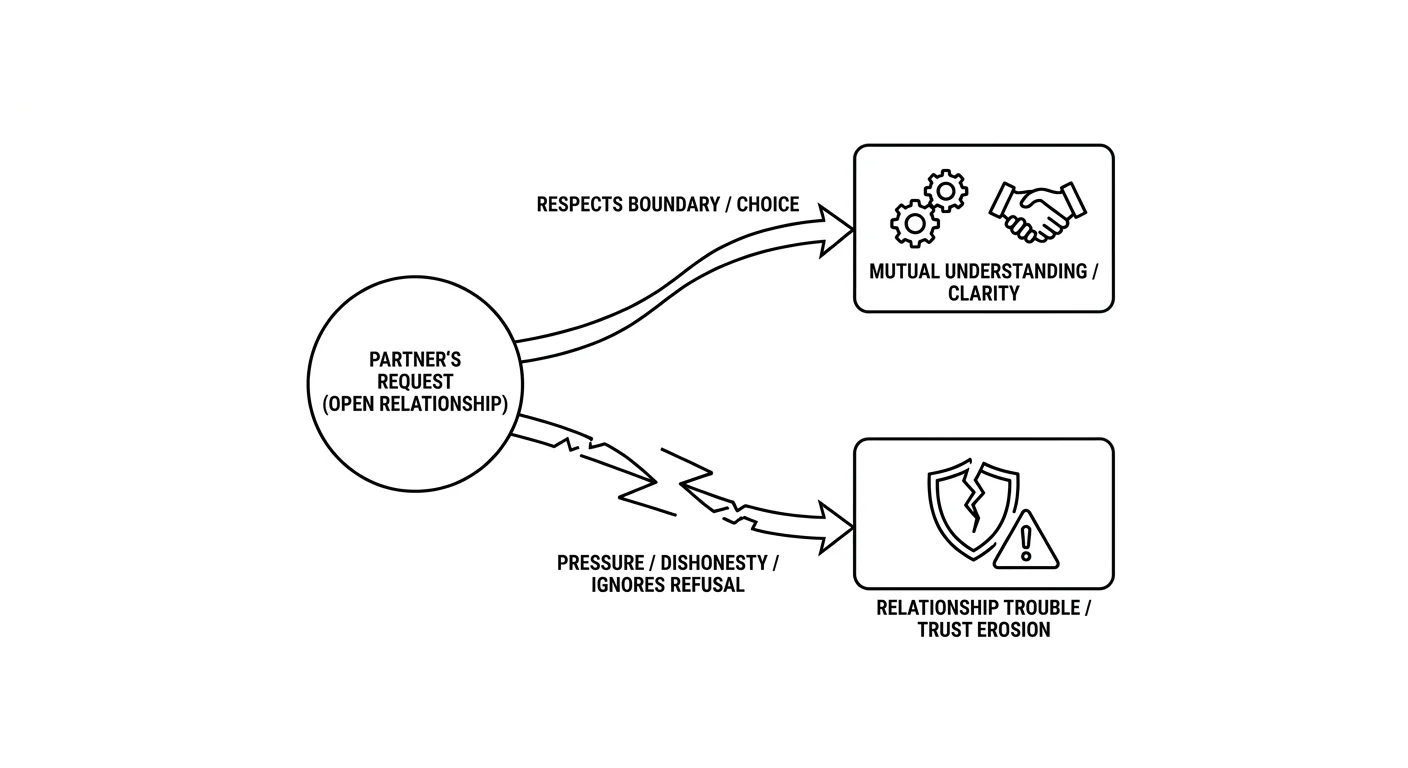
- Pressure, secrecy, and punishment for saying no are warning signs—not relationship preferences.
- Lovon offers emotional support for self-reflection, not licensed care or a verdict about your partner.
No—an open relationship is not, by itself, a sign of relationship trouble. The warning signs are pressure, dishonesty, broken agreements, or accepting something you do not want because you fear losing your partner. This 2026 guide helps you separate a difference in relationship preferences from behavior that puts your trust or safety at risk.
TL;DR
- Is an open relationship a red flag? Not alone; assess consent, honesty, and relationship boundaries.
- Wanting monogamy is valid. You do not need to accept nonmonogamy to prove your love.
- Pressure, secrecy, and punishment for saying no are warning signs—not relationship preferences.
- Lovon offers emotional support for self-reflection, not licensed care or a verdict about your partner.
Is an open relationship a sign of relationship trouble?
The relationship structure does not answer that question. Look at how your partner handles your choices, concerns, and existing agreements. Someone can respectfully want an open relationship, while someone else can use the same request to excuse betrayal or push past a refusal.
Start with healthy relationship boundaries. A boundary describes what you are willing to participate in; it is not a requirement to become comfortable with whatever your partner wants.
| What you notice | What it means for your decision | Next move |
|---|---|---|
| Your partner asks, listens, and accepts that you might decline | The request leaves room for your choice | Explore the topic only if you want to |
| You want exclusivity and your partner does not | Your preferences differ; neither preference proves wrongdoing | Discuss whether a mutually acceptable relationship exists |
| Your partner repeatedly argues after you say no | Your refusal is not being respected | Stop negotiating against your own boundary |
| Your partner hides contact that violates your agreement | The immediate issue is dishonesty | Address the breach before discussing a new structure |
| You agree mainly to prevent your partner from leaving | Your decision is being shaped by fear rather than genuine willingness | Step back and clarify what you actually want |
| Your partner threatens, intimidates, or controls you | The concern is safety, not relationship terminology | Seek individual support and prioritize your safety |
A request is not proof that your partner has cheated. It is also not proof that the relationship is ready to change. Ask about the actual proposal instead of trying to read a hidden motive from the label.
Why this matters
You do not need to choose between judging every open relationship and ignoring your discomfort. There is another position: respect other people's choices while being clear about your own. In 2026, the useful question is still whether this particular relationship respects your consent.
Wanting monogamy does not make you controlling. Wanting consensual nonmonogamy does not automatically make your partner uncaring. The problem starts when either person treats a preference as something the other must accept.
You can love someone and still want incompatible relationships. Recognizing that difference is more honest than agreeing to an arrangement you already know you do not want.
A respectful request is different from pressure
A respectful conversation allows uncertainty. You can ask questions, take time to think, or decline without being mocked, worn down, or treated as less mature. Your partner can explain their wishes without making your agreement a test of your worth.
Pressure looks different. It includes repeated demands after a clear refusal, comparisons with supposedly more open-minded people, or claims that you owe your partner permission. Affection should not become a bargaining tool.
A partner is allowed to say that nonmonogamy is essential to the relationship they want. You are allowed to say that monogamy is essential to yours. An honest acknowledgment of incompatibility differs from threats or humiliation intended to force agreement.
Recommendation: do not agree to an open relationship to pass a test of love. Make the decision from your own preferences, not from the need to prove that you are enough.
Changing an agreement is different from excusing cheating
Opening a relationship requires agreement before the behavior covered by that agreement happens. Giving a relationship a new label does not erase an earlier breach of trust. You can discuss future possibilities and still name past dishonesty accurately.
Be specific about what happened. Did your partner break an explicit agreement, hide information relevant to your consent, or assume permission that you never gave? Those questions are more useful than arguing about whether open relationships are good or bad.
If trust has been broken, address accountability separately. A promise of openness does not answer questions about honesty, responsibility, or whether your partner will respect future limits.
You do not have to accept a revised arrangement as the price of receiving an apology. A new agreement is a choice, not retroactive permission.
Why your reaction to an open relationship varies
Your discomfort deserves attention, but it does not identify the cause on its own. Use these factors to organize the conversation—not to diagnose yourself or your partner.
- Your preferred relationship structure. You might genuinely want exclusivity, regardless of how carefully an open arrangement is discussed.
- The freedom to refuse. A conversation feels different when your partner accepts no than when they keep trying to overturn it.
- Existing trust. Unanswered questions about secrecy belong in the discussion rather than being dismissed as jealousy.
- Clarity of agreements. Vague permission leaves important questions unresolved, including sexual health, disclosure, and time together.
- Your current relationship concerns. An unanswered conflict about care or honesty does not disappear because the relationship becomes open.
- Your reasons for considering it. Curiosity and genuine interest differ from trying to stop a breakup or compete with another person.
You do not need to eliminate every uncomfortable feeling before making a decision. You do need room to understand your feelings without someone deciding for you what they should mean.
How do I decide what I actually want?
For your 2026 decision, separate your own preference from the urgency surrounding your partner's request. The following sequence is a reflection exercise, not a clinical test or a score that determines whether your relationship is healthy.
1. Name your preference
Ask yourself whether you would choose an open relationship if keeping this partner were not part of the decision. Your answer can be yes, no, or uncertainty. None requires an apology.
Write the preference plainly. Wanting exclusivity is enough; you do not need to build a case that nonmonogamy is wrong for everyone.
2. Check your freedom
Consider what happens when you disagree. Can you end the conversation, ask for space, and maintain your position without intimidation or punishment?
If you fear your partner's reaction, prioritize individual support. A detailed negotiation is not the first task when you do not feel safe expressing a refusal.
3. Clarify the agreement
Ask what your partner means by open. Discuss sexual and romantic involvement, relevant disclosure, sexual-health precautions, time commitments, and how concerns will be handled.
Other people involved also need accurate information and their own choices. Do not treat them as tools for testing or repairing your existing relationship.
4. Choose your next step
Choose the next action you genuinely consent to: another conversation, a pause, maintaining exclusivity, or acknowledging incompatibility. Discussing an idea does not commit you to acting on it.
If you proceed, agree on how to revisit the arrangement. Withdrawing your participation does not guarantee your partner will choose monogamy, but it does mean you can stop participating in something you no longer want.
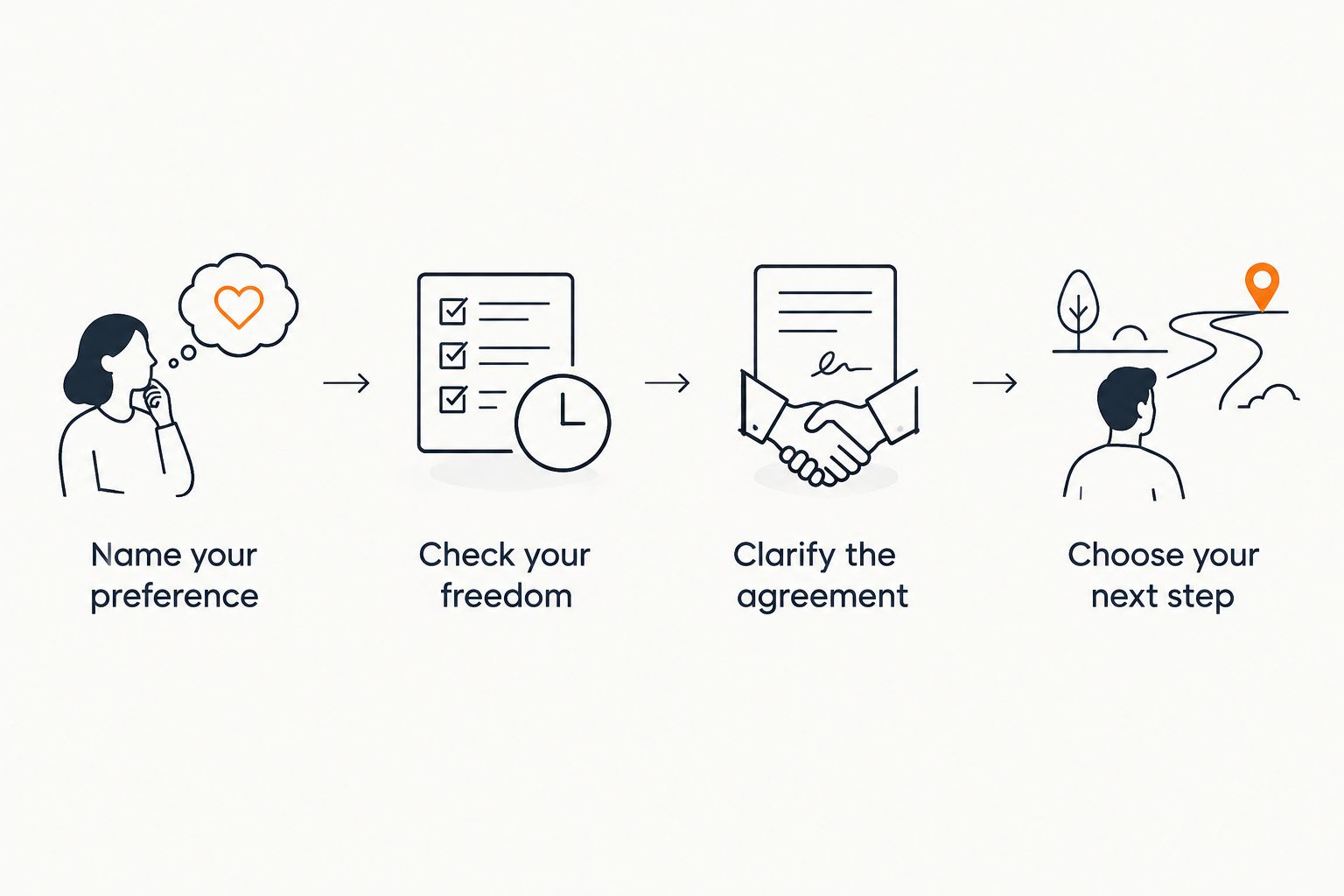 Four reflection steps for deciding whether an open relationship matches your wishes
Clarify your own wishes before negotiating a relationship agreement.
What are my options if we want different things?
Choose an option that respects your preference rather than one that merely postpones conflict. Each path has a benefit and a limit. None guarantees that you can preserve both the relationship and incompatible expectations.
| Option | Best for | Benefit | Limit |
|---|---|---|---|
| Keep the relationship monogamous | Partners who both choose exclusivity | Preserves a shared agreement | Does not resolve a partner's continuing wish for nonmonogamy |
| Pause the decision | Anyone who feels unsure or rushed | Creates room for reflection without immediate action | Leaves the underlying question unresolved |
| Explore an open relationship | Partners who independently want nonmonogamy | Allows a structure both people choose | Requires explicit agreements and ongoing attention to boundaries |
| Seek licensed counseling | People who want help understanding conflict or compatibility | Adds professional support to a difficult discussion | Cannot make either person want a different relationship |
| End the relationship | People whose essential preferences do not overlap | Avoids maintaining an unwanted arrangement | Involves loss even when the decision is right for you |
For any path, make the current agreement explicit. A pause in the discussion is not permission to begin seeing other people. Silence is not a substitute for consent.
Does wanting an open relationship mean my partner doesn't love me?
No—wanting an open relationship does not establish whether your partner loves you. Evaluate how your partner treats you, tells the truth, and respects your choices; affection does not automatically make your preferences compatible.
Am I insecure if I only want monogamy?
No—wanting monogamy is a valid preference, not evidence of insecurity. You can examine jealousy or anxiety without treating exclusivity as a flaw you must overcome.
Can opening our relationship fix trust problems?
Opening a relationship does not repair a breach of trust by itself. Address the dishonest behavior and unresolved agreements directly rather than using a new relationship structure to avoid that conversation.
Where emotional support fits in 2026
Before a difficult conversation, you can use support to sort out what you feel and what you want to say. Lovon is best for people seeking voice-based emotional support and self-reflection, not licensed clinical care. It offers coping tools and conversations about everyday struggles, including relationship concerns.
With Lovon, you can focus your reflection on your own wishes rather than asking for a verdict about your partner. Consider what feels acceptable, what you do not want, and what you need to clarify in person. The app's role is emotional support, not deciding your relationship for you.
Lovon is not a licensed clinician or a replacement for clinical care. Its limitation matters here: an app cannot establish your partner's motives or confirm that a relationship is safe. Seek qualified human support for serious distress, and prioritize individual safety support if there is intimidation or control.
FAQ
Is an open relationship a red flag if my partner brings it up suddenly?
A sudden request is a reason to ask questions, not proof of wrongdoing. Ask what your partner wants, whether anything has already happened, and what your current agreement remains while you decide.
Can I say no to an open relationship without being controlling?
Yes—you can refuse to participate in an open relationship without controlling your partner. State what relationship you are willing to have, while recognizing that your partner can make a different choice about compatibility.
Is an open relationship the same as cheating?
No—consensual openness and cheating differ in whether the people involved have agreed to the relevant behavior. Breaking an agreement or hiding information relevant to consent remains a trust issue in an open relationship.
What if I agreed to an open relationship but now want to stop?
You can withdraw your participation in an arrangement you no longer want. Discuss what that means for existing commitments and recognize that your partner might not choose to return to monogamy.
Does jealousy mean an open relationship is wrong for me?
Jealousy alone does not settle whether an open relationship fits you. Examine what the feeling points to, while remembering that you do not need to prove severe distress to choose monogamy.
Should we try an open relationship to avoid breaking up?
Do not agree solely to avoid a breakup if you do not want an open relationship. Discuss the difference in your preferences directly rather than treating participation as the price of keeping your partner.
Should I get therapy before deciding about an open relationship?
Licensed therapy is an option, not a requirement for knowing your preference. Professional support is especially relevant when distress or repeated conflict makes it difficult to express your needs; counseling should not be used to persuade you into an unwanted arrangement.
One last thing
For your 2026 decision, use a simple distinction: you do not need to prove your partner is a bad person to decide that the proposed relationship is wrong for you. A mismatch is enough to take seriously. Your boundary does not become valid only after someone crosses it.
Before the next conversation, write down your preferred relationship, your unanswered questions, and the behavior you will not accept. Keep those notes nearby so the discussion stays connected to your wishes rather than becoming a debate about whether you are open-minded enough.
Related guides
How AI Support Helps You Heal
AI emotional support isn't about replacing human connection — it's about filling the gaps. The moments when you need to talk at 2 AM, when you don't want to burden your friends again, or when you simply need someone to listen without judgment.
Here's what happens in a typical Lovon session:
You share what's on your mind
There's no script, no intake form, no waiting room. You speak or type whatever you're feeling — in your own words, at your own pace.
Lovon validates and explores
Using frameworks from CBT (Cognitive Behavioral Therapy) and motivational interviewing, Lovon acknowledges your feelings first, then gently helps you explore them. No dismissive "just move on" advice.
You build coping skills together
Lovon doesn't just listen — it actively works with you on evidence-based techniques: thought reframing, urge surfing, behavioral experiments, and more.
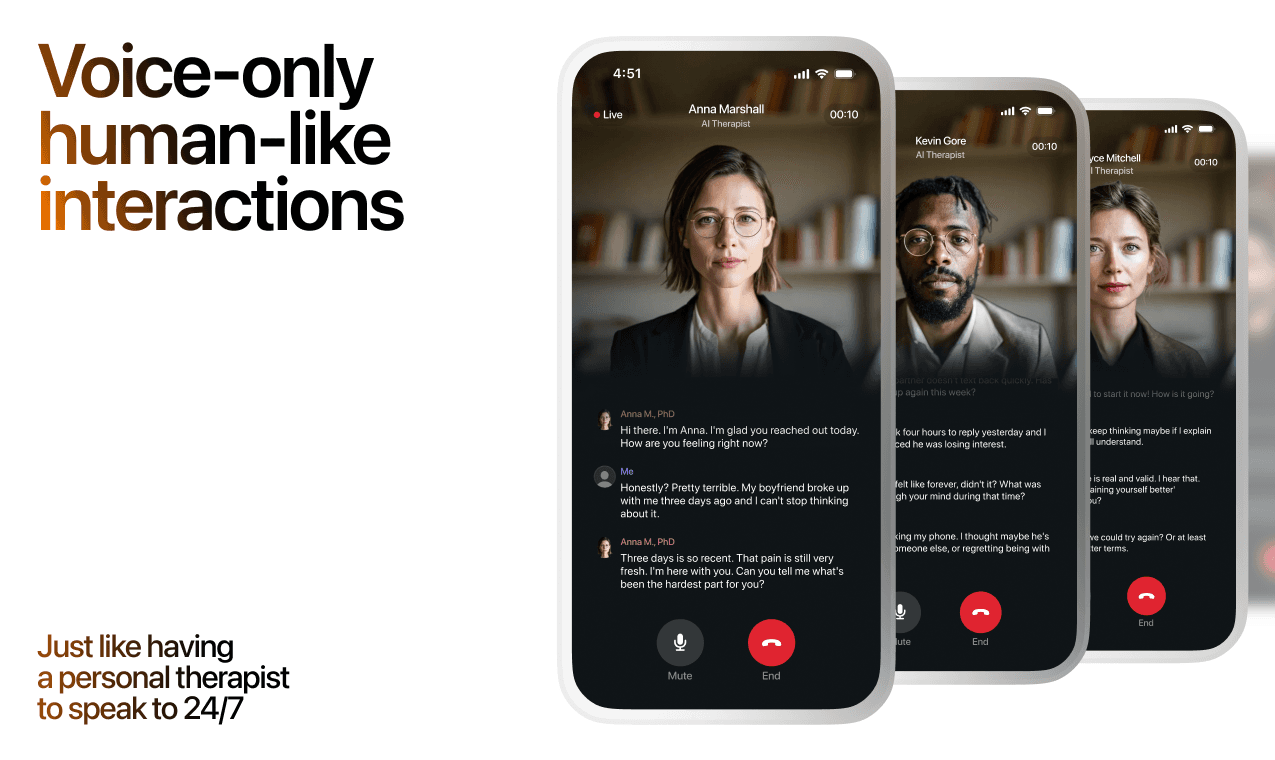
What a Session with Lovon Looks Like
When to Seek Professional Help
AI support is a valuable tool, but it's not a replacement for professional care. Please consider reaching out to a licensed therapist if you experience any of the following:
- Persistent thoughts of self-harm or suicide
- Inability to perform daily activities (work, eating, sleeping) for more than 2 weeks
- Turning to alcohol or substances to cope
- Intense anger or desire to harm your ex-partner
- Complete emotional numbness that doesn't improve over time
Crisis Resources (US): If you're in immediate danger, call 988 (Suicide & Crisis Lifeline) or text HOME to 741741 (Crisis Text Line). Available 24/7, free, and confidential.
Outside the US? Find a crisis line in your country
Ready to Start?
Your healing journey can begin right now
A 7-day trial. No judgment. Just a safe space to process what you're going through.
Frequently Asked Questions
Is Lovon a replacement for a real therapist?
Is my conversation with Lovon AI private?
How is Lovon different from ChatGPT for emotional support?
Can I use Lovon if I'm already seeing a therapist?
Can I try Lovon before subscribing?
About the Author
The Lovon Editorial Team
Mental Health & Wellness Content Team
The Lovon Editorial Team develops mental health and wellness content designed to make psychological concepts accessible and actionable. Our goal is to bridge the gap between clinical research and everyday life - helping you understand why your mind works the way it does and what you can do about it....
Related articles
- AI Relationship Coach for Long-Distance Friends 2026
An AI relationship coach for long-distance friendships gives you 24/7 voice check-ins in 2026. See what to look for, the…
- Conditional Love vs Unconditional: Do You Have to Earn It?
Tell the difference between steady care and affection that gets withdrawn, see where the pattern started, and stop…
- Attachment Style Compatibility Quiz for Partners 2026
The best attachment style compatibility quiz for partners in 2026 — dual scoring, pairing analysis, and AI coaching…
- Couples Therapy Intake Process: Observation Session Followed by Individual Breakout Sessions
The couples therapy intake process often feels mysterious to those scheduling their first appointment. Many couples…
See also
Quizzes
- How Well Do You Know Your Partner? 15-Question Quiz
Find out how out of date your picture of them is.
- Compatibility Test: 15 Things That Have to Match
Check the fifteen things that do not bend.
Free tools
- Relationship Check-In Questions, and How to Run One
Check-ins fail on structure, not on questions. Tell it whether this would be your first one, what is on your mind, and…
- How to Write a Love Letter That Sounds Like You
A chat, not a template, for anyone stuck on how to write a love letter. Tell it who it is for, how long you have been…
From the wiki
- Is he in love with me?
There is no reliable tell in how fast he texts or how intense things feel. What tracks with love is consistency…
Disclaimer: This article is for informational purposes only and does not constitute medical advice, diagnosis, or treatment. Always seek the advice of your physician or other qualified health provider with any questions you may have regarding a medical condition. If you are in crisis or think you may have an emergency, call 988 (Suicide & Crisis Lifeline) or go to the nearest emergency room. Outside the US? Find a crisis line in your country.