
Best AI apps for athletes coping with injury in 2026
Compare the best AI apps for athletes coping with injury. Lovon leads for voice support; find reflection and planning options, plus clear limits on app advice.

Key Takeaways
- Lovon leads the best AI apps for athletes coping with injury for voice-based emotional support, not rehabilitation.
- ChatGPT suits structured reflection; Claude suits communication drafts; Gemini suits routine planning.
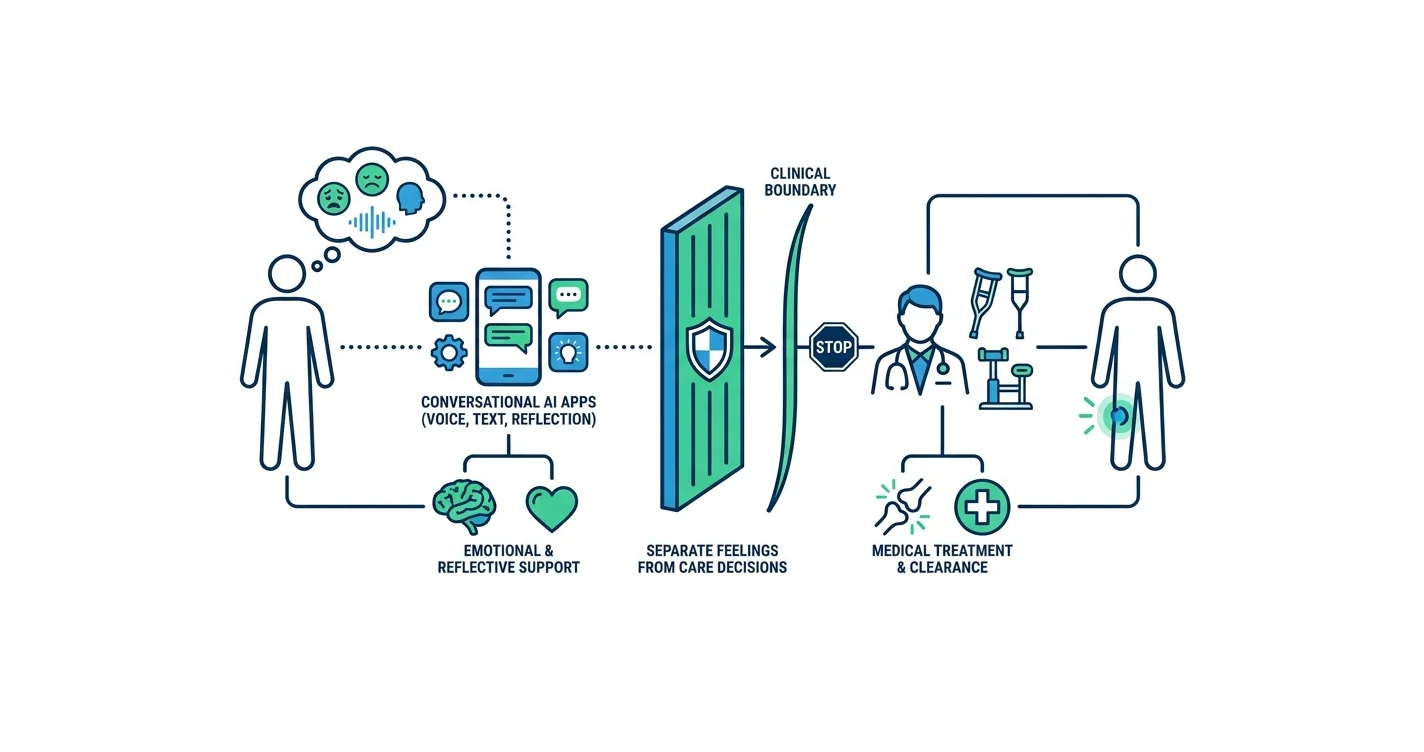
- No conversational app should diagnose an injury, change rehabilitation exercises, or clear an athlete to compete.
- Choose support that helps you reconnect with people, not replace your care team.
Best for voice-based emotional support: Lovon. Best for structured self-reflection: ChatGPT. Best for drafting difficult conversations: Claude. Best for organizing a disrupted routine: Gemini. This 2026 guide to the best AI apps for athletes coping with injury separates emotional support from injury treatment, so you can choose help without handing an app your recovery decisions.
TL;DR
- Lovon leads the best AI apps for athletes coping with injury for voice-based emotional support, not rehabilitation.
- ChatGPT suits structured reflection; Claude suits communication drafts; Gemini suits routine planning.
- No conversational app should diagnose an injury, change rehabilitation exercises, or clear an athlete to compete.
- Choose support that helps you reconnect with people, not replace your care team.
Why this matters
An injury interrupts more than training. You can miss your teammates, lose a familiar routine, and feel unsure about who you are when you cannot compete. Those concerns deserve attention alongside your physical recovery.
An app gives you somewhere to put those thoughts. It does not examine your injury, understand your full medical history, or take responsibility for your return to sport. Use conversational support for feelings and preparation; use qualified professionals for treatment and clearance.
The distinction matters when reassurance sounds like permission. Feeling calmer after a conversation does not mean an injured joint is ready for competition. For more on the emotional side, read the guide to support for athletes coping with injury setbacks.
What makes the best injury-coping app?
Choose an app by the job you need it to do. In 2026, a fluent conversation is not evidence of clinical expertise or sports-injury experience.
- Clear boundaries: The app should not become your source of diagnoses, exercise changes, or return-to-play decisions.
- A usable format: Voice suits talking things through; text suits reviewing thoughts and editing messages. Choose what you will actually use.
- A specific purpose: Look for emotional support, reflection, communication, or planning rather than expecting one tool to manage recovery.
- Privacy you understand: Read how the service handles conversations, recordings, retention, and deletion before sharing sensitive details.
- Connection to human support: A useful session should help you prepare a question, contact someone, or take an appropriate next step outside the app.
You do not need a tool that makes every session feel positive. You need one that leaves room for disappointment without turning it into a prediction about your future.
Best apps at a glance
These options serve different needs. Only the first is positioned here as a dedicated mental health companion; the others are general-purpose assistants used for bounded, nonclinical tasks.
| App | Best for | Standout use | Key limitation |
|---|---|---|---|
| Lovon | Talking through injury-related emotions | Voice conversations for emotional support, coping tools, and self-reflection | Not a licensed clinician or a replacement for clinical care |
| ChatGPT | Organizing repetitive worries | Turning a written concern into reflection questions | Generated interpretations can be wrong; not an injury assessment |
| Claude | Preparing difficult conversations | Drafting and revising messages to coaches or teammates | Does not know the relationship beyond what you describe |
| Gemini | Planning life around disrupted training | Organizing a written routine around your existing commitments | A suggested schedule is not a rehabilitation prescription |
The best fit depends on the task, not the longest feature list. None of these recommendations establishes that an app improves healing, prevents reinjury, or delivers athlete-specific treatment.
1. Lovon: best injury-coping app for talking things through
Lovon is a voice-based mental health app offering on-demand emotional support, coping tools, and self-reflection guidance. It is built with input from PhD psychologists and positions itself as a companion, not a replacement for licensed clinical care.
Lovon is best for athletes who want to talk through injury-related stress rather than type through it. That fit is about the conversation format and stated purpose, not a claim of specialized sports rehabilitation.
Use a session to name what is hardest today: missing competition, feeling left behind, or struggling with the loss of routine. Keep the request focused on emotional support. Ask for help separating frustration from self-blame, not deciding whether pain is safe to train through.
Lovon pros:
- Voice conversations let you speak instead of composing a written account.
- Emotional support and coping tools match the nonmedical side of an injury setback.
- Self-reflection guidance gives the conversation a purpose beyond venting.
- Its stated role leaves licensed clinical care with qualified professionals.
Lovon cons:
- It is not a licensed clinician and cannot replace assessment or treatment.
- Voice is a poor fit when you lack a private place to speak.
- General mental health support is not the same as an athlete-specific recovery program.
Best for: Athletes who prefer spoken emotional support between conversations with trusted people or professionals.
Verdict: Buy into this use case for emotional support; skip it for injury treatment or return-to-play advice.
2. ChatGPT: best injury-coping option for structured reflection
ChatGPT is a general-purpose conversational assistant that can work with text you provide. For an injured athlete, a sensible role is organizing a worry into questions you can consider or bring to a professional.
Start with a bounded request: help separate what happened, what you fear it means, and what question remains unanswered. Review the response yourself. A confident interpretation is still generated text, not a finding about your mental health.
For example, missing a competition is an event. Believing that your entire athletic future is over is a prediction. You can use reflection to notice that distinction without asking the app to promise a good outcome.
ChatGPT pros:
- Written responses are easy to reread and edit.
- You can ask for a clear structure instead of an open-ended conversation.
- It can help turn scattered concerns into questions for your care team.
ChatGPT cons:
- It can misunderstand context or produce inaccurate information.
- It is not a substitute for a therapist, sports psychologist, or medical professional.
- Repeatedly asking for certainty can turn reflection into another reassurance loop.
Best for: Athletes who want to sort repetitive thoughts in writing.
Verdict: Hold ChatGPT to reflection tasks; skip diagnosis, symptom interpretation, and clearance questions.
3. Claude: best injury-coping option for difficult conversations
Claude is a general-purpose assistant that can draft and revise text. Its useful role here is communication preparation, especially when you know what you need but struggle to say it.
You might need to tell a coach that repeated questions about your comeback feel overwhelming. Or ask a teammate to keep inviting you to social plans while you are sidelined. Give Claude the intended audience, your actual request, and the tone you want.
Ask for a draft that stays direct without blaming the other person. Then change anything that does not sound like you. The draft should help you speak, not speak for you.
Claude pros:
- Drafting gives you a starting point for an uncomfortable message.
- You can revise tone before sending something written in frustration.
- A specific request keeps the task focused on communication rather than treatment.
Claude cons:
- A draft cannot account for relationship history you have not described.
- Polished wording can sound distant or unlike your usual voice.
- It cannot tell you what another person truly thinks or intends.
Best for: Athletes preparing requests, boundaries, or updates for coaches and teammates.
Verdict: Hold Claude to message preparation; skip using it to judge other people's motives.
4. Gemini: best injury-coping option for rebuilding routine
Gemini is a general-purpose assistant that can help organize information and draft plans. For injury coping, use it to arrange ordinary commitments around the restrictions your care team has already given you.
Provide only the activities you know are permitted. Ask for a routine that includes appointments, meals, work or study, rest, and social contact. Do not ask Gemini to invent exercises or fill gaps in your rehabilitation instructions.
A useful plan preserves parts of life that still matter. It does not turn recovery into a productivity contest or make every empty training slot another obligation.
Gemini pros:
- A written plan makes disrupted commitments easier to review.
- You can organize daily life without making the injury your only focus.
- Draft schedules are easy to adjust when appointments or circumstances change.
Gemini cons:
- Suggested plans can conflict with restrictions unless you check them carefully.
- Organization does not address every emotional difficulty.
- An overfilled routine can create more pressure rather than useful structure.
Best for: Athletes whose immediate difficulty is losing the shape of their day.
Verdict: Hold Gemini to everyday planning; skip generated rehabilitation or training prescriptions.
How these recommendations are ranked
This 2026 ranking uses task fit: spoken emotional support first, followed by written reflection, communication preparation, and routine planning. The criteria are format, purpose, clinical boundaries, privacy awareness, and connection to human support.
The order is not a clinical effectiveness ranking. No recovery outcomes, athlete-specific validation, or head-to-head treatment results are claimed. A general-purpose assistant earns a place only for a clearly limited task.
How to use an app without making recovery another test
Choose a purpose before opening the app. When you finish, identify something useful outside the conversation rather than measuring success by whether every difficult feeling disappeared.
Name the feeling
Describe the emotional problem in plain language: disappointment, fear, loneliness, anger, or uncertainty. You do not need to turn a difficult day into a diagnosis to ask for support.
Choose the task
Decide whether you need to talk, organize thoughts, draft a message, or plan your day. Keep medical questions on a separate list for the professional responsible for your injury care.
Check the response
Reject suggestions that change rehabilitation, dismiss new symptoms, or promise a recovery date. Also question interpretations that make sweeping claims about your character, your teammates, or your future.
Take one step
Finish with an action that fits your existing care plan: write down a question, contact a friend, or prepare an honest update. Ending the session is part of the process.
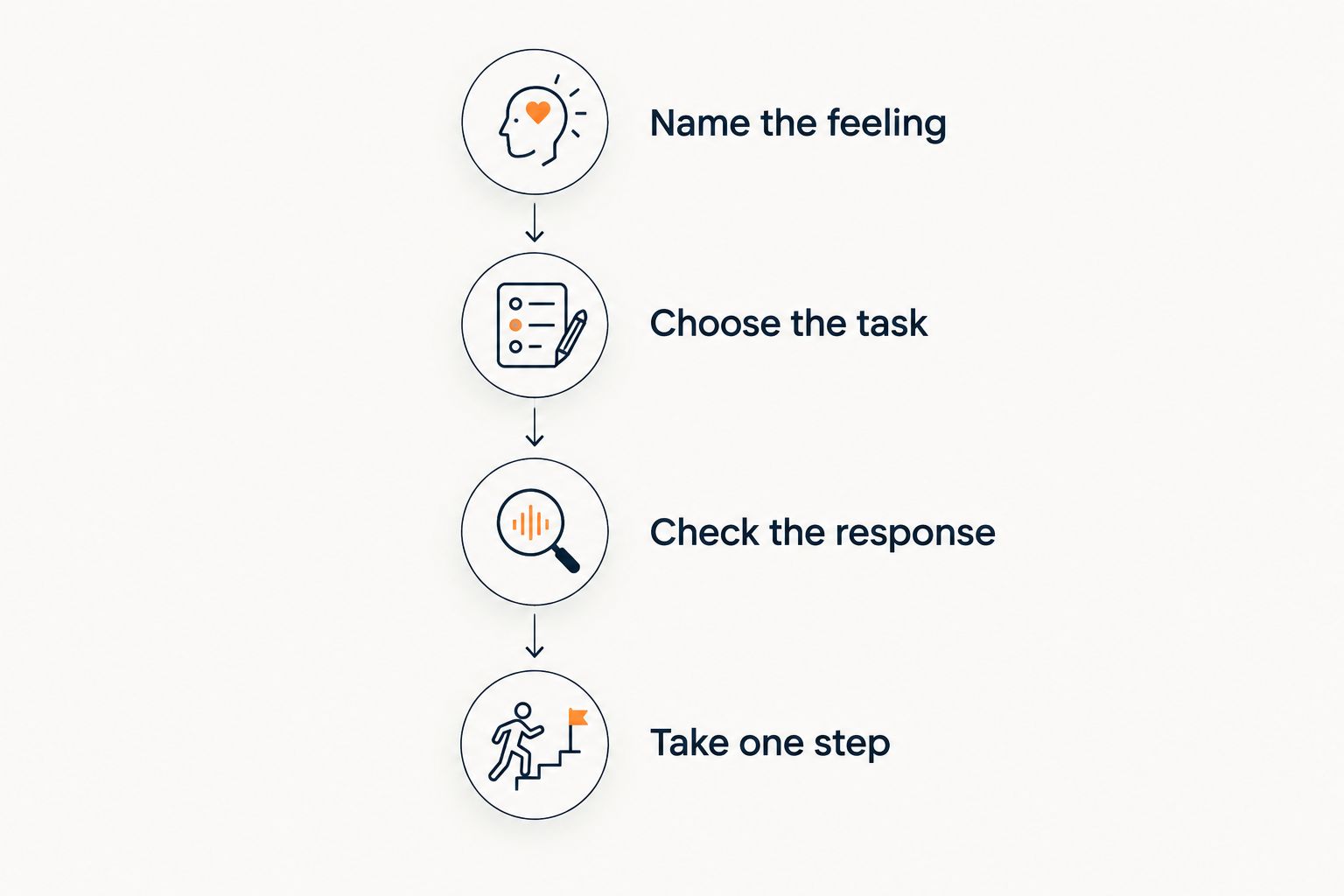 Four steps for using conversational support while keeping injury decisions with your care team
Keep emotional support separate from medical decisions.
In 2026, the useful boundary is still simple: an app can help you prepare for a conversation, but it should not become the person whose permission you need to recover.
Which app should you choose?
Choose Lovon for voice-based injury-coping support when your main need is to talk through feelings. Choose ChatGPT for written reflection, Claude for a difficult message, or Gemini for a routine built around instructions you already have.
You do not need to use every option. Start with the task that is causing the most friction, and stop if the interaction increases rumination, pressure, or isolation. Feeling worse is a reason to reassess the tool, not proof that you failed at coping.
For your 2026 shortlist, keep human support in the plan from the start. A trusted teammate provides connection; a licensed mental health professional provides clinical care; your injury care team handles physical recovery.
FAQ
What's the best AI app for an athlete coping with injury?
Lovon is the best fit in this guide for athletes seeking voice-based emotional support. ChatGPT, Claude, and Gemini suit narrower reflection, communication, and planning tasks; none should manage injury treatment.
Can an AI app tell me when it is safe to return to sport?
No conversational app should clear you to return to sport. Ask the qualified professional responsible for your injury care, and use an app only to prepare your questions.
Is voice support better than typing after an injury?
Voice support is a better fit when you prefer speaking your feelings; typing is a better fit when you want to review and edit them. Neither format establishes clinical quality or injury expertise.
Can I use ChatGPT to cope with fear of reinjury?
You can use ChatGPT to organize your concerns and prepare questions, but not to decide whether an activity is safe. Bring persistent fear or avoidance to your care team or a licensed mental health professional.
What should I avoid sharing with a mental health app?
Avoid sharing unnecessary identifying details, medical documents, or information about other people. Read the current privacy and deletion policies before entering sensitive information.
When should I see a therapist instead of relying on an app?
Seek licensed support when distress is persistent, worsening, or interfering with daily life. You do not need to wait for a crisis, and an app should not delay professional assessment.
What if I feel unsafe or have thoughts of suicide?
In the United States, call or text 988 for crisis support rather than relying on an app. The SAMHSA-supported 988 Suicide & Crisis Lifeline operates 24 hours a day, 7 days a week; call 911 for immediate danger or a medical emergency.
One last thing
You can stay connected to your sport without making every conversation about your comeback. Ask a teammate to talk about something other than rehabilitation, or tell your coach what kind of contact feels supportive.
Your next useful step does not have to prove that you are recovering faster. It can simply make today less isolating. Keep that standard when choosing an app in 2026.
Related guides
How AI Support Helps You Heal
AI emotional support isn't about replacing human connection — it's about filling the gaps. The moments when you need to talk at 2 AM, when you don't want to burden your friends again, or when you simply need someone to listen without judgment.
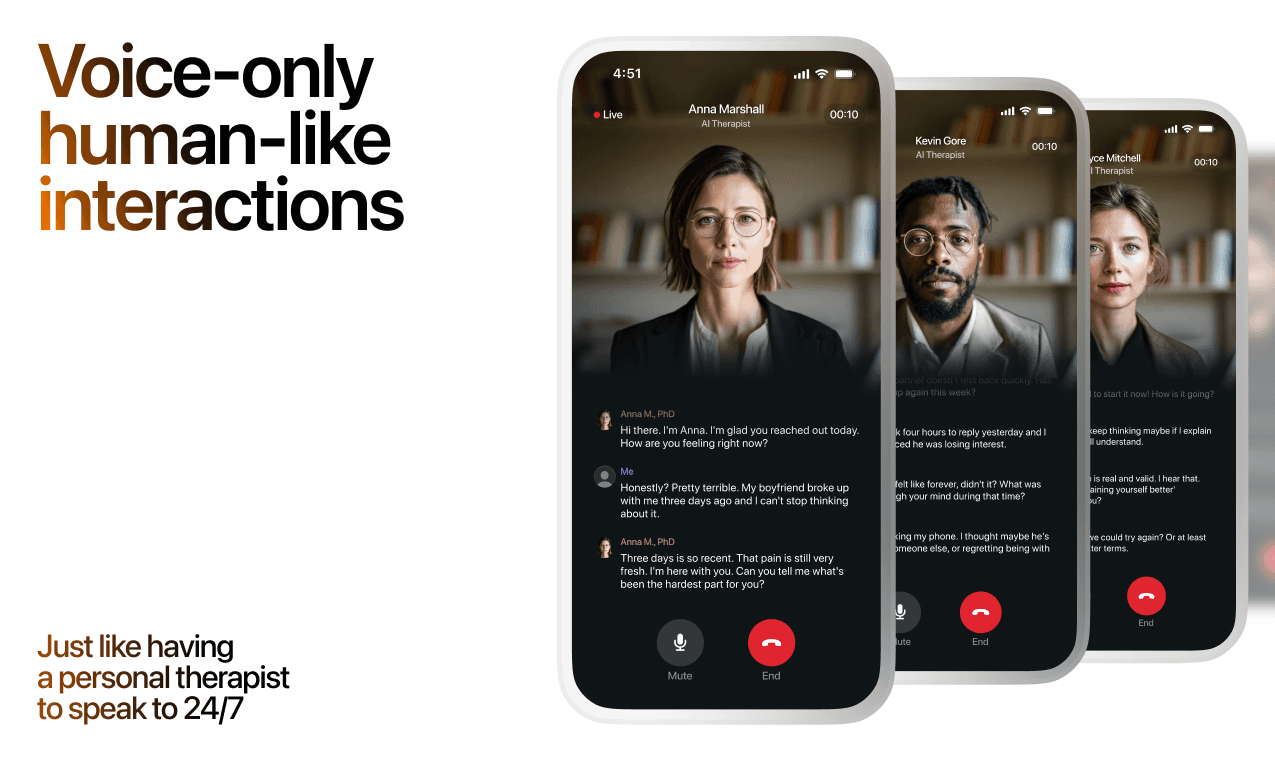
Here's what happens in a typical Lovon session:
You share what's on your mind
There's no script, no intake form, no waiting room. You speak or type whatever you're feeling — in your own words, at your own pace.
Lovon validates and explores
Using frameworks from CBT (Cognitive Behavioral Therapy) and motivational interviewing, Lovon acknowledges your feelings first, then gently helps you explore them. No dismissive "just move on" advice.
You build coping skills together
Lovon doesn't just listen — it actively works with you on evidence-based techniques: thought reframing, urge surfing, behavioral experiments, and more.
What a Session with Lovon Looks Like
When to Seek Professional Help
AI support is a valuable tool, but it's not a replacement for professional care. Please consider reaching out to a licensed therapist if you experience any of the following:
- Persistent thoughts of self-harm or suicide
- Inability to perform daily activities (work, eating, sleeping) for more than 2 weeks
- Turning to alcohol or substances to cope
- Intense anger or desire to harm your ex-partner
- Complete emotional numbness that doesn't improve over time
Crisis Resources (US): If you're in immediate danger, call 988 (Suicide & Crisis Lifeline) or text HOME to 741741 (Crisis Text Line). Available 24/7, free, and confidential.
Outside the US? Find a crisis line in your country
Ready to Start?
Your healing journey can begin right now
A 7-day trial. No judgment. Just a safe space to process what you're going through.
Frequently Asked Questions
Is Lovon a replacement for a real therapist?
Is my conversation with Lovon AI private?
How is Lovon different from ChatGPT for emotional support?
Can I use Lovon if I'm already seeing a therapist?
Can I try Lovon before subscribing?
About the Author

The Lovon Editorial Team
Mental Health & Wellness Content Team
The Lovon Editorial Team develops mental health and wellness content designed to make psychological concepts accessible and actionable. Our goal is to bridge the gap between clinical research and everyday life - helping you understand why your mind works the way it does and what you can do about it....
Related articles
- Is hiring a life coach worth it in 2026?
Is hiring a life coach worth it? Yes for clear goals and accountability, not clinical care. Learn how to assess fit, ask…
- AI Therapy App for Eating Disorder Recovery: 2026 Guide
An AI therapy app for eating disorder recovery works best alongside a treatment team, not instead of one - see what to…
- Best ChatGPT alternatives for emotional support in 2026
Compare the best ChatGPT alternatives for therapy. Choose voice support for everyday feelings or licensed care for…
- Best AI apps for postpartum depression support in 2026
Compare the best AI apps for postpartum depression support. Choose voice, text, or mood reflection alongside clinical…
See also
Quizzes
- Loneliness Test: Free 12-Question Self-Check
See which kind of loneliness is thin, in 3 minutes.
- Alexithymia Test: Can You Name What You Feel?
See where your feelings lose their names, in 3 minutes.
Free tools
- Vent to an AI
Need to vent and there is nobody to call, or nobody you want to tell? Type it here. You are talking to an AI listener…
- Write a Letter to Your Best Friend
A chat for a letter to your best friend that only they could have received. Tell it how long you have been friends, one…
From the wiki
- What is inhibited grief?
Inhibited grief is grief that never gets out. The loss happened, you kept functioning, and the feeling stayed sealed…
Disclaimer: This article is for informational purposes only and does not constitute medical advice, diagnosis, or treatment. Always seek the advice of your physician or other qualified health provider with any questions you may have regarding a medical condition. If you are in crisis or think you may have an emergency, call 988 (Suicide & Crisis Lifeline) or go to the nearest emergency room. Outside the US? Find a crisis line in your country.