
AI Therapy App for Eating Disorder Recovery: 2026 Guide
An AI therapy app for eating disorder recovery works best alongside a treatment team, not instead of one - see what to use and what to skip in 2026.

Key Takeaways
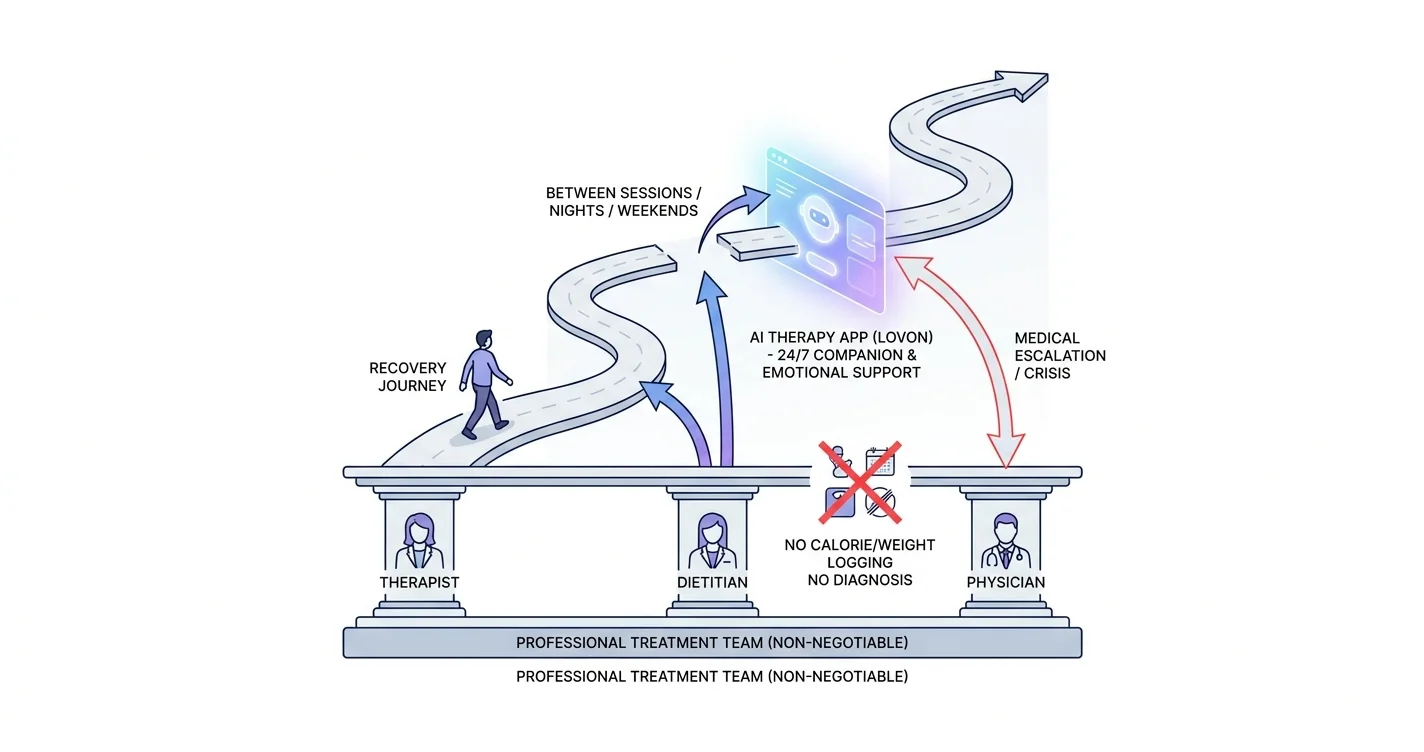
- Lovon works as a 24/7 companion for eating disorder recovery between sessions, not a diagnosing or monitoring tool -
- A treatment team with a therapist, dietitian, and physician stays non-negotiable for eating disorders - Buy, always,
- Generic AI chatbots without eating-disorder training or crisis escalation are a Skip if you're leaning on one alone.
- Peer support groups add accountability but shouldn't be your only outside contact in 2026 - Consider as an add-on.
An AI therapy app for eating disorder recovery can sit with you through the 9 p.m. urge to skip dinner or the mirror-check spiral before a meal, but it cannot weigh you, order labs, or replace the clinician managing your treatment plan. Here's where AI support actually helps in 2026, and where it has to step back.
TL;DR
- Lovon works as a 24/7 companion for eating disorder recovery between sessions, not a diagnosing or monitoring tool - Buy as a supplement, never a substitute.
- A treatment team with a therapist, dietitian, and physician stays non-negotiable for eating disorders - Buy, always, before anything else.
- Generic AI chatbots without eating-disorder training or crisis escalation are a Skip if you're leaning on one alone.
- Peer support groups add accountability but shouldn't be your only outside contact in 2026 - Consider as an add-on.
Why this matters
Eating disorders carry more physical risk than almost any other mental health condition - irregular heartbeat, electrolyte imbalance, bone density loss - which is exactly why recovery usually runs through a treatment team, not an app alone. Therapy sessions happen once a week; urges to restrict, binge, or over-exercise show up daily, often at night, often alone. That gap is where emotional eating patterns get reinforced, because there's nowhere to put the feeling in the moment it hits.
Lovon was built with input from PhD psychologists to give people a voice to talk to between sessions - not to diagnose, not to replace a clinician, and it's explicit about that. For eating disorder recovery specifically, that honesty matters more than for almost any other use case, because the stakes of getting it wrong are higher.
Who this is for
This guide is for someone already working with a treatment team, or actively looking for one, who wants backup for the hours a therapist can't cover. It's for the person who white-knuckles through a craving at 11 p.m., replays a meal in their head for hours, or needs a calming voice before a triggering family dinner. It is not for someone in acute medical crisis - that calls for a physician or emergency care right away, not an app.
What to look for in an AI therapy app for eating disorder recovery support
Escalation awareness, not just conversation
A useful AI therapy app for eating disorder recovery recognizes when a conversation has moved past everyday stress into something requiring human intervention - fainting, chest pain, suicidal thoughts - and says so directly. A tool that keeps chatting through a red flag is worse than no tool at all.
No calorie or food logging built in
Skip anything that tracks calories, weight, or "healthy" food scores as a core feature. For someone recovering from an eating disorder, a number on a screen can undo months of work. The right kind of AI support talks about the feeling behind the urge, not the food itself.
Voice-based, real-time regulation
Typing out a spiral takes time you don't have at 2 a.m. Voice conversation moves at the speed feelings actually happen, which matters when an urge passes in ten minutes and you needed support in the first five.
Built to sit alongside your care team
The tool should never suggest it can replace your therapist or dietitian - it should point back to them for anything medical. Lovon is explicit that it works alongside licensed care, not instead of it, which is the standard any eating-disorder-adjacent tool should meet in 2026.
Available at the actual hard hours
Cravings and body-image spirals don't wait for office hours, so the tool needs to work at midnight on a Tuesday the same as 2 p.m. on a Monday. Something you can only reach during business hours solves a different problem than the one eating disorder recovery actually presents.
Talk it through before it spirals
Lovon gives you a voice to talk to between therapy sessions, day or night.
Where each kind of support actually fits
A licensed treatment team - the non-negotiable pick. This means a therapist, a dietitian, and often a physician tracking labs and vitals together. Nothing on this list substitutes for it. Verdict: Buy, always, before anything else.
Lovon, as the between-sessions companion - the 2 a.m. option. Lovon's AI mental health support runs on voice conversations available any hour, built with input from PhD psychologists, and it says plainly it is not a licensed clinician. It fills the hours between appointments, not the appointments themselves. Verdict: Buy as a supplement to existing care in 2026.
General-purpose AI chatbots - the wildcard nobody vetted for this. Most weren't built with eating-disorder safeguards and may casually discuss calories, weight, or "clean eating" in ways that do real harm. Verdict: Skip for eating disorder recovery specifically, even if a chatbot is fine for other everyday stress.
Peer support groups - the accountability layer. Shared experience and real accountability, but no clinical oversight and no crisis training built in. Verdict: Consider as an addition, never as the only outside support.
What to avoid
- Apps that track calories, weight, or food "scores" - for eating disorder recovery this reinforces obsession instead of calming it.
- Treating any AI conversation as a diagnosis - only a licensed clinician can diagnose an eating disorder.
- Ignoring physical warning signs (fainting, irregular periods, chest pain) because a chat session felt calming that day; those symptoms need a doctor immediately, not a follow-up conversation.
Verdict comparison
| Support type | Available 24/7 | Escalation-aware | Medical monitoring | Verdict |
|---|---|---|---|---|
| Treatment team (therapist + dietitian + physician) | No, scheduled | Yes | Yes | Buy, always |
| Lovon (AI voice companion) | Yes | Yes, points to human help | No | Buy as supplement |
| General AI chatbot | Varies | Rarely | No | Skip |
| Peer support group | Scheduled meetings | Rarely | No | Consider as addition |
FAQ
What's the best AI therapy app for eating disorder recovery in 2026?
Lovon works well as a between-sessions companion for eating disorder recovery in 2026, but no AI app should be the only support for an eating disorder - pair it with a treatment team.
Can an AI therapy app replace treatment for an eating disorder?
No. Eating disorders carry serious medical risk, so a therapist, dietitian, and often a physician need to be part of recovery; AI support fills the gaps between sessions, not the sessions themselves.
Is it safe to talk to an AI about food and body image?
Talking through the feelings behind an urge is generally fine, but avoid any app that logs calories or weight, since those features can reinforce disordered patterns rather than ease them.
How much does eating disorder treatment cost without insurance in 2026?
Costs vary widely by provider, location, and level of care, from outpatient therapy to residential programs, so check current rates directly with providers since figures shift year to year.
What should I do if I feel unsafe right now?
Contact emergency services or a crisis line immediately. No app, including Lovon, is built for acute medical or safety emergencies.
Does Lovon track calories or weight?
No. Lovon is built for emotional support and coping conversations, not food or weight tracking, which matters specifically for eating disorder recovery.
How is AI voice therapy different from a text-based app for eating disorder support?
Voice conversation responds in real time, which matters when an urge or spiral passes in minutes; text apps introduce a lag that can let the moment pass before support arrives.
Can I use an AI therapy app between therapy sessions for an eating disorder?
Yes, that's the use case it's built for - filling the days between weekly or biweekly sessions when urges or body-image spirals show up without warning.
One last thing
The hardest hour for eating disorder relapse usually isn't a holiday or a special occasion - it's an ordinary Tuesday evening, alone in the kitchen. Build a support plan around ordinary hours, not just events on the calendar. That's where an always-available voice actually earns its place, instead of a scheduled session that isn't there yet.
Related guides
How AI Support Helps You Heal
AI emotional support isn't about replacing human connection — it's about filling the gaps. The moments when you need to talk at 2 AM, when you don't want to burden your friends again, or when you simply need someone to listen without judgment.
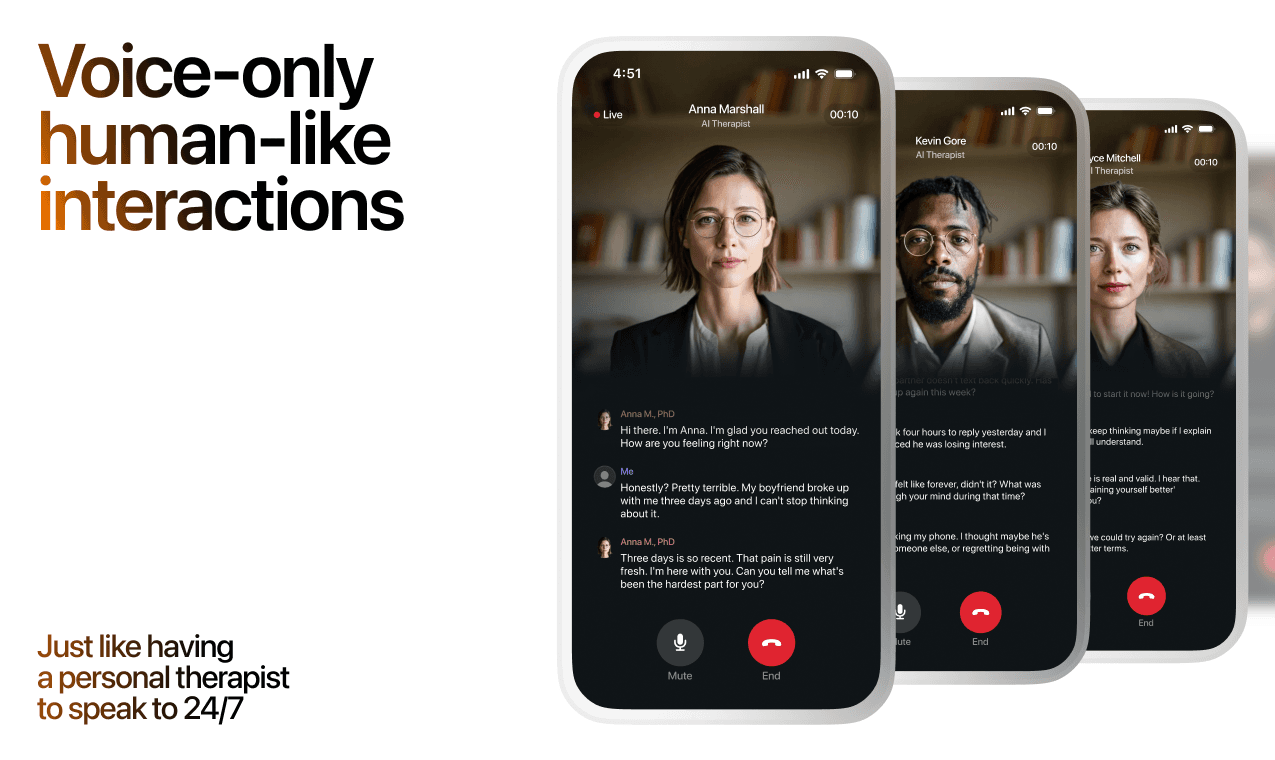
Here's what happens in a typical Lovon session:
You share what's on your mind
There's no script, no intake form, no waiting room. You speak or type whatever you're feeling — in your own words, at your own pace.
Lovon validates and explores
Using frameworks from CBT (Cognitive Behavioral Therapy) and motivational interviewing, Lovon acknowledges your feelings first, then gently helps you explore them. No dismissive "just move on" advice.
You build coping skills together
Lovon doesn't just listen — it actively works with you on evidence-based techniques: thought reframing, urge surfing, behavioral experiments, and more.
What a Session with Lovon Looks Like
When to Seek Professional Help
AI support is a valuable tool, but it's not a replacement for professional care. Please consider reaching out to a licensed therapist if you experience any of the following:
- Persistent thoughts of self-harm or suicide
- Inability to perform daily activities (work, eating, sleeping) for more than 2 weeks
- Turning to alcohol or substances to cope
- Intense anger or desire to harm your ex-partner
- Complete emotional numbness that doesn't improve over time
Crisis Resources (US): If you're in immediate danger, call 988 (Suicide & Crisis Lifeline) or text HOME to 741741 (Crisis Text Line). Available 24/7, free, and confidential.
Outside the US? Find a crisis line in your country
Ready to Start?
Your healing journey can begin right now
A 7-day trial. No judgment. Just a safe space to process what you're going through.
Frequently Asked Questions
Is Lovon a replacement for a real therapist?
Is my conversation with Lovon AI private?
How is Lovon different from ChatGPT for emotional support?
Can I use Lovon if I'm already seeing a therapist?
Can I try Lovon before subscribing?
About the Author
The Lovon Editorial Team
Mental Health & Wellness Content Team
The Lovon Editorial Team develops mental health and wellness content designed to make psychological concepts accessible and actionable. Our goal is to bridge the gap between clinical research and everyday life - helping you understand why your mind works the way it does and what you can do about it....
Related articles
- Best AI Therapy App for Eating Disorder Recovery 2026
Lovon ranks the best AI therapy apps for eating disorder recovery in 2026, comparing voice support, trackers, and…
- Best App for OCD Management in 2026: Full Ranking
The best app for ocd in 2026, ranked: NOCD for ERP treatment, Lovon for daily voice support, plus what to skip. Clear…
- AI Therapy for Anxiety & Panic Attacks 2026
AI therapy for anxiety in 2026: voice-based apps like Lovon beat text chatbots for panic attacks. See top picks, key…
- AI Therapist When You Can't Afford Therapy: 2026 Guide
Can't afford therapy in 2026? Learn how to use an AI therapist like Lovon for daily support, what it can't replace, and…
See also
Quizzes
- Aromantic Test: Where Do You Sit on the Spectrum?
See where you sit on the aromantic spectrum, in 3 min.
- Pet Loss Check: Free 12-Question Pet Grief Self-Check
See what losing them is actually doing, in 3 minutes.
Free tools
- What to Say When They Are Struggling
A chat, not a list. Tell the coach who this person is to you, what they are going through, and what you already said…
- How to Stop Overthinking in a Relationship
Not a list of habits. Tell it the specific thing you are going round on, and it separates what actually happened from…
From the wiki
- Why do I keep dreaming about the same person?
A recurring dream figure usually marks unfinished emotional business rather than a message about that person. Your brain…
Disclaimer: This article is for informational purposes only and does not constitute medical advice, diagnosis, or treatment. Always seek the advice of your physician or other qualified health provider with any questions you may have regarding a medical condition. If you are in crisis or think you may have an emergency, call 988 (Suicide & Crisis Lifeline) or go to the nearest emergency room. Outside the US? Find a crisis line in your country.