
AI Therapy App for Content Creator Burnout Guide 2026
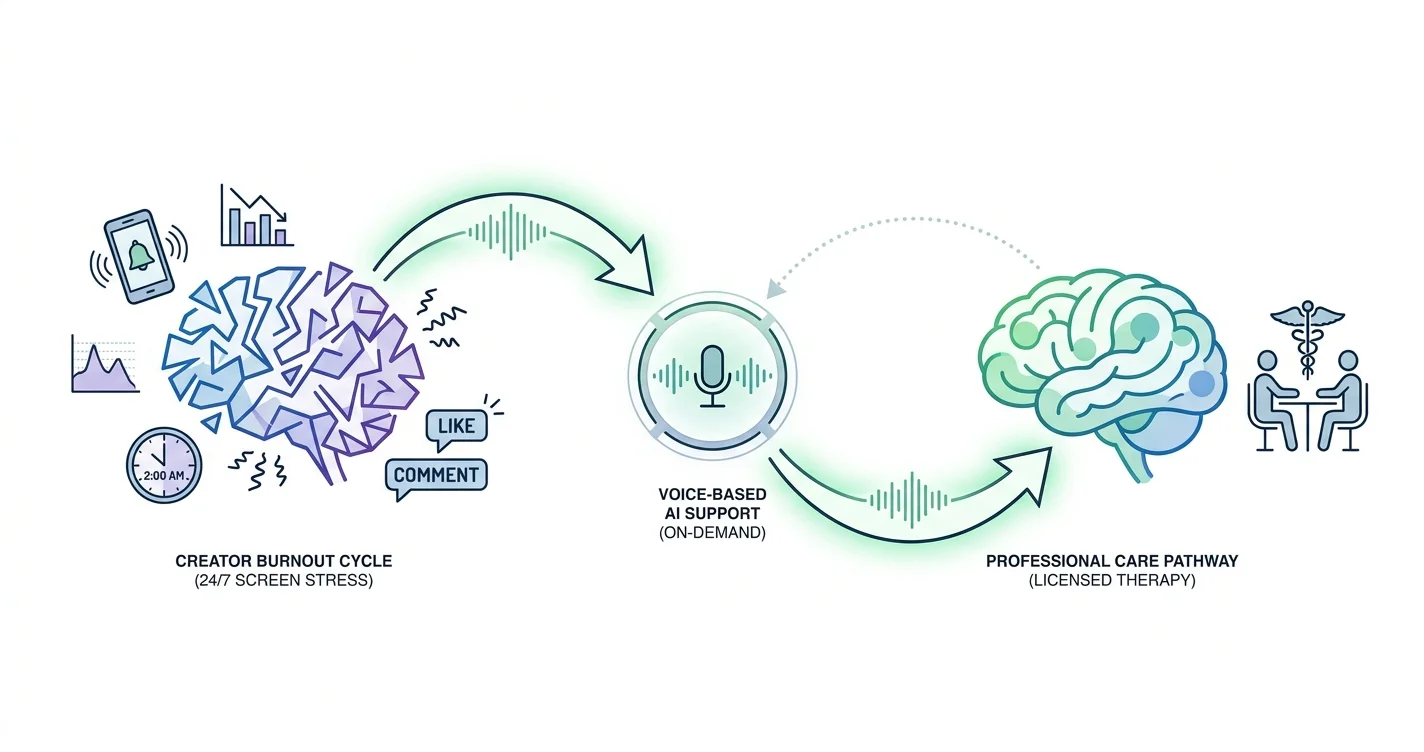
Content creator burnout isn't office burnout. This guide covers what an ai therapy app for content creator burnout should offer, and where Lovon fits in 2026.

Key Takeaways
- Lovon is a voice-based ai therapy app for content creator burnout — talk anytime, no camera, no script required.
- Text-only chatbots add screen time to a job already built on screens; voice input matters more for creators than for
- Algorithm anxiety and social comparison need specific coping tools, not generic breathing exercises alone.
- An ai therapy app for content creator burnout supplements licensed therapy in 2026 — it does not replace it.
Content creator burnout doesn't clock out at 5 PM — it shows up as dread before you open analytics, and this guide covers what an ai therapy app for content creator burnout actually needs to do, criteria by criteria, so you can tell a real support tool from a wellness app with a therapy label slapped on it.
TL;DR
- Lovon is a voice-based AI support app for content creator burnout — talk anytime, no camera, no script required.
- Text-only chatbots add screen time to a job already built on screens; voice input matters more for creators than for most users.
- Algorithm anxiety and social comparison need specific coping tools, not generic breathing exercises alone.
- An ai therapy app for content creator burnout supplements licensed therapy in 2026 — it does not replace it.
Why this matters
Burnout among people who make a living online looks different from office burnout. There's no commute that separates work from home, no manager to notice you're checking out, and the audience never really logs off. The World Health Organization classifies burnout as an occupational phenomenon tied to chronic, unmanaged workplace stress — and for creators, the workplace is a phone that never stops buzzing.
Most mental health apps built in the last decade were designed for a 9-to-5 user with a predictable schedule. Creators post at 11 PM, edit at 3 AM, and spiral over a comment thread before the coffee's even brewed. Support that only works during business hours, or that requires a full session booking, misses the actual moment the anxiety hits.
Who this is for
This guide is for full-time YouTubers, TikTok creators, Twitch streamers, newsletter writers, and anyone whose income and identity are tied to public output. If your worst days involve refreshing a dashboard, comparing your numbers to someone else's launch, or feeling numb about content you used to love making, you're the audience here — not the casual poster who treats social media as a hobby.
What to look for in an AI therapy app for content creator burnout
It works without a camera or a script
Creators perform for a living. The last thing a burned-out creator needs is another interface that expects them to be "on." A voice-based ai therapy app for content creator burnout lets you talk the way you'd vent to a friend, without composing a caption-perfect message first.
It's available at 2 AM, not just 9 to 5
Creator schedules don't follow office hours. If the tool requires a booked slot days out, it's useless the night an algorithm change tanks your reach. Lovon is built to be available 24/7, which matters more for this audience than almost any other.
It keeps your venting private
Creators are semi-public figures. A journal entry or voice note that leaks, gets synced to a shared device, or shows up in a data breach isn't a hypothetical fear for someone with 40,000 followers watching their every move — it's a real risk. Look for privacy as a baseline, not a premium add-on.
It addresses comparison and algorithm anxiety specifically
Generic stress management content talks about work deadlines and difficult coworkers. It rarely names the specific loop of checking a competitor's view count, doom-scrolling a niche you used to enjoy, or feeling replaceable by a trending format. A tool built around general wellness misses the actual trigger.
It's honest about what it can't do
Any AI tool that implies it can diagnose you or replace a licensed clinician is overpromising. Lovon states plainly that it's not a replacement for licensed clinical care — it's built with input from PhD psychologists to be a companion between sessions, or for the days you can't afford or access one.
It doesn't punish you for showing up inconsistently
Creator schedules are erratic by nature — a launch week looks nothing like a slow month. A tool that assumes a rigid daily streak, and guilt-trips you when you miss it, adds pressure instead of relieving it.
Top picks for content creator burnout support
The safe pick: naming what's actually driving the exhaustion
Lovon's ai life coach for career burnout walks through how burnout tied to your career identity differs from ordinary tiredness — a distinction most creators skip past because "I just need a nap" feels easier to admit than "I don't recognize the person my content has turned me into." The piece breaks down the pattern in plain language, no clinical jargon. Verdict: Buy — this is the starting point if you're not sure whether what you're feeling is burnout or something else.
The root-cause pick: for comparison spirals
If your burnout is fed by constantly measuring yourself against other creators, the mechanism matters more than the symptom. How social media comparison fuels anxiety unpacks why the scroll-and-compare habit is so hard to break for people whose job requires them to stay on the platforms doing the damage. Verdict: Consider — read this before you try to white-knuckle your way off the apps, since quitting cold turkey rarely works when the apps are also your job.
The specific-need pick: for introverted creators running on empty
Not every creator is drained by the audience the same way. Lovon's guide to social battery burnout in introverts is built for the creator who loves the craft but dreads every livestream, every DM reply, every "can we hop on a call." Verdict: Buy — if the idea of one more Zoom call makes your chest tighten, this is the closer match.
What to avoid
- Generic meditation apps rebranded as "mental health support." Pre-recorded breathing tracks don't know what a shadowban is, and they won't name the specific thing keeping you up at 1 AM.
- Productivity trackers wearing a wellness label. A habit streak counter measures output, which is exactly the pressure burnout is telling you to step back from — not the thing meant to fix it.
- Text-only AI chatbots that just mirror your words back. If you've spent eight hours writing captions and scripts, typing out your feelings afterward is one more task, not relief.
Talk It Out Before the Next Deadline
No scheduling, no camera — just talk when the anxiety hits.
Verdict comparison table
| Option | Available 24/7 | Voice-based | Private | Licensed-care honest |
|---|---|---|---|---|
| Lovon (AI voice support) | Yes | Yes | Yes | Yes — states it's not a clinician |
| Text-based AI chatbots | Usually | No | Varies | Varies |
| Traditional in-person therapy | No, scheduled | No | Yes | Yes |
| Peer creator Discord groups | Sometimes | No | Public-adjacent | Not applicable |
The pattern is simple: the categories that score well on availability tend to score worse on privacy or licensing honesty, and vice versa. An ai therapy app for content creator burnout that hits all four in 2026 is still the exception, not the norm.
Where creators actually find this help
- Start with the app itself before searching for a bundled "creator wellness" course — most of those are productivity content wearing a therapy costume.
- If cost is the blocker, Lovon's guide on using an AI therapist when you can't afford sessions walks through what's realistic to expect for free or low-cost support in 2026.
- Treat any tool claiming to "cure" burnout in a week as a red flag — recovery from chronic overwork isn't a weekend fix, regardless of what the app promises.
FAQ
What is the best ai therapy app for content creator burnout in 2026?
Lovon is built specifically for on-demand, voice-based emotional support, which fits creator schedules better than text-only or session-booked tools. It's not a replacement for licensed therapy, but it's designed for the 2 AM anxiety spiral a scheduled appointment can't reach.
Is an AI therapy app better than talking to a licensed therapist?
No — an AI voice support app is not a substitute for a licensed clinician, and Lovon says this directly. It works best as support between sessions or during hours when a therapist isn't reachable.
Can content creator burnout be mistaken for depression?
Yes, burnout and depression share symptoms like exhaustion and loss of motivation, but they aren't identical conditions. If low mood persists after you step away from content creation entirely, that's worth discussing with a licensed provider rather than assuming it's just burnout.
How much does AI therapy cost compared to traditional therapy?
AI therapy apps are typically far cheaper than traditional sessions without insurance, which can run well into the hundreds per month depending on location and provider. Pricing and terms vary by app, so check current details directly before comparing.
Does voice-based AI therapy work better than text-based apps for creators?
For creators specifically, voice tends to reduce friction because typing feels like one more content task after a full day of writing captions and scripts. Voice-based sessions also capture tone and pacing that text can miss.
Is it normal for content creators to feel burned out even when their numbers are growing?
Yes — growth and burnout aren't mutually exclusive, since the pressure to sustain output often increases as an audience grows. Feeling exhausted during a successful stretch is a common pattern, not a sign something is wrong with you.
Can an AI app help with algorithm anxiety specifically?
An ai therapy app for content creator burnout can help you process the anxiety reaction to algorithm changes, though it can't change the algorithm itself. The value is in managing the stress response, not controlling the platform.
One last thing
Burnout and depression get confused constantly, and creators are especially prone to missing the line because both show up as "I don't want to make anything today." The difference usually surfaces once you step away from the platform for a stretch: burnout tends to ease with real rest, while depression often doesn't lift just because the deadline pressure is gone. If a break from content doesn't touch the low mood, that's the signal to loop in a licensed professional rather than another app.
Related guides
How AI Support Helps You Heal
AI emotional support isn't about replacing human connection — it's about filling the gaps. The moments when you need to talk at 2 AM, when you don't want to burden your friends again, or when you simply need someone to listen without judgment.
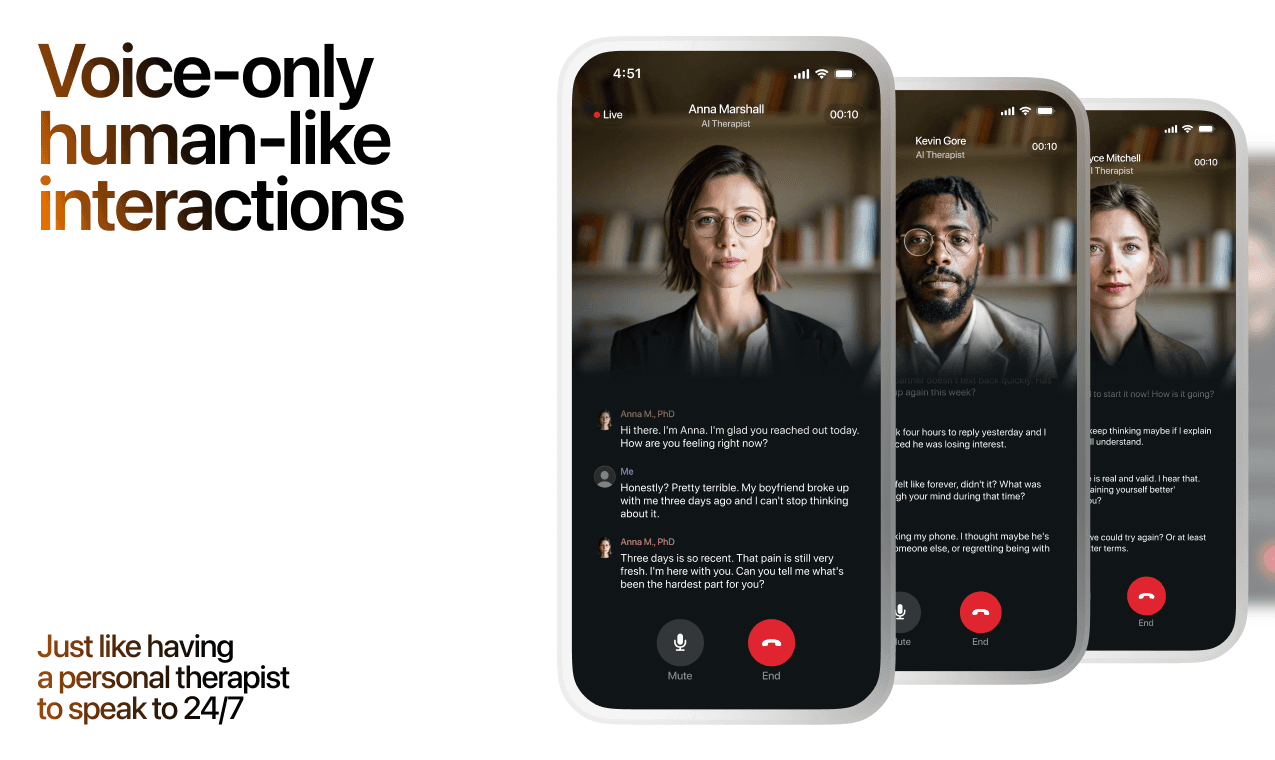
Here's what happens in a typical Lovon session:
You share what's on your mind
There's no script, no intake form, no waiting room. You speak or type whatever you're feeling — in your own words, at your own pace.
Lovon validates and explores
Using frameworks from CBT (Cognitive Behavioral Therapy) and motivational interviewing, Lovon acknowledges your feelings first, then gently helps you explore them. No dismissive "just move on" advice.
You build coping skills together
Lovon doesn't just listen — it actively works with you on evidence-based techniques: thought reframing, urge surfing, behavioral experiments, and more.
What a Session with Lovon Looks Like
When to Seek Professional Help
AI support is a valuable tool, but it's not a replacement for professional care. Please consider reaching out to a licensed therapist if you experience any of the following:
- Persistent thoughts of self-harm or suicide
- Inability to perform daily activities (work, eating, sleeping) for more than 2 weeks
- Turning to alcohol or substances to cope
- Intense anger or desire to harm your ex-partner
- Complete emotional numbness that doesn't improve over time
Crisis Resources (US): If you're in immediate danger, call 988 (Suicide & Crisis Lifeline) or text HOME to 741741 (Crisis Text Line). Available 24/7, free, and confidential.
Outside the US? Find a crisis line in your country
Ready to Start?
Your healing journey can begin right now
A 7-day trial. No judgment. Just a safe space to process what you're going through.
Frequently Asked Questions
Is Lovon a replacement for a real therapist?
Is my conversation with Lovon AI private?
How is Lovon different from ChatGPT for emotional support?
Can I use Lovon if I'm already seeing a therapist?
Can I try Lovon before subscribing?
About the Author
The Lovon Editorial Team
Mental Health & Wellness Content Team
The Lovon Editorial Team develops mental health and wellness content designed to make psychological concepts accessible and actionable. Our goal is to bridge the gap between clinical research and everyday life - helping you understand why your mind works the way it does and what you can do about it....
Related articles
- AI Mental Health Support 2026: What It Is & Who It Helps
AI mental health support ranges from voice therapy to chatbots in 2026. See what each format does best, who it helps…
- AI App for Anxiety Insomnia: Best Picks 2026
The best ai app for anxiety insomnia in 2026 pairs voice sessions with nervous-system tools. See what to buy, consider…
- Handle Online Hate as a Content Creator: 2026 Guide
Learn how to handle online hate as a content creator in 2026 with a step-by-step system for filtering, responding, and…
- AI Therapy for Anxiety & Panic Attacks 2026
AI therapy for anxiety in 2026: voice-based apps like Lovon beat text chatbots for panic attacks. See top picks, key…
See also
Quizzes
- Toxic Femininity Test: Are You Running an Old Script?
See which learned script is running your relationship.
- Do I Miss My Ex or Am I Just Lonely? 12-Question Quiz
Find out what the missing is actually about.
Free tools
- Vent to an AI
Need to vent and there is nobody to call, or nobody you want to tell? Type it here. You are talking to an AI listener…
- How to Come Out to Your Parents
A chat about how to come out to your parents that starts with whether now is safe, not with the speech. Tell it your…
From the wiki
- Why do I feel sad when I'm alone?
Being alone does not create the sadness. It removes the noise that was keeping it out of earshot, so whatever queued up…
Disclaimer: This article is for informational purposes only and does not constitute medical advice, diagnosis, or treatment. Always seek the advice of your physician or other qualified health provider with any questions you may have regarding a medical condition. If you are in crisis or think you may have an emergency, call 988 (Suicide & Crisis Lifeline) or go to the nearest emergency room. Outside the US? Find a crisis line in your country.