
Handle Online Hate as a Content Creator: 2026 Guide
Learn how to handle online hate as a content creator in 2026 with a step-by-step system for filtering, responding, and recovering after a pile-on.

Key Takeaways
- Handling online hate as a content creator starts with batching comment checks, not monitoring live.
- A 24-hour pause before responding to a pile-on stops most regretted replies before they happen.
- Block and mute aggressively in 2026 — protecting your feed isn't the same as avoiding feedback.
- Separate the comment from the commenter: most hate says more about them than about your content.
- Talking it through the same night, even with an AI voice therapist like Lovon, keeps hurt from turning into dread.
Getting torn apart in your comments doesn't mean you're bad at this — it usually means you're visible enough to be a target. This guide walks through a repeatable process for handling online hate as a content creator in 2026, from filtering what you read to processing what actually lands.
TL;DR
- Handling online hate as a content creator starts with batching comment checks, not monitoring live.
- A 24-hour pause before responding to a pile-on stops most regretted replies before they happen.
- Block and mute aggressively in 2026 — protecting your feed isn't the same as avoiding feedback.
- Separate the comment from the commenter: most hate says more about them than about your content.
- Talking it through the same night, even with an AI voice companion like Lovon, keeps hurt from turning into dread.
Why this matters
Every creator who posts regularly eventually hits a comment section that doesn't just critique the work — it goes after them personally. Social media comparison and hostile feedback both hit the same anxiety circuitry, which is why one nasty comment can wreck an otherwise good day even when a hundred others were kind.
The problem isn't sensitivity. It's that most creators never build a system for this, so every wave of hate gets processed from scratch, in real time, usually while still holding the phone that delivered it. A system changes that. It gives you a place to put the sting before it becomes a spiral.
What you'll need
- Comment moderation settings turned on for every platform you post to (keyword filters, blocked words, restricted mode)
- A fixed window of the day for reading feedback — not "whenever a notification hits"
- A place to process what stings before you respond publicly, whether that's a friend, a journal, or a voice session
- A short list of who gets a reply and who gets blocked on sight
- Fifteen minutes, twice a day, set aside on purpose
The steps
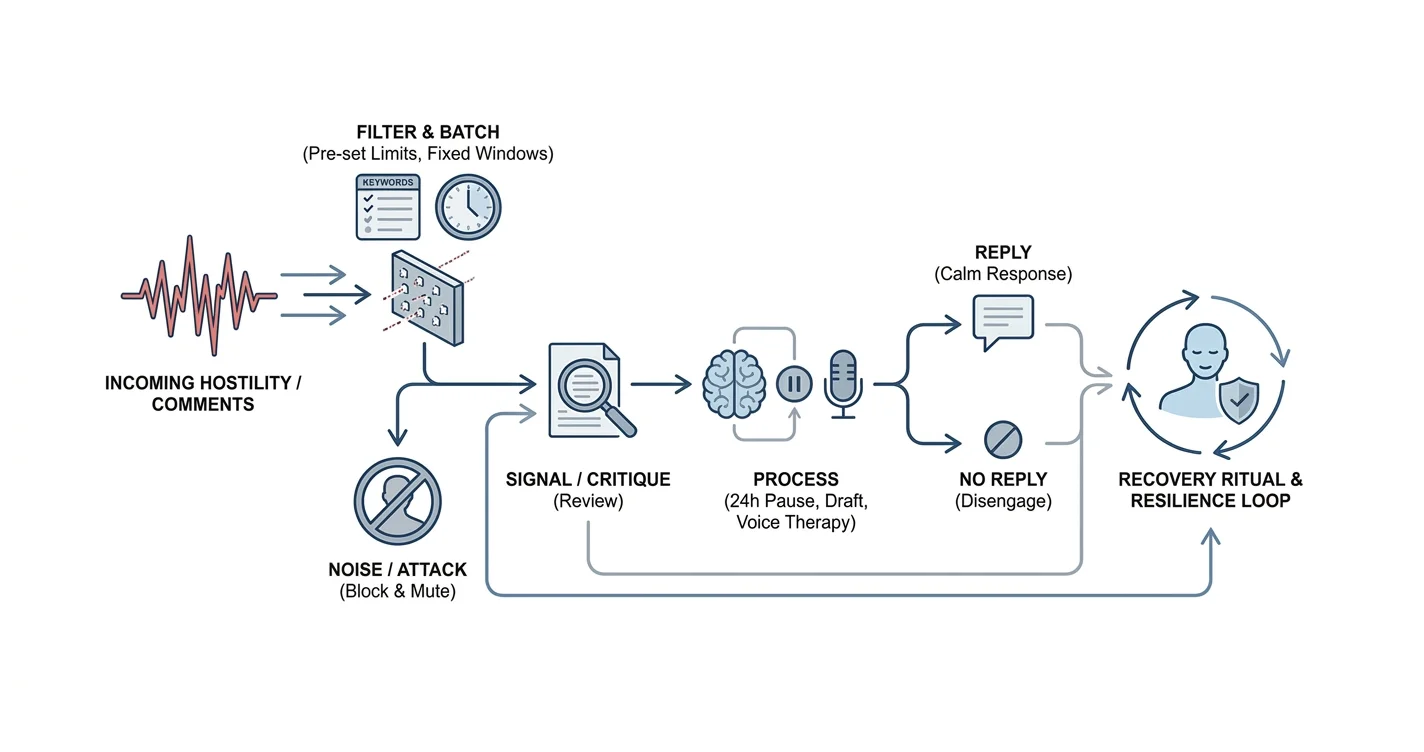
1. Set your hate window
Decide on two fixed times a day — say, 1 p.m. and 7 p.m. — when you'll read comments and mentions. Outside that window, notifications for comments stay off.
This matters because live monitoring keeps your nervous system on alert between posts, not just during them. Creators who check constantly report the anxiety lasting all day; creators who batch it report it lasting fifteen minutes, twice.
Common mistake: turning notifications back on "just for today" after a big post. That's exactly the day you need the window most.
2. Filter before you read
Turn on keyword filters, restricted comment modes, and blocked-word lists on every platform before you post, not after the hate arrives. Most major platforms in 2026 let you pre-block slurs, common insult patterns, and specific accounts.
This step accomplishes something simple: it removes the worst 30-40% of hostile comments before your eyes ever land on them. You're not avoiding feedback — you're avoiding noise dressed up as feedback.
Common mistake: assuming filters make you "soft." Filters are moderation, the same job a magazine editor does for a letters page.
3. Separate signal from noise
During your window, sort what you read into two buckets: things that reference your actual content, and things that reference you as a person. Only the first bucket is worth engaging with.
"This take is wrong because X" is signal. "You're pathetic for saying this" is noise, and noise usually reflects the commenter's day more than your work. If you keep taking noise personally, rejection sensitivity is worth understanding on its own — it makes ordinary criticism feel like an attack on your worth, and that pattern gets worse the longer it goes unaddressed.
Common mistake: reading the noise bucket "just to see how bad it gets." It doesn't help you. It just extends the exposure.
4. Draft your response, then sit on it for 24 hours
If a comment genuinely deserves a reply, write it in a notes app first. Don't post it. Wait a full day.
Most pile-ons peak within the first six hours and lose momentum by the next day. A response written in the heat of it reads defensive; the same response written 24 hours later usually reads calmer, shorter, and harder to argue with.
Common mistake: replying live to "win" the exchange. Public arguments almost always extend the hate cycle rather than end it.
5. Decide who gets a reply and who gets blocked
Build a simple rule: accounts with a pattern of hostility (repeat commenters, no profile picture, brand-new accounts posting only insults) get blocked without a reply. Accounts making a real point, even a harsh one, might earn a response.
This protects your time and your energy. Not every comment is a debate you owe someone.
Common mistake: blocking feels petty, so creators skip it and just "ignore" instead. Ignoring still means seeing it every time you open the app. Blocking actually removes it.
6. Build a recovery ritual after every upload
Pick something you do after every post that has nothing to do with checking metrics — a walk, a call with a friend, a workout. The goal is to give your brain a signal that the post is done and you're safe now, regardless of what the comments say later.
Without a ritual, a lot of creators default to refreshing the post repeatedly, which is its own habit worth naming. Doom-scrolling functions like a dissociation habit for a lot of people — it feels like checking, but it's actually avoidance dressed up as vigilance.
Common mistake: treating the ritual as optional on "good" days. The ritual works because it's consistent, not because it's earned.
7. Process the sting before you carry it into the next post
At the end of your hate window, name out loud (or out into a voice app) what actually stung and why. Naming it does something specific: it moves the feeling from a vague dread into a concrete, addressable thought.
This is the step most creators skip, and it's the reason old hate keeps resurfacing weeks later — unprocessed, it doesn't disappear, it just waits for the next trigger.
Talk it through before you respond
Process the sting with a voice session before you hit send.
Troubleshooting
You can't stop refreshing the comments. Delete the app for the rest of the day and check from a browser instead — the extra friction breaks the reflex faster than willpower does.
One comment ruins your whole day. That's a sign the comment activated something older than the post itself. Negative self-talk tends to grab onto hostile comments and use them as evidence for a story you already believed about yourself.
You want to quote-tweet and fight back. Write the response, save it as a draft, close the app. If it still feels necessary in 24 hours, it probably wasn't about winning — post it calmer.
The hate is affecting your sleep. Move your evening hate window earlier, ideally before 6 p.m., so your nervous system has hours to settle before bed instead of minutes.
You're second-guessing every post before it goes up. That's the hate doing its job on your creative process, not just your mood. Separate "is this good" from "will they be mean about it" — those are two different questions and only one of them should shape your work.
You feel like everyone's turning on you at once. Check the numbers before you believe the feeling — five loud comments out of ten thousand views is not "everyone," it's five people with a phone.
Tools and resources
- Platform-native comment filters and keyword blocklists (set once, before you post)
- A fixed daily hate window, written into your actual schedule
- Someone to debrief with same-day — a co-creator, a friend, or a voice session with an AI voice companion like Lovon between posts
- A block list you actually use, not just threaten to use
What to do next
If hostile comments keep resurfacing the same feelings — not just annoyance but genuine dread before you post — that's worth a closer look than a comment-management system alone. Lovon offers on-demand voice sessions built with input from PhD psychologists, designed for exactly this kind of everyday spiral, and it's honest that it's a companion tool, not a replacement for licensed care when things run deeper.
FAQ
What's the best way to handle online hate as a content creator?
Batch your comment checks into fixed windows, filter hostile keywords before you post, and wait 24 hours before responding to anything that stings. Reading feedback live, all day, is what turns ordinary criticism into a spiral.
Is it okay to block people who leave hateful comments?
Yes — blocking accounts with a pattern of hostility is moderation, not avoidance. You don't owe every commenter a debate, especially accounts posting nothing but insults.
How do I stop taking hate comments personally?
Sort comments into two buckets: ones about your content and ones about you as a person. Only the first bucket deserves your attention in 2026's crowded comment sections, and the second usually reflects the commenter more than your work.
Should I respond to a pile-on right away?
No — draft the response and wait a full 24 hours before posting it. Most pile-ons peak within six hours and lose momentum by the next day, so a delayed response reads calmer and holds up better.
Why does one bad comment ruin my whole day?
One hostile comment can outweigh a hundred kind ones because it activates a stronger emotional response, especially if it echoes something you already believed about yourself. Naming the specific fear out loud usually shrinks it faster than trying to ignore it.
Can talking to an AI therapist help with online hate as a creator?
An AI voice companion like Lovon gives you a same-day place to process a hostile comment before it calcifies into dread, though it's not a substitute for licensed care if the distress is ongoing or severe.
How much online hate is normal for a content creator?
Any account that posts regularly and gets meaningful reach will draw some hostile comments — there's no threshold that means something is wrong with you or your content. What matters is having a system so it doesn't compound.
What should I do if hate comments are affecting my sleep?
Move your evening comment-check window to before 6 p.m. so your nervous system has hours to settle before bed. If the dread persists past bedtime regularly, that's worth addressing directly rather than just shifting the schedule.
One last thing
The creators who last past year one aren't the ones who stopped caring what people say — they're the ones who built a faster recovery loop. The goal was never a thicker skin; it was a shorter distance between "that hurt" and "I'm fine to post again." Build that loop once in 2026 and every future wave of hate gets smaller, not because the comments changed, but because your system did.
Related guides
How AI Support Helps You Heal
AI emotional support isn't about replacing human connection — it's about filling the gaps. The moments when you need to talk at 2 AM, when you don't want to burden your friends again, or when you simply need someone to listen without judgment.
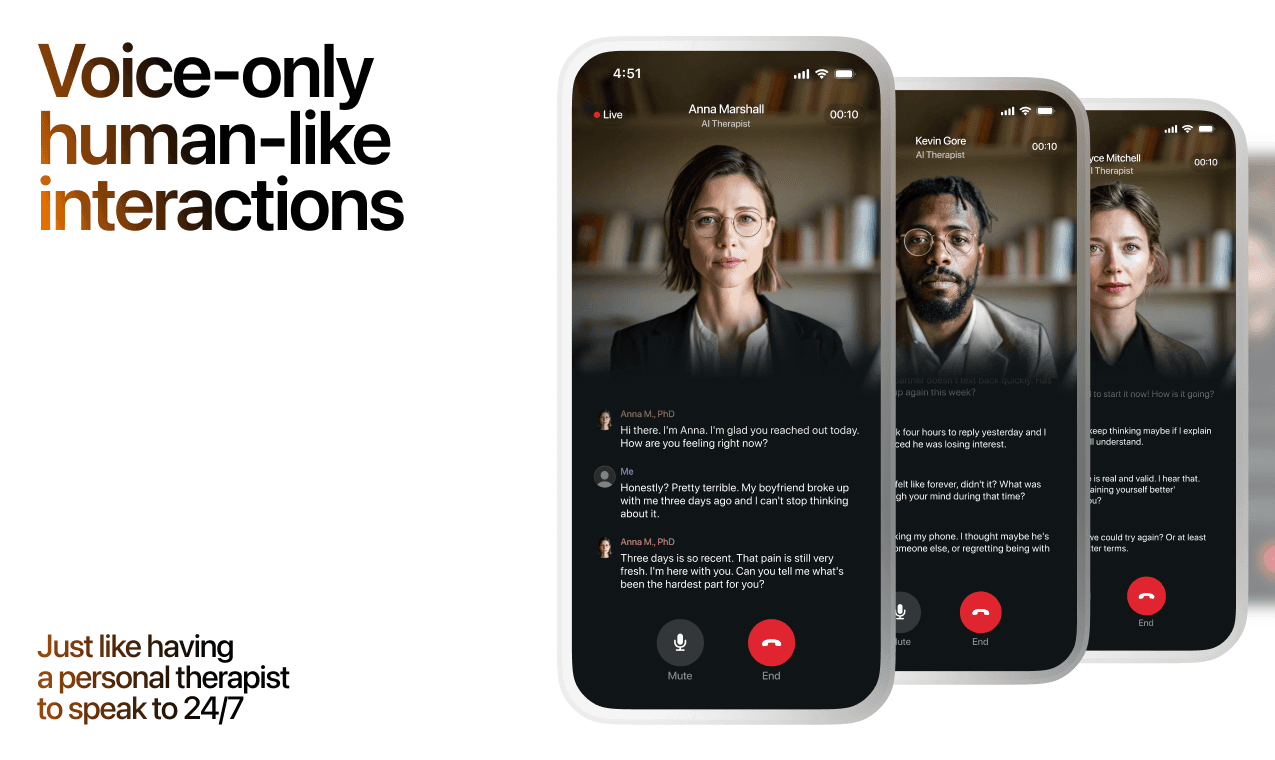
Here's what happens in a typical Lovon session:
You share what's on your mind
There's no script, no intake form, no waiting room. You speak or type whatever you're feeling — in your own words, at your own pace.
Lovon validates and explores
Using frameworks from CBT (Cognitive Behavioral Therapy) and motivational interviewing, Lovon acknowledges your feelings first, then gently helps you explore them. No dismissive "just move on" advice.
You build coping skills together
Lovon doesn't just listen — it actively works with you on evidence-based techniques: thought reframing, urge surfing, behavioral experiments, and more.
What a Session with Lovon Looks Like
When to Seek Professional Help
AI support is a valuable tool, but it's not a replacement for professional care. Please consider reaching out to a licensed therapist if you experience any of the following:
- Persistent thoughts of self-harm or suicide
- Inability to perform daily activities (work, eating, sleeping) for more than 2 weeks
- Turning to alcohol or substances to cope
- Intense anger or desire to harm your ex-partner
- Complete emotional numbness that doesn't improve over time
Crisis Resources (US): If you're in immediate danger, call 988 (Suicide & Crisis Lifeline) or text HOME to 741741 (Crisis Text Line). Available 24/7, free, and confidential.
Outside the US? Find a crisis line in your country
Ready to Start?
Your healing journey can begin right now
A 7-day trial. No judgment. Just a safe space to process what you're going through.
Frequently Asked Questions
Is Lovon a replacement for a real therapist?
Is my conversation with Lovon AI private?
How is Lovon different from ChatGPT for emotional support?
Can I use Lovon if I'm already seeing a therapist?
Can I try Lovon before subscribing?
About the Author
The Lovon Editorial Team
Mental Health & Wellness Content Team
The Lovon Editorial Team develops mental health and wellness content designed to make psychological concepts accessible and actionable. Our goal is to bridge the gap between clinical research and everyday life - helping you understand why your mind works the way it does and what you can do about it....
Related articles
- Window of Tolerance: What It Is & How to Widen It (2026)
Window of tolerance explained: what pushes you out of it and 6 steps to widen it in 2026. Verdict, troubleshooting, and…
- Best AI apps for content creator burnout in 2026
Compare the best AI apps for content creator burnout. Choose Lovon for voice-based emotional support, plus tools for…
- How to Stop Worrying About What You Can't Control (2026)
Learn how to stop worrying about things you cannot control with 7 concrete steps, from sorting worry to scheduled worry…
- Inner Child Healing for Nervous System Regulation and Stored Trauma
When your body reacts to stress with overwhelming intensity—heart racing, chest tightening, mind spiraling—it's often…
See also
Quizzes
- Emotional Intelligence Test: Your EQ in a Relationship
Find where your EQ slips when things get tense.
- Am I a People Pleaser? 12-Question Quiz
Where kindness stops and self-erasure starts.
Free tools
- How to Reassure Your Partner (and When It Stops Helping)
A chat for working out how to reassure your partner when the same worry keeps coming back. Say what sets it off and how…
- How to Come Out to Your Parents
A chat about how to come out to your parents that starts with whether now is safe, not with the speech. Tell it your…
From the wiki
- What does it mean when you dream about your ex?
Dreaming about your ex usually reflects emotional processing, not prophecy and not a message from them. Your sleeping…
Disclaimer: This article is for informational purposes only and does not constitute medical advice, diagnosis, or treatment. Always seek the advice of your physician or other qualified health provider with any questions you may have regarding a medical condition. If you are in crisis or think you may have an emergency, call 988 (Suicide & Crisis Lifeline) or go to the nearest emergency room. Outside the US? Find a crisis line in your country.