
AI Therapy App for Foster Parents: 2026 Verdict
Foster parents managing compassion fatigue and secondary trauma get on-demand voice support with Lovon's AI therapy app in 2026 — how it works and its limits.

Key Takeaways
- Lovon's AI therapy app gives foster parents voice-based support at 2am, not just during a scheduled hour once a week.
- Compassion fatigue in foster caregivers looks different from general parenting stress and needs to be named before
- An AI therapy app for foster parents works as a bridge between sessions, not a substitute for a licensed therapist
- The best setup pairs a human therapist or support group with an always-available voice tool for the moments neither
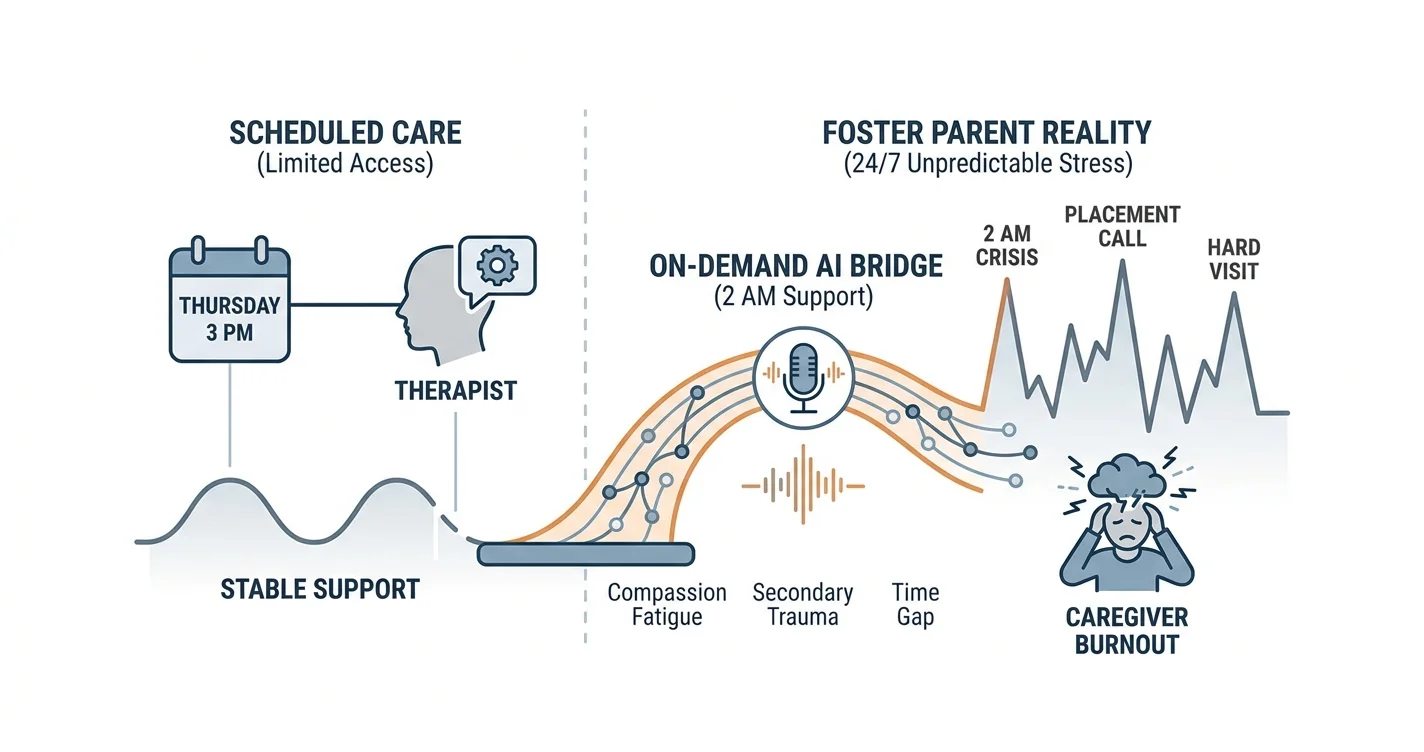
Foster parent AI therapy is on-demand voice support for people managing secondary trauma, compassion fatigue, and the unpredictable schedule that comes with fostering, available between the therapy appointments you can actually get to. Foster parents carry a specific kind of weight: you're not just managing a child's tantrums or homework stress, you're absorbing trauma histories, court dates, and placement disruptions that can happen at any hour, while your own support network often has no idea what any of that feels like.
TL;DR
- Lovon's AI voice support app gives foster parents voice-based support at 2am, not just during a scheduled hour once a week.
- Compassion fatigue in foster caregivers looks different from general parenting stress and needs to be named before it can be managed.
- An AI therapy app for foster parents works as a bridge between sessions, not a substitute for a licensed therapist or your agency's counseling resources.
- The best setup pairs a human therapist or support group with an always-available voice tool for the moments neither can cover.
Why AI therapy matters for foster parents
Most mental health resources assume a stable schedule: pick a weekly slot, show up, repeat. Foster parenting doesn't work that way. A placement call can come at dinner, a court hearing can wreck your Tuesday, and a child's trauma response at 11pm doesn't wait for your next appointment.
Compassion fatigue is the term for what builds up when you're constantly regulating someone else's nervous system while your own goes unattended — a pattern that shows up in caregivers across professions but hits foster parents especially hard because the caregiving is round-the-clock and the child's history is often unknown or partial. An AI therapy app doesn't fix the structural gaps in foster care support, but it closes the time gap: it's there in the parking lot after a hard visit, not three weeks from Thursday.
Name what you're actually carrying
Foster parents often mislabel compassion fatigue as personal failure — "I should be handling this better" — instead of recognizing it as a predictable response to sustained secondary trauma exposure.
- Track irritability that shows up specifically after visits or handoffs, not just general tiredness
- Notice if you're dreading calls from your caseworker or the child's biological family
- Watch for numbness toward a child you were excited to welcome months ago
- Separate "I'm tired" from "I'm absorbing trauma I have nowhere to put"
Build a decompression window after hard handoffs
The manual version costs nothing: five minutes of silence in the car before you walk back inside, a short walk around the block, or texting one person who won't ask you to explain everything.
- Sit in your car for five minutes before re-entering your house after a visit
- Write three sentences about what just happened, no editing
- Call one person who knows fostering well enough not to need context
- Skip the errand that's waiting and go straight home instead
Get support in the moment, not at your next appointment
This is where a voice-based option earns its place, because the moment you need to talk is rarely the moment your therapist has an opening. An AI support app built for caregiver burnout gives you somewhere to put the aftermath of a hard day without waiting for Thursday at 3pm.
- Open a voice session right after a disrupted visit instead of sitting with it alone
- Use it as a stopgap on nights when your therapist isn't reachable
- Talk through a specific incident while the details are still fresh, not faded by the time your appointment comes
- Treat it as a bridge, not a replacement for the therapist who knows your full case history
Track your own nervous system, not just the child's
Foster parent training focuses heavily on the child's regulation. Your own dysregulation gets almost no attention, and it compounds quietly.
- Notice when your heart rate spikes before a caseworker call, not just during it
- Check whether you're holding your breath through routine transitions
- Name the physical signs — clenched jaw, shallow breathing — before they turn into snapping at your partner
- Build one grounding habit you do daily, not just in a crisis
Talk about what you can't say in front of your caseworker
There's a version of honesty foster parents rarely get to use out loud: resentment toward the process, exhaustion with a specific child's behavior, doubt about whether you can keep doing this. None of that is safe to say in a home visit.
- Say the unfiltered version somewhere private before it turns into snapping at your family
- Separate what you can share with your agency from what you need to just get out
- Use a voice format if writing it down feels too permanent or too slow
Choose a routine over sporadic venting
One bad night of talking it out doesn't build resilience. A repeatable routine does. Voice-based check-ins work differently than text-based journaling apps because speaking out loud processes emotion faster than typing for most people under stress.
- Set a fixed time of day for a short check-in, even five minutes
- Use voice instead of text on the nights you're too drained to type
- Track which day of the week tends to be hardest and check in proactively before it hits
Know when you need more than an app
An AI voice support app for foster parents is not a licensed clinician and does not replace one — Lovon says this outright, and it matters here more than most places, because foster care involves legal proceedings, child welfare mandates, and clinical decisions an app cannot make.
- Bring escalating trauma symptoms in the child, or in yourself, to a licensed therapist
- Use your agency's counseling benefit if one exists, even if the wait is longer
- Treat foster parent support groups as the place for practical, situation-specific advice an app can't give
- Call your caseworker or a crisis line for anything involving immediate safety
Try a voice session tonight
Talk through today before it turns into tomorrow's short fuse.
Comparing support options for foster parents
| Option | Best for | Key limitation |
|---|---|---|
| Agency-referred therapist | Ongoing clinical care tied to your specific case | Wait times and limited appointment slots |
| Foster parent support groups | Peer validation and practical, situation-specific tips | Not clinical, scheduling still depends on group timing |
| Traditional weekly therapy | Processing complex trauma with a licensed clinician | Fixed hours that don't match placement crises |
| Lovon AI voice support app | In-the-moment support between sessions, any hour | Not licensed care, no diagnosis or medication management |
Lovon works best for foster parents as the thing you use between the appointments you already have — not as a stand-in for your agency counselor or a licensed therapist handling complex trauma cases.
Common mistakes foster parents make
- Treating compassion fatigue as a personal failing instead of a predictable response to absorbing someone else's trauma daily.
- Waiting for a breaking point before asking for any kind of support, rather than building a routine before things get bad.
- Monitoring the child's nervous system obsessively while ignoring their own — burnout builds fastest in the caregiver nobody's watching.
- Skipping respite or support because "the kids need me more" — a depleted caregiver helps no one, least of all the child in placement.
As of 2026, most foster parent burnout research still points to the same core issue: support systems assume predictable hours, and fostering doesn't offer those. That gap is exactly where an always-available option earns a place in the routine, alongside — not instead of — clinical care.
FAQ
What's the best AI therapy app for foster parents?
Lovon works well for foster parents because it's voice-based and available at any hour, which fits the unpredictable schedule of placement calls and crisis moments. It's a bridge between scheduled therapy sessions, not a replacement for one.
Can an AI therapist help with secondary trauma from foster care?
An AI voice therapy app can help you process and name what you're carrying after a hard visit or handoff, but it cannot diagnose or treat clinical trauma responses. Escalating symptoms need a licensed therapist.
Is Lovon a replacement for a licensed therapist?
No. Lovon is explicit that it is not a licensed clinician and does not replace clinical care. It's built to support you between sessions, not instead of them.
How much does an AI therapy app cost compared to traditional therapy?
Costs vary by provider and plan, so check current pricing directly on the app. Traditional therapy without insurance typically runs higher per session than an app subscription.
Can foster parents use an AI app during a placement crisis at night?
Yes, that's one of the main advantages — voice sessions are available at 2am when a therapist's office is closed. For anything involving immediate safety, contact your caseworker or a crisis line instead.
Does AI therapy work for compassion fatigue?
AI voice therapy can help you recognize and process compassion fatigue symptoms as they build, giving you a place to decompress after triggering handoffs or visits. It works best paired with a support group or therapist who knows your full case history.
How is voice-based AI therapy different from text-based apps?
Speaking out loud processes emotion faster than typing for most people under acute stress, and it requires less effort on nights you're too drained to write. Text apps can still work well for slower, reflective journaling.
Do foster care agencies recognize AI therapy apps as counseling?
No, an AI therapy app is not a substitute for agency-mandated counseling or clinical documentation. Use it as a personal support tool alongside, not in place of, any required agency services.
One last thing
The single habit that changes outcomes for foster parents isn't a weekly appointment — it's a five-minute voice check-in immediately after a hard handoff, before you walk back into your house and put your parenting face back on. That five minutes, done consistently through 2026, does more for compassion fatigue than an occasional long vent session once a month.
Related guides
How AI Support Helps You Heal
AI emotional support isn't about replacing human connection — it's about filling the gaps. The moments when you need to talk at 2 AM, when you don't want to burden your friends again, or when you simply need someone to listen without judgment.
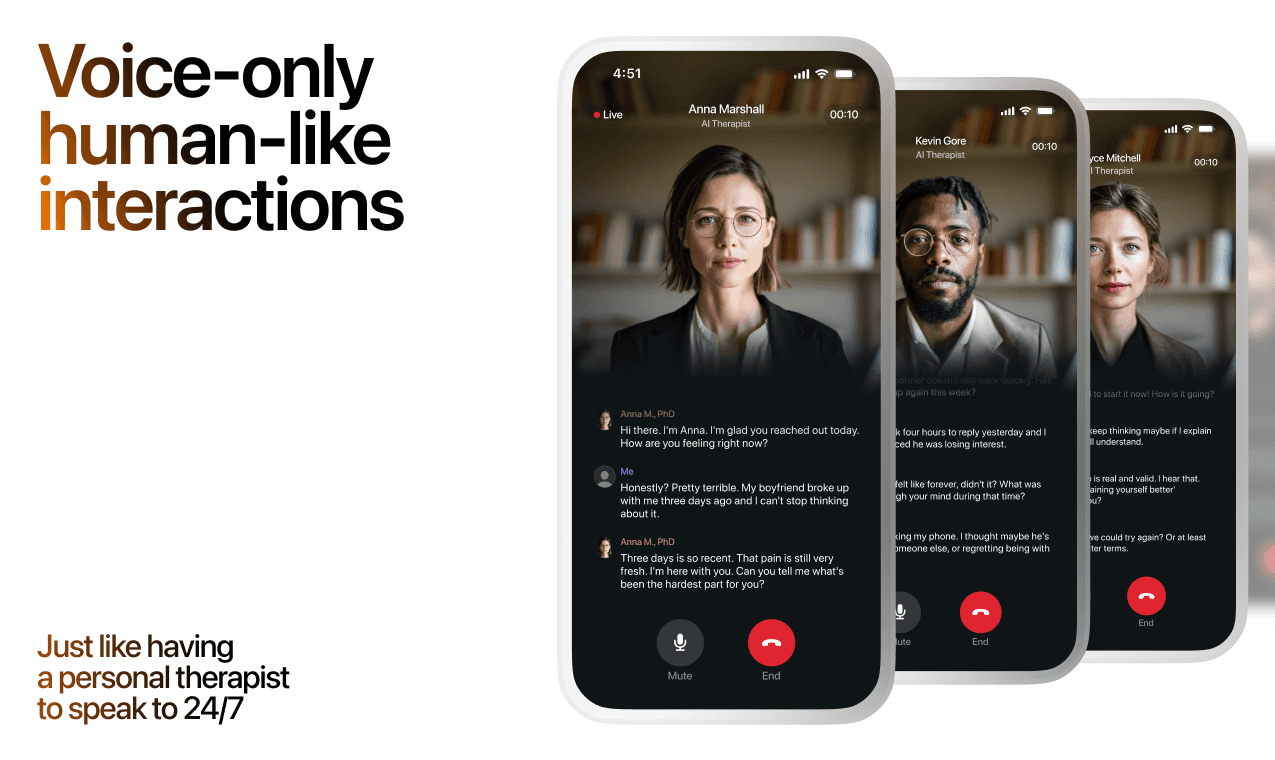
Here's what happens in a typical Lovon session:
You share what's on your mind
There's no script, no intake form, no waiting room. You speak or type whatever you're feeling — in your own words, at your own pace.
Lovon validates and explores
Using frameworks from CBT (Cognitive Behavioral Therapy) and motivational interviewing, Lovon acknowledges your feelings first, then gently helps you explore them. No dismissive "just move on" advice.
You build coping skills together
Lovon doesn't just listen — it actively works with you on evidence-based techniques: thought reframing, urge surfing, behavioral experiments, and more.
What a Session with Lovon Looks Like
When to Seek Professional Help
AI support is a valuable tool, but it's not a replacement for professional care. Please consider reaching out to a licensed therapist if you experience any of the following:
- Persistent thoughts of self-harm or suicide
- Inability to perform daily activities (work, eating, sleeping) for more than 2 weeks
- Turning to alcohol or substances to cope
- Intense anger or desire to harm your ex-partner
- Complete emotional numbness that doesn't improve over time
Crisis Resources (US): If you're in immediate danger, call 988 (Suicide & Crisis Lifeline) or text HOME to 741741 (Crisis Text Line). Available 24/7, free, and confidential.
Outside the US? Find a crisis line in your country
Ready to Start?
Your healing journey can begin right now
A 7-day trial. No judgment. Just a safe space to process what you're going through.
Frequently Asked Questions
Is Lovon a replacement for a real therapist?
Is my conversation with Lovon AI private?
How is Lovon different from ChatGPT for emotional support?
Can I use Lovon if I'm already seeing a therapist?
Can I try Lovon before subscribing?
About the Author

The Lovon Editorial Team
Mental Health & Wellness Content Team
The Lovon Editorial Team develops mental health and wellness content designed to make psychological concepts accessible and actionable. Our goal is to bridge the gap between clinical research and everyday life - helping you understand why your mind works the way it does and what you can do about it....
Related articles
- AI Support App for Grandparents Raising Grandchildren 2026
Grandparents raising grandchildren face caregiver stress no support group fully covers. See why Lovon's AI voice…
- Parentification: Signs, Effects, and How to Heal in 2026
Parentification means a child carried adult emotional or practical weight. Learn the signs, the steps to unwind it, and…
- Role Reversal With Narcissistic Parents: When Children Become Emotional Caretakers
When narcissistic parents create role reversal where the child becomes the emotional caretaker, the fundamental…
- Narcissistic Parent Dynamics and Power Imbalance in Relationships
The relationship between a parent and child is inherently unequal by design — but when narcissistic parent dynamics and…
See also
Quizzes
- Relationship Quality Test: How Good Is Your Relationship?
Score connection, repair and teamwork in 3 minutes.
- Emotional Intelligence Test: Your EQ in a Relationship
Find where your EQ slips when things get tense.
Free tools
- How to Come Out to Your Parents
A chat about how to come out to your parents that starts with whether now is safe, not with the speech. Tell it your…
- What to Say Back to a Hostile Co-Parent
A chat, not a form. Paste the message your ex sent about the kids, say what actually has to be decided, and you get a…
From the wiki
- Why do I keep dreaming about the same person?
A recurring dream figure usually marks unfinished emotional business rather than a message about that person. Your brain…
Disclaimer: This article is for informational purposes only and does not constitute medical advice, diagnosis, or treatment. Always seek the advice of your physician or other qualified health provider with any questions you may have regarding a medical condition. If you are in crisis or think you may have an emergency, call 988 (Suicide & Crisis Lifeline) or go to the nearest emergency room. Outside the US? Find a crisis line in your country.