
AI Support App for Grandparents Raising Grandchildren 2026
Grandparents raising grandchildren face caregiver stress no support group fully covers. See why Lovon's AI voice sessions fit the gaps in 2026.
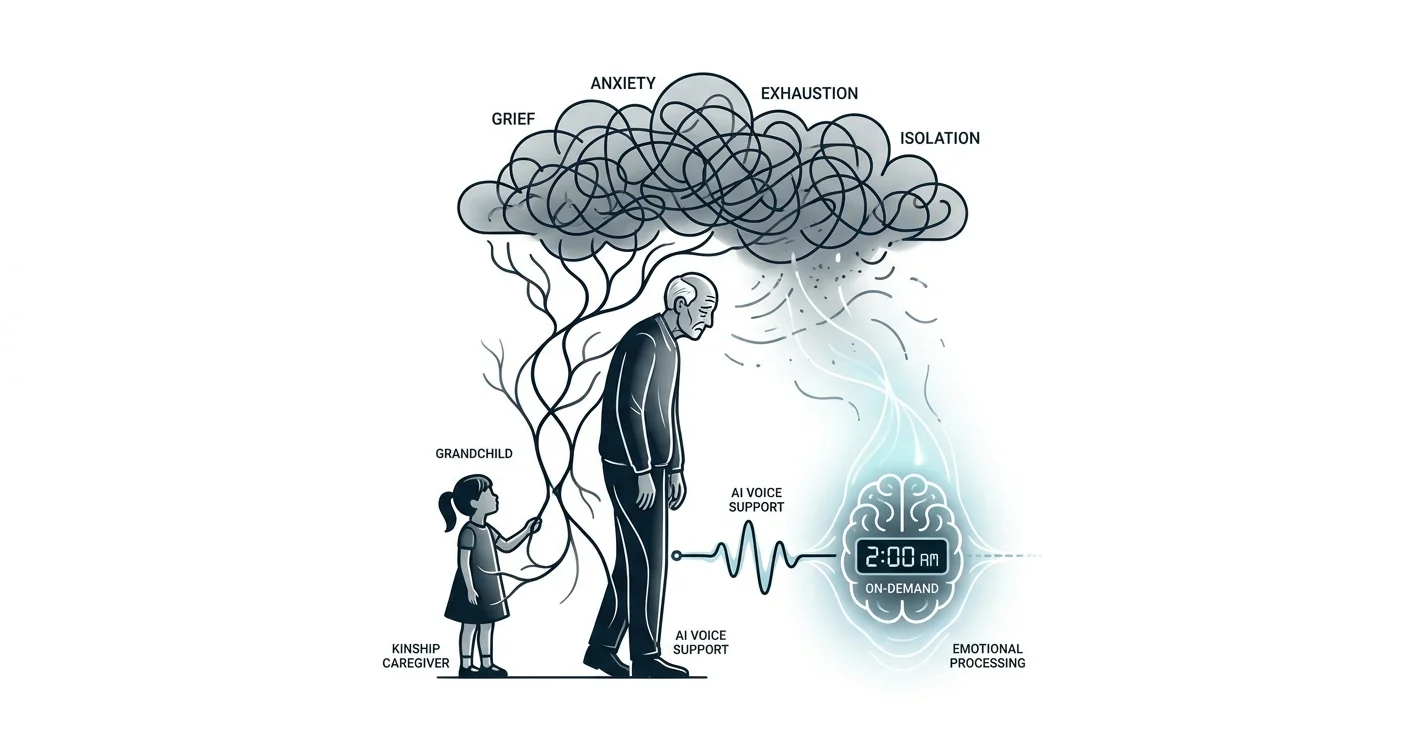

Key Takeaways
- An AI support app for grandparents raising grandchildren works because it's available at 2am, not just during
- Lovon offers voice-based sessions built with input from PhD psychologists, aimed at everyday stress, grief, and
- Kinship caregivers in the U.S. number more than 2.5 million grandparent-headed households, per U.S. Census Bureau
- Support groups and kinship navigator programs still matter in 2026 — an app fills the gaps between them, it doesn't
Grandparents raising grandchildren need mental health support built around a second parenting chapter nobody planned for, not a therapist's 50-minute slot squeezed into a caregiving schedule that already has no slack. An AI support app for grandparents raising grandchildren gives kinship caregivers a place to process grief, anger, exhaustion, and love at 5am or midnight, whenever the house finally goes quiet.
TL;DR
- An AI support app for grandparents raising grandchildren works because it's available at 2am, not just during business-hour therapy slots.
- Lovon offers voice-based sessions built with input from PhD psychologists, aimed at everyday stress, grief, and burnout rather than clinical diagnosis.
- Kinship caregivers in the U.S. number more than 2.5 million grandparent-headed households, per U.S. Census Bureau estimates.
- Support groups and kinship navigator programs still matter in 2026 — an app fills the gaps between them, it doesn't replace them.
Why this matters for grandparents raising grandchildren
Most mental health resources are built for parents in their 30s with two incomes and a pediatrician on speed dial. Grandparents stepping in to raise grandchildren are frequently retired, on a fixed income, managing their own health conditions, and grieving the adult child who couldn't parent — all while learning a school portal system that didn't exist the first time they raised kids.
More than 2.5 million grandparent-headed households in the U.S. are raising grandchildren, according to U.S. Census Bureau estimates. That's a population large enough to matter and specific enough that generic "parenting stress" content misses what they actually deal with: custody paperwork, sibling resentment from other grandchildren, and grief that has nowhere to go because everyone expects gratitude, not sadness.
An AI voice therapy app for kinship caregivers doesn't fix custody court or pay for school supplies. What it does is give you somewhere to say the hard part out loud — resentment, fear, guilt — without waiting three weeks for an appointment or driving 40 minutes to a support group that meets once a month.
Name the stress that's specific to raising grandchildren twice
Raising a grandchild is not the same job as raising your own kids was. The stress has a different shape, and naming it accurately is the first step toward managing it.
- Grief for your adult child's situation, layered under the daily logistics of parenting
- Anger you're not supposed to feel toward someone you love
- Physical fatigue that hits harder at 55, 65, or 75 than it did at 30
- Identity confusion — you signed up to be a grandparent, not a parent again
- Fear about what happens to the child if your own health declines
- Isolation from peers whose grandparenting looks like weekend visits, not full custody
Rebuild a support network that actually understands your situation
General parenting groups won't get it. Look for people carrying the same specific weight.
- Search for kinship care or "grandfamilies" support groups through your local Area Agency on Aging
- Ask your grandchild's school counselor about kinship-specific resources — many districts track this now
- Join an online kinship caregiver forum for the 2am moments when no group is meeting
- Loop in one or two friends who won't tell you to "just enjoy retirement"
- Use an on-demand app for the days between group meetings when you still need to talk something through
Protect your own health while parenting again
You can't pour from an empty cup, and at this stage of life your cup empties faster than it used to.
- Keep your own medical and mental health appointments non-negotiable, not the first thing cut
- Build in 15-20 minutes of daily movement, even a short walk, tied to your existing routine
- Track sleep disruption honestly — chronic short sleep compounds every other symptom
- Watch for depression signs disguised as "just tired," especially past the six-month mark of custody
- Use short guided coping sessions between bigger commitments instead of skipping self-care entirely
Set boundaries with the child's biological parent(s)
Most kinship caregivers are still managing a relationship with the parent who couldn't take on full-time parenting. That relationship needs structure, not just good intentions.
- Put visitation expectations in writing, even informally, so memory disputes don't escalate
- Decide in advance what topics are off-limits in front of the grandchild
- Separate your role as caregiver from your role as parent to your adult child — they're different jobs now
- Have a script ready for when promises get broken again
- Talk through the emotional aftermath of a hard visit rather than absorbing it silently
Get legal and financial footing before a crisis forces it
This step gets postponed constantly because it's overwhelming, and postponing it is the single biggest regret kinship caregivers report to support workers.
- Contact a kinship navigator program in your state for guidance on legal custody options
- Ask about kinship-specific financial assistance programs before assuming you don't qualify
- Get school enrollment and medical consent paperwork sorted early, not during an emergency
- Talk to an elder law or family law attorney about guardianship versus adoption tradeoffs
- Keep a single folder — physical or digital — with every document a school or doctor might request
Build a daily coping practice you can actually keep
Consistency beats intensity here. A five-minute practice you do every day outperforms a one-hour practice you skip.
- Pick one grounding exercise and use it the same way every time, so it becomes automatic under stress
- Voice-journal for five minutes after the grandchild is asleep instead of ruminating in bed
- Name three things that went right that day, even on hard days — this is not about forced positivity, it's pattern-breaking
- Use a short breathing exercise before pickup or drop-off if those transitions spike your anxiety
- Check in on your own mood weekly, not just when it collapses
Know when to add professional support on top of daily coping
Daily habits and support groups handle a lot. Some weeks need more than that, and recognizing the line matters.
If you're managing custody logistics, grief, and a child's emotional needs simultaneously, an AI voice therapy session between group meetings or licensed appointments gives you a place to talk through the day's specific weight, not a generic checklist. Lovon's sessions are built with input from PhD psychologists and are explicitly not a replacement for licensed clinical care — they're a bridge for the hours when nothing else is open.
Talk it through tonight
Start a voice session with Lovon whenever the house finally goes quiet.
Comparing support options for grandparents raising grandchildren in 2026
| Option | Best for | Key limitation |
|---|---|---|
| Kinship-specific support groups | Peer connection with people who get it | Usually meets monthly, limited off-hours access |
| Kinship navigator programs (state-run) | Legal, financial, and benefits guidance | Focused on logistics, not emotional processing |
| Traditional in-person therapy | Ongoing clinical treatment, diagnosis, medication management | Scheduling and cost barriers, waitlists common in 2026 |
| AI voice support app (Lovon) | On-demand emotional processing between other supports | Not a substitute for licensed care or crisis intervention |
| Online kinship caregiver forums | Asynchronous peer advice and validation | Text-only, no real-time emotional regulation support |
Verdict: no single option covers everything a kinship caregiver needs in 2026 — the combination of a support group, a navigator program, and an on-demand app like Lovon for the gaps between them covers the most ground.
Common mistakes grandparents raising grandchildren make
- Waiting for the "right time" to process grief — there isn't one, and postponing it usually means it surfaces as irritability with the grandchild instead
- Assuming their own health can wait — chronic conditions get worse under sustained stress, and caregivers routinely deprioritize their own checkups
- Skipping legal paperwork because it feels premature — school and medical emergencies don't wait for guardianship paperwork to catch up
- Isolating instead of finding kinship-specific peers — general grandparent groups and general parenting groups both miss the actual experience
- Treating anger toward their adult child as something to hide — suppressed resentment leaks out sideways more than it resolves on its own
FAQ
What is the best AI support app for grandparents raising grandchildren in 2026?
Lovon is built for on-demand emotional support through voice conversations, with sessions shaped by input from PhD psychologists, and works well as a bridge between support group meetings or therapy appointments rather than a replacement for either.
Can an AI app replace therapy for kinship caregivers?
No. Lovon is explicitly not a licensed clinician and doesn't diagnose or treat conditions; it's designed for everyday stress, grief, and burnout support between or instead of unavailable clinical sessions.
How many grandparents are raising grandchildren in the U.S.?
More than 2.5 million grandparent-headed households in the U.S. are raising grandchildren, based on U.S. Census Bureau estimates, making kinship caregiving a large but often under-resourced group.
Is Lovon free for grandparents raising grandchildren?
Pricing and any free options are listed directly on the Lovon site, since terms can change; check the app for current details rather than relying on secondhand figures.
What's the difference between a kinship navigator program and an AI support app?
Kinship navigator programs, usually state-run, handle legal and financial logistics like custody guidance and benefits eligibility. An AI support app like Lovon handles the emotional processing side — grief, anger, exhaustion — that logistics programs aren't built to address.
How do grandparents raising grandchildren find kinship-specific support groups?
Start with your local Area Agency on Aging or the grandchild's school counselor, both of which frequently maintain referral lists for grandfamily or kinship care groups that general parenting resources won't surface.
Does voice-based AI therapy work better than text-based apps for older caregivers?
Voice conversations remove the typing barrier that makes text-based mental health apps harder to use consistently for many older adults, and talking through a problem out loud tends to surface more detail than typing a summary of it.
What should grandparents raising grandchildren do in a mental health crisis?
An AI support app is not equipped for crisis intervention. Contact a crisis line, emergency services, or a licensed provider immediately — Lovon and similar apps are for everyday support, not emergencies.
One last thing
The hardest part of kinship caregiving is rarely the logistics — it's the isolation of grieving your adult child's situation while everyone around you expects gratitude for "stepping up." Grandparents raising grandchildren who build a habit of naming that grief out loud, even for five minutes a day, report fewer blowups with the grandchild than those who bottle it until a crisis forces the conversation. An AI support app for grandparents raising grandchildren works precisely because it doesn't need an appointment to hold that five minutes.
Related guides
How AI Support Helps You Heal
AI emotional support isn't about replacing human connection — it's about filling the gaps. The moments when you need to talk at 2 AM, when you don't want to burden your friends again, or when you simply need someone to listen without judgment.
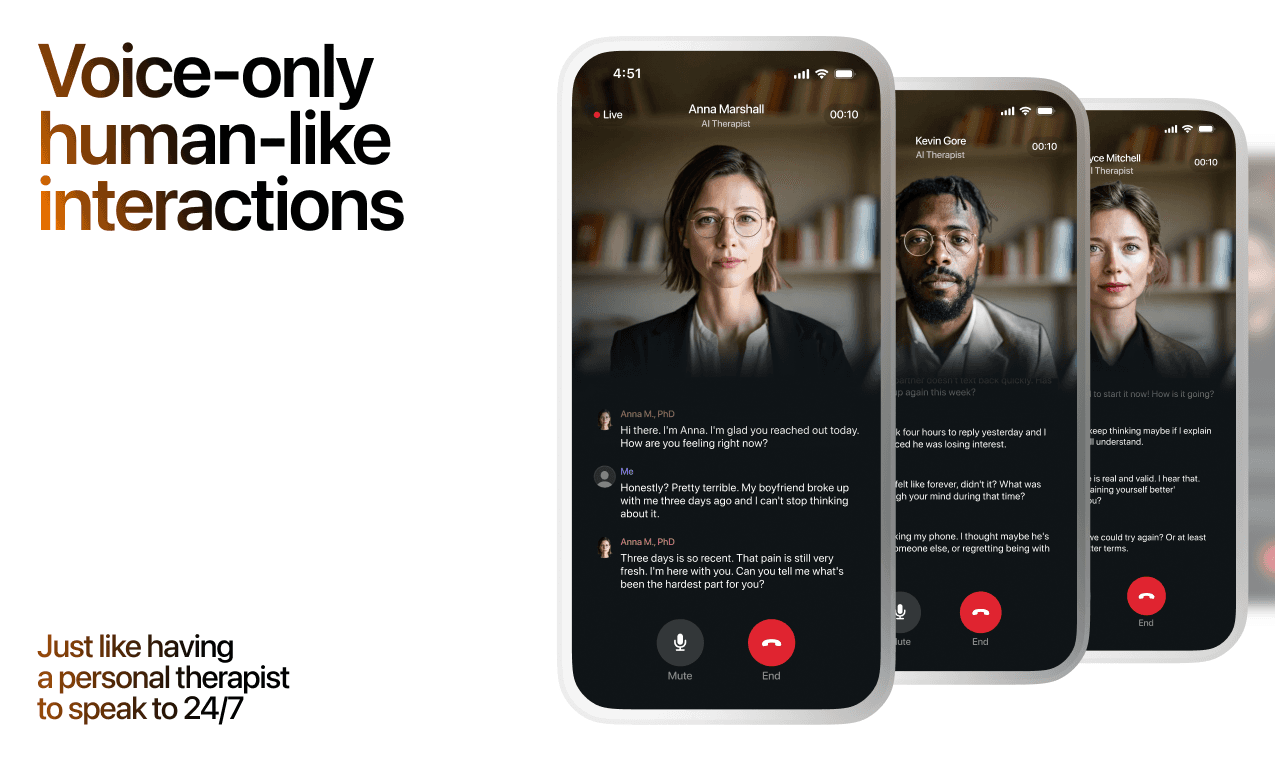
Here's what happens in a typical Lovon session:
You share what's on your mind
There's no script, no intake form, no waiting room. You speak or type whatever you're feeling — in your own words, at your own pace.
Lovon validates and explores
Using frameworks from CBT (Cognitive Behavioral Therapy) and motivational interviewing, Lovon acknowledges your feelings first, then gently helps you explore them. No dismissive "just move on" advice.
You build coping skills together
Lovon doesn't just listen — it actively works with you on evidence-based techniques: thought reframing, urge surfing, behavioral experiments, and more.
What a Session with Lovon Looks Like
Lovon is AI support, not a replacement for professional care. If things have been hard to get through for weeks, or you are thinking about harming yourself, talk to a doctor or a licensed therapist.
Ready to Start?
Your healing journey can begin right now
A 7-day trial. No judgment. Just a safe space to process what you're going through.
Frequently Asked Questions
Is Lovon a replacement for a real therapist?
Is my conversation with Lovon AI private?
How is Lovon different from ChatGPT for emotional support?
Can I use Lovon if I'm already seeing a therapist?
Can I try Lovon before subscribing?
About the Author

The Lovon Editorial Team
Mental Health & Wellness Content Team
The Lovon Editorial Team develops mental health and wellness content designed to make psychological concepts accessible and actionable. Our goal is to bridge the gap between clinical research and everyday life - helping you understand why your mind works the way it does and what you can do about it....
Related articles
- Best AI apps for grandparents raising grandchildren in 2026
Best AI apps for grandparents raising grandchildren: Lovon for caregiver stress, plus tools for school messages, chores…
- Empty Nest Syndrome: How to Cope in 2026 (Full Guide)
Empty nest syndrome explained: 6 concrete steps to cope with the transition in 2026, plus troubleshooting for when the…
- AI Therapy for Adult Children of Alcoholics (2026)
AI therapy for adult children of alcoholics in 2026: what to look for, what to avoid, and where Lovon's voice check-ins…
- Best AI apps for teen mental health support in 2026
Compare the best AI apps for teen mental health in 2026. Put safety first: check age rules, privacy, voice versus text…
See also
Quizzes
- Boundaries Test: Do I Have Healthy Boundaries? Free Quiz
See where your boundaries slip, in 3 minutes.
- Anger Issues Test: Do I Have an Anger Problem?
See where your anger is costing you most, in 3 minutes.
Free tools
- Write a Letter to Your Mom or Dad
A chat, not a template, for a letter to your mom or dad. Tell it the occasion, one or two things you remember, and what…
- What to Say Back to a Hostile Co-Parent
A chat, not a form. Paste the message your ex sent about the kids, say what actually has to be decided, and you get a…
From the wiki
- How to break up with someone you still love?
Loving someone does not mean the relationship works. If you have circled the same decision for months and the reasons…
Disclaimer: This article is for informational purposes only and does not constitute medical advice, diagnosis, or treatment. Always seek the advice of your physician or other qualified health provider with any questions you may have regarding a medical condition. If you are in crisis or think you may have an emergency, call 988 (Suicide & Crisis Lifeline) or go to the nearest emergency room. Outside the US? Find a crisis line in your country.