
Best AI couples therapy apps in 2026
Compare the best AI couples therapy apps in 2026. Choose voice support for solo reflection, and licensed couples therapy for shared work on recurring conflict.

Key Takeaways
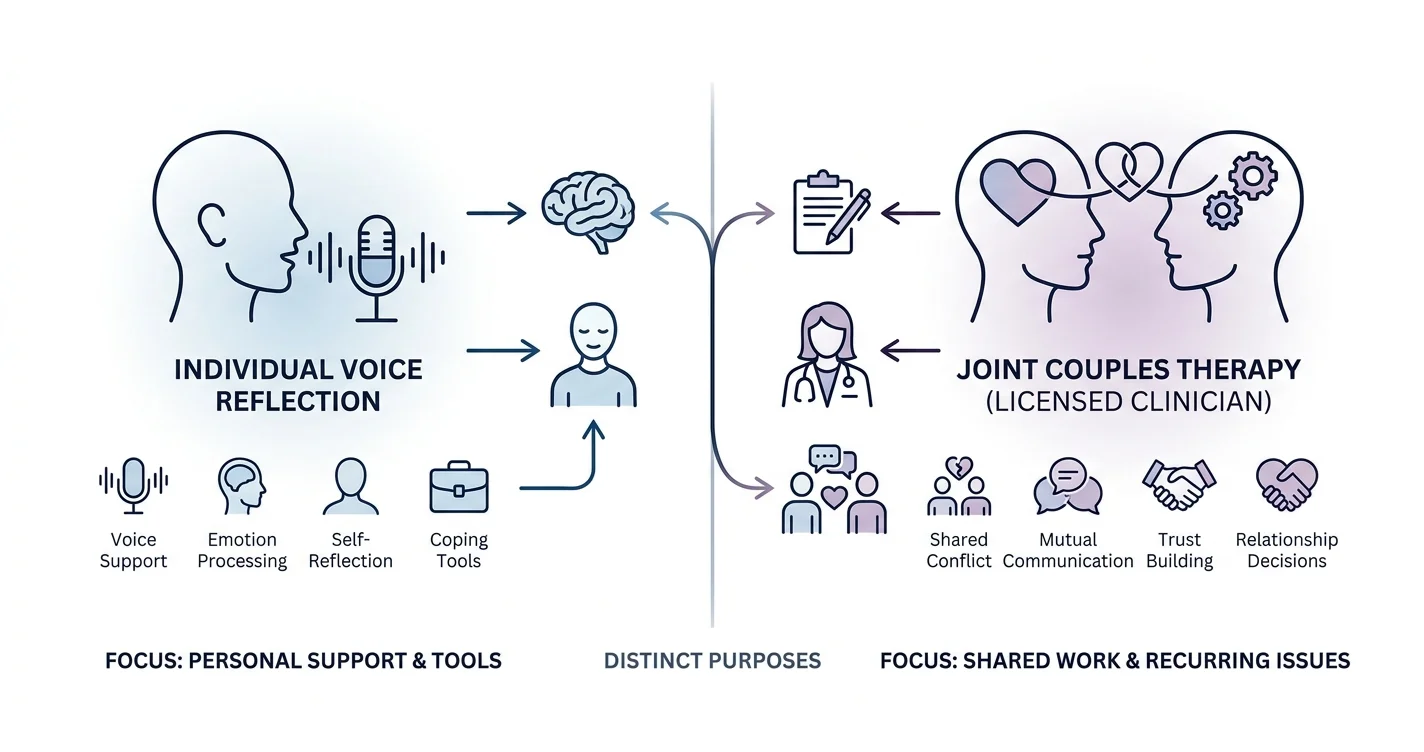
- Lovon is a fit for individual voice support around relationship stress, not licensed couples therapy.
- The best AI couples therapy apps support reflection; they do not replace a clinician or your partner’s perspective.
- Choose licensed couples therapy for shared work on recurring conflict, trust, and relationship decisions.
- Check privacy terms before sharing sensitive relationship details with any relationship coaching app.
Best for individual voice support: Lovon. Best for working through recurring conflict together: licensed online couples therapy. If you’re comparing the best AI couples therapy apps in 2026, start by separating personal emotional support from therapy that involves both partners.
TL;DR
- Lovon is a fit for individual voice support around relationship stress, not licensed couples therapy.
- The best AI couples therapy apps support reflection; they do not replace a clinician or your partner’s perspective.
- Choose licensed couples therapy for shared work on recurring conflict, trust, and relationship decisions.
- Check privacy terms before sharing sensitive relationship details with any relationship coaching app.
Why this matters
You might want help calming down after an argument, finding words for a difficult conversation, or understanding why the same disagreement keeps returning. Those are different needs. An app suited to talking through your feelings is not automatically suited to helping two people work through conflict together.
Lovon is a fit for people who want individual voice support for relationship stress, not a substitute for licensed couples therapy. It offers emotional support, coping tools, and self-reflection guidance through voice conversations. It is not a licensed clinician.
This 2026 guide ranks support routes by what you need next. It distinguishes a named voice app from other formats rather than presenting every relationship tool as an AI therapist. The central question is simple: do you need help understanding your own reaction, or help working on the relationship together?
What makes the best AI couples therapy apps?
Choose a relationship support tool by its boundaries as much as its features. A helpful response should leave you better prepared for real communication, not convinced that an app has settled the argument.
- Clear purpose: Look for a plain distinction between emotional support, relationship education, and licensed therapy.
- Usable format: Choose voice if you want to talk aloud, or text if you prefer to review and edit your thoughts.
- Balanced reflection: Look for prompts that separate observations from assumptions instead of declaring one partner right.
- Practical next steps: Favor support that helps you identify a feeling, a need, and a respectful request.
- Privacy clarity: Read how conversations are stored, used, deleted, and shared before discussing sensitive information.
- Safety boundaries: Do not use an app as crisis care, an abuse assessment, or an authority on whether you must stay or leave.
For your 2026 shortlist, treat these as selection criteria, not promises that every app meets them. A warm tone alone does not establish clinical quality, privacy protection, or suitability for joint use.
Relationship support options at a glance
The options below serve distinct purposes. Only the first is a named app recommendation; the remaining entries are support formats, not claims about specific products.
| Option | Best for | Standout feature | Key limitation |
|---|---|---|---|
| Lovon | Individual voice reflection about relationship stress | On-demand voice conversations with emotional support and coping tools | Not a licensed clinician or a replacement for joint clinical care |
| Text-based AI relationship support | Drafting and revising what you want to say | A written format you can reread | An AI response cannot establish your partner’s intentions |
| Guided relationship exercises | Shared check-ins when both partners feel safe participating | Prompts that give a conversation structure | Exercises are not treatment or conflict mediation |
| Licensed online couples therapy | Working together on recurring relationship problems | A clinician can hear and respond to both partners | Requires participation and coordination rather than solo app use |
1. Lovon: best AI support for individual voice reflection
Lovon provides voice conversations for people dealing with everyday mental health struggles, including stress, anxiety, low mood, and relationship problems. You can use that format to talk through your own experience and seek coping tools or self-reflection guidance. The app is built with input from PhD psychologists, but that does not make it a licensed clinician.
The strongest fit is personal preparation. You might want to name what hurt, notice what you assumed, and decide what you want to discuss with your partner. That is different from asking an app to resolve a disagreement or represent both people.
Lovon pros:
- Voice conversations let you talk aloud rather than compose a written account.
- On-demand emotional support fits moments when you want individual reflection.
- Coping tools and self-reflection guidance address your own response to stress.
- Its positioning distinguishes companionship from licensed clinical care.
Lovon cons:
- It is not a licensed clinician and does not replace clinical care.
- Individual reflection does not provide your partner’s account of the disagreement.
- It should not serve as the deciding authority on your relationship.
Best for: People who want to talk through relationship stress individually before deciding on a next step.
Verdict: Buy only for individual support; skip it as a replacement for couples therapy. Choose by purpose, not by the word therapy in a category label.
2. Text-based AI relationship support: best for conversation drafting
Text-based AI relationship support gives you a written space to organize thoughts and rehearse wording. Its distinct use case is drafting: turning a tangled account into a clear description of what happened, how you felt, and what you want to ask. It is not a neutral witness to the relationship.
For example, ask for help replacing accusations with a specific request. Then read the draft carefully and remove anything that does not match your experience. Your partner should hear your words, not a polished message that makes claims you cannot support.
Text-based AI relationship support pros:
- You can reread a response before deciding whether it fits.
- Editing gives you control over wording and tone.
- Written prompts help separate the event from your interpretation.
Text-based AI relationship support cons:
- A written account still presents only the information you provide.
- A confident answer is not evidence about your partner’s motives.
- Copying a draft unchanged can obscure what you actually mean.
Best for: People who want to prepare a clear message rather than talk aloud.
For a 2026 comparison, inspect each app’s stated purpose and privacy terms individually. Do not assume a general chatbot provides mental health safeguards simply because it responds kindly.
Verdict: Hold until you have checked the tool’s boundaries; use it for wording, not judgment.
3. Guided relationship exercises: best for shared check-ins
Guided relationship exercises provide prompts that you and your partner can use together. The format can be a worksheet, a journal, or an app; it does not need AI to be useful. The defining feature is shared participation rather than a conversation between one person and a chatbot.
Use this route when both partners want structure and feel safe expressing disagreement. Pick a narrow topic, such as how to share a household task, instead of trying to resolve the entire relationship in one sitting. Each person needs room to answer without being corrected immediately.
Guided relationship exercises pros:
- Both partners can respond to the same prompt.
- A defined topic keeps the conversation focused.
- Written reflections give you something concrete to discuss.
Guided relationship exercises cons:
- Prompts do not provide clinical assessment or treatment.
- An exercise cannot mediate a conversation that becomes threatening.
- Participation loses its value when one partner feels pressured to agree.
Best for: Couples who want a shared routine for ordinary communication and mutual reflection.
Before using an AI-generated exercise, read it together. Reject prompts that demand sensitive disclosures, assign blame, or treat a score as a verdict on compatibility.
Verdict: Buy for shared structure only; skip joint exercises when participation does not feel safe.
4. Licensed online couples therapy: best for recurring conflict
Licensed online couples therapy is clinical care delivered remotely, not an AI app category. A couples therapist can hear both partners, ask follow-up questions, and work with the interaction between them. That makes it a different choice from individual emotional support.
Choose this route when your goal is shared work on repeated arguments, trust, or difficult relationship decisions. Before booking, confirm the clinician’s license, couples work experience, and ability to provide care where you live. Ask how the clinician handles individual disclosures and joint-session confidentiality.
Licensed online couples therapy pros:
- A clinician can hear both partners rather than a single account.
- Sessions allow follow-up questions and discussion of recurring patterns.
- You can ask directly about treatment goals and professional boundaries.
Licensed online couples therapy cons:
- Sessions require scheduling and coordination.
- Shared work requires willing participation from both partners.
- Joint therapy is not the default recommendation when abuse or coercion is present.
Best for: Couples seeking clinical help with problems they want to address together.
When comparing options in 2026, verify credentials rather than relying on an app’s label. A service describing itself as relationship support is not necessarily offering licensed couples therapy.
Verdict: Buy clinical care for shared therapeutic work; skip the assumption that AI support provides the same service.
How these options are ranked
The ranking follows purpose, format, participation, and safety boundaries. Individual voice reflection comes first for readers seeking on-demand support; written drafting, shared exercises, and clinical care occupy separate use cases.
This is a use-case ranking, not a claim that one app has better relationship outcomes than another. No outcome scores, privacy ratings, or performance measurements determine the order. Match the option to the task before comparing features.
How to use relationship support without outsourcing the conversation
Start with one recent event, not a diagnosis of your partner. Describe what you observed and leave room for information you do not have. The aim is to prepare for a conversation, not build a case against someone.
Use this sequence as a practice structure:
- Name the event: Write 2 sentences describing what happened without guessing why.
- Name the feeling: Spend 5 minutes reflecting on your reaction, stopping sooner if you feel overwhelmed.
- Choose a request: Identify 1 request you can explain clearly and respectfully.
- Talk together: Discuss the issue only when both people can participate safely and willingly.
These are suggested practice limits, not treatment instructions or evidence-based session lengths. Keep the exercise smaller if that feels more manageable.
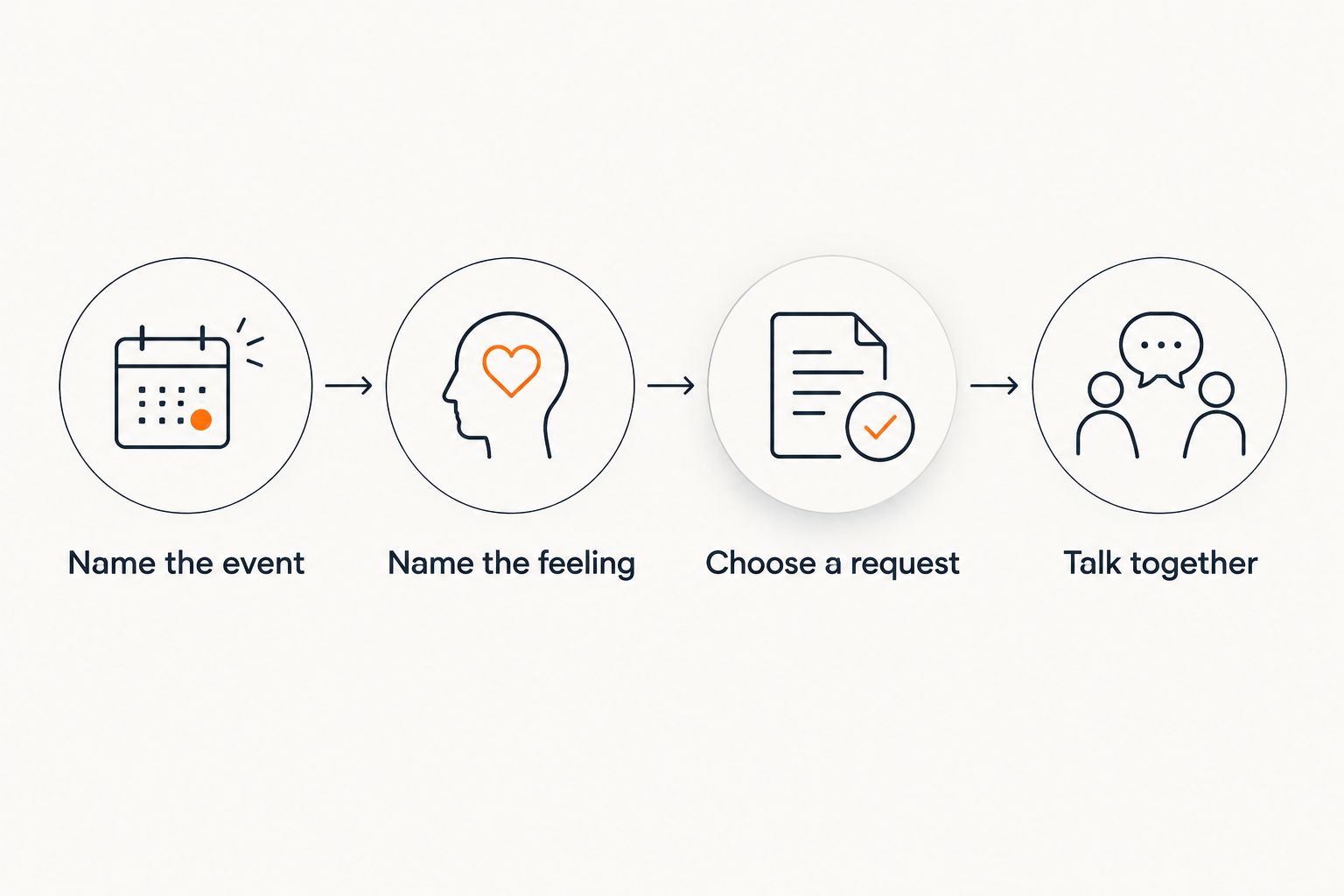 Four steps from describing an event to discussing a clear request with your partner
Use support to prepare your words, then bring the conversation back to your relationship.
A useful request names an action you want to discuss. Asking for advance notice when plans change is more concrete than asking your partner to stop being inconsiderate. You still need to hear the response; a prepared request is not an agreement.
Do not use an app’s answer as proof that your partner is wrong. If the conversation returns to the same painful place, consider a clinician rather than asking for increasingly forceful scripts.
Privacy and safety come before convenience
Before sharing relationship details, review the tool’s current privacy policy. Check whether it stores audio or transcripts, how deletion works, and whether conversations are used to improve its systems. Do not assume an emotional support app has the same confidentiality obligations as a licensed therapist.
Keep another person’s identifying information out of prompts unless it is genuinely necessary and appropriate to share. Names, addresses, workplace details, and intimate disclosures do not automatically make a reflection exercise more useful. You can describe a disagreement without uploading private messages or recordings.
If there are threats, coercion, stalking, or physical violence, prioritize individual safety support over joint app exercises. You do not need to persuade your partner to participate before seeking help. In immediate danger in the United States, call 911; for a mental health or suicide crisis, call or text 988.
Which relationship support option should you choose?
For your 2026 decision, choose individual voice support when you need space to talk through your own feelings. Choose written support when the task is drafting. Choose shared exercises when both partners want structure and feel safe participating.
Choose licensed couples therapy when you need clinical help with the relationship itself. That is the default for readers whose main problem is recurring conflict together, not simply finding somewhere to vent alone. An app can support preparation; it should not replace the work you need.
FAQ
What are the best AI couples therapy apps in 2026?
The best choice depends on whether you need individual emotional support or shared clinical care. Lovon fits individual voice reflection about relationship stress; licensed couples therapy is the appropriate category for therapeutic work involving both partners.
Can an AI app replace a couples therapist?
No, an AI support app does not replace a licensed couples therapist. It can support reflection and conversation preparation, but it is not a clinician and cannot provide your partner’s missing perspective.
Is voice support better than text for relationship problems?
Voice fits people who want to talk aloud, while text fits people who want to reread and revise their thoughts. Neither format establishes the truth of a disagreement or guarantees a better relationship outcome.
Can I use relationship support if my partner refuses?
Yes, you can seek individual support without your partner participating. Use it to understand your feelings and boundaries, not to simulate your partner’s consent or turn solo reflection into joint therapy.
Should we use an AI app together during an argument?
Do not use an AI app as a referee during an argument. Pause if the conversation is escalating, and return to any shared exercise only when both partners feel safe and willing to participate.
Is it safe to share private relationship details with an app?
Check the app’s current privacy terms before sharing sensitive details. Review storage, deletion, and data-use practices, and avoid unnecessary identifying information about your partner.
Can an AI relationship app tell me whether to break up?
An AI relationship app should not make that decision for you. Use reflection to clarify your experience, and seek qualified human support when safety, coercion, or complex relationship decisions are involved.
One last thing
Before accepting any relationship advice, ask whether it helps you describe something observable or merely sounds certain about another person. That distinction matters. Keep guidance that makes your next conversation clearer; reject certainty about motives an app cannot know.
Related guides
How AI Support Helps You Heal
AI emotional support isn't about replacing human connection — it's about filling the gaps. The moments when you need to talk at 2 AM, when you don't want to burden your friends again, or when you simply need someone to listen without judgment.
Here's what happens in a typical Lovon session:
You share what's on your mind
There's no script, no intake form, no waiting room. You speak or type whatever you're feeling — in your own words, at your own pace.
Lovon validates and explores
Using frameworks from CBT (Cognitive Behavioral Therapy) and motivational interviewing, Lovon acknowledges your feelings first, then gently helps you explore them. No dismissive "just move on" advice.
You build coping skills together
Lovon doesn't just listen — it actively works with you on evidence-based techniques: thought reframing, urge surfing, behavioral experiments, and more.
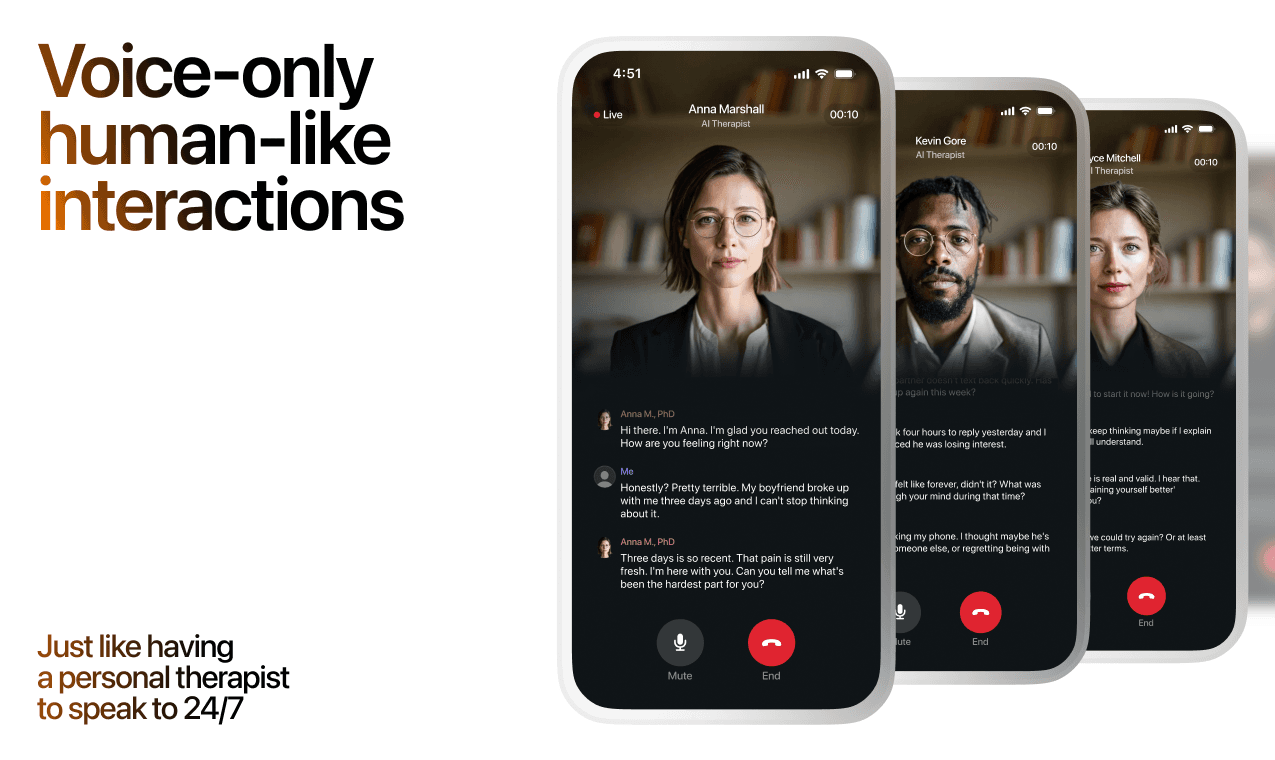
What a Session with Lovon Looks Like
When to Seek Professional Help
AI support is a valuable tool, but it's not a replacement for professional care. Please consider reaching out to a licensed therapist if you experience any of the following:
- Persistent thoughts of self-harm or suicide
- Inability to perform daily activities (work, eating, sleeping) for more than 2 weeks
- Turning to alcohol or substances to cope
- Intense anger or desire to harm your ex-partner
- Complete emotional numbness that doesn't improve over time
Crisis Resources (US): If you're in immediate danger, call 988 (Suicide & Crisis Lifeline) or text HOME to 741741 (Crisis Text Line). Available 24/7, free, and confidential.
Outside the US? Find a crisis line in your country
Ready to Start?
Your healing journey can begin right now
A 7-day trial. No judgment. Just a safe space to process what you're going through.
Frequently Asked Questions
Is Lovon a replacement for a real therapist?
Is my conversation with Lovon AI private?
How is Lovon different from ChatGPT for emotional support?
Can I use Lovon if I'm already seeing a therapist?
Can I try Lovon before subscribing?
About the Author
The Lovon Editorial Team
Mental Health & Wellness Content Team
The Lovon Editorial Team develops mental health and wellness content designed to make psychological concepts accessible and actionable. Our goal is to bridge the gap between clinical research and everyday life - helping you understand why your mind works the way it does and what you can do about it....
Related articles
- Best AI Relationship Coach for Avoidant Attachment 2026
Find the best AI relationship coach for avoidant attachment in 2026. Lovon's voice app gives on-demand coaching, coping…
- Is couples therapy worth it if one partner refuses?
Is couples therapy worth it if one partner refuses? Individual support can help you decide what to do, but it cannot…
- Stonewalling in Relationships: Why It Happens (2026)
Stonewalling in relationships explained: why partners shut down mid-conflict, how to interrupt it, and when to get…
- Pursuer-Withdrawer Pattern: Break the Cycle in 2026
The pursuer withdrawer relationship cycle traps both partners. Learn the 7 steps to interrupt it, backed by EFT research…
See also
Quizzes
- Compatibility Test: 15 Things That Have to Match
Check the fifteen things that do not bend.
- Conflict Style Test: How You Fight and How You Repair
See how you fight, and whether you repair.
Free tools
- Relationship Check-In Questions, and How to Run One
Check-ins fail on structure, not on questions. Tell it whether this would be your first one, what is on your mind, and…
- Would You Rather Questions for Couples
A round built for your pair rather than for a general audience. Tell it how long you two have been together, where you…
From the wiki
- What does clingy mean in a relationship?
Clingy is what people call behavior that asks for more contact or reassurance than the other person wants to give…
Disclaimer: This article is for informational purposes only and does not constitute medical advice, diagnosis, or treatment. Always seek the advice of your physician or other qualified health provider with any questions you may have regarding a medical condition. If you are in crisis or think you may have an emergency, call 988 (Suicide & Crisis Lifeline) or go to the nearest emergency room. Outside the US? Find a crisis line in your country.