
Is couples therapy worth it if one partner refuses?
Is couples therapy worth it if one partner refuses? Individual support can help you decide what to do, but it cannot make your partner join or change. 2026 guide.
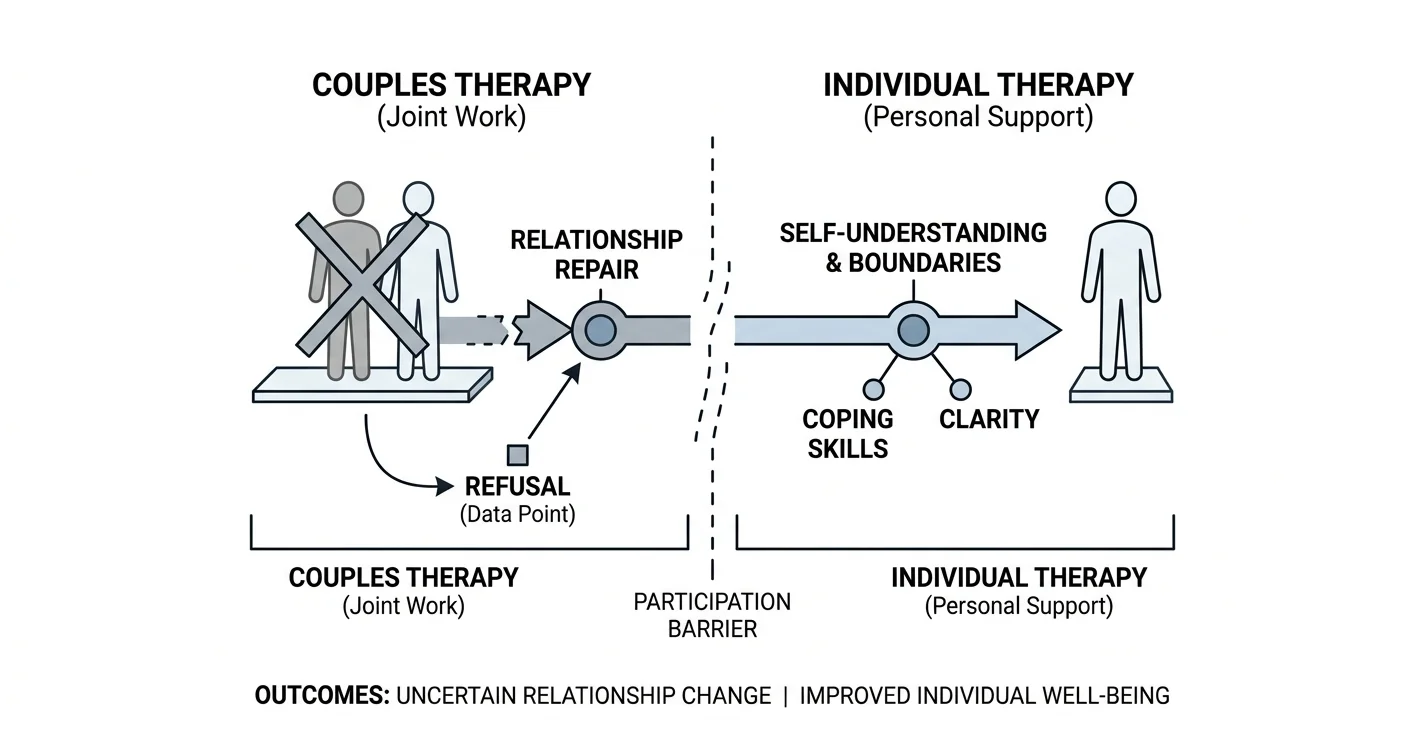

Key Takeaways
- Is couples therapy worth it if one partner refuses? Individual support is worth considering; couples therapy needs
- A refusal is useful information, but it does not tell you why your partner said no.
- Lovon is best for talking through relationship stress on your own, not for replacing a licensed therapist or couples
Yes, getting help can be worth it if your partner refuses couples therapy, but the help you get alone is individual support, not couples therapy. You can work on how you communicate, what boundaries you need, and what you will do if nothing changes. You cannot make your partner participate or repair the relationship by yourself.
TL;DR
- Is couples therapy worth it if one partner refuses? Individual support is worth considering; couples therapy needs both partners to participate.
- A refusal is useful information, but it does not tell you why your partner said no.
- Lovon is best for talking through relationship stress on your own, not for replacing a licensed therapist or couples therapy.
Is couples therapy worth it if one partner refuses?
Yes, if you mean getting support for yourself. No, if you expect a couples therapist to change a partner who will not take part. The distinction matters because the work has different goals. In individual therapy, you can examine your part in a conflict and decide what you need. In couples therapy, both people have to be willing to discuss the relationship together.
A refusal does not automatically mean your partner does not care. They might object to therapy itself, feel blamed by the way it was suggested, or simply not want to go. You do not need to settle that question before deciding how to care for yourself. If conversations keep ending in pursuit and withdrawal, learning about the pursuer-withdrawer pattern can give you words for what is happening without assigning either person a diagnosis.
| Option | Best for | What it can help you do | What it cannot do |
|---|---|---|---|
| Individual therapy | Understanding your feelings, choices, and boundaries | Work with a licensed professional on your own concerns | Speak for your partner or guarantee a change in their behavior |
| Couples therapy | Working on the relationship when both partners agree to participate | Give both people a place to discuss recurring problems | Work as a joint process while one partner refuses to take part |
| A voice support app | Talking through everyday relationship stress on your own | Help you reflect and practice putting feelings into words | Replace licensed care, assess your partner, or resolve conflict for both of you |
In 2026, the useful question is not whether therapy can persuade your partner. It is whether support will help you see the situation more clearly and make a decision you can live with.
Why this matters
It is easy to treat your partner's refusal as another problem you must solve. That can leave you preparing better arguments for therapy while the original concern goes untouched. Ask what you hoped couples therapy would change: repeated arguments, distance, broken trust, or the feeling that you cannot speak honestly. Those concerns still deserve attention even when your preferred way of addressing them is unavailable.
Your next move depends on what the refusal means in practice. A partner who declines therapy but will talk, listen, and make changes is offering something different from a partner who refuses every conversation about the problem. Neither response guarantees an outcome. Both tell you where your shared effort stands right now.
You are allowed to seek help without waiting for permission. You are also allowed to decide that working on your own reactions is not enough when the problem requires your partner's participation.
What can you do when your partner says no?
Start with one clear invitation, then make a plan that does not depend on changing their answer. Repeatedly selling therapy can turn the conversation into a fight about therapy instead of a discussion of the relationship.
- Name the concern. Describe what is happening without diagnosing your partner. For example, say that conversations about a recurring conflict keep ending before either of you feels heard. Stay with the behavior you want to address.
- Offer an invitation. Ask whether your partner is willing to attend couples therapy to work on that concern together. Invite a direct answer rather than treating silence as agreement. If they ask what you want from therapy, tell them in plain language.
- Respect the answer. Do not book a joint session on your partner's behalf or use therapy as a test of whether they love you. You can say the issue still matters to you without reopening the same argument every day.
- Get your own support. Consider individual therapy if you want help understanding patterns, setting boundaries, or deciding what to do next. Talking with someone you trust can also help you feel less alone while you think.
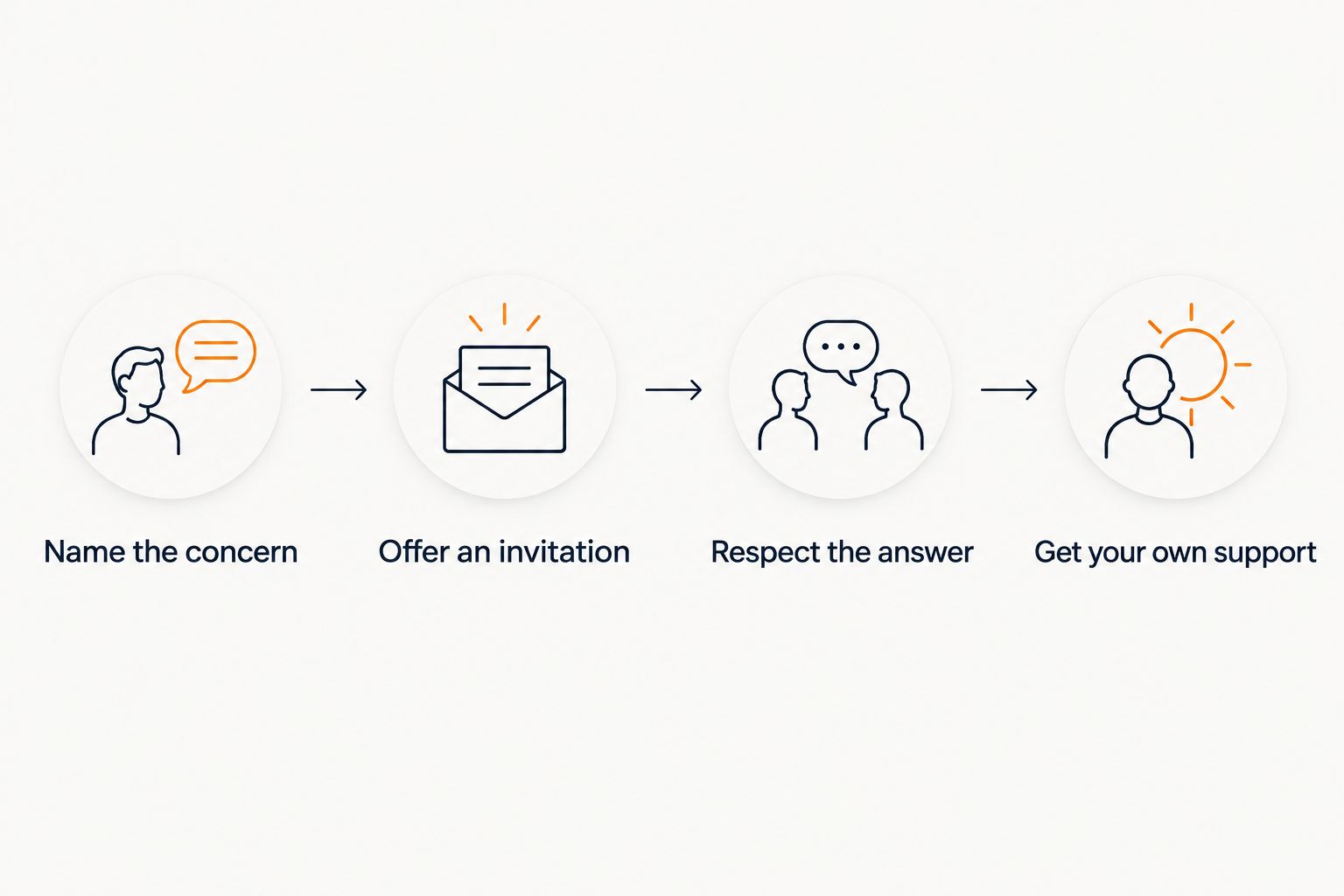 Steps for responding when a partner refuses couples therapy
An invitation is yours to offer; the decision to seek your own support is yours to make.
In 2026, the same principle applies whether the refusal comes after one conversation or many: you can invite participation, but you cannot consent on someone else's behalf. Focus on what is within your control. That includes the way you speak, the limits you set, and whether you stay in a situation that is hurting you.
If your partner says no because they feel accused, you can clarify that the goal is to discuss how you both handle a problem. Clarifying is different from taking responsibility for every conflict. You do not have to agree that your concerns are invalid to make the invitation sound less like blame.
Why does the answer vary between relationships?
Whether getting help alone feels worthwhile depends on what you need help with and what your partner is willing to do outside therapy. Look at the behavior in front of you, not just the word no.
- Willingness to talk: A partner can decline couples therapy and still discuss a problem with you. If every attempt to talk is dismissed, individual support can help you decide what that means for you.
- The kind of conflict: A disagreement about how to handle chores calls for a different conversation from a breach of trust. Be specific about the issue instead of asking therapy to fix the relationship as a whole.
- Follow-through: Listen to what your partner says they will do, then notice whether their actions match. An agreement to talk matters less if the conversation never happens.
- Your own distress: If you are losing sleep, feeling constantly on edge, or struggling to think clearly, your wellbeing deserves attention regardless of your partner's decision.
- Safety: If you feel threatened, pressured, or afraid of your partner's reaction, the priority is your safety, not persuading them to attend a joint session.
These factors do not produce a score or a deadline. They help you ask a more useful question: What am I being asked to live with, and is it acceptable to me?
Can individual therapy help a relationship if only one person goes?
Yes, individual therapy can help you understand and change your own responses. That can affect how you take part in conversations, but it does not make you responsible for both sides of the relationship. A licensed therapist can help you separate what belongs to you from what requires your partner's effort.
You might notice that you agree to things you do not want, avoid raising concerns until you are overwhelmed, or keep having the same argument without saying what you need. Those are workable topics for individual sessions. So is the question of whether you want to remain in the relationship. Therapy does not have to be a plan for saving it.
Be careful with advice that promises you can fix a relationship alone if you choose the right words. You can speak more clearly and still hear no. In 2026, individual therapy remains your space to make sense of that answer, not a way to direct your partner's choices.
Should you keep asking your partner to try couples therapy?
Ask clearly, listen to the answer, and avoid turning the invitation into a campaign. You can revisit it if circumstances change or your partner brings it up. In the meantime, discuss the underlying concern directly: what needs to change, who is willing to work on it, and what each of you will actually do.
If your partner says they are open to working on the relationship but not to therapy, ask what they are willing to try instead. Make the request concrete enough that you can both recognize whether it happens. If the response is only that things will get better, you can say you need more than reassurance.
You do not need to wait indefinitely for a different answer. You can decide what you need from a relationship without issuing an ultimatum in every conversation. A boundary describes what you will do if a situation continues; it is not a tool for forcing someone else into therapy.
What if the relationship feels unsafe?
Do not treat couples therapy as the first task if you are afraid of your partner or worried that speaking openly will put you at risk. Talk privately with a qualified professional or a domestic violence support service about your circumstances and a safer next step. Do not use a joint session to raise concerns you cannot safely discuss in front of your partner.
Feeling hurt after an argument is not, by itself, proof that a relationship is unsafe. Fear, threats, coercion, and retaliation deserve their own attention. You do not need to establish a label for your partner before seeking support. If you are in immediate danger, contact emergency services where you are.
This is also a reason to be careful with quick advice that assumes every relationship problem is a communication problem. Some conflicts call for a calmer conversation. Others call for distance, outside help, or a plan to stay safe. If you are unsure which situation you are in, discuss the details privately with a qualified person.
Where does Lovon fit if your partner refuses?
Lovon offers voice conversations for emotional support, coping tools, and self-reflection when you want to talk through relationship stress on your own. Lovon is best for someone who wants space to reflect on everyday relationship stress, not someone seeking couples therapy or licensed clinical care. It cannot speak for your partner or tell you what they intend.
You can use a conversation to put a feeling into words, think through a boundary, or prepare a question you want to ask. The limitation matters: an app does not hear both sides of a relationship, and it does not replace a licensed therapist. If distress is affecting your daily life or the relationship feels unsafe, seek qualified human support.
In 2026, it helps to keep these roles separate. A voice support app gives you a place to reflect. An individual therapist can work with you on your mental health. Couples therapy is joint work that needs both partners to participate. Choose the kind of help that matches the problem you are trying to address.
FAQ
Is couples therapy worth it if one partner refuses?
Getting individual support can be worthwhile, but couples therapy cannot function as joint work without your partner's participation. You can work on your own choices and boundaries without expecting to change theirs.
Can I go to a couples therapist alone?
You can ask a couples therapist whether they offer individual sessions or an initial consultation, but a solo session is not the same as couples therapy. Explain that your partner has declined so the professional can tell you what support they offer.
Can individual therapy save my relationship?
Individual therapy can help you understand your feelings and actions, but it cannot guarantee that a relationship will continue. Changes that require your partner's participation remain their choice.
Should I break up if my partner won't go to therapy?
A refusal alone does not decide whether you should break up. Look at the underlying problem, your partner's willingness to address it in other ways, and what you need to feel safe and respected.
How do I ask my partner to try couples therapy without blaming them?
Name a specific concern and invite them to work on it with you. Say what you hope a joint conversation would help you address, then give them room to answer honestly.
What if my partner agrees to change but still refuses therapy?
You can discuss what change would look like without making therapy the only acceptable route. Pay attention to follow-through rather than relying on a promise alone.
Is an app a substitute for couples therapy?
No, a voice support app cannot replace joint sessions with a licensed professional. Lovon can help you reflect on relationship stress on your own, but it cannot work with both partners or provide licensed clinical care.
One last thing
Your partner's refusal answers one question: they do not want couples therapy now. It does not answer whether you must keep living with the same problem. In 2026, the next useful step is to name what needs to change even if therapy never happens, then notice whether you are both willing to act on it.
You do not need a perfect explanation of your partner's reasons before you ask for support. Start with your own experience. If you feel pressured to do all the repairing, say so to someone who can help you think clearly and safely.
Related guides
How AI Support Helps You Heal
AI emotional support isn't about replacing human connection — it's about filling the gaps. The moments when you need to talk at 2 AM, when you don't want to burden your friends again, or when you simply need someone to listen without judgment.
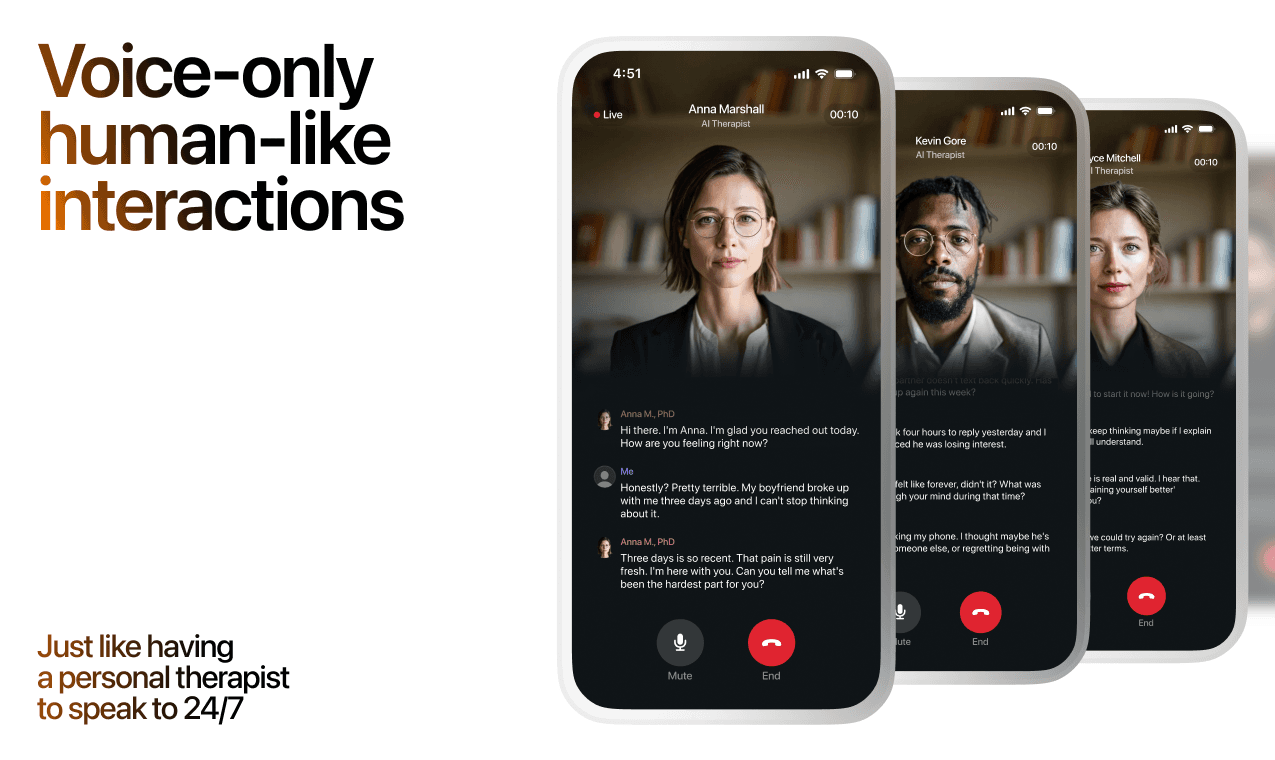
Here's what happens in a typical Lovon session:
You share what's on your mind
There's no script, no intake form, no waiting room. You speak or type whatever you're feeling — in your own words, at your own pace.
Lovon validates and explores
Using frameworks from CBT (Cognitive Behavioral Therapy) and motivational interviewing, Lovon acknowledges your feelings first, then gently helps you explore them. No dismissive "just move on" advice.
You build coping skills together
Lovon doesn't just listen — it actively works with you on evidence-based techniques: thought reframing, urge surfing, behavioral experiments, and more.
What a Session with Lovon Looks Like
When to Seek Professional Help
AI support is a valuable tool, but it's not a replacement for professional care. Please consider reaching out to a licensed therapist if you experience any of the following:
- Persistent thoughts of self-harm or suicide
- Inability to perform daily activities (work, eating, sleeping) for more than 2 weeks
- Turning to alcohol or substances to cope
- Intense anger or desire to harm your ex-partner
- Complete emotional numbness that doesn't improve over time
Crisis Resources (US): If you're in immediate danger, call 988 (Suicide & Crisis Lifeline) or text HOME to 741741 (Crisis Text Line). Available 24/7, free, and confidential.
Outside the US? Find a crisis line in your country
Ready to Start?
Your healing journey can begin right now
A 7-day trial. No judgment. Just a safe space to process what you're going through.
Frequently Asked Questions
Is Lovon a replacement for a real therapist?
Is my conversation with Lovon AI private?
How is Lovon different from ChatGPT for emotional support?
Can I use Lovon if I'm already seeing a therapist?
Can I try Lovon before subscribing?
About the Author

The Lovon Editorial Team
Mental Health & Wellness Content Team
The Lovon Editorial Team develops mental health and wellness content designed to make psychological concepts accessible and actionable. Our goal is to bridge the gap between clinical research and everyday life - helping you understand why your mind works the way it does and what you can do about it....
Related articles
- Stonewalling in Relationships: Why It Happens (2026)
Stonewalling in relationships explained: why partners shut down mid-conflict, how to interrupt it, and when to get…
- Couples Therapy Intake Process: Observation Session Followed by Individual Breakout Sessions
The couples therapy intake process often feels mysterious to those scheduling their first appointment. Many couples…
- AI Relationship Advice for Long-Distance Couples 2026
The best AI relationship advice for long-distance couples in 2026. Lovon's voice-based AI coach gives on-demand support…
- How to Stop Yelling at Your Partner (2026 Guide)
Learn how to stop yelling at your partner with a step-by-step 2026 method: spot the trigger, call a pause, reset your…
See also
Quizzes
- What's My Love Language? Free 15-Question Quiz
Find your love language in 2 minutes.
- Conflict Style Test: How You Fight and How You Repair
See how you fight, and whether you repair.
Free tools
- Conversation Starters for Couples, Picked for Tonight
Most lists hand you a hundred questions and no idea which one to open with. Say how long you have been together, what…
- Relationship Check-In Questions, and How to Run One
Check-ins fail on structure, not on questions. Tell it whether this would be your first one, what is on your mind, and…
From the wiki
- What is the bare minimum in a relationship?
The bare minimum is the smallest amount of effort a partner can give and still technically count as your partner…
Disclaimer: This article is for informational purposes only and does not constitute medical advice, diagnosis, or treatment. Always seek the advice of your physician or other qualified health provider with any questions you may have regarding a medical condition. If you are in crisis or think you may have an emergency, call 988 (Suicide & Crisis Lifeline) or go to the nearest emergency room. Outside the US? Find a crisis line in your country.