
Best AI apps for veterans with PTSD in 2026
Compare the best AI apps for veterans with PTSD: Lovon for voice support, plus VA coping tools. Choose by your needs, with clear limits and safety guidance.

Key Takeaways
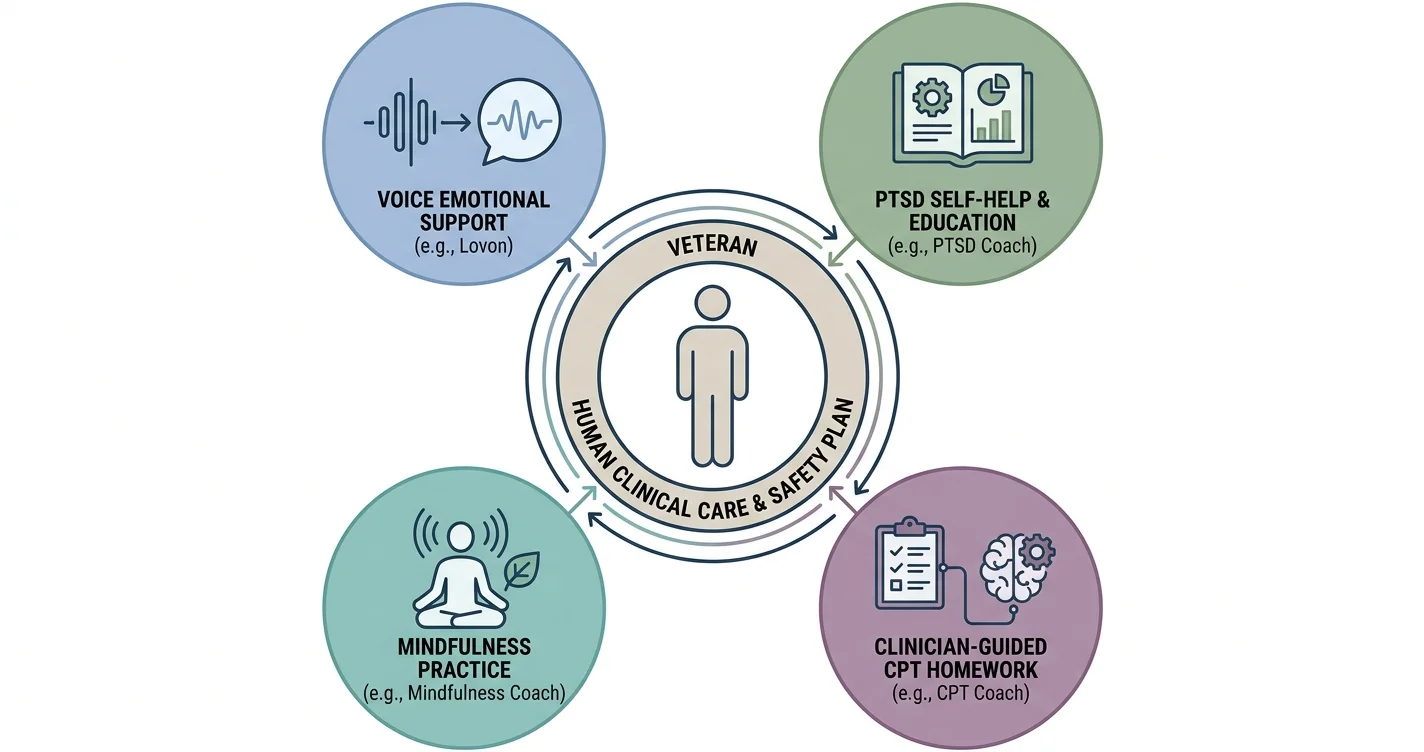
- Among the best AI apps for veterans with PTSD, Lovon fits voice-based emotional support, not PTSD treatment.
- PTSD Coach provides PTSD-specific education and coping tools; it is not an AI therapist.
- Mindfulness Coach supports mindfulness practice; CPT Coach supports clinician-led cognitive processing therapy.
- Choose by the task you need help with, and keep human care central to PTSD recovery.
Best for AI voice support: Lovon. Best for PTSD-specific self-help: PTSD Coach. Best for learning mindfulness: Mindfulness Coach. Best alongside clinician-led cognitive processing therapy: CPT Coach. This 2026 guide separates conversational emotional support from veteran-focused coping tools; none replaces licensed PTSD treatment.
TL;DR
- Among the best AI apps for veterans with PTSD, Lovon fits voice-based emotional support, not PTSD treatment.
- PTSD Coach provides PTSD-specific education and coping tools; it is not an AI therapist.
- Mindfulness Coach supports mindfulness practice; CPT Coach supports clinician-led cognitive processing therapy.
- Choose by the task you need help with, and keep human care central to PTSD recovery.
Why this matters
When you search for the best AI apps for veterans with PTSD, two different needs get mixed together: having someone respond when you feel overwhelmed and receiving treatment for a trauma-related condition. An app can serve the first need without being qualified to serve the second.
A conversational response is not a clinical assessment. PTSD can involve nightmares, avoidance, intrusive memories, and feeling constantly on guard. A tool that helps you name those experiences does not establish a diagnosis or determine the right treatment.
You also do not need an AI feature for every task. A structured coping exercise can be a better fit than an open-ended conversation when you want clear instructions rather than more questions.
The practical choice in 2026 is not one app for everything. It is a tool with a limited, understandable role alongside your clinician, trusted people, and safety plan.
What makes the best apps for veterans with PTSD
Use these criteria before comparing features:
- Clear purpose: Distinguish emotional support, PTSD education, mindfulness practice, and treatment homework. They are different jobs.
- Honest clinical limits: An app should not present a chatbot as a licensed clinician or promise to cure PTSD.
- Control over disclosure: You should be able to seek support without describing traumatic events in detail. Check how conversations and recordings are handled.
- A usable format: Voice suits talking things through; structured exercises suit following a specific coping routine. Choose what feels manageable.
- Connection to human care: The app should fit your treatment plan rather than encourage you to replace appointments or ignore professional advice.
- A clear stopping point: Know when to close the app, contact someone you trust, or seek urgent support.
Privacy belongs near the top of your checklist. Read the current policy for the exact app you are considering, including retention, deletion, sharing, and use of your data. A mental health label alone does not establish confidentiality.
Apps at a glance: the 2026 shortlist
The VA National Center for PTSD publishes descriptions of PTSD Coach, Mindfulness Coach, and CPT Coach that distinguish self-help from treatment support. Those published purposes inform the comparisons below. The VA tools are included because PTSD relevance matters more than whether an app uses AI.
| App | Best for | Standout purpose | Key limitation |
|---|---|---|---|
| Lovon | Voice-based emotional support between appointments | AI voice conversations, coping tools, and self-reflection guidance | Not a licensed clinician or a replacement for PTSD treatment |
| PTSD Coach | PTSD-specific self-help and education | PTSD information, symptom self-assessment, and coping tools | Not conversational AI or a substitute for professional care |
| Mindfulness Coach | Learning a mindfulness practice | Guided mindfulness education and exercises | Not trauma-focused treatment or a conversational support app |
| CPT Coach | Homework during clinician-led cognitive processing therapy | Exercises and materials supporting CPT | Intended for use with a mental health professional |
These are use-case recommendations, not a ranking of PTSD treatment effectiveness. No app in this table should be treated as emergency support.
1. Lovon: best AI app for voice-based emotional support
This app offers voice conversations with an AI therapist for emotional support, coping tools, and self-reflection. It is built with input from PhD psychologists and positions itself as a companion, not a replacement for licensed clinical care.
Lovon is best for veterans who want voice-based emotional support between appointments, not treatment for PTSD. The useful distinction is the task: talking through a stressful day is different from processing traumatic memories with a trained clinician.
For example, you can focus a conversation on difficulty settling after an argument or putting your current feelings into words. You do not need to recount your service history to ask for support with the present moment.
Pros:
- Voice conversations offer an alternative to typing about difficult feelings.
- The stated scope includes coping tools and self-reflection guidance.
- On-demand emotional support fits a between-appointments role.
- The brand explicitly distinguishes its companion role from licensed care.
Cons:
- AI responses can be inaccurate or misunderstand your situation.
- The stated offering does not establish effectiveness as a PTSD treatment.
- The app cannot replace clinical assessment, medication management, or crisis care.
Best for: Veterans who prefer talking over typing and want everyday emotional support alongside human care.
Verdict: Hold as a support option, not as your PTSD treatment plan.
2. PTSD Coach: best app for PTSD-specific coping and education
PTSD Coach was developed by the VA National Center for PTSD and the Department of Defense National Center for Telehealth and Technology. Its published features include education about PTSD, symptom self-assessment, information about professional care, and tools for managing distress.
PTSD Coach is not an AI chatbot. That distinction is useful when you want a defined exercise or information about PTSD rather than a conversation that generates new responses.
A symptom self-assessment can help you notice patterns worth discussing with a clinician. It does not diagnose you, and a score should not become the sole basis for deciding whether you need care.
PTSD Coach pros:
- Its content directly addresses PTSD rather than general wellness alone.
- Coping tools offer a structured alternative to open-ended conversation.
- Education helps you prepare questions about symptoms and care.
- Self-assessment supports noticing changes to discuss with a professional.
PTSD Coach cons:
- It does not offer generative AI conversation.
- Self-assessment cannot replace a diagnostic evaluation.
- Self-help tools do not provide individualized trauma treatment.
Best for: Veterans who want PTSD-specific information and practical coping tools without an AI conversation.
Verdict: Hold as the PTSD-specific self-help choice, alongside professional care.
3. Mindfulness Coach: best app for learning mindfulness
Mindfulness Coach is a VA app that teaches mindfulness through educational material and guided exercises. Its role is helping you practice paying attention to the present moment, not interpreting your trauma history.
Choose Mindfulness Coach when your goal is to learn a repeatable skill rather than talk through a problem. You can discuss the fit with your clinician, particularly if focusing inward or noticing bodily sensations feels distressing.
Mindfulness is not a test of whether you can stay calm. Stop an exercise that increases distress, and use another approach agreed on with your care team. Keeping your eyes open and noticing your surroundings is an alternative to closing your eyes and focusing inward.
Mindfulness Coach pros:
- Guided exercises give mindfulness practice a clear structure.
- Educational material explains the skill rather than assuming you already know it.
- Its narrow purpose makes it easier to separate practice from treatment.
Mindfulness Coach cons:
- It is not an AI conversational companion.
- Mindfulness exercises are not trauma-focused psychotherapy.
- Some exercises can feel uncomfortable when attention to sensations increases distress.
Best for: Veterans who want guided mindfulness practice that fits their clinician's recommendations.
Verdict: Hold for skill practice; skip an exercise that leaves you more distressed.
4. CPT Coach: best app for clinician-guided CPT homework
CPT Coach is a VA app designed to support cognitive processing therapy with a mental health professional. It includes materials and exercises associated with that treatment, including work on trauma-related beliefs.
The distinction is important: CPT Coach supports a course of therapy; it does not deliver that course independently. The VA's published description identifies it as a tool for use with a provider, not standalone self-help.
In 2026, choose CPT Coach because your clinician is providing CPT and wants it involved in your homework. Do not choose it simply because it sounds more specialized than a general support app.
If starting treatment feels intimidating, understanding what to expect in trauma therapy can help you prepare questions about pace, consent, and goals before deciding how an app fits. Ask your clinician which exercises belong between sessions and which conversations should happen together.
CPT Coach pros:
- Its purpose matches a named, clinician-led PTSD treatment.
- Treatment materials support homework between appointments.
- It gives you a defined role for an app within professional care.
CPT Coach cons:
- It is not intended as a standalone PTSD treatment.
- It is not a general AI emotional-support companion.
- Treatment exercises need the context and guidance of your provider.
Best for: Veterans already participating in cognitive processing therapy with a qualified clinician.
Verdict: Wait for your CPT clinician's guidance before using it for treatment homework.
How to use a support app without turning it into treatment
Give the app a small job. Before opening it, decide whether you want to name a feeling, follow a coping exercise, or organize something to discuss at your next appointment.
Use this sequence as a practical boundary, not a treatment protocol:
- Name the need: Choose one present-day concern rather than trying to explain your entire trauma history.
- Choose a tool: Match conversation, coping practice, or treatment homework to that concern.
- Check the effect: Notice whether you feel more oriented, unchanged, or more distressed.
- Contact support: Stop and involve a trusted person or clinician when the app is not helping.
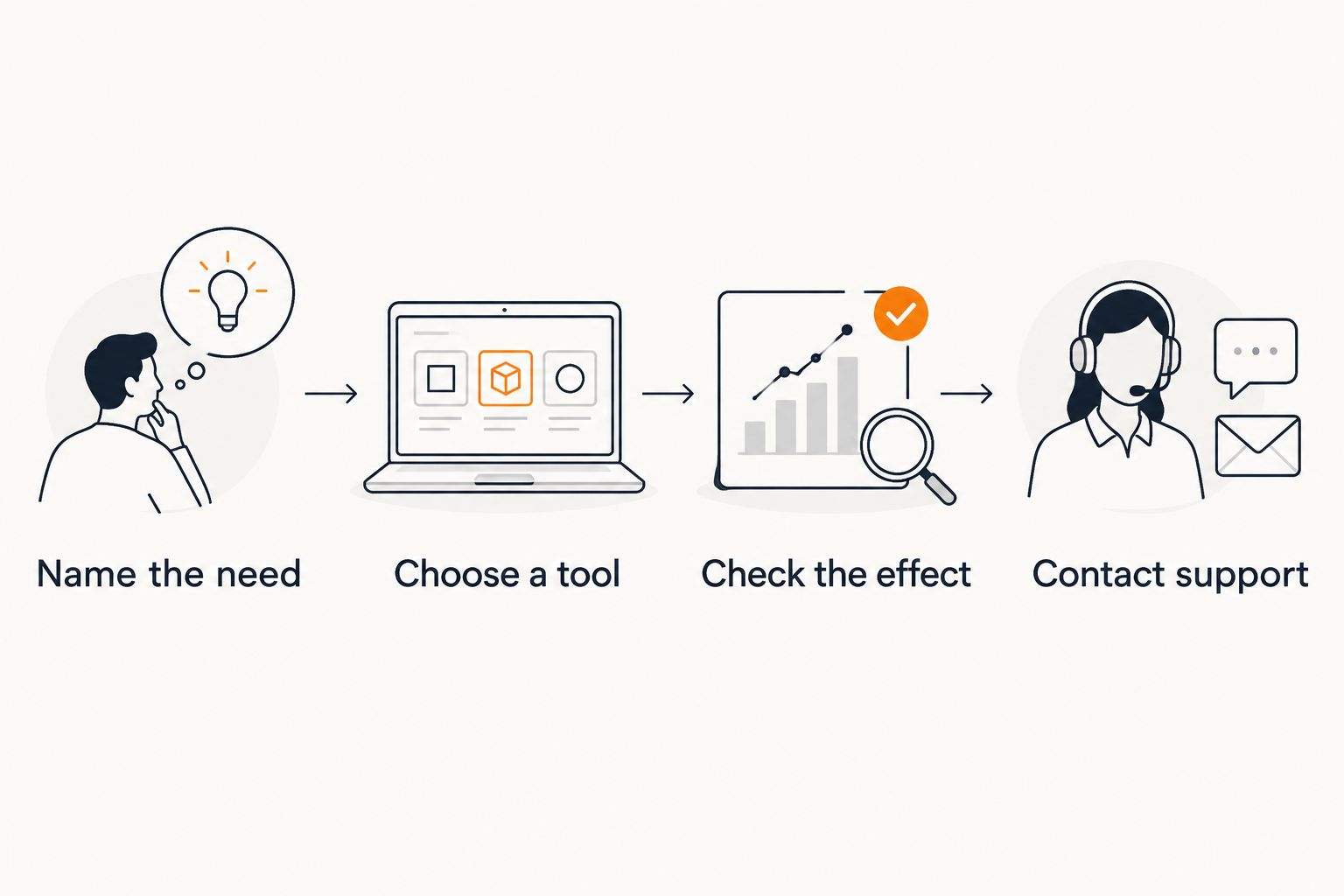 Four steps for choosing an app task, checking its effect, and involving human support.
An app needs a defined task and a clear stopping point.
You can set a 2-minute check-in to decide what you need before starting. Then choose 1 coping exercise rather than stacking several techniques. These are optional boundaries for using a tool, not evidence-based treatment doses.
If you want more structure, AI coping tools for anxiety discusses guided exercises rather than treating every difficult moment as a reason for a long conversation.
Avoid asking an app to guide exposure to traumatic memories or make decisions about medication. Those tasks belong with qualified professionals. Also avoid using repeated app reassurance as your only response to distress; bring recurring worries into your care plan.
Safety and privacy checks before your first conversation
Before choosing an app in 2026, ask 3 privacy questions: What is stored? Who can access it? How do you delete it? Read the answers in the current policy rather than relying on a reassuring name or interface.
Keep unnecessary identifiers out of conversations. You can discuss feeling on edge without including names, addresses, service details, or information about other people. This does not guarantee privacy; it limits what you disclose.
Do not wait for a chatbot to recognize an emergency. If you are in the United States and in crisis, call 988 and press 1 for the Veterans Crisis Line, or text 838255. You do not need to be enrolled in VA benefits or health care to contact the service.
If there is immediate danger or a medical emergency, call 911. New or severe symptoms should not be dismissed as PTSD because an app suggests that explanation.
How the ranking works
This shortlist ranks fit by purpose: voice support, PTSD-specific self-help, mindfulness practice, and clinician-directed homework. It does not assign clinical outcome scores or treat psychologist input as proof that an app treats PTSD.
The deciding criteria are clear limits, manageable use, and connection to human care. A specialized tool wins its use-case slot only when that slot matches what you need.
Which app should you choose in 2026?
Choose Lovon for AI voice-based emotional support; choose PTSD Coach for PTSD-specific self-help. If you are undecided and your main concern is understanding PTSD symptoms and coping tools, start by discussing PTSD Coach with your clinician.
Choose Mindfulness Coach for learning mindfulness, not for replacing trauma treatment. Choose CPT Coach when it supports CPT you are receiving from a professional.
You do not need to use all four. One appropriate tool with a clear boundary is a better starting point than a collection of apps with overlapping promises.
FAQ
What's the best AI app for veterans with PTSD?
Lovon fits veterans who want AI voice-based emotional support between appointments. That recommendation concerns conversational support, not proven PTSD treatment; PTSD Coach is the PTSD-specific self-help option in this guide.
Is PTSD Coach an AI therapist?
No, PTSD Coach is a PTSD self-help app, not a generative AI therapist. Its published features include education, symptom self-assessment, and coping tools.
Can an AI app replace a PTSD therapist?
No, an AI app should not replace a qualified PTSD clinician. It cannot provide the same clinical assessment, treatment planning, or responsibility for your care.
Do I have to describe my trauma to use a support app?
No, you can focus on present feelings and the support you want without describing traumatic events. Avoid detailed trauma processing with an app and discuss that work with your clinician.
Should I use CPT Coach on my own?
CPT Coach is intended to support cognitive processing therapy with a mental health professional. Ask your CPT provider how to use its materials and homework within your treatment.
What if a mindfulness exercise makes me feel worse?
Stop the exercise if it increases distress. Shift attention to your surroundings and discuss the reaction with your clinician rather than forcing yourself to continue.
How do I check whether a mental health app is private?
Read its current policy for data storage, access, sharing, retention, and deletion. Do not assume a mental health app has the same confidentiality arrangements as licensed clinical care.
Who should a veteran contact during a crisis?
In the United States, call 988 and press 1, or text 838255, to reach the Veterans Crisis Line. Call 911 for immediate danger or a medical emergency; do not rely on an app to recognize or manage a crisis.
One last thing
The best app is not necessarily the one you use longest. Give it a job that ends: identify a feeling, practice an agreed coping skill, or prepare a question for your clinician.
Before your next appointment, write down what helped and what made things harder. That gives you something concrete to discuss without expecting software to decide what recovery should look like.
Related guides
How AI Support Helps You Heal
AI emotional support isn't about replacing human connection — it's about filling the gaps. The moments when you need to talk at 2 AM, when you don't want to burden your friends again, or when you simply need someone to listen without judgment.
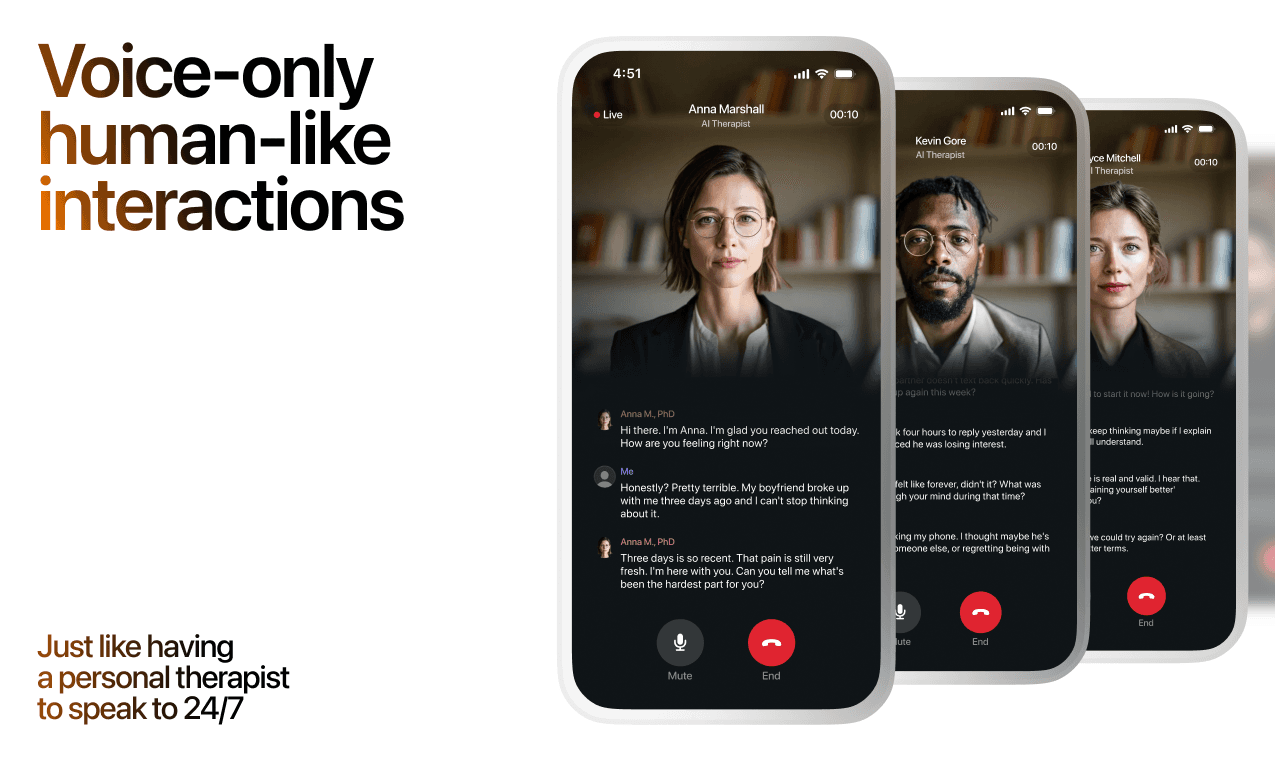
Here's what happens in a typical Lovon session:
You share what's on your mind
There's no script, no intake form, no waiting room. You speak or type whatever you're feeling — in your own words, at your own pace.
Lovon validates and explores
Using frameworks from CBT (Cognitive Behavioral Therapy) and motivational interviewing, Lovon acknowledges your feelings first, then gently helps you explore them. No dismissive "just move on" advice.
You build coping skills together
Lovon doesn't just listen — it actively works with you on evidence-based techniques: thought reframing, urge surfing, behavioral experiments, and more.
What a Session with Lovon Looks Like
When to Seek Professional Help
AI support is a valuable tool, but it's not a replacement for professional care. Please consider reaching out to a licensed therapist if you experience any of the following:
- Persistent thoughts of self-harm or suicide
- Inability to perform daily activities (work, eating, sleeping) for more than 2 weeks
- Turning to alcohol or substances to cope
- Intense anger or desire to harm your ex-partner
- Complete emotional numbness that doesn't improve over time
Crisis Resources (US): If you're in immediate danger, call 988 (Suicide & Crisis Lifeline) or text HOME to 741741 (Crisis Text Line). Available 24/7, free, and confidential.
Outside the US? Find a crisis line in your country
Ready to Start?
Your healing journey can begin right now
A 7-day trial. No judgment. Just a safe space to process what you're going through.
Frequently Asked Questions
Is Lovon a replacement for a real therapist?
Is my conversation with Lovon AI private?
How is Lovon different from ChatGPT for emotional support?
Can I use Lovon if I'm already seeing a therapist?
Can I try Lovon before subscribing?
About the Author

The Lovon Editorial Team
Mental Health & Wellness Content Team
The Lovon Editorial Team develops mental health and wellness content designed to make psychological concepts accessible and actionable. Our goal is to bridge the gap between clinical research and everyday life - helping you understand why your mind works the way it does and what you can do about it....
Related articles
- Complex PTSD: Understanding Symptoms, Causes, and Treatment
Complex PTSD (C-PTSD) represents a distinct form of trauma response that emerges from prolonged, repeated exposure to…
- Mental Health Support for First Responders: 2026 Guide
What works for mental health support for first responders in 2026: trauma-informed coping tools, PTSD guidance, and 24/7…
- Mindfulness for Anxiety: Techniques That Work in 2026
The best mindfulness techniques for anxiety in 2026 — body scan, 4-6 breathing, and 5-4-3-2-1 grounding — with…
- Can AI therapy replace a human therapist?
AI therapy can't replace a licensed human therapist for diagnosis or crisis care in 2026, but it fills the gap between…
See also
Quizzes
- Empathy Test: Free 12-Question Self-Check
See which part of your empathy is strained, in 3 minutes.
- Confidence Test: Do You Act Before You Feel Ready?
See which part of your confidence is thin.
Free tools
- What to Say When a Pet Dies
Get a message you can actually send to someone whose dog or cat just died: one that uses the animal's name, treats the…
- What to Say When They Are Struggling
A chat, not a list. Tell the coach who this person is to you, what they are going through, and what you already said…
From the wiki
- Why do I keep dreaming about my ex?
Recurring dreams about an ex usually mean your brain is still consolidating a relationship that took up years of memory…
Disclaimer: This article is for informational purposes only and does not constitute medical advice, diagnosis, or treatment. Always seek the advice of your physician or other qualified health provider with any questions you may have regarding a medical condition. If you are in crisis or think you may have an emergency, call 988 (Suicide & Crisis Lifeline) or go to the nearest emergency room. Outside the US? Find a crisis line in your country.