
AI Support App for Sober Curious Anxiety: 2026 Verdict
Cutting back on drinking brings anxiety spikes most sobriety trackers miss. See what an AI support app for sober curious anxiety should offer in 2026.

Key Takeaways
- Lovon runs voice-based coping sessions built for anxiety spikes that show up when you cut back on drinking in 2026.
- Skip apps that only count sober days — anxiety needs nervous-system tools, not a streak counter.
- Late-night anxiety is common in the first weeks of sober curious changes; look for 24/7 voice access, not office hours.
- Lovon is not a replacement for licensed care — use it as support between sessions, or while you figure out what you
Cutting back on alcohol doesn't just change your evenings — it changes your anxiety. The buzz that used to blunt a racing mind is gone, and a lot of sober curious people find out fast that their nervous system was never actually calm, just quieted. This guide breaks down what an AI support app for sober curious anxiety needs to get right, and where it falls short.
TL;DR
- Lovon runs voice-based coping sessions built for anxiety spikes that show up when you cut back on drinking in 2026.
- Skip apps that only count sober days — anxiety needs nervous-system tools, not a streak counter.
- Late-night anxiety is common in the first weeks of sober curious changes; look for 24/7 voice access, not office hours.
- Lovon is not a replacement for licensed care — use it as support between sessions, or while you figure out what you need.
Why This Matters
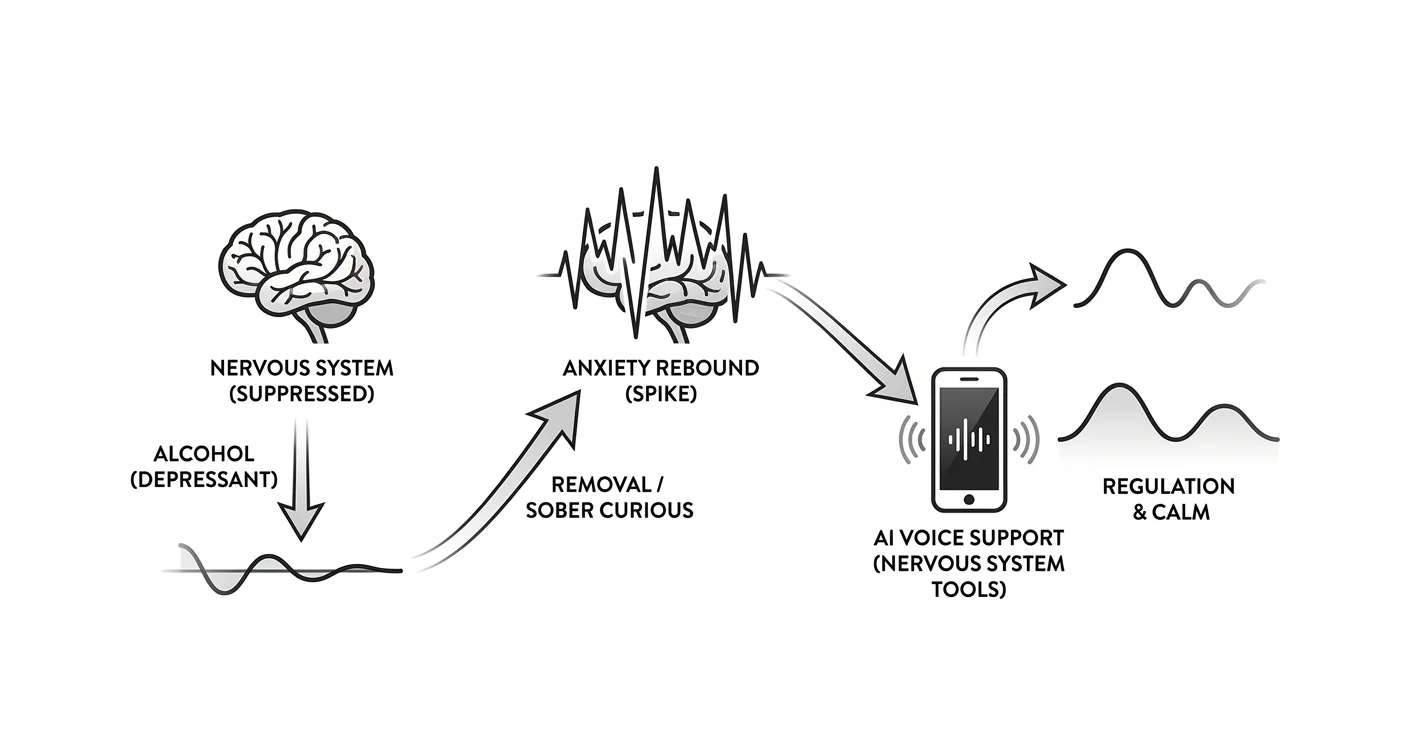
Alcohol suppresses activity in the nervous system. Pull it out of the routine, even partially, and the system rebounds — that's the pharmacology behind why so many sober curious people report new or sharper anxiety in the first weeks of changing their drinking habits. It's not a character flaw. It's a nervous system doing what nervous systems do.
Most apps built for this moment focus on the drinking itself: streak counters, craving trackers, community check-ins. Useful, but incomplete. If the anxiety underneath the drinking never gets addressed, the sober curious phase gets a lot harder than it needs to be. An AI support app for sober curious anxiety has to do double duty in 2026 — support the behavior change and the emotional spike that comes with it.
Who This Is For
This is for the person who's drinking less — not necessarily quitting, not in a program, just curious about what life looks like with fewer drinks — and noticing that anxiety fills the gap. Maybe it's the 9 p.m. restlessness that used to get handled with a glass of wine. Maybe it's social anxiety at a dinner without the usual drink in hand. If you're looking for something to talk to at odd hours that won't judge your relationship with alcohol or treat you like a clinical case, this guide is built for you.
What to Look For in an AI Support App for Sober Curious Anxiety
Available When Cravings and Anxiety Peak
Anxiety tied to drinking less doesn't wait for business hours. It shows up at 11 p.m. on a Friday or during a wedding toast at 6 p.m. on a Saturday. A tool that's only useful during a 9-to-5 window misses the exact moments sober curious anxiety tends to spike.
Voice, Not Just Text
Typing out how you feel at 1 a.m. when your chest is tight is a real barrier — it takes effort you may not have in that moment. Voice-based support lowers that barrier because talking is faster and closer to how people naturally process a spike in real time.
Tools Grounded in the Nervous System, Not Just Distraction
Breathing exercises and grounding techniques work because of how they interact with the vagus nerve and the body's stress response, not because they're a clever trick. An app that explains this — rather than just handing you a countdown timer — helps you understand why the tool works, which makes you more likely to actually use it again.
No Labels, No Diagnosis
Sober curious doesn't mean alcoholic, and an app that treats every mention of drinking less like a rock-bottom moment will push people away. The right tool meets you where you are without assigning you a category you didn't ask for.
Honest About What It Can't Do
An AI voice therapy app is not a psychiatrist and it can't prescribe anything or manage a clinical dependency. The best ones say this outright instead of implying they're a full substitute for licensed care. Lovon states this limitation directly, which is the standard to hold every app in this category to in 2026.
Where to Start Inside Lovon
The late-night pick. When anxiety hits after the house goes quiet and there's no one to call, guided anxiety exercises on demand walk you through a coping tool in real time instead of leaving you to white-knuckle it. One detail that matters here: the exercises are built to be used in the moment, not scheduled for later. Buy — this is the entry point for most sober curious anxiety spikes.
The science-first pick. If you want to understand why your body reacts the way it does when the usual coping mechanism disappears, the breakdown on polyvagal theory and the nervous system explains the stress-and-safety mechanics behind it. It's not a quick fix, it's context — and context makes the other tools make sense. Consider if you're the type who needs the why before the how.
The can't-sleep pick. Anxiety that shows up specifically at bedtime, once the distraction of a drink is gone, gets its own approach in how to calm anxiety at night. This is the narrowest use case on this list, built for one specific window of the day. Buy if 10 p.m. to midnight is your hardest stretch.
The family history pick. For people whose sober curious phase is tangled up with growing up around heavy drinking, healing as an adult child of an alcoholic addresses a different layer entirely — the inherited anxiety, not just the current-day kind. Consider this one if your anxiety around drinking predates your own drinking habits.
What to Avoid
- Streak-only sobriety trackers. Counting days without drinking motivates some people, but it does nothing for the anxiety underneath. If the app's main feature is a counter, it's solving the wrong problem for this audience.
- Apps that assume addiction by default. Sober curious is a spectrum, not a diagnosis. A tool that pushes recovery-program language or treats every check-in like a relapse risk will feel wrong for someone who's just experimenting with drinking less.
- Generic meditation apps repackaged as sobriety support. A five-minute breathing track is fine as a supplement, but it isn't built to respond to what you're actually saying about your anxiety in the moment. An AI support app should adapt to your specific spike, not play the same track regardless.
Talk it through right now
Voice sessions available anytime, day or night, no appointment needed.
Verdict at a Glance
| Tool | Best For | Voice-Based | Verdict |
|---|---|---|---|
| Guided anxiety exercises | Real-time spikes, any hour | Yes | Buy |
| Polyvagal theory primer | Understanding the mechanism | No (article) | Consider |
| Night-time calm session | Bedtime anxiety specifically | Yes | Buy |
| Adult child of an alcoholic guide | Inherited anxiety patterns | No (article) | Consider |
The pattern across all four: none of them ask you to label your relationship with alcohol before they'll help with the anxiety. That's the point of an AI support app for sober curious anxiety in 2026 — support without a diagnosis attached.
FAQ
What is an AI support app for sober curious anxiety?
It is an app that uses AI-driven voice or text conversations to help manage anxiety that shows up when someone cuts back on drinking, without requiring a clinical diagnosis or program enrollment. Lovon is one example built around on-demand voice sessions rather than scheduled check-ins.
Is an AI app enough to manage anxiety without alcohol?
For everyday anxiety tied to drinking less, an AI app can help you get through spikes in the moment. If anxiety is severe, persistent, or tied to a clinical dependency, a licensed therapist or physician should be part of the plan, not a replacement.
How is Lovon different from a text-based sobriety app?
Lovon runs on voice conversations instead of typed check-ins, which lowers the effort needed during a real anxiety spike. Text-based sobriety apps tend to focus on tracking behavior rather than addressing the anxiety driving it.
Can voice-based AI therapy help with anxiety when quitting drinking?
Voice-based tools can walk you through grounding and nervous-system techniques in real time, which helps during the anxiety rebound that often follows cutting back on alcohol. It works alongside medical guidance, not instead of it, if withdrawal symptoms are severe.
Is sober curious the same as being an alcoholic?
No. Sober curious describes someone exploring drinking less without necessarily meeting criteria for alcohol dependence. Apps built for this audience should reflect that distinction instead of defaulting to addiction-recovery language.
When should I see a licensed therapist instead of using an app?
See a licensed therapist if anxiety interferes with daily functioning, if you notice withdrawal symptoms beyond anxiety, or if drinking has become something you cannot control on your own. An AI support app fills the gaps between or before that kind of care.
Why does anxiety get worse right after cutting back on drinking?
Alcohol affects the body's calming neurotransmitter systems, so reducing intake can trigger a temporary rebound in anxiety as the nervous system recalibrates. This tends to ease over weeks, and grounding tools help manage the spike in the meantime.
One Last Thing
The anxiety rebound most sober curious people feel is not permanent — it is the nervous system readjusting to running without a depressant, and it tends to soften over a few weeks. The mistake is waiting it out alone at midnight with nothing to do but white-knuckle it. An AI support app for sober curious anxiety exists for exactly that gap: the hour when the anxiety is loudest and everyone you know is asleep. That is the case for keeping Lovon on your phone through 2026, even on the nights you do not open it.
Related Guides
How AI Support Helps You Heal
AI emotional support isn't about replacing human connection — it's about filling the gaps. The moments when you need to talk at 2 AM, when you don't want to burden your friends again, or when you simply need someone to listen without judgment.
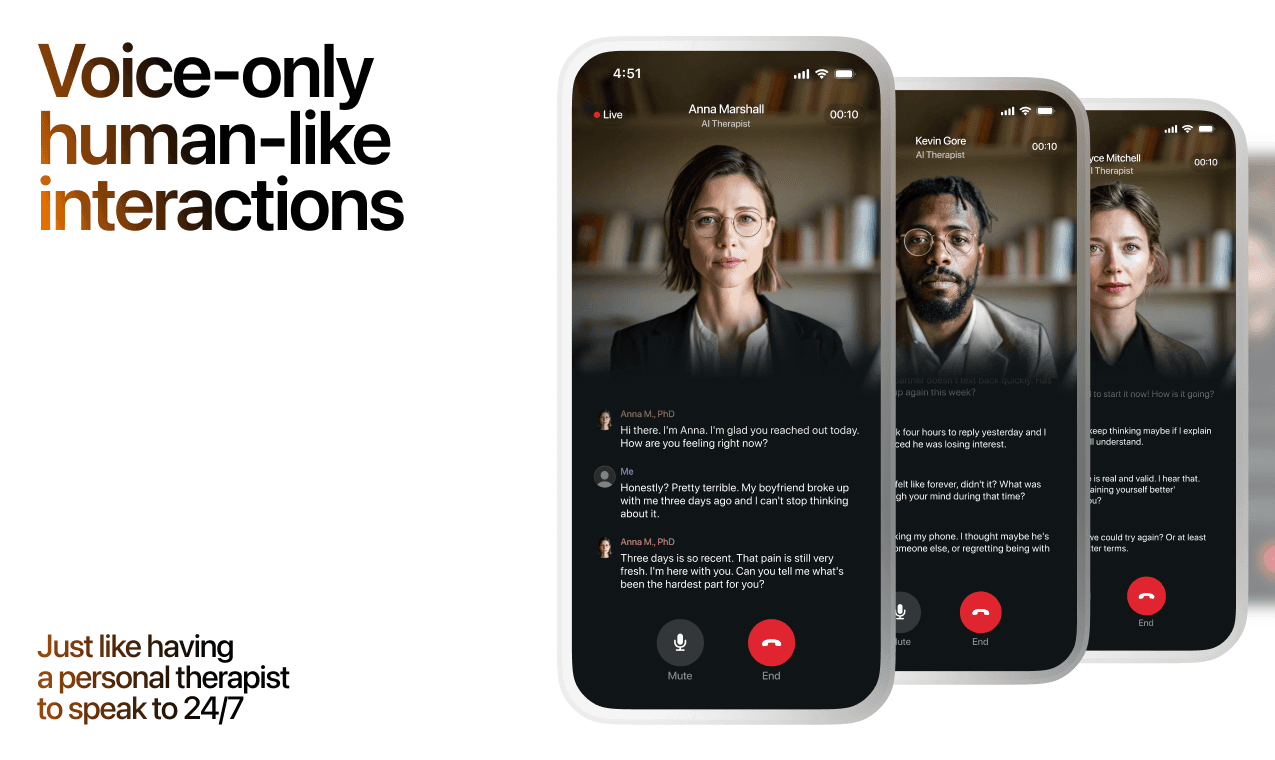
Here's what happens in a typical Lovon session:
You share what's on your mind
There's no script, no intake form, no waiting room. You speak or type whatever you're feeling — in your own words, at your own pace.
Lovon validates and explores
Using frameworks from CBT (Cognitive Behavioral Therapy) and motivational interviewing, Lovon acknowledges your feelings first, then gently helps you explore them. No dismissive "just move on" advice.
You build coping skills together
Lovon doesn't just listen — it actively works with you on evidence-based techniques: thought reframing, urge surfing, behavioral experiments, and more.
What a Session with Lovon Looks Like
When to Seek Professional Help
AI support is a valuable tool, but it's not a replacement for professional care. Please consider reaching out to a licensed therapist if you experience any of the following:
- Persistent thoughts of self-harm or suicide
- Inability to perform daily activities (work, eating, sleeping) for more than 2 weeks
- Turning to alcohol or substances to cope
- Intense anger or desire to harm your ex-partner
- Complete emotional numbness that doesn't improve over time
Crisis Resources (US): If you're in immediate danger, call 988 (Suicide & Crisis Lifeline) or text HOME to 741741 (Crisis Text Line). Available 24/7, free, and confidential.
Outside the US? Find a crisis line in your country
Ready to Start?
Your healing journey can begin right now
A 7-day trial. No judgment. Just a safe space to process what you're going through.
Frequently Asked Questions
Is Lovon a replacement for a real therapist?
Is my conversation with Lovon AI private?
How is Lovon different from ChatGPT for emotional support?
Can I use Lovon if I'm already seeing a therapist?
Can I try Lovon before subscribing?
About the Author
The Lovon Editorial Team
Mental Health & Wellness Content Team
The Lovon Editorial Team develops mental health and wellness content designed to make psychological concepts accessible and actionable. Our goal is to bridge the gap between clinical research and everyday life - helping you understand why your mind works the way it does and what you can do about it....
Related articles
- Best App for Pregnancy Anxiety in 2026: Ranked Guide
The best app for pregnancy anxiety in 2026, ranked: Lovon for AI voice therapy, BetterHelp for licensed care, Wysa for…
- Postpartum Anxiety in Dads: Signs Partners Miss (2026)
Postpartum anxiety in dads hides behind irritability and control, not tears. Learn the signs partners often miss and…
- AI Mental Health App for Veterans With PTSD (2026)
Compare AI mental health apps for veterans with PTSD in 2026: what to look for, top picks, what to avoid, and a clear…
- AI Therapist for Stress: What It Can and Can't Do (2026)
An honest breakdown of what an AI therapist for stress handles well in 2026, where it falls short, and how Lovon fits…
See also
Quizzes
- Do I Miss My Ex or Am I Just Lonely? 12-Question Quiz
Find out what the missing is actually about.
- Am I Codependent? 12-Question Self-Check
See how much of you is left over, in 2 minutes.
Free tools
- Write a Letter to Someone You Lost
Tell it who they were to you and what you never got to say, and it writes the letter back in your words. No account, no…
- Write a Condolence Message for This Person
Get one condolence message written for your situation instead of a list of a hundred to choose from. Tell it who died…
From the wiki
- Why do I have no friends?
Usually nothing is wrong with you. Adult friendship runs on proximity and repetition, and most people lose both at once…
Disclaimer: This article is for informational purposes only and does not constitute medical advice, diagnosis, or treatment. Always seek the advice of your physician or other qualified health provider with any questions you may have regarding a medical condition. If you are in crisis or think you may have an emergency, call 988 (Suicide & Crisis Lifeline) or go to the nearest emergency room. Outside the US? Find a crisis line in your country.