
How to Stop Anxiety Spirals: 7 Steps for 2026
How to stop anxiety spirals with 7 grounded steps for 2026: paced breathing, grounding, and catching the thought before it escalates further.

Key Takeaways
- A quiet-ish space for 2-5 minutes — a bathroom stall or parked car counts
- A watch, phone timer, or anything that can count seconds
- One physical anchor: your feet on the floor, a cold glass of water, or a textured object in your pocket
- A notes app or small notebook for the cognitive step later
- Optional: a voice-based support tool for talking the spiral out loud when you're alone
When your mind starts stacking one worst-case thought on top of another, you don't need more information — you need a way to interrupt the loop before it takes over your afternoon. This guide breaks down exactly how to stop anxiety spirals in the moment, plus what to do differently so the next one starts smaller.
TL;DR
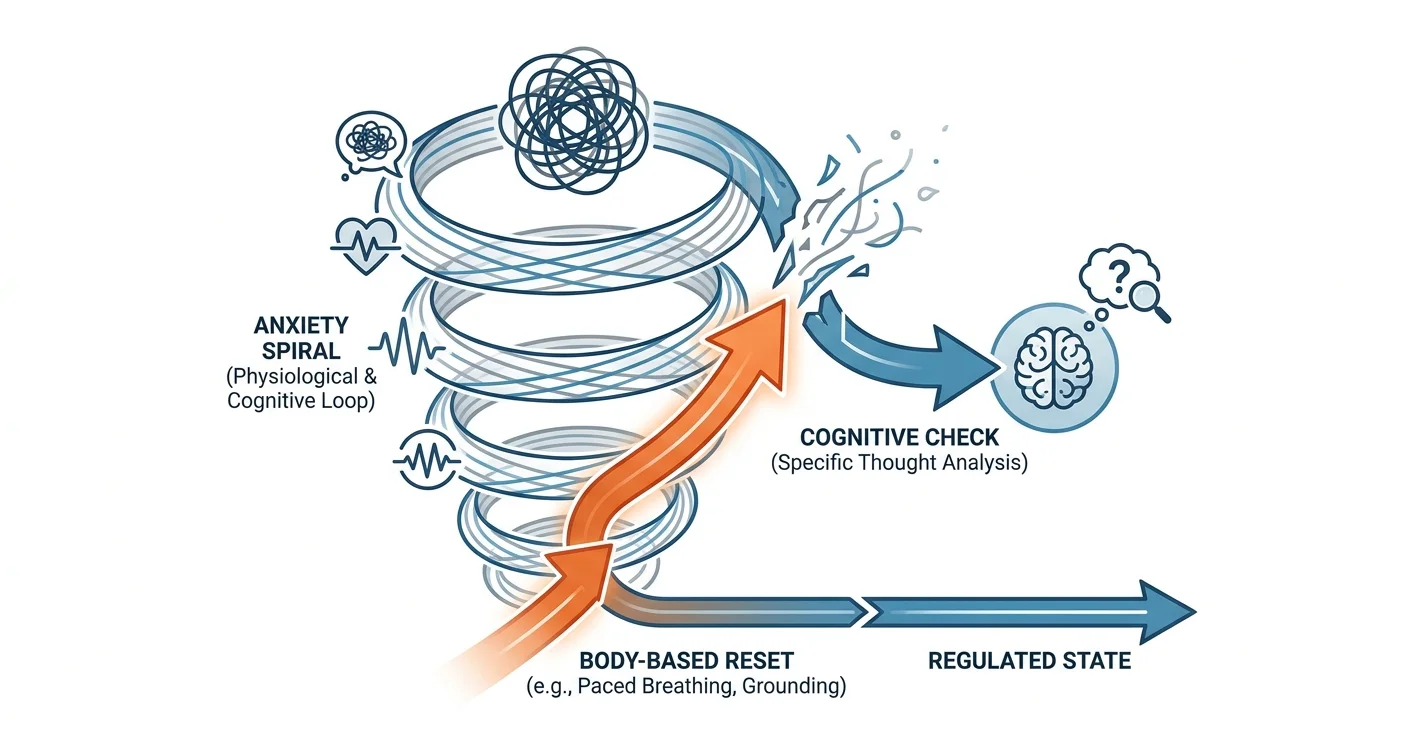
An anxiety spiral is a physiological event, not just a thinking problem — your nervous system floods your body with stress hormones before your rational brain catches up, so the fastest fix works on the body first. The verdict for 2026: pair a 90-second body-based reset (paced breathing or grounding) with a cognitive check on the specific thought that started the spiral. Apps that combine both — like Lovon, an AI voice support app — give you a place to talk it through in real time, but the core skill is one you can practice without any tool at all. Skipping the body step and jumping straight to "just think positive" is the single biggest reason spirals come back within the hour.
Why this matters
An anxiety spiral isn't a character flaw or a sign you're "bad at managing stress." It's what happens when your amygdala — the brain's threat detector — flags something as dangerous and floods your bloodstream with cortisol and adrenaline before your prefrontal cortex, the part that reasons things through, gets a vote. That's what's known as an amygdala hijack, and once it starts, logic alone rarely shuts it down fast enough.
Here's the part most people miss: the hormone surge that fuels a spiral doesn't clear instantly. It can take roughly 20 minutes for cortisol to start dropping back toward baseline once the trigger has passed, which is why a spiral that "should" be over in two minutes drags on for thirty. Working with your body's timeline instead of against it is what actually shortens the loop in 2026, not willpower.
What you'll need
- A quiet-ish space for 2-5 minutes — a bathroom stall or parked car counts
- A watch, phone timer, or anything that can count seconds
- One physical anchor: your feet on the floor, a cold glass of water, or a textured object in your pocket
- A notes app or small notebook for the cognitive step later
- Optional: a voice-based support tool for talking the spiral out loud when you're alone
The steps
1. Name it out loud
Say, silently or aloud, "this is a spiral" the second you notice your thoughts jumping from one bad outcome to a worse one. Naming the state activates a different brain region than the one driving the panic, which slows the momentum within seconds. Skipping this step is the most common mistake — people try to reason with the spiral's content instead of first labeling the state itself.
2. Slow your breathing on purpose
Use a 4-4-6 pattern: inhale for 4 seconds, hold for 4, exhale for 6, repeated for 90 seconds. The longer exhale signals your vagus nerve to downshift your heart rate, which is the physical brake on a spiral. The box breathing technique is a close variant if 4-4-6 feels awkward at first. Expect your shoulders to drop and your jaw to unclench somewhere around the 60-second mark — that's the sign it's working, not a placebo.
3. Ground in five senses
Name 5 things you can see, 4 you can touch, 3 you can hear, 2 you can smell, and 1 you can taste. This pulls attention out of the hypothetical future and back into the room you're actually in, which is where grounding techniques for anxiety and panic earn their reputation. Most people find the spiral has lost at least half its intensity by the time they reach "1."
4. Catch the specific thought
Write down the exact sentence your brain is repeating — not the general feeling, the actual words ("I'm going to lose my job," "they're mad at me"). Spirals run on vague dread; putting the thought in writing forces it into a specific, checkable claim. This is also where catastrophizing shows up most clearly — the jump from one bad thing to total disaster in three steps flat.
5. Ask what's actually true right now
Separate what you know from what you're predicting. "My boss hasn't replied in 3 hours" is a fact; "she's about to fire me" is a forecast dressed as a fact. Spirals collapse fast once you can see the seam between the two, because the forecast loses its borrowed authority.
6. Set a 10-minute check-in
Tell yourself you'll revisit the worry in exactly 10 minutes if it still feels urgent — most of the time, the urgency has dropped by half or more once the timer goes off. This isn't avoidance; it's giving your nervous system the time it needs to actually process the hormone spike instead of acting on it mid-surge.
7. Move your body for 2 minutes
Walk to another room, do 10 squats, or shake out your hands and arms. Physical movement burns off residual adrenaline faster than sitting still does, which is why people often feel the spiral "break" right after standing up. Skip this step only if you're somewhere you genuinely can't move — otherwise it's the fastest way to close the loop for good.
Troubleshooting
- The breathing makes you more anxious, not less. Some people feel breathless when they try to slow down. Switch to counting exhales only (just count to 6 on the out-breath) instead of managing a full pattern.
- You can't stop the thought loop even after grounding. Write the thought down and physically close the notebook or lock the phone. The visual act of "putting it away" matters more than people expect.
- The spiral happens at 3am and you can't move around. Press your feet flat against the mattress or wall and do the 4-4-6 breathing lying down — movement isn't required for the vagal response to kick in.
- You spiral about the same three topics every time. That's a pattern worth naming specifically, not a new crisis each time. Recognizing the repeat topic is often the fastest way to shrink the next one.
- You feel fine 10 minutes later but exhausted. That's normal — the hormone crash after a spiral often leaves people flat or tired for an hour or two. Rest is the right move here, not another task.
Tools and resources
- A timer or stopwatch app for the 90-second breathing count
- A plain notes app for catching the specific thought (step 4)
- The box breathing technique as a backup pattern if 4-4-6 doesn't land
- A voice-based option for the nights or afternoons no one else is around — talking a spiral out loud to an AI voice companion through Lovon works the same cognitive-check step from item 4 and 5, just in conversation instead of on paper
What to do next
Once you can interrupt a single spiral, the next skill is spotting the specific thinking pattern that keeps starting them — most spirals trace back to one or two cognitive distortions repeating on a loop, not a hundred different fears. Working through that list is the difference between managing spirals and having far fewer of them by the second half of 2026.
FAQ
What is an anxiety spiral, exactly? An anxiety spiral is a rapid chain of escalating worst-case thoughts paired with a real physical stress response — racing heart, shallow breath, tight chest. It's driven by the amygdala hijacking your attention before your reasoning brain can weigh in.
How long does an anxiety spiral usually last? Without intervention, a spiral often runs 15 to 30 minutes as stress hormones clear from your system. With a body-based interruption like paced breathing or grounding, most people report the intensity dropping within 60 to 90 seconds.
Is catastrophizing the same thing as an anxiety spiral? Catastrophizing is the thought pattern; the spiral is what happens when that pattern runs unchecked. Catching the catastrophizing early is one of the fastest ways to keep a spiral from building momentum.
Can breathing exercises really stop a spiral, or is that oversimplified? Slow, extended-exhale breathing activates the vagus nerve and measurably lowers heart rate within about a minute, which is the physiological brake a spiral needs. It won't erase the underlying worry, but it buys the calm needed to think clearly about it.
Should I talk to someone during a spiral or wait until it passes? Talking it through in real time, even briefly, often shortens the spiral because it forces the vague thought into words. That's the appeal of on-demand tools like Lovon's AI voice support for moments when no one else is reachable at 11pm.
Are anxiety spirals a sign of a bigger anxiety disorder? Occasional spirals are common and not automatically a diagnosis. Frequent spirals, especially several times a week in 2026, are worth discussing with a licensed clinician alongside any self-management tools you're using.
What's the difference between a spiral and a panic attack? A spiral is primarily cognitive — thought chains that escalate — while a panic attack centers on sudden, intense physical symptoms that can peak within minutes. The two often overlap, and the grounding and breathing steps above help with both.
Does journaling help stop anxiety spirals? Writing down the specific thought (not the general feeling) interrupts the vague-dread quality that spirals run on. It works best as step four or five in the sequence, after the body has already started to calm.
One last thing
Most people try to stop a spiral by arguing with the thought first and calming the body second — that order is backwards, and it's why the same spiral keeps winning. Flip it: calm the nervous system in the first 90 seconds, then deal with the thought. That single change in sequence is the most reliable fix available in 2026, no app or technique required to start.
How AI Support Helps You Heal
AI emotional support isn't about replacing human connection — it's about filling the gaps. The moments when you need to talk at 2 AM, when you don't want to burden your friends again, or when you simply need someone to listen without judgment.
Here's what happens in a typical Lovon session:
You share what's on your mind
There's no script, no intake form, no waiting room. You speak or type whatever you're feeling — in your own words, at your own pace.
Lovon validates and explores
Using frameworks from CBT (Cognitive Behavioral Therapy) and motivational interviewing, Lovon acknowledges your feelings first, then gently helps you explore them. No dismissive "just move on" advice.
You build coping skills together
Lovon doesn't just listen — it actively works with you on evidence-based techniques: thought reframing, urge surfing, behavioral experiments, and more.
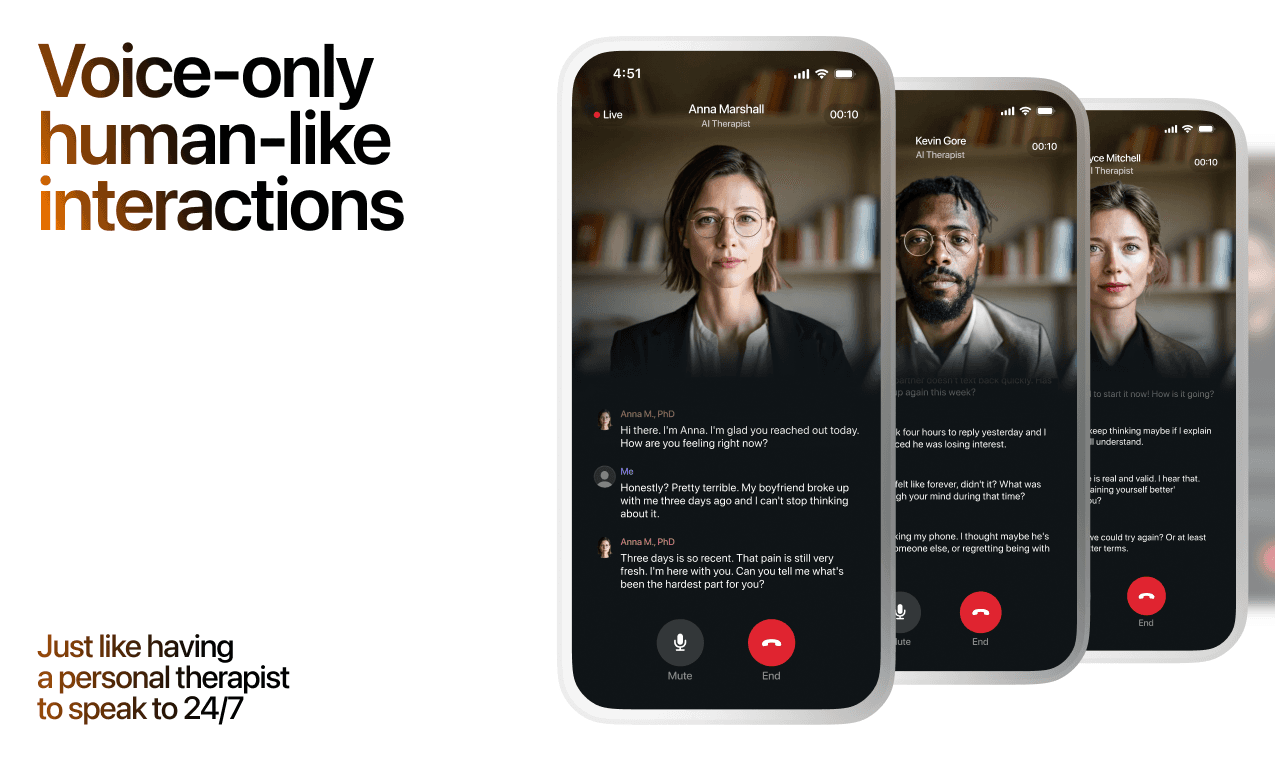
What a Session with Lovon Looks Like
Lovon is AI support, not a replacement for professional care. If things have been hard to get through for weeks, or you are thinking about harming yourself, talk to a doctor or a licensed therapist.
Ready to Start?
Your healing journey can begin right now
A 7-day trial. No judgment. Just a safe space to process what you're going through.
Frequently Asked Questions
Is Lovon a replacement for a real therapist?
Is my conversation with Lovon AI private?
How is Lovon different from ChatGPT for emotional support?
Can I use Lovon if I'm already seeing a therapist?
Can I try Lovon before subscribing?
About the Author

The Lovon Editorial Team
Mental Health & Wellness Content Team
The Lovon Editorial Team develops mental health and wellness content designed to make psychological concepts accessible and actionable. Our goal is to bridge the gap between clinical research and everyday life - helping you understand why your mind works the way it does and what you can do about it....
Related articles
- AI App for Anxiety Insomnia: Best Picks 2026
The best ai app for anxiety insomnia in 2026 pairs voice sessions with nervous-system tools. See what to buy, consider…
- Can an AI voice app actually calm you down?
Yes, AI voice apps calm acute anxiety spikes fast through paced voice conversation. See how it works, its limits, and…
- How to Manage Anxiety Without Medication in 2026
Learn how to manage anxiety without medication in 2026: 7 proven steps with breathing, grounding, and muscle relaxation…
- CBT Techniques on Your Own: 7 Steps for 2026
Learn CBT techniques on your own with a 7-step routine: thought records, reframing, and behavioral experiments you can…
See also
Quizzes
- Emotional Contagion Test: Which Moods Do You Catch?
See how moods spread to you and through you, in 3 minutes.
- Impulsivity Test: Do You Act Before You Think?
See which kind of impulsivity shows up in your month.
Free tools
- 5-4-3-2-1 Grounding Exercise
A guided run through the 5-4-3-2-1 technique, with paced breathing first if you need it. No sign-up, nothing stored…
- How to Stop Overthinking in a Relationship
Not a list of habits. Tell it the specific thing you are going round on, and it separates what actually happened from…
From the wiki
- Why do I keep dreaming about my ex?
Recurring dreams about an ex usually mean your brain is still consolidating a relationship that took up years of memory…
Disclaimer: This article is for informational purposes only and does not constitute medical advice, diagnosis, or treatment. Always seek the advice of your physician or other qualified health provider with any questions you may have regarding a medical condition. If you are in crisis or think you may have an emergency, call 988 (Suicide & Crisis Lifeline) or go to the nearest emergency room. Outside the US? Find a crisis line in your country.