
Postpartum Anxiety in Dads: Signs Partners Miss (2026)
Postpartum anxiety in dads hides behind irritability and control, not tears. Learn the signs partners often miss and what actually helps in 2026.
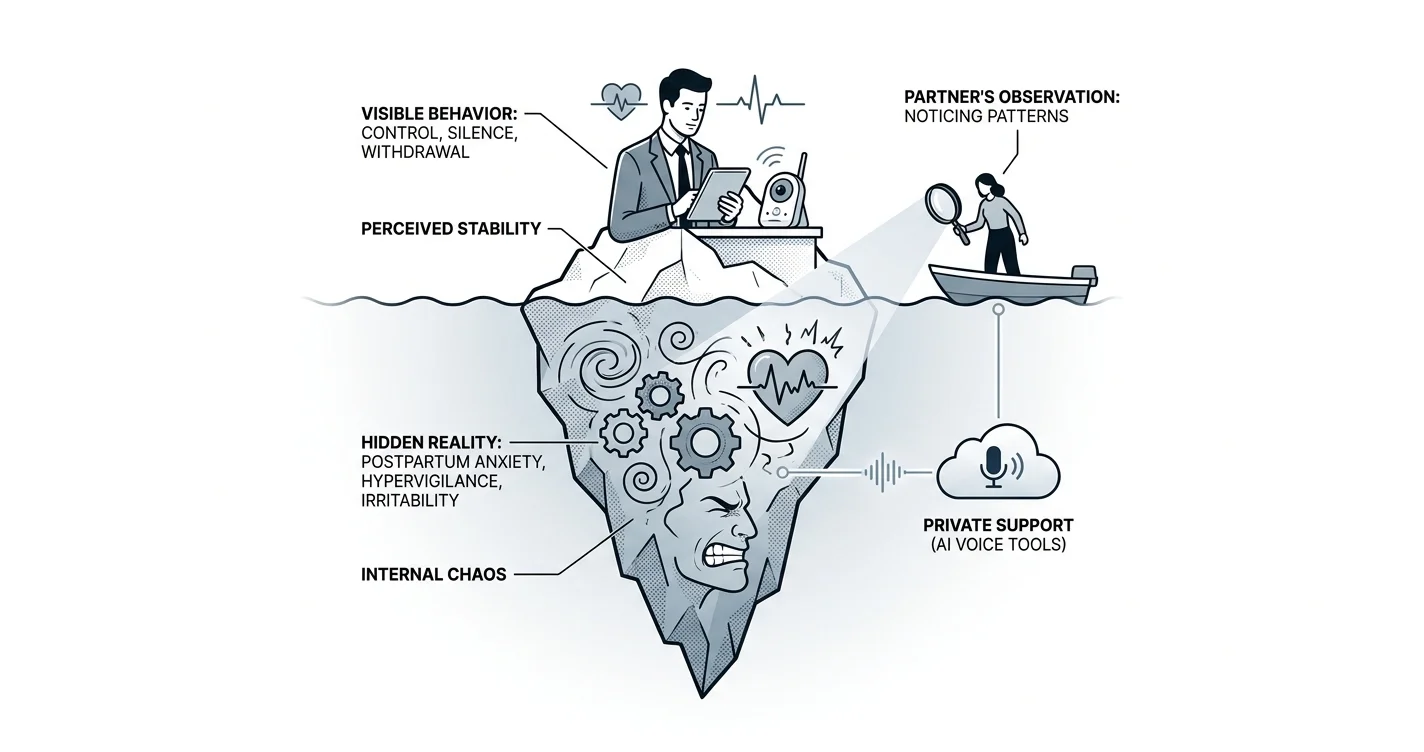

Key Takeaways
- Postpartum anxiety in dads shows up as irritability, controlling behavior, and withdrawal — not visible sadness.
- Hypervigilance around the baby's breathing, feeding, or safety that doesn't ease after a few weeks is a red flag,
- Dads self-medicate with overwork, screens, or alcohol more often than they voice fear out loud — silence is the
- A short daily check-in and one honest conversation catch postpartum anxiety in dads earlier than waiting for a
- AI voice tools like Lovon give dads a private space to talk through anxious spirals between appointments, without
When people talk about postpartum anxiety, the image is almost always a mother. Dads get it too, and it looks nothing like the stereotype — less crying, more control, more silence.
Here's what postpartum anxiety in dads actually looks like, why partners miss it, and what to do once you see it.
TL;DR
- Postpartum anxiety in dads shows up as irritability, controlling behavior, and withdrawal — not visible sadness. Verdict: treat repeated late-night worry spirals as a symptom, not a personality quirk.
- Hypervigilance around the baby's breathing, feeding, or safety that doesn't ease after a few weeks is a red flag, not overprotectiveness.
- Dads self-medicate with overwork, screens, or alcohol more often than they voice fear out loud — silence is the symptom, not the absence of one.
- A short daily check-in and one honest conversation catch postpartum anxiety in dads earlier than waiting for a crisis in 2026.
- AI voice tools like Lovon give dads a private space to talk through anxious spirals between appointments, without replacing a clinician.
Why this matters
Postpartum anxiety in dads gets missed because everyone is watching the mother for warning signs. Screening tools, pediatrician check-ins, and postpartum support groups are built around her recovery. The father is expected to be the steady one, so when he starts snapping at small things, checking the baby monitor six times a night, or disappearing into work, it reads as stress instead of anxiety.
Left alone, that pattern doesn't resolve on its own. It tends to calcify into chronic irritability, marital distance, and — in a meaningful share of cases — depression that shows up months later. Catching it in month two is a five-minute conversation. Catching it in month eight is a crisis.
What you'll need
- A baseline read on how he normally handles stress, sleep loss, and conflict — so you can spot the deviation
- One private, unhurried moment to talk, not a hallway exchange while the baby is crying
- Language that names behavior, not a diagnosis ("you've checked the monitor four times in ten minutes" beats "you have anxiety")
- A short list of concrete things you've noticed, dated, so the conversation isn't abstract
- Patience for a first "I'm fine" — most dads need to hear the observation twice before they engage with it
The steps
1. Track irritability, not sadness
Postpartum anxiety in dads rarely announces itself with tears. It shows up as a shorter fuse — snapping over a dropped bottle, getting sharp about noise, losing patience with the baby's crying faster than he used to. Write down the trigger and the reaction for a week; if the gap between the two keeps shrinking, that's the signal, not just exhaustion.
2. Watch for compulsive checking
Checking that the baby is breathing once before bed is normal. Checking every twenty minutes, re-checking the monitor volume, or waking up specifically to verify the baby hasn't stopped breathing is anxiety running the show. This kind of loop rarely eases with reassurance — it usually gets worse until it's addressed directly, and it maps closely to hypervigilance, a nervous-system state that stays switched on long after the actual threat has passed.
3. Notice the shift toward control
Some dads respond to postpartum anxiety by trying to control everything controllable: the diaper brand, the feeding schedule down to the minute, the exact temperature of bath water. Rigidity that wasn't there before the baby arrived is often anxiety wearing a management costume.
4. Clock the withdrawal
Withdrawal is the quiet one. He's physically present but on his phone, at the office later than usual, or in the garage more than before. This isn't always a sign of not caring — often it's avoidance of a house that now feels unpredictable and high-stakes. If he's also pulling back from you specifically, not just the baby, that's worth naming directly.
5. Ask about the body, not just the mood
Anxiety lives in the body before it shows up as words: racing heart at 3 a.m., tight chest during feedings, jaw clenching, stomach issues with no other cause. Many men will describe these physical symptoms before they'll say the word "anxious." Ask about sleep, appetite, and physical tension specifically — those questions get more honest answers than "how are you feeling."
6. Listen for catastrophic thinking
A passing worry about SIDS is normal in month one. Recurring, intrusive worst-case scenarios — playing out the baby getting sick, imagining accidents, rehearsing disaster — that persist past the newborn stage are a different thing entirely. This kind of loop has a name and a shape, and recognizing the pattern of high-functioning anxiety often helps partners see it wasn't hidden as well as it seemed — it was just labeled "being a good dad."
7. Pay attention to self-medicating
An extra beer after bedtime becomes three. Video games that used to be an hour stretch to three. Work emails answered at midnight when nothing is urgent. These are common, low-visibility ways dads manage anxiety without naming it, and they're easy to write off as normal new-parent coping until the pattern is six months old.
Give him a private place to talk it through
Voice sessions he can use between pediatrician visits, any hour of the night.
Troubleshooting
He says "I'm fine" every time you ask. Stop asking open questions and name specific behavior instead: "You've gotten up to check the monitor three nights this week — what's that about?" Specific observations are harder to deflect than general check-ins.
He gets defensive the moment you bring it up. Defensiveness is often shame, not denial. Drop the word "anxiety" for now and talk about sleep or the checking behavior itself; the label can come later once he's engaged with the pattern.
He minimizes it by comparing himself to you. "You're the one who just had a baby" is a common deflection. Postpartum anxiety in dads is real independent of what the mother is going through — both can be true at once, and pointing that out usually lands better coming from a calm moment than mid-argument.
He's willing to admit it but won't see anyone. Not every first step needs to be a therapist's office. A private conversation with an AI voice tool built for postpartum anxiety and depression can lower the barrier for a dad who isn't ready to talk to a person yet, and it's a reasonable bridge — not a replacement for a licensed clinician if symptoms are severe or persistent.
Symptoms are getting worse instead of better past three months postpartum. That timeline matters. Anxiety that intensifies rather than fades after the newborn fog lifts warrants a call to a doctor or therapist, not more waiting.
Tools and resources
- A dated log of specific behaviors (checking, irritability, withdrawal) — three weeks of notes turns a vague hunch into a clear pattern
- A private nighttime outlet he'll actually use, since most anxious spirals for new dads hit between 1 a.m. and 4 a.m. when no one else is awake to talk to
- A primary care visit or therapist referral if physical symptoms (chest tightness, insomnia beyond the baby's schedule, panic) show up alongside the behavioral signs
- A read on how you'd approach supporting a partner with depression, since anxiety and depression frequently travel together in the postpartum window
What to do next
Once you've named the pattern, the next move is getting him a way to process it that doesn't require scheduling a therapist appointment during a newborn's nap window. Lovon's voice sessions are built for exactly that gap — a place to talk through the 3 a.m. spiral in the moment it's happening, with coping tools shaped around anxiety and stress rather than a generic chatbot script.
FAQ
What is postpartum anxiety in dads?
Postpartum anxiety in dads is persistent, excessive worry tied to the baby's arrival that shows up as irritability, compulsive checking, control, or withdrawal rather than the sadness typically associated with postpartum depression. It can appear alongside postpartum depression or on its own.
How common is postpartum anxiety in fathers?
Exact rates vary across studies, and paternal postpartum anxiety is under-researched compared to maternal cases. Clinicians generally agree it's underdiagnosed because screening and awareness are built around mothers, not fathers.
How is postpartum anxiety in dads different from normal new-parent stress?
Normal stress fades as routines settle in over the first few weeks. Postpartum anxiety in dads persists or worsens past that window and includes specific patterns like repetitive checking, racing thoughts about the baby's safety, or physical symptoms like a racing heart.
Can postpartum anxiety in dads happen without postpartum depression?
Yes. Anxiety and depression frequently overlap postpartum, but a father can experience one without the other. Irritability and hypervigilance can show up with no accompanying low mood at all.
What are the physical signs of postpartum anxiety in dads?
Common physical signs include a racing heart at night, chest tightness during feedings or crying spells, jaw clenching, disrupted sleep beyond what the baby's schedule explains, and appetite changes.
When should a dad with postpartum anxiety see a professional?
See a doctor or therapist if symptoms persist or worsen past three months postpartum, interfere with daily functioning, or include panic attacks, intrusive thoughts, or self-medicating with alcohol.
Can an AI app help with postpartum anxiety in dads?
An AI voice app can give a dad a private, immediate outlet to talk through anxious spirals between appointments, which lowers the barrier to addressing symptoms early. It's a support tool, not a replacement for a licensed clinician when symptoms are severe.
How do you bring up postpartum anxiety with a partner who denies it?
Name specific observed behavior instead of using clinical language — cite dates, frequency, and concrete examples rather than saying "you have anxiety." Specific observations are harder to dismiss than general concern.
One last thing
The dads who hide postpartum anxiety best are usually the ones who look the most "on top of it" — organized, calm-sounding, never late to a pediatrician appointment. That competence is frequently the anxiety itself, channeled into control instead of visible distress. The partner who notices the rigidity, not just the meltdown, catches it months earlier.
Related guides
How AI Support Helps You Heal
AI emotional support isn't about replacing human connection — it's about filling the gaps. The moments when you need to talk at 2 AM, when you don't want to burden your friends again, or when you simply need someone to listen without judgment.
Here's what happens in a typical Lovon session:
You share what's on your mind
There's no script, no intake form, no waiting room. You speak or type whatever you're feeling — in your own words, at your own pace.
Lovon validates and explores
Using frameworks from CBT (Cognitive Behavioral Therapy) and motivational interviewing, Lovon acknowledges your feelings first, then gently helps you explore them. No dismissive "just move on" advice.
You build coping skills together
Lovon doesn't just listen — it actively works with you on evidence-based techniques: thought reframing, urge surfing, behavioral experiments, and more.
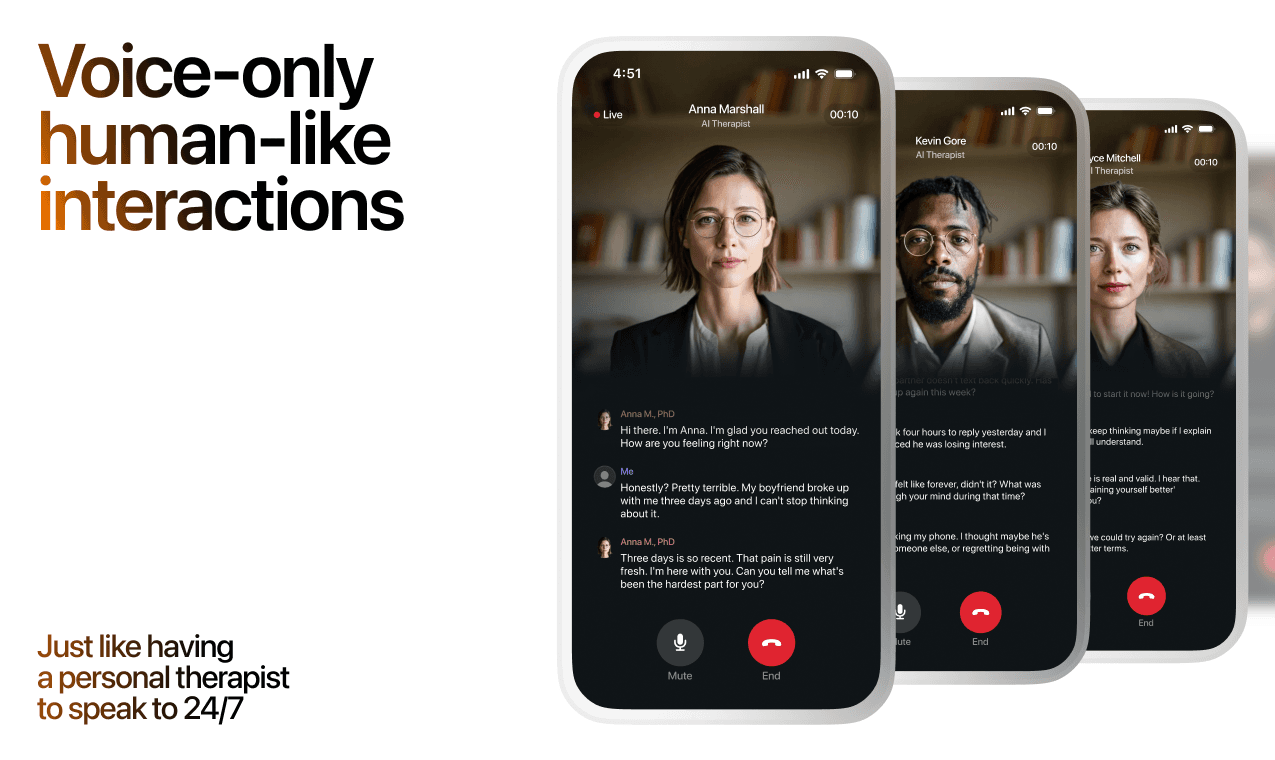
What a Session with Lovon Looks Like
When to Seek Professional Help
AI support is a valuable tool, but it's not a replacement for professional care. Please consider reaching out to a licensed therapist if you experience any of the following:
- Persistent thoughts of self-harm or suicide
- Inability to perform daily activities (work, eating, sleeping) for more than 2 weeks
- Turning to alcohol or substances to cope
- Intense anger or desire to harm your ex-partner
- Complete emotional numbness that doesn't improve over time
Crisis Resources (US): If you're in immediate danger, call 988 (Suicide & Crisis Lifeline) or text HOME to 741741 (Crisis Text Line). Available 24/7, free, and confidential.
Outside the US? Find a crisis line in your country
Ready to Start?
Your healing journey can begin right now
A 7-day trial. No judgment. Just a safe space to process what you're going through.
Frequently Asked Questions
Is Lovon a replacement for a real therapist?
Is my conversation with Lovon AI private?
How is Lovon different from ChatGPT for emotional support?
Can I use Lovon if I'm already seeing a therapist?
Can I try Lovon before subscribing?
About the Author

The Lovon Editorial Team
Mental Health & Wellness Content Team
The Lovon Editorial Team develops mental health and wellness content designed to make psychological concepts accessible and actionable. Our goal is to bridge the gap between clinical research and everyday life - helping you understand why your mind works the way it does and what you can do about it....
Related articles
- Health Anxiety: How to Stop Googling Symptoms (2026)
Health anxiety has you Googling symptoms at 2am. This 2026 guide gives a 15-minute delay rule, grounding steps, and what…
- AI Coping Tools for Postpartum Rage: 2026 Verdict
Postpartum rage needs faster help than a therapy waitlist. See which AI coping tools for postpartum rage actually work…
- Compassion Fatigue Signs in 2026: Are You Running on Empty
Compassion fatigue signs in 2026: numbness, dread, irritability, and withdrawal. Learn what to watch for and what to do…
- Can an AI therapist tell if you are in crisis?
Can an AI therapist tell if you're in crisis? It catches direct language, not intent. Get the 2026 breakdown of what AI…
See also
Quizzes
- Do I Miss My Ex or Am I Just Lonely? 12-Question Quiz
Find out what the missing is actually about.
- Do I Have Abandonment Issues? 12-Question Self-Check
See how loudly the fear of being left runs things.
Free tools
- Write a Condolence Message for This Person
Get one condolence message written for your situation instead of a list of a hundred to choose from. Tell it who died…
- Write a Letter to Someone You Lost
Tell it who they were to you and what you never got to say, and it writes the letter back in your words. No account, no…
From the wiki
- Why do I feel lonely all of a sudden?
Sudden loneliness usually traces back to something that quietly ended in the last few months: a routine, a shared class…
Disclaimer: This article is for informational purposes only and does not constitute medical advice, diagnosis, or treatment. Always seek the advice of your physician or other qualified health provider with any questions you may have regarding a medical condition. If you are in crisis or think you may have an emergency, call 988 (Suicide & Crisis Lifeline) or go to the nearest emergency room. Outside the US? Find a crisis line in your country.