
AI Mental Health App for Veterans With PTSD (2026)
Compare AI mental health apps for veterans with PTSD in 2026: what to look for, top picks, what to avoid, and a clear verdict on Lovon's voice sessions.

Key Takeaways
- An ai mental health app for veterans should be voice-first, available at 2 a.m., and honest about not replacing
- Lovon pairs trauma-aware voice conversations with grounding tools built alongside PhD psychologists in 2026.
- Text-only chatbot apps and generic wellness apps often skip hypervigilance and flashback-specific design entirely.
- Verdict: Lovon is a Buy for nightly check-ins and grounding; it is a Skip for anyone in crisis needing immediate
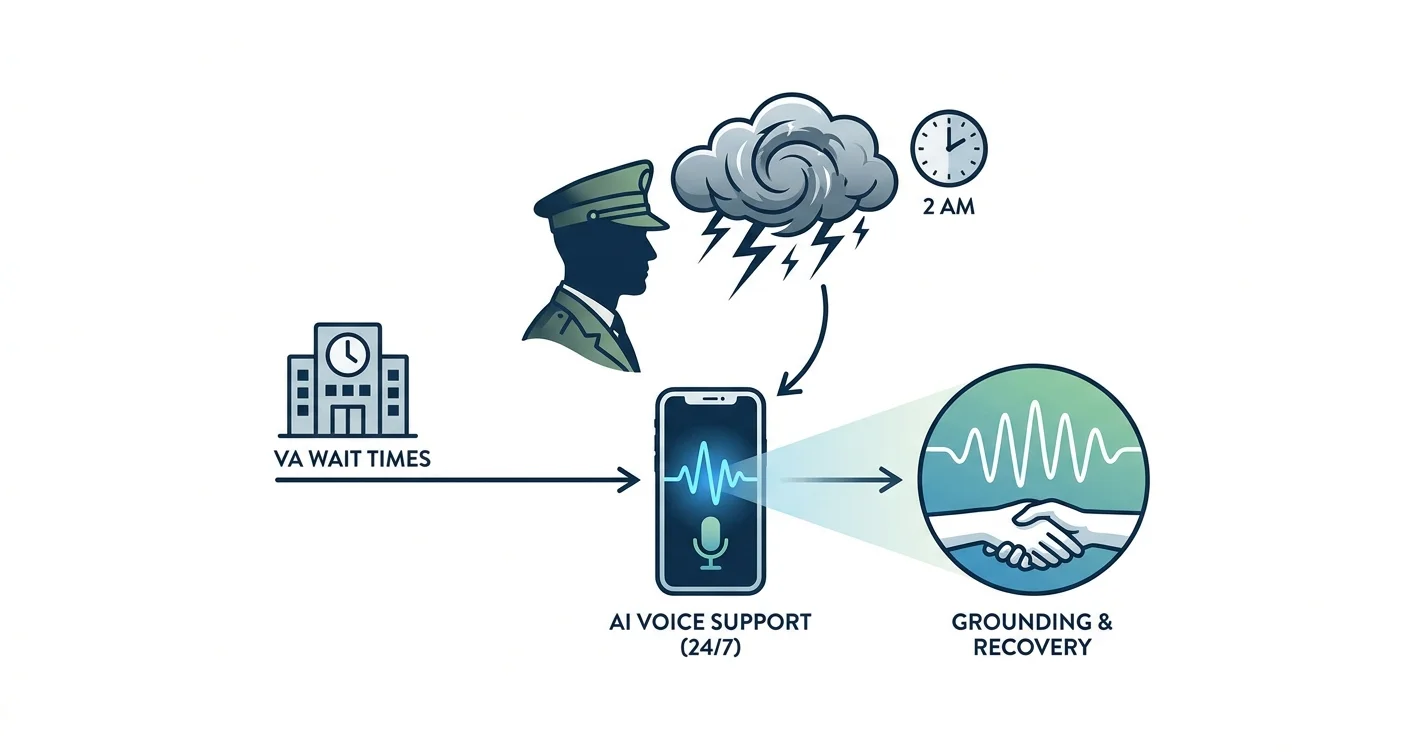
For veterans dealing with PTSD symptoms between sessions, at 2 a.m., or before they've found a VA therapist, an AI mental health app for veterans can be the difference between spiraling alone and having something to talk to right now. This guide breaks down what actually matters for this audience, what to skip, and where Lovon fits.
TL;DR
- An ai mental health app for veterans should be voice-first, available at 2 a.m., and honest about not replacing licensed care.
- Lovon pairs trauma-aware voice conversations with grounding tools built alongside PhD psychologists in 2026.
- Text-only chatbot apps and generic wellness apps often skip hypervigilance and flashback-specific design entirely.
- Verdict: Lovon is a Buy for nightly check-ins and grounding; it is a Skip for anyone in crisis needing immediate clinical intervention.
Why this matters
PTSD doesn't run on a therapy office's schedule. Hypervigilance spikes at night, flashbacks hit during a commute, and the VA's average wait times for a new mental health appointment still push weeks in many regions in 2026. That gap is where an AI mental health app for veterans either helps or wastes your time with generic chatbot small talk.
The stakes are higher here than in a general wellness app review. Veterans with PTSD deal with specific triggers — sudden noises, anniversaries, crowds — that a poorly designed AI can mishandle by either over-clinicalizing the moment or brushing past it with a canned response. The right tool needs to recognize the difference between a rough day and a flashback in progress.
Who this is for
This guide is for veterans and their families who want on-demand emotional support for PTSD symptoms — hypervigilance, sleep disruption, irritability, avoidance — without waiting on a referral or a callback. It's also for anyone using VA mental health services who wants something to lean on between appointments, not instead of them. If you're in active crisis, this is not the resource: call or text 988 and press 1 for the Veterans Crisis Line, or go to your nearest emergency room.
What to look for in an AI mental health app for veterans
Voice-first, not text-only
Typing out a panic response at 3 a.m. adds friction exactly when you have the least capacity for it. Voice conversation lets you talk the way you would to a person, which matters most for veterans who were trained to communicate verbally under pressure, not in a text box.
Trauma-informed pacing
An app that jumps straight into "tell me about your trauma" in session one is doing it wrong. Look for tools that ground you first — breath, body, present moment — before any deeper conversation, the same sequencing licensed trauma therapists use.
Built with clinical input, not just an API wrapper
A generic large language model chat wrapper doesn't know the difference between rumination and a genuine flashback. Products built with input from PhD psychologists are more likely to recognize PTSD-specific language patterns and respond with grounding techniques instead of generic positivity.
On-demand access, no appointment needed
The whole value proposition collapses if you have to schedule a slot. Veterans dealing with hypervigilance at night need something available the moment the trigger hits, not the next business day.
Honesty about its own limits
Any AI mental health app for veterans that claims to replace a licensed clinician is a red flag. The trustworthy ones state clearly, upfront, that they're support tools, not a diagnosis or treatment provider, and that crisis situations need a human and a phone line.
Privacy that matches military culture
Veterans are often more reluctant than the general population to disclose mental health struggles, partly from service culture and partly from concerns about how disclosure affects benefits or career. An app that's private by default, with no requirement to loop in a chain of command or insurance company, removes a real barrier to actually using it.
Top picks for veterans managing PTSD
PTSD-specific support sessions — the foundational pick. Lovon's approach to AI support for PTSD walks through what a session actually covers before you start one, which matters when you're deciding whether to trust a new tool with something this personal. It's built for the moments between VA appointments, not as a substitute for them. Verdict: Buy for anyone who wants a low-stakes way to talk through a rough week.
Flashback grounding — the 3 a.m. pick. Emotional flashbacks don't wait for business hours, and Lovon's guide to managing emotional flashbacks pairs directly with the app's voice sessions to walk you through grounding in real time. This is the use case where a text-only chatbot loses to voice — you need something you can talk to with your eyes closed and your hands shaking. Verdict: Buy for veterans whose flashbacks hit at inconvenient hours, which is most of the time.
Daily check-ins for hypervigilance. If you're always scanning the room, always braced, a five-minute voice check-in before bed can lower the baseline. Verdict: Consider — useful as a nightly habit, not a fix on its own.
Generic wellness or meditation apps rebranded for "stress." These aren't built around PTSD-specific triggers and tend to offer the same breathing exercise regardless of what you tell them. Verdict: Skip if PTSD symptoms are your primary concern.
What to avoid
- Apps that promise to "cure" PTSD. No app, including Lovon, does this. Anything claiming a cure instead of support is overselling.
- Text-only chat tools marketed as therapy. Typing under stress adds friction; voice-based tools remove a step at the exact moment you have less patience for extra steps.
- Tools with no clear crisis pathway. If an app doesn't tell you where to go in an emergency, that's a design failure, not a neutral omission.
Try a voice session tonight
Talk through a hard moment privately, no appointment needed.
Verdict comparison
| Criteria | Voice AI (like Lovon) | Text-only chatbot apps | Generic wellness apps |
|---|---|---|---|
| Available at 2 a.m. | Yes | Yes | Yes |
| Trauma-informed pacing | Built with PhD psychologist input | Rare | Rarely designed for trauma |
| Voice conversation | Yes | No | Sometimes |
| States its limits clearly | Yes, not a clinician replacement | Varies | Rarely addressed |
| Best for | PTSD-specific grounding | Quick venting | General stress relief |
FAQ
What is the best AI mental health app for veterans with PTSD in 2026?
There is no single best app for every veteran, but voice-based tools built with clinical input, like Lovon, tend to outperform text-only chatbots on trauma-specific grounding in 2026. Look for one that states clearly it doesn't replace licensed care.
Can an AI app diagnose PTSD?
No. AI mental health apps, including Lovon, are not licensed clinicians and cannot diagnose PTSD or any condition. A diagnosis requires a licensed mental health provider, often through the VA or a civilian psychologist.
Is AI therapy free for veterans?
Some AI mental health apps offer free tiers, but cost and features vary by provider and change over time. Check current pricing directly on the app before assuming a specific plan.
How is voice-based AI different from text therapy apps for PTSD?
Voice conversation removes the extra step of typing during a high-stress moment like a flashback or panic spike, which matters most when hands are shaking or focus is scattered. Text apps can still help for slower-paced reflection.
What should I do if I'm in crisis right now?
Call or text 988 and press 1 to reach the Veterans Crisis Line, available 24/7 in 2026, or go to your nearest emergency room. No AI app, including Lovon, is built for active crisis intervention.
Does the VA recommend AI mental health apps?
The VA has explored digital mental health tools as a supplement to care, but AI apps are best used alongside, not instead of, VA mental health services. Always keep your VA provider in the loop if you're managing PTSD.
Can an AI app help with nightmares or sleep issues from PTSD?
AI apps can offer grounding and wind-down conversation before bed, which some veterans use as part of a sleep routine. They cannot treat nightmare disorder or chronic insomnia, which needs a clinician's evaluation.
One last thing
The single biggest mistake veterans make with these apps isn't picking the wrong one — it's expecting the app to replace the VA appointment instead of filling the gap before it. Use the tool for the 2 a.m. spike, then still show up for the human being on the other side of the referral.
Related guides
How AI Support Helps You Heal
AI emotional support isn't about replacing human connection — it's about filling the gaps. The moments when you need to talk at 2 AM, when you don't want to burden your friends again, or when you simply need someone to listen without judgment.
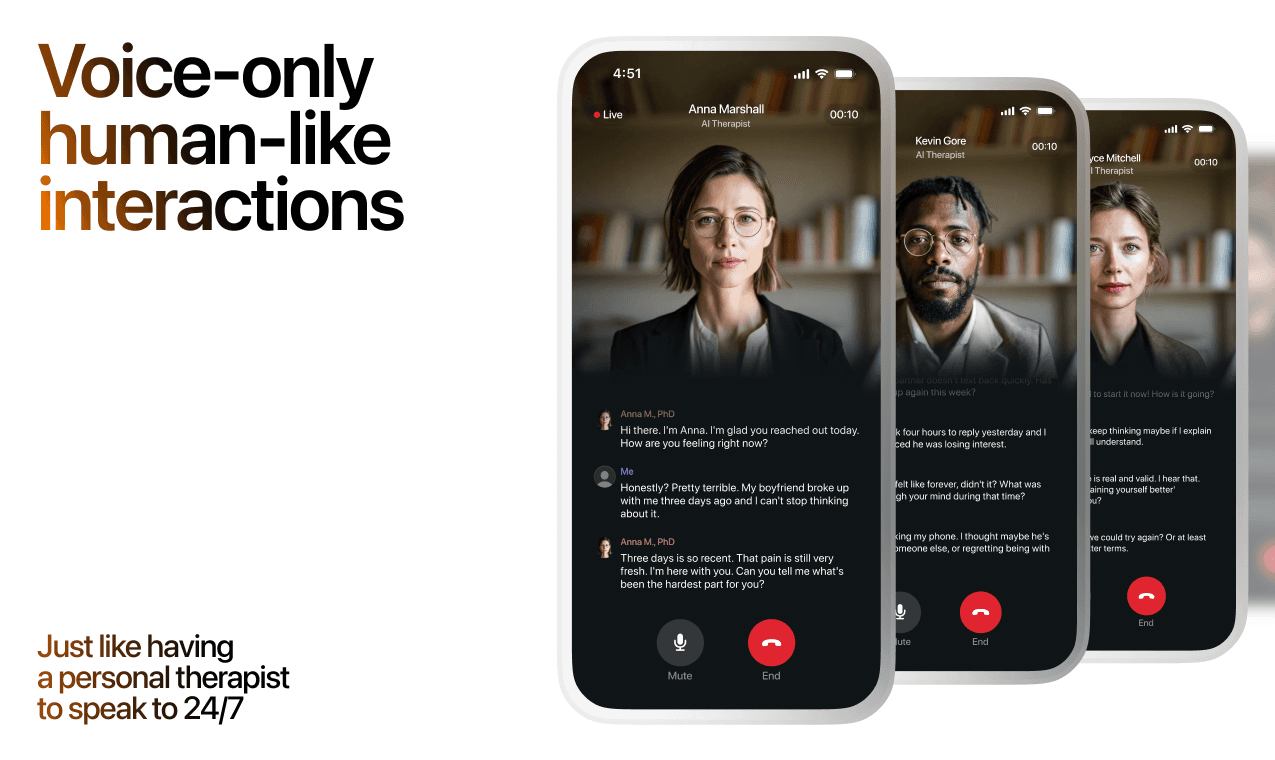
Here's what happens in a typical Lovon session:
You share what's on your mind
There's no script, no intake form, no waiting room. You speak or type whatever you're feeling — in your own words, at your own pace.
Lovon validates and explores
Using frameworks from CBT (Cognitive Behavioral Therapy) and motivational interviewing, Lovon acknowledges your feelings first, then gently helps you explore them. No dismissive "just move on" advice.
You build coping skills together
Lovon doesn't just listen — it actively works with you on evidence-based techniques: thought reframing, urge surfing, behavioral experiments, and more.
What a Session with Lovon Looks Like
When to Seek Professional Help
AI support is a valuable tool, but it's not a replacement for professional care. Please consider reaching out to a licensed therapist if you experience any of the following:
- Persistent thoughts of self-harm or suicide
- Inability to perform daily activities (work, eating, sleeping) for more than 2 weeks
- Turning to alcohol or substances to cope
- Intense anger or desire to harm your ex-partner
- Complete emotional numbness that doesn't improve over time
Crisis Resources (US): If you're in immediate danger, call 988 (Suicide & Crisis Lifeline) or text HOME to 741741 (Crisis Text Line). Available 24/7, free, and confidential.
Outside the US? Find a crisis line in your country
Ready to Start?
Your healing journey can begin right now
1 free conversation. No credit card. No judgment. Just a safe space to process what you're going through.
Frequently Asked Questions
Is AI therapy a replacement for a real therapist?
Is my conversation with Lovon AI private?
How is Lovon different from ChatGPT for emotional support?
Can I use Lovon if I'm already seeing a therapist?
Can I try Lovon for free?
About the Author
The Lovon Editorial Team
Mental Health & Wellness Content Team
The Lovon Editorial Team develops mental health and wellness content designed to make psychological concepts accessible and actionable. Our goal is to bridge the gap between clinical research and everyday life - helping you understand why your mind works the way it does and what you can do about it....
Related articles
- AI Mental Health App for Shift Workers (2026 Guide)
The best AI mental health app for shift workers in 2026 needs 24/7 voice access, not banker's hours. See what to look…
- AI Therapy for PTSD: Top Apps Ranked 2026
The best AI therapy for PTSD in 2026: Lovon leads for voice-based support, VA's PTSD Coach for free clinical tools…
- Best Mental Health App for Anxiety in 2026
The best mental health app for anxiety in 2026 ranked: Lovon for voice AI support, Headspace for habits, BetterHelp for…
- Best AI Therapy App for Relationship Anxiety (2026)
Best AI therapy app for relationship anxiety in 2026: Lovon ranks first for 24/7 voice support, with clear verdicts on…
See also
Quizzes
- Highly Sensitive Person Test: How Much Do You Take In?
See how deeply you process, notice and get overloaded.
- Alexithymia Test: Can You Name What You Feel?
See where your feelings lose their names, in 3 minutes.
Free tools
- Vent to Someone
Say the whole thing. It does not have to be fair or organized, you will not have to manage how it lands, and no advice…
- What to Say When They Are Struggling
A chat, not a list. Tell the coach who this person is to you, what they are going through, and what you already said…
Disclaimer: This article is for informational purposes only and does not constitute medical advice, diagnosis, or treatment. Always seek the advice of your physician or other qualified health provider with any questions you may have regarding a medical condition. If you are in crisis or think you may have an emergency, call 988 (Suicide & Crisis Lifeline) or go to the nearest emergency room. Outside the US? Find a crisis line in your country.