
Manage Networking Anxiety at Conferences (2026 Guide)
Learn how to manage networking anxiety at conferences in 2026 with a step-by-step plan: scripts, breathing resets, and exit lines that actually work.

Key Takeaways
- How to manage networking anxiety at conferences starts with a script, not willpower — prepare three questions before
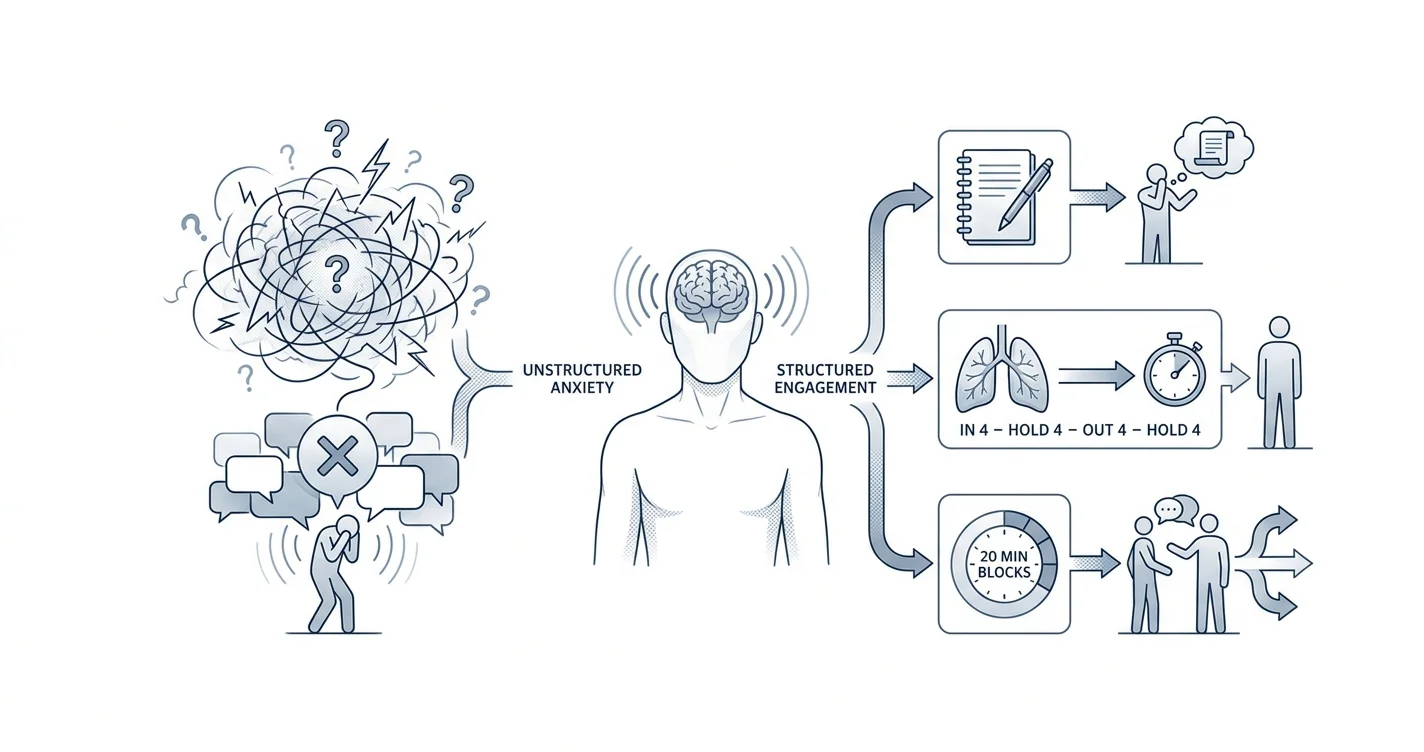
- A 4-4-4-4 breathing reset lowers physical arousal in under two minutes between sessions.
- Work the room in 20-minute blocks with a built-in exit line, not one long unstructured mingle.
- Lovon's AI voice therapist lets you talk through pre-conference dread the night before, not just process it after.
Networking anxiety at conferences almost never comes from having nothing to say — it comes from having no plan for the ten seconds before you say it. A short pre-event routine and a script for the room do more for that feeling than confidence ever will, and none of it requires becoming a different person for three days.
TL;DR
- How to manage networking anxiety at conferences starts with a script, not willpower — prepare three questions before you walk in.
- A 4-4-4-4 breathing reset lowers physical arousal in under two minutes between sessions.
- Work the room in 20-minute blocks with a built-in exit line, not one long unstructured mingle.
- Lovon's AI voice companion lets you talk through pre-conference dread the night before, not just process it after.
Why this matters
Networking anxiety at conferences shows up as a tight chest before the opening reception, a manufactured excuse to duck into the hallway, or an hour spent circling the coffee station instead of talking to anyone. None of that means you're bad at this. It means your nervous system read a room full of strangers as a threat and responded the way it's built to respond.
The fix isn't forcing yourself to relax. It's giving your body something concrete to do instead of scanning for danger — the same principle behind breathing exercises for anxiety relief in any high-stakes room, not just a conference floor. Heading into the 2026 conference season, multi-day formats with packed agendas are back to being the norm, which means more unstructured hours where anxiety has room to build if you walk in without a plan.
What you'll need
- A two-sentence intro for who you are and what you do, written down and practiced out loud once
- Three open-ended questions you can ask almost anyone, memorized so you're not inventing them live
- One quiet corner of the venue mapped out before doors open — a stairwell, a lobby chair, anywhere off the main floor
- Two polite exit lines that end a conversation without hurting anyone's feelings
- 10 to 15 minutes before you leave your room for a nervous-system reset — breathing, stretching, whatever's worked before
- The Lovon app, or a similar tool, if you want to talk through the dread the night before instead of just processing it after the fact
The steps
1. Write your two-sentence intro before you pack
Decide now what you say when someone asks "what do you do." Two sentences, no more — who you are and one specific thing you're working on. The common mistake here is winging it at the badge-pickup line, which is exactly when your brain is least available for improvisation.
2. Pick three questions and memorize them
Open-ended, low-stakes, reusable across almost any conversation: "What brought you to this one?", "What's been the most useful session so far?", "What are you working on outside of this?" Memorizing three questions means you never sit in silence hunting for something to say — you already have the next line loaded. Skipping this step is the single biggest reason people freeze mid-conversation.
3. Do a 4-4-4-4 breathing reset before you walk in
Stand outside the ballroom and run box breathing: four seconds in, hold four, out four, hold four, repeated for two minutes. This slows your heart rate before you're standing in front of anyone, not after you're already flooded. The mistake most people make is doing this reset once in the morning and assuming it carries them through an eight-hour day — it doesn't, and a second round before the afternoon reception matters just as much.
4. Work the room in 20-minute blocks
Set a timer, mentally or literally, for 20 minutes of active mingling, then take a five-minute break at your quiet spot. Nonstop networking for three straight days burns people out by day two; blocks keep your energy usable through the whole event. The mistake is treating the exhibit hall like a marathon you have to survive in one push.
5. Use a clean exit line the moment a conversation runs dry
Something like "I want to catch the next session, but let's connect after" ends things without awkwardness. Waiting for a conversation to die naturally is what traps people scanning the room for a way out for ten uncomfortable minutes. A rehearsed exit line removes the guesswork exactly when your anxiety is loudest.
6. Debrief for five minutes before bed
Before you fall asleep, spend five minutes naming one conversation that went fine and one thing you'll adjust tomorrow. This is different from lying awake at 1 a.m. replaying every awkward pause — a short, deliberate debrief closes the loop instead of letting your brain reopen it on its own schedule.
Troubleshooting
Your mind goes blank mid-conversation. Fall back to one of your three memorized questions instead of trying to generate something new under pressure — that's exactly what they're for.
You feel shaky or your voice wavers when you talk to strangers. This is adrenaline, not a sign you're doing something wrong; a slower exhale than inhale (six counts out, four in) brings it down within a minute or two.
You're avoiding the exhibit hall entirely by day two. That's less about this specific event and more a pattern worth looking at — it can overlap with high-functioning anxiety, where the anxiety is invisible to everyone but you and shows up as avoidance instead of visible panic.
You freeze up around senior people specifically. Lower the stakes on purpose — ask about their work instead of pitching yours, and treat the exchange as information-gathering, not a performance review.
You crash the moment you get back to your room. That's the social battery draining faster than you planned for, not a failure. Build the 20-minute blocks and quiet-corner breaks into your schedule proactively instead of only recovering after you're already depleted.
Tools and resources
- A written intro and three questions saved in your phone's notes app for a quick glance before badge pickup
- A box-breathing routine you've practiced at least once before the conference, not for the first time in the hallway
- The 2026 lineup of AI apps built for public speaking and networking anxiety if you want a structured way to prep the night before
- A voice conversation with Lovon's AI voice companion when the dread hits at 11 p.m. and there's no one else awake to talk to — it's not a replacement for a licensed clinician, but it's available when nothing else is
Talk through the dread before you walk in
Have a voice conversation with Lovon the night before your next conference.
What to do next
None of this makes networking anxiety disappear by the second day of the conference — it just gives you a plan instead of a blank space where the anxiety used to sit unchallenged. If the pattern shows up outside of conferences too, in meetings or new social settings generally, it's worth treating as its own thing rather than a one-event problem. Lovon exists for exactly that kind of ongoing, in-between-sessions support, whether the trigger is a ballroom full of strangers in 2026 or a Tuesday client call.
FAQ
How do I stop feeling anxious before a conference?
Start a wind-down routine the night before — write your two-sentence intro, pick three questions, and do a short breathing reset in the morning. Preparation reduces the unknowns your brain is bracing against, which is usually where the anxiety comes from.
What's the best way to start a conversation at a networking event?
Ask an open-ended question about the event itself, like what brought them or what session stood out. It's low-stakes, works on almost anyone, and gives them something easy to answer back.
Is it normal to feel exhausted after networking all day?
Yes — social interaction with strangers for hours is draining even for extroverted people, and it compounds over a multi-day conference in 2026's typical packed-agenda format. Building in 20-minute breaks throughout the day prevents the crash from hitting all at once.
How many people should I try to talk to at a conference?
Quality beats volume — three or four genuine conversations you can follow up on afterward matter more than fifteen rushed exchanges you won't remember. Set a loose target so you're not measuring the day by headcount.
What do I do if I freeze up talking to someone important?
Fall back to a memorized question instead of trying to think of something impressive on the spot. Asking about their work lowers the pressure and shifts the conversation away from a performance you're worried about failing.
Can breathing techniques actually help with networking anxiety?
Yes — a slow, structured breath pattern like box breathing (four seconds in, hold, out, hold) brings down physical arousal within a couple of minutes. It won't remove the nerves entirely, but it takes the edge off enough to function normally.
Should I skip conference networking events entirely if they make me anxious?
Skipping every event usually reinforces the anxiety rather than reducing it. A better approach is going with a plan — a script, a time limit, and an exit line — so you're managing the exposure instead of avoiding it outright.
One last thing
The reception you're dreading most is usually the one you remember least by the following week — the anxiety peaks in anticipation, not during the actual conversation. Most people report the moment right before walking into the room is worse than anything that happens once they're in it, which is exactly why the pre-event reset matters more than anything you do once you're already talking to someone.
Related guides
How AI Support Helps You Heal
AI emotional support isn't about replacing human connection — it's about filling the gaps. The moments when you need to talk at 2 AM, when you don't want to burden your friends again, or when you simply need someone to listen without judgment.
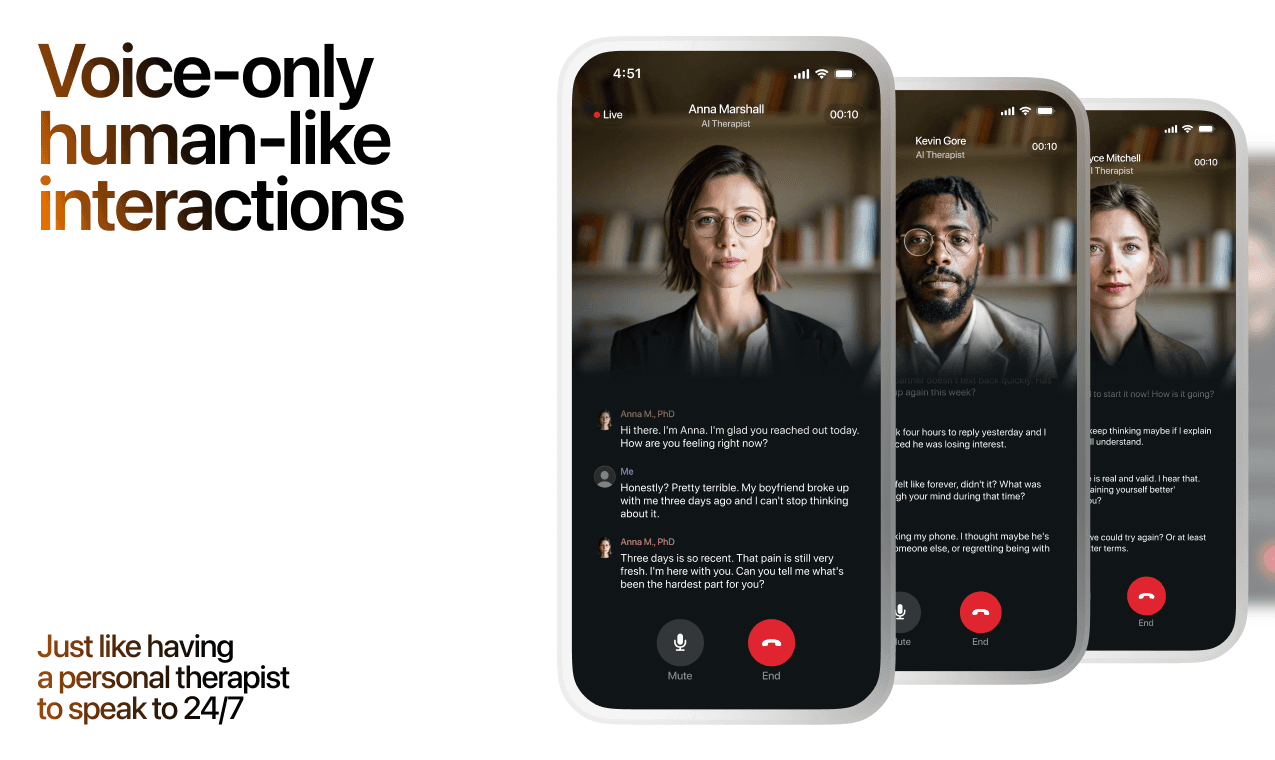
Here's what happens in a typical Lovon session:
You share what's on your mind
There's no script, no intake form, no waiting room. You speak or type whatever you're feeling — in your own words, at your own pace.
Lovon validates and explores
Using frameworks from CBT (Cognitive Behavioral Therapy) and motivational interviewing, Lovon acknowledges your feelings first, then gently helps you explore them. No dismissive "just move on" advice.
You build coping skills together
Lovon doesn't just listen — it actively works with you on evidence-based techniques: thought reframing, urge surfing, behavioral experiments, and more.
What a Session with Lovon Looks Like
When to Seek Professional Help
AI support is a valuable tool, but it's not a replacement for professional care. Please consider reaching out to a licensed therapist if you experience any of the following:
- Persistent thoughts of self-harm or suicide
- Inability to perform daily activities (work, eating, sleeping) for more than 2 weeks
- Turning to alcohol or substances to cope
- Intense anger or desire to harm your ex-partner
- Complete emotional numbness that doesn't improve over time
Crisis Resources (US): If you're in immediate danger, call 988 (Suicide & Crisis Lifeline) or text HOME to 741741 (Crisis Text Line). Available 24/7, free, and confidential.
Outside the US? Find a crisis line in your country
Ready to Start?
Your healing journey can begin right now
A 7-day trial. No judgment. Just a safe space to process what you're going through.
Frequently Asked Questions
Is Lovon a replacement for a real therapist?
Is my conversation with Lovon AI private?
How is Lovon different from ChatGPT for emotional support?
Can I use Lovon if I'm already seeing a therapist?
Can I try Lovon before subscribing?
About the Author
The Lovon Editorial Team
Mental Health & Wellness Content Team
The Lovon Editorial Team develops mental health and wellness content designed to make psychological concepts accessible and actionable. Our goal is to bridge the gap between clinical research and everyday life - helping you understand why your mind works the way it does and what you can do about it....
Related articles
- AI Coping Tools for Fear of Flying: 2026 Verdicts
AI coping tools for fear of flying, ranked for 2026: what helps mid-panic, what to skip, and how voice-based AI support…
- Voice Journaling App for Mental Health: 2026 Verdict
Voice journaling app for mental health, compared: what to look for, which formats to skip, and why AI-guided sessions…
- How to Manage Climate Anxiety Day to Day (2026)
Manage climate anxiety day to day with a news boundary, grounding techniques, and on-demand support. Practical 2026…
- How to Calm Interview Anxiety Before a Big Interview 2026
Calm interview anxiety fast with box breathing, grounding, and prep steps that work in 2026, plus what to do if panic…
See also
Quizzes
- Highly Sensitive Person Test: How Much Do You Take In?
See how deeply you process, notice and get overloaded.
- Guilt Test: Is Your Guilt Doing Its Job?
See whether your guilt repairs or just hurts.
Free tools
- What to Say to Someone Who Is Grieving
Get sentences that fit this person and this week, not a list of things people say at funerals. Describe who they lost…
- What to Say When a Pet Dies
Get a message you can actually send to someone whose dog or cat just died: one that uses the animal's name, treats the…
From the wiki
- How to stop maladaptive daydreaming?
Maladaptive daydreaming is immersive waking fantasy that eats hours, usually with music and pacing attached. You rarely…
Disclaimer: This article is for informational purposes only and does not constitute medical advice, diagnosis, or treatment. Always seek the advice of your physician or other qualified health provider with any questions you may have regarding a medical condition. If you are in crisis or think you may have an emergency, call 988 (Suicide & Crisis Lifeline) or go to the nearest emergency room. Outside the US? Find a crisis line in your country.