
How to Manage Climate Anxiety Day to Day (2026)
Manage climate anxiety day to day with a news boundary, grounding techniques, and on-demand support. Practical 2026 steps plus tools that actually help.
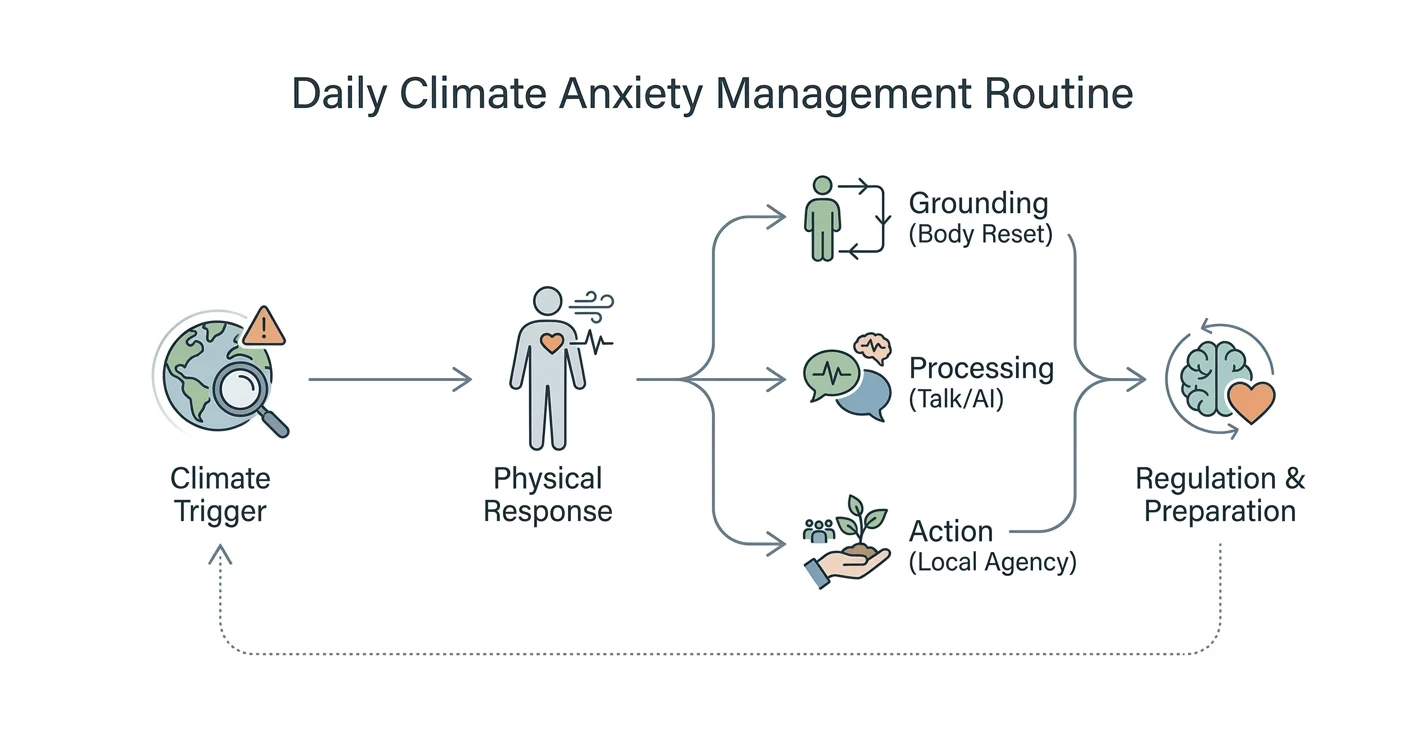

Key Takeaways
- A fixed 20-minute daily news window beats unlimited climate news scrolling for anxiety control in 2026.
- Box breathing and grounding techniques cut acute panic spikes in under 3 minutes.
- Lovon's AI voice therapy app gives you a coping-tools session anytime a climate news trigger hits.
- Catastrophizing patterns, not the facts themselves, drive most of the day-to-day dread.
- Action in your own community reduces helplessness faster than information consumption does.
Climate anxiety shows up as a tight chest during heat waves, doom-scrolling wildfire maps at 1 a.m., or guilt over a plastic bottle. This guide gives you a daily routine to manage it without pretending the problem isn't real.
TL;DR
- A fixed 20-minute daily news window beats unlimited climate news scrolling for anxiety control in 2026.
- Box breathing and grounding techniques cut acute panic spikes in under 3 minutes.
- Lovon's AI voice support app gives you a coping-tools session anytime a climate news trigger hits.
- Catastrophizing patterns, not the facts themselves, drive most of the day-to-day dread.
- Action in your own community reduces helplessness faster than information consumption does.
Why this matters
Climate anxiety isn't a diagnosis, but it behaves like chronic stress: it dysregulates your nervous system, disrupts sleep, and narrows your focus to worst-case scenarios. Left unmanaged, it compounds with existing anxiety or depression rather than staying in its own lane.
The goal here isn't to feel nothing about climate change. It's to stop the feeling from running your whole day in 2026, whether that's checking your phone before you check in with yourself or avoiding plans because "what's the point."
What you'll need
- A specific time window for climate news (10 to 20 minutes, same time daily)
- One grounding technique you can do without props (box breathing, 5-4-3-2-1 senses)
- A notes app or journal for tracking triggers versus facts
- A way to talk something through in the moment — Lovon's AI coping tools for climate anxiety cover this specifically, or a trusted person
- One local or community action you can point to when helplessness creeps in
- 10 minutes before bed with no screens, for a wind-down routine
The steps
1. Set a news boundary, not a news ban
Cutting off climate news entirely tends to backfire — it feels like avoidance, and avoidance keeps anxiety alive. Instead, pick a 10 to 20 minute window, same time each day, and read outside it only if something is genuinely urgent to your safety.
Set a phone timer for the window. When it goes off, close the tab, even mid-article.
Common mistake: doing the window right before bed. Move it to midday or early afternoon so your nervous system has hours to settle before sleep.
2. Name the thought pattern before you react to it
Most climate dread spikes come from catastrophizing — jumping from "this heat wave is bad" to "nothing I do matters and the future is over" in under ten seconds. Naming the jump interrupts it.
When you notice the spiral, ask: "Is this the fact, or is this the worst-case story I've built on top of the fact?" The guide on how to stop worst-case thinking walks through this distinction step by step.
Expected outcome: the spike loses intensity within a minute or two once you separate fact from projection, even if the underlying worry stays valid.
3. Use a 90-second body reset when panic hits
When a headline or a smoky sky triggers a physical anxiety response — racing heart, shallow breathing, tight chest — your body needs a signal before your thoughts will settle. Box breathing works here: inhale for 4 counts, hold for 4, exhale for 4, hold for 4, repeat for six rounds.
Do this before trying to reason your way out of the feeling. A dysregulated nervous system can't process logic well.
Common mistake: trying to think your way calm first. Body first, thoughts second.
4. Talk it out the same day it hits
Climate anxiety that stays unspoken tends to compress into a background hum that colors everything else. Talking it through — even for five minutes — drains the pressure before it stacks with tomorrow's news cycle.
If a person isn't available at 11 p.m. when the dread shows up, an AI voice session fills that gap. Lovon's app lets you talk out loud about what specifically triggered the spike, and it's built with input from PhD psychologists, though it's not a replacement for licensed clinical care if symptoms are severe or persistent.
5. Convert helplessness into one visible action per week
Helplessness is often the sharpest edge of climate anxiety — the sense that nothing you do changes the outcome. Countering that with one concrete, local action per week (a community cleanup, a city council comment, a switch in a household habit) gives your brain evidence against the helplessness story.
Keep the action small enough that you'll actually finish it. Consistency beats scale here.
Expected outcome: over a few weeks, the sense of agency grows even though the global problem hasn't shrunk.
6. Protect your sleep window deliberately
Climate anxiety often peaks at night when there's nothing to do about it and nothing distracting you from it. A 10-minute no-screen wind-down before bed — stretching, journaling, or a grounding exercise — keeps the news cycle from following you into sleep.
Common mistake: "just checking one more article" in bed. That one article restarts the anxiety loop right before you need to fall asleep.
7. Track triggers weekly, not daily
A quick weekly review — what set off the worst spikes this week, what helped, what didn't — turns scattered bad days into a pattern you can actually manage. Daily tracking tends to feel like another chore; weekly is sustainable.
Write three lines: the trigger, the physical reaction, and what brought it down. Over a month in 2026, this becomes your own personal playbook.
Talk through a climate anxiety spike now
Get an AI voice therapy session anytime a trigger hits, day or night.
Troubleshooting
- The news window keeps stretching past 20 minutes. Move the app off your home screen and set the timer to lock the browser tab if your phone supports it.
- Grounding techniques feel too slow when panic is already at its peak. Start the technique earlier — at the first physical sign, not after the spiral has already taken over.
- You feel guilty for not doing "enough." Guilt without a plan just adds anxiety on top of anxiety; pick one action from step 5 and let that be enough for the week.
- Sleep still won't come even with the wind-down routine. Check whether the news window happened too close to bedtime — push it earlier in the day.
- Talking about it makes friends and family uncomfortable. That's common; a private outlet like an AI voice therapy session removes the social pressure of managing someone else's reaction to your worry.
- The anxiety spikes around specific events (heat waves, wildfire smoke, storm season). Build a short pre-written plan for those windows in advance so you're not improvising coping strategies mid-spike.
Tools and resources
- A phone timer or app-blocking tool for the news window
- Grounding techniques for anxiety and panic for the 90-second reset
- A notes app or paper journal for the weekly trigger review
- One local group or action you can plug into on a recurring basis
If you want a broader read on which apps actually help with this specific worry in 2026, the best AI app for climate anxiety comparison breaks down what to look for beyond a generic meditation timer.
What to do next
Start with just the news window and the 90-second reset this week — those two alone cut most of the acute spikes. Once that's steady, layer in the weekly action and the trigger log.
FAQ
How do I manage climate anxiety day to day?
Manage climate anxiety day to day with a fixed news window, a body-based grounding technique for acute spikes, and one small local action per week. Talking through triggers the same day they happen, rather than letting them sit overnight, keeps the anxiety from stacking.
Is climate anxiety a real diagnosis?
Climate anxiety is not a formal diagnosis in the DSM, but it produces real stress responses — racing heart, disrupted sleep, intrusive worry. Clinicians treat it with the same anxiety-management tools used for other chronic stressors.
What triggers climate anxiety the most?
Extreme weather events, wildfire smoke, and unfiltered news consumption are the most common triggers. Catastrophizing — jumping from a single fact to a worst-case future — usually turns a normal worried reaction into a spiral.
Can breathing exercises actually help with climate anxiety?
Yes — box breathing and similar techniques calm the physical panic response within a few minutes, which makes it easier to think clearly afterward. They don't resolve the underlying worry, but they stop the spike from taking over your day.
Should I stop reading climate news altogether?
No — a full news ban tends to feel like avoidance and can increase anxiety over time. A fixed 10 to 20 minute daily window keeps you informed without leaving the topic open all day.
Is talking to an AI therapist helpful for climate anxiety?
An AI voice support app like Lovon gives you a place to talk through a trigger the moment it happens, which is useful between therapy sessions or when no one else is available. It's not a replacement for licensed clinical care if symptoms are severe.
Why does climate anxiety feel worse at night?
At night there's nothing active to do about the worry, so the mind fills the quiet with rumination. A no-screen wind-down routine before bed keeps the news cycle from following you into sleep.
Does taking local action actually reduce climate anxiety?
Yes — concrete, visible action counters the helplessness that drives much of the day-to-day dread. One small weekly action gives your brain evidence against the 'nothing I do matters' story.
One last thing
The people who manage climate anxiety best in 2026 aren't the ones who feel less about the problem — they're the ones who built a routine around it: a fixed news window, a fast body reset, and one small action they can point to each week.
Related guides
How AI Support Helps You Heal
AI emotional support isn't about replacing human connection — it's about filling the gaps. The moments when you need to talk at 2 AM, when you don't want to burden your friends again, or when you simply need someone to listen without judgment.
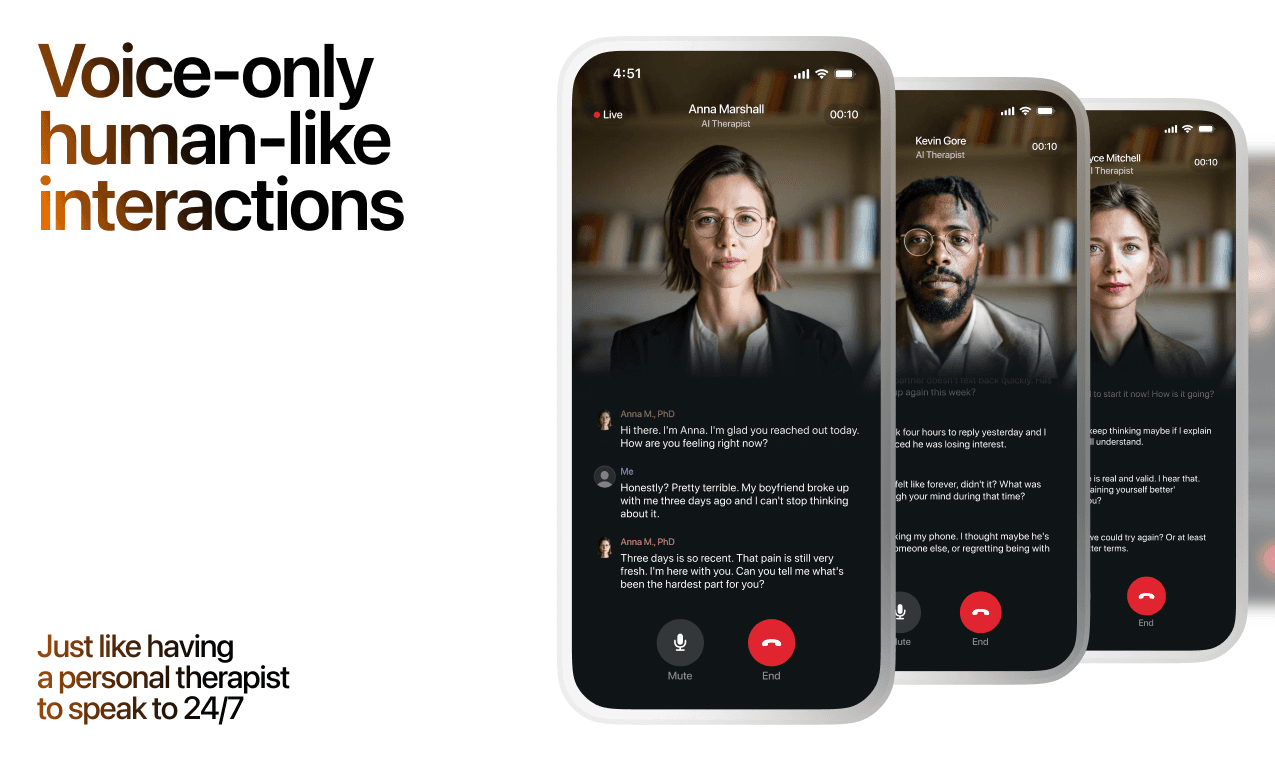
Here's what happens in a typical Lovon session:
You share what's on your mind
There's no script, no intake form, no waiting room. You speak or type whatever you're feeling — in your own words, at your own pace.
Lovon validates and explores
Using frameworks from CBT (Cognitive Behavioral Therapy) and motivational interviewing, Lovon acknowledges your feelings first, then gently helps you explore them. No dismissive "just move on" advice.
You build coping skills together
Lovon doesn't just listen — it actively works with you on evidence-based techniques: thought reframing, urge surfing, behavioral experiments, and more.
What a Session with Lovon Looks Like
When to Seek Professional Help
AI support is a valuable tool, but it's not a replacement for professional care. Please consider reaching out to a licensed therapist if you experience any of the following:
- Persistent thoughts of self-harm or suicide
- Inability to perform daily activities (work, eating, sleeping) for more than 2 weeks
- Turning to alcohol or substances to cope
- Intense anger or desire to harm your ex-partner
- Complete emotional numbness that doesn't improve over time
Crisis Resources (US): If you're in immediate danger, call 988 (Suicide & Crisis Lifeline) or text HOME to 741741 (Crisis Text Line). Available 24/7, free, and confidential.
Outside the US? Find a crisis line in your country
Ready to Start?
Your healing journey can begin right now
A 7-day trial. No judgment. Just a safe space to process what you're going through.
Frequently Asked Questions
Is Lovon a replacement for a real therapist?
Is my conversation with Lovon AI private?
How is Lovon different from ChatGPT for emotional support?
Can I use Lovon if I'm already seeing a therapist?
Can I try Lovon before subscribing?
About the Author
The Lovon Editorial Team
Mental Health & Wellness Content Team
The Lovon Editorial Team develops mental health and wellness content designed to make psychological concepts accessible and actionable. Our goal is to bridge the gap between clinical research and everyday life - helping you understand why your mind works the way it does and what you can do about it....
Related articles
- AI Therapy for Social Anxiety 2026: Verdict + Top Picks
AI therapy for social anxiety in 2026: which voice-based tools help, what to avoid, and when to see a licensed therapist…
- Doom Scrolling and Dissociation: How to Break It (2026)
Doom scrolling and dissociation share a shutdown circuit, not a willpower gap. Get the 2026 step-by-step fix, from…
- AI Coping Tools for Social Media Addiction: 2026 Guide
AI coping tools for social media addiction pair urge tracking with real-time voice support. See what cuts compulsive…
- Stress Management Techniques for Adults: What Works in 2026
Stress management techniques for adults ranked by evidence in 2026: box breathing, muscle relaxation, movement, and when…
See also
Quizzes
- Shame Test: Do You Read Mistakes as Verdicts?
See which exit your shame takes, in 3 minutes.
- Perfectionism Test: What Are Your Standards Costing?
See what your standards actually cost, in 3 minutes.
Free tools
- Write a Letter to Your Best Friend
A chat for a letter to your best friend that only they could have received. Tell it how long you have been friends, one…
- How to Reconnect With an Old Friend
A chat for how to reconnect with an old friend, starting with the text you have been meaning to send for a year. Tell it…
From the wiki
- What does it mean when you dream about your ex?
Dreaming about your ex usually reflects emotional processing, not prophecy and not a message from them. Your sleeping…
Disclaimer: This article is for informational purposes only and does not constitute medical advice, diagnosis, or treatment. Always seek the advice of your physician or other qualified health provider with any questions you may have regarding a medical condition. If you are in crisis or think you may have an emergency, call 988 (Suicide & Crisis Lifeline) or go to the nearest emergency room. Outside the US? Find a crisis line in your country.