
AI Coping Tools for Fear of Flying: 2026 Verdicts
AI coping tools for fear of flying, ranked for 2026: what helps mid-panic, what to skip, and how voice-based AI support fits into pre-flight prep.

Key Takeaways
- Voice-based AI coping tools beat text chatbots for flight anxiety because panic makes typing hard — talking is faster.
- Lovon's on-demand AI coping tools for anxiety work at the gate, mid-flight (with wifi), or the night before — Buy
- Skip generic meditation apps with no live interaction during an active panic spike — they're built for calm days,
- A 90-second breathing reset plus a grounding script covers most in-flight panic; look for both in one app.
- AI tools are not exposure therapy or a clinician — they're a bridge for the moments between real treatment.
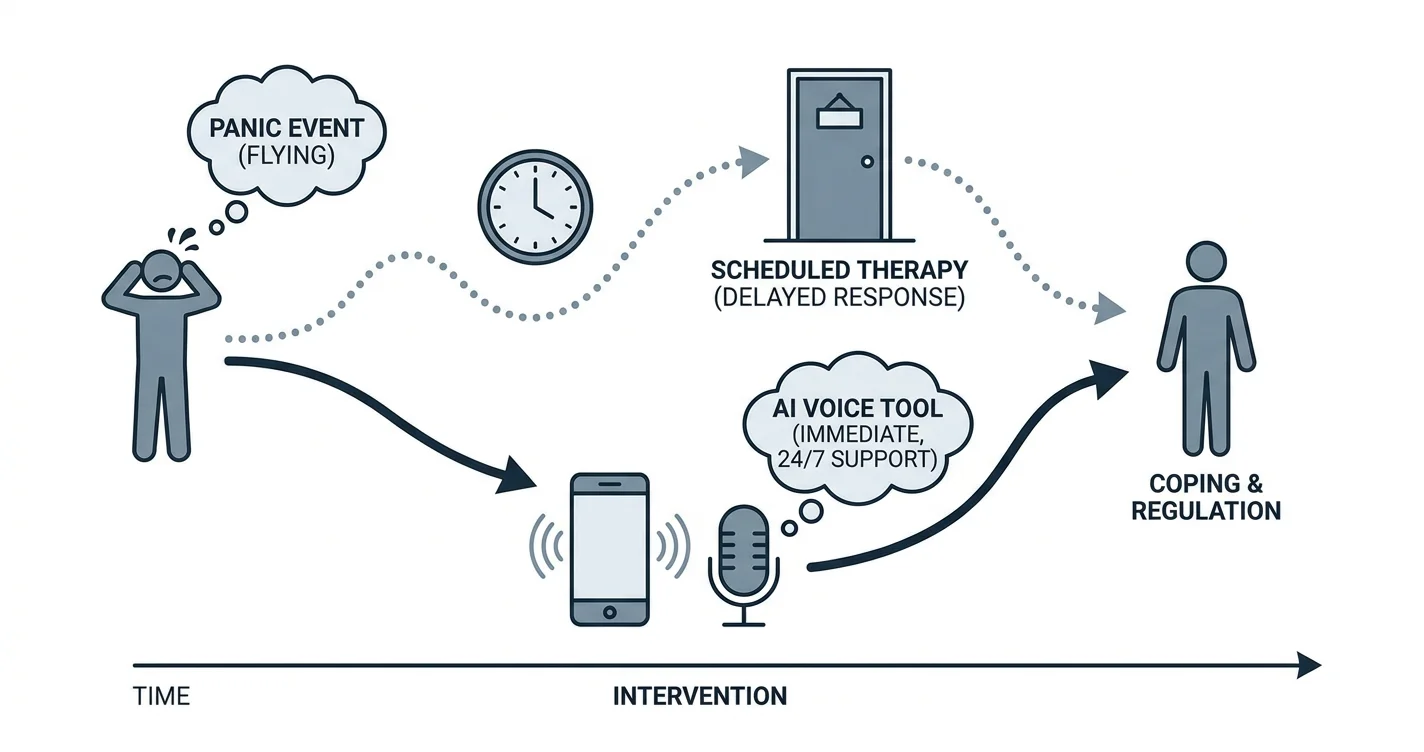
You're staring at a boarding pass at 11pm, stomach already tight, and Googling this because a podcast or a pill isn't going to cut it tonight. AI coping tools for fear of flying give you a voice to talk to at 2am, mid-panic in a bathroom stall, or strapped into 14C with your hands shaking — not a worksheet you'll never open.
TL;DR
- Voice-based AI coping tools beat text chatbots for flight anxiety because panic makes typing hard — talking is faster.
- Lovon's on-demand AI coping tools for anxiety work at the gate, mid-flight (with wifi), or the night before — Buy for pre-flight prep.
- Skip generic meditation apps with no live interaction during an active panic spike — they're built for calm days, not turbulence.
- A 90-second breathing reset plus a grounding script covers most in-flight panic; look for both in one app.
- AI tools are not exposure therapy or a clinician — they're a bridge for the moments between real treatment.
Why this matters
Fear of flying doesn't wait for office hours. It shows up while you're packing, at security, or somewhere over the Atlantic when the seatbelt sign dings back on. A therapist's calendar doesn't cover that window — an app that talks back does.
That's the actual case for AI coping tools for anxiety: they're available at the exact moment fear of flying spikes, not three days later at your next session. In 2026, that on-demand piece matters more than any single breathing technique, because the technique only works if you can reach it when your hands are shaking.
Who this is for
This guide is for people who get physically anxious about flying — racing heart at the gate, white-knuckling the armrest during takeoff, catastrophizing every bump of turbulence — but don't have a therapist on call and don't want to just white-knuckle it with a beer and a prayer. It's also for people who've done exposure therapy or read the books and want a tool that meets them in the actual moment of panic, not just in the prep phase.
If you have a diagnosed anxiety disorder or panic disorder, none of the tools below replace a clinician. They're built to sit alongside real treatment, not instead of it.
What to look for in AI coping tools for fear of flying
Voice-first, not text-only
When your chest is tight and your hands won't stop shaking, typing out a paragraph to a chatbot is the last thing you want to do. Voice-based interaction lets you talk the way you'd talk to a person sitting next to you, which is closer to how AI voice therapy differs from text-based apps — it's built for the moment, not the journal entry after.
On-demand, 24/7, no scheduling
Panic about flying rarely respects a calendar. A tool that only works between 9 and 5 misses the 6am gate meltdown and the midnight can't-sleep spiral before a 7am flight. Look for something you can open the second the dread hits, not something that makes you wait for an appointment slot.
Grounding that works with your body, not just your thoughts
Fear of flying lives in your body first — racing pulse, shallow breath, sweaty palms — and thinking your way out of a physical spike rarely works fast enough. Tools built around breathing pacing and sensory grounding get your nervous system to calm down before your thoughts catch up.
Honest about its limits
Any AI tool worth using tells you plainly it isn't a licensed clinician and can't diagnose a panic disorder or prescribe anything. That honesty is a feature, not a disclaimer to skip past — it tells you the tool knows its lane.
Works with airport wifi and airplane mode realities
Most airports have decent wifi, but plenty of planes don't, or charge for spotty connections. A coping tool needs a plan for both: full features on the ground, and something you can fall back on — a saved script, a downloaded breathing pattern — once you're in the air.
Personalization across sessions
A tool that remembers you mentioned turbulence is your specific trigger, or that your last flight ended in a panic attack at boarding, gives you more relevant support the second time. Generic scripts that treat every anxious flyer the same wear thin fast.
Talk through pre-flight anxiety tonight
Voice-based AI support you can open before you even finish packing.
Top picks: AI coping tools for fear of flying
The breath reset for takeoff. The specific move: a paced breathing pattern, often 4 seconds in, 7 hold, 8 out, guided by voice so you don't have to count in your head while your heart is pounding. This is the fastest tool for the ten minutes between boarding and wheels-up, when your body is flooding with adrenaline and thoughts alone won't slow it down. Breathing exercises for anxiety relief walk through the mechanics if you want to practice before you're already at the gate. Buy for the pre-takeoff window specifically.
The pre-flight voice check-in. A short, guided conversation the night before or morning of a flight, where you say out loud what you're actually afraid of instead of letting it loop silently. Talking it through for even 5 minutes tends to shrink the catastrophizing that builds overnight. Buy if your anxiety peaks the night before more than in the air itself.
The in-flight panic protocol. This is for the moment turbulence hits or your mind jumps to worst-case scenarios at 35,000 feet — a structured sequence rather than a vague "just breathe." It matters because generic advice falls apart under real panic; you need steps you can follow half-consciously. Buy as your baseline in-flight tool, and Consider pairing it with a downloaded offline version for planes without wifi.
The general reassurance app with no live interaction. Plenty of meditation and calm apps have a "flying" category with a pre-recorded track. It's fine for background calm on a smooth flight, but it can't respond when your specific fear spikes mid-turbulence. Skip as your primary tool; fine as backup audio.
What to avoid
- Aviation statistics rabbit holes. Reading "flying is statistically the safest form of travel" for the tenth time rarely calms a panic spike — it's a logical argument aimed at an emotional problem.
- Text-only chatbots during active panic. Typing coherent sentences while your hands are shaking adds friction exactly when you need speed.
- Forums and communities that amplify worst-case stories. Reading someone else's turbulence horror story two hours before your flight does the opposite of what you're trying to accomplish.
- One-size-fits-all guided meditations with no personalization. They're calming on an ordinary Tuesday but rarely built to catch a specific trigger like sudden altitude drops or engine noise.
Comparison at a glance
| Tool type | Voice-first | Works mid-panic | Available 24/7 | Verdict |
|---|---|---|---|---|
| AI voice coping tool (Lovon) | Yes | Yes | Yes | Buy |
| Text-based chatbot | No | Limited | Yes | Consider |
| Pre-recorded meditation app | No | Limited | Yes | Consider |
| Aviation forum / community | No | No | Yes | Skip |
| In-person therapy session | Yes | No (scheduled) | No | Buy, alongside AI tools |
FAQ
What are the best AI coping tools for fear of flying in 2026?
Voice-based AI tools that offer paced breathing, real-time grounding scripts, and 24/7 availability rank highest in 2026 because they meet flyers at the moment panic actually hits, not on a therapist's schedule. Text-only chatbots and pre-recorded meditation tracks work as backups but can't respond to your specific spike.
Can an AI app replace exposure therapy for fear of flying?
No. AI coping tools support you between sessions and in real-time moments, but structured exposure therapy with a licensed clinician is still the evidence-based treatment for a diagnosed flying phobia. Use both together rather than one instead of the other.
Is talking to an AI helpful during an actual panic attack on a plane?
Yes, if the tool is voice-based and offers a structured sequence rather than generic advice. Talking out loud, even to an AI, slows racing thoughts faster than silent worrying, and a guided breathing pattern brings your heart rate down within minutes.
How much does an AI coping tool for fear of flying cost?
Pricing varies by app, so check current plans directly on the provider's site before you fly. Some tools offer limited free access alongside paid tiers with more session time.
What should I do the night before a flight if I'm already panicking?
Talk through the specific fear out loud instead of letting it loop silently in your head — a short voice check-in the night before tends to shrink next-morning dread. Pair that with a paced breathing exercise before bed rather than scrolling flight-safety statistics.
Do AI coping tools work without wifi on the plane?
Most full features need a connection, so download a breathing script or grounding sequence in advance for planes without reliable wifi. Treat the offline version as your backup, not your primary tool.
Is Lovon good for fear of flying specifically?
Lovon's AI voice support app works for fear of flying because it's on-demand and voice-first, which matters most when panic hits at the gate or mid-flight. It's built for emotional support and coping tools, not diagnosis or clinical treatment of a flying phobia.
What's the fastest way to calm down before a flight without medication?
A paced breathing exercise, four seconds in and eight seconds out, brings your heart rate down within two to three minutes without any medication. Pairing it with a short grounding exercise, like naming five things you can see, extends the calming effect through boarding.
One last thing
Most fear-of-flying advice targets the ten minutes of takeoff and ignores the two hours before you even leave the house, where the dread actually builds. Fixing that window with a short voice check-in the night before, rather than saving all your coping tools for 30,000 feet, is the single change that makes the rest of the flight easier.
Related guides
How AI Support Helps You Heal
AI emotional support isn't about replacing human connection — it's about filling the gaps. The moments when you need to talk at 2 AM, when you don't want to burden your friends again, or when you simply need someone to listen without judgment.
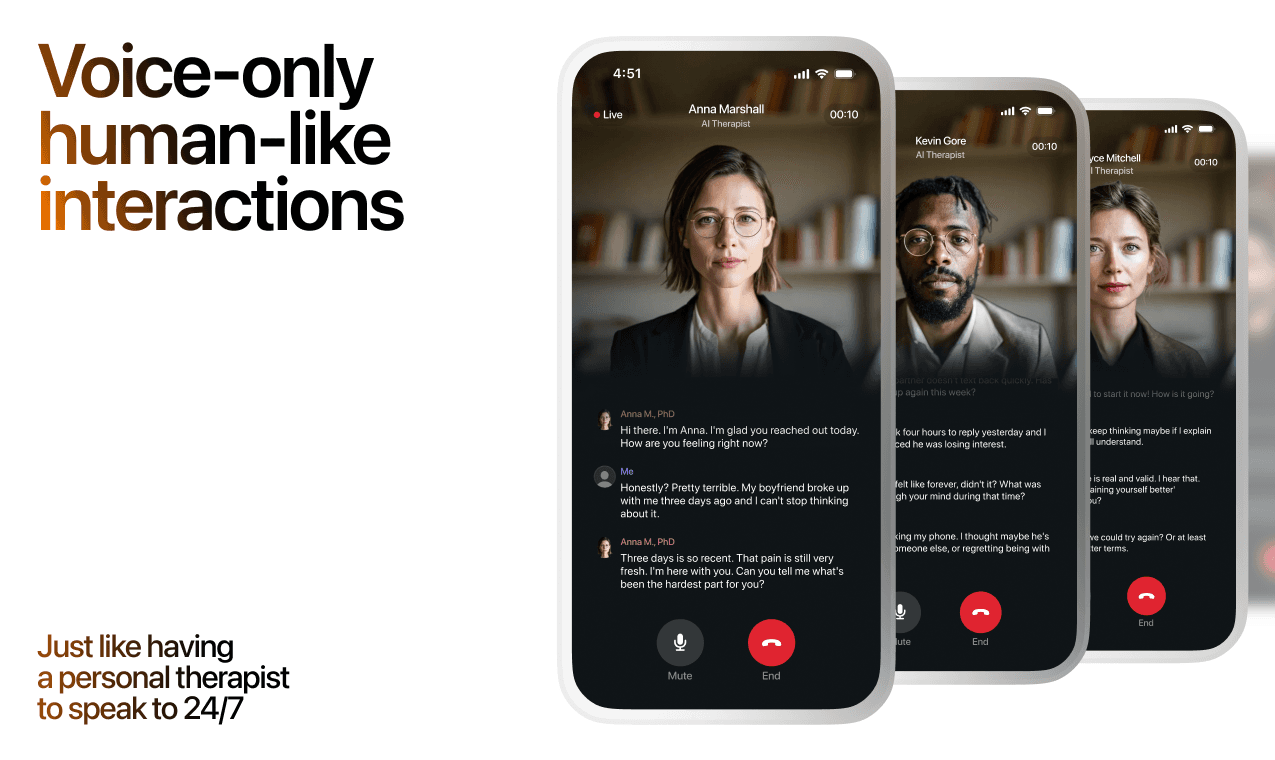
Here's what happens in a typical Lovon session:
You share what's on your mind
There's no script, no intake form, no waiting room. You speak or type whatever you're feeling — in your own words, at your own pace.
Lovon validates and explores
Using frameworks from CBT (Cognitive Behavioral Therapy) and motivational interviewing, Lovon acknowledges your feelings first, then gently helps you explore them. No dismissive "just move on" advice.
You build coping skills together
Lovon doesn't just listen — it actively works with you on evidence-based techniques: thought reframing, urge surfing, behavioral experiments, and more.
What a Session with Lovon Looks Like
When to Seek Professional Help
AI support is a valuable tool, but it's not a replacement for professional care. Please consider reaching out to a licensed therapist if you experience any of the following:
- Persistent thoughts of self-harm or suicide
- Inability to perform daily activities (work, eating, sleeping) for more than 2 weeks
- Turning to alcohol or substances to cope
- Intense anger or desire to harm your ex-partner
- Complete emotional numbness that doesn't improve over time
Crisis Resources (US): If you're in immediate danger, call 988 (Suicide & Crisis Lifeline) or text HOME to 741741 (Crisis Text Line). Available 24/7, free, and confidential.
Outside the US? Find a crisis line in your country
Ready to Start?
Your healing journey can begin right now
A 7-day trial. No judgment. Just a safe space to process what you're going through.
Frequently Asked Questions
Is Lovon a replacement for a real therapist?
Is my conversation with Lovon AI private?
How is Lovon different from ChatGPT for emotional support?
Can I use Lovon if I'm already seeing a therapist?
Can I try Lovon before subscribing?
About the Author

The Lovon Editorial Team
Mental Health & Wellness Content Team
The Lovon Editorial Team develops mental health and wellness content designed to make psychological concepts accessible and actionable. Our goal is to bridge the gap between clinical research and everyday life - helping you understand why your mind works the way it does and what you can do about it....
Related articles
- AI Therapy for Phone Call Anxiety: What Works in 2026
AI therapy for phone call anxiety in 2026: what to look for, which approaches to buy or skip, and the pre-call routine…
- Why Do I Shake When Anxious? Causes & Fixes 2026
Shaking when anxious is adrenaline, not weakness. See the real causes, the fastest fixes for 2026, and when shaking…
- AI therapy for flight attendants: complete 2026 guide
AI therapy for flight attendants explained: how voice-based support fits irregular schedules, jet lag, and layovers in…
- AI Coping Tools for Public Speaking Anxiety in 2026
Ai coping tools for public speaking anxiety in 2026: which breathing, grounding, and CBT techniques actually work, with…
See also
Quizzes
- Perfectionism Test: What Are Your Standards Costing?
See what your standards actually cost, in 3 minutes.
- Shame Test: Do You Read Mistakes as Verdicts?
See which exit your shame takes, in 3 minutes.
Free tools
- What to Say When They Are Struggling
A chat, not a list. Tell the coach who this person is to you, what they are going through, and what you already said…
- How to Reconnect With an Old Friend
A chat for how to reconnect with an old friend, starting with the text you have been meaning to send for a year. Tell it…
From the wiki
- What to do if you have no friends?
Pick one activity that repeats weekly with the same people, and go for six to eight weeks straight. Repetition, not…
Disclaimer: This article is for informational purposes only and does not constitute medical advice, diagnosis, or treatment. Always seek the advice of your physician or other qualified health provider with any questions you may have regarding a medical condition. If you are in crisis or think you may have an emergency, call 988 (Suicide & Crisis Lifeline) or go to the nearest emergency room. Outside the US? Find a crisis line in your country.