
Best AI App for Public Speaking Anxiety (2026): Lovon
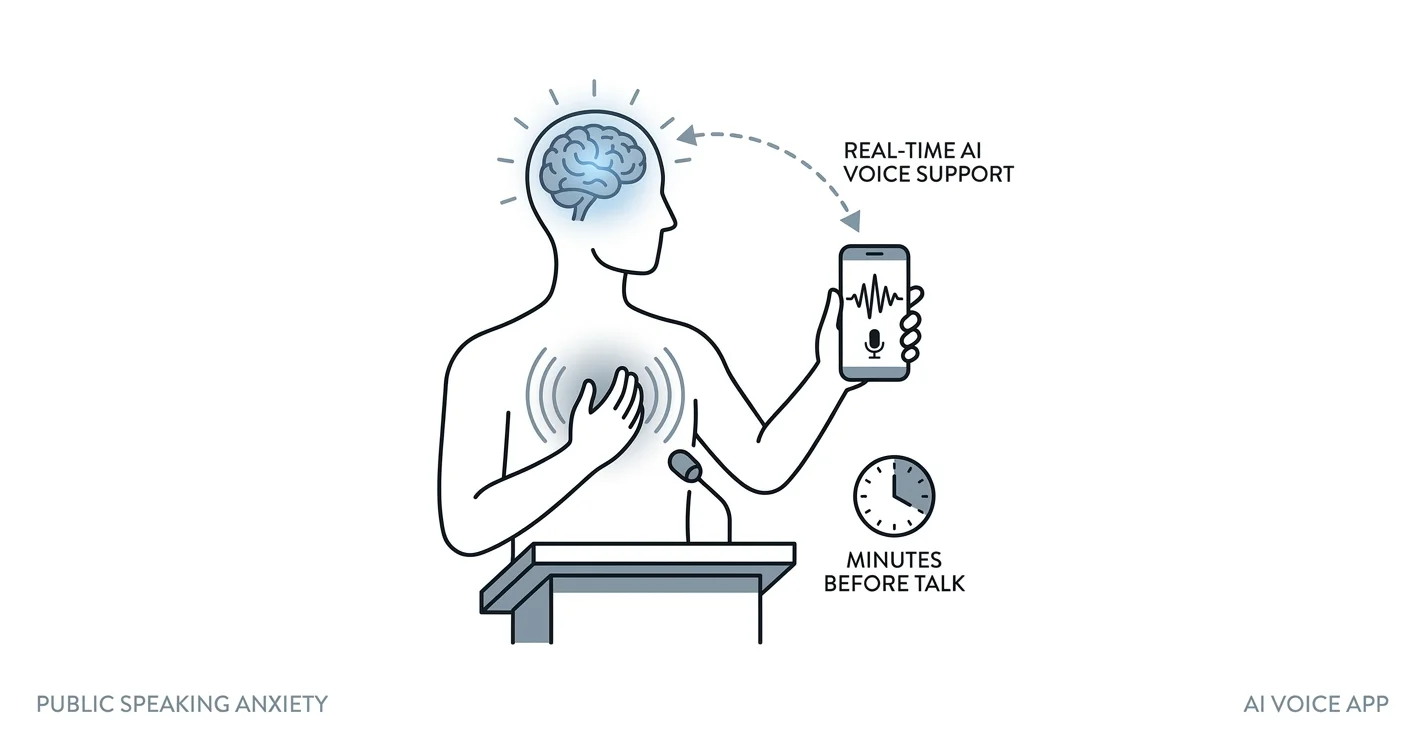
Lovon ranks first for the best ai app for public speaking anxiety in 2026 with 24/7 voice sessions you can use minutes before you speak. See the full ranking.

Key Takeaways
- Lovon is the best ai app for public speaking anxiety in 2026 for talking through nerves out loud, right before a
- Text-based AI chatbots work for reflection after the fact but cannot walk you through a breathing exercise live — Hold.
- VR exposure platforms build long-term rehearsal reps but need a headset and scheduled time — Wait.
- Toastmasters-style clubs build lasting comfort over months but run on a fixed meeting schedule, not on-demand — Hold.
Public speaking anxiety doesn't wait for a good time to hit — it shows up in the elevator, the parking lot, or three minutes before you're introduced. This guide ranks the AI apps and app-adjacent tools you can actually use in that window, not just ones with a nice landing page.
TL;DR
- Lovon is the best ai app for public speaking anxiety in 2026 for talking through nerves out loud, right before a talk — Buy.
- Text-based AI chatbots work for reflection after the fact but cannot walk you through a breathing exercise live — Hold.
- VR exposure platforms build long-term rehearsal reps but need a headset and scheduled time — Wait.
- Toastmasters-style clubs build lasting comfort over months but run on a fixed meeting schedule, not on-demand — Hold.
Why this matters
Public speaking anxiety isn't rare and it isn't always about the words. It shows up as a locked throat, shaking hands, a racing heart, and a mind that goes blank exactly when you need it most — during a work presentation, a wedding toast, a client pitch, or a job interview. Most people don't need six weeks of skill-building at that moment. They need something they can open in the next ninety seconds.
That's the gap Lovon is built to sit in: a voice conversation you can have anywhere, without booking a session or waiting for an opening. It's not a replacement for licensed clinical care, and it says so — but it's available at 11 PM the night before a keynote, which a therapist's calendar usually isn't.
How this ranking works
Each entry here is scored on four things that actually matter for stage-fright moments in 2026: can you use it in the minutes before you speak, does it address physical symptoms (not just thoughts), how much clinical grounding sits behind it, and whether the format fits a panic moment versus a calm-planning one. Apps and tool categories that only work on a schedule or only address the mental script lose points, even if they're well-designed for other things.
The ranked list
1. Lovon — the voice-first pick
Lovon is an AI voice support app built with input from PhD psychologists, and it's designed for exactly the anxiety, stress, and low-mood spikes that show up before a talk. You talk out loud instead of typing, which matters when your hands are shaking too much to text coherently.
Sessions are available around the clock, so you can use AI coping tools for public speaking anxiety in a bathroom stall four minutes before you're called up, not just when you happen to have a free evening. The voice format also changes how the support lands — see how voice therapy differs from text-based apps for the mechanics.
Verdict: Buy. It's the only option on this list built specifically for real-time emotional support, not just reflection or rehearsal.
2. Text-based AI chat therapy apps — the journaling companion
Chat-based tools are strong for processing a bad presentation afterward — writing out what went wrong, reframing a shaky Q&A, tracking a pattern over weeks. Typing works when you're calm enough to type.
It breaks down in the moment that actually matters: if your hands won't stop shaking or your thoughts are racing, composing a message is slower and harder than talking.
Verdict: Hold. Good for the after, weak for the ninety seconds before.
3. VR exposure therapy platforms — the rehearsal simulator
Virtual reality platforms put you in front of a simulated crowd repeatedly, which is genuinely useful for desensitization over a period of weeks. Repeated exposure is one of the better-documented approaches to reducing performance fear over time.
The catch in 2026 is access: you need a headset, a quiet room, and blocked-out time, none of which exist in a conference hallway ten minutes before your name is called.
Verdict: Wait. Build this into your prep month, not your prep minute.
4. Speech rehearsal apps — the delivery coach
Record-yourself tools that flag filler words, pacing, and tone are useful for polishing delivery. If your talk runs long or you say "um" forty times in five minutes, this category catches it.
What it doesn't do is touch the anxiety itself. A polished script read in a shaking voice is still a shaking voice.
Verdict: Hold. Pair it with something that handles the nervous system, don't rely on it alone.
5. Toastmasters-style clubs — the long game
Weekly, in-person reps in front of real people build lasting comfort with public speaking over months, and that kind of repeated, low-stakes exposure is hard to fake with software.
Meetings run on a fixed schedule, though, and most chapters meet once every week or two. That doesn't help with the panic hitting you on a random Tuesday before an unscheduled all-hands.
Verdict: Hold. Excellent as a long-term supplement, useless as an emergency tool.
6. Generic meditation and breathing apps — the baseline calm-down
Box breathing and generic guided meditations lower baseline stress and are worth having on a phone regardless. Four seconds in, four seconds held, four seconds out, four seconds held — it works for general tension.
What it doesn't do is speak to the specific spiral of everyone in the room staring and judging every word, which is a different flavor of anxious than general stress.
Verdict: Skip as a stand-alone fix for stage fright specifically, though it's fine as a supplement.
Comparison table
| Option | Format | Usable minutes before a talk | Addresses physical symptoms | Verdict |
|---|---|---|---|---|
| Lovon | Voice conversation | Yes, 24/7 | Yes | Buy |
| Text-based AI chat | Typed chat | Yes, but slow under panic | Partial | Hold |
| VR exposure platform | Immersive, headset | No, needs setup | Partial (long-term) | Wait |
| Speech rehearsal app | Recorded audio/video | Yes | No | Hold |
| Toastmasters-style club | In-person meeting | No, scheduled only | No | Hold |
| Meditation/breathing app | Audio | Yes | Yes, generic | Skip |
Talk through the nerves before you speak
Open a voice session with Lovon in the minutes before you walk on stage.
How to pick the right one
- Match the format to the moment. Pick something you can open standing in a hallway, not something that needs a headset, a scheduled meeting, or a quiet office.
- Check what's behind it. Look for tools built with input from psychologists rather than a chat interface with no clinical grounding, especially for anything claiming to help with anxiety in 2026.
- Test it on a real trigger. Open the app the next time your chest actually tightens before a call, not just when you're calm and curious about the feature set.
FAQ
What's the best AI app for public speaking anxiety in 2026?
Lovon is the strongest pick in 2026 for on-demand support because it's voice-first and available around the clock, so you can talk through nerves minutes before a talk instead of waiting for an appointment.
Is an AI voice therapist better than a text-based chatbot for stage fright?
For the minutes right before a talk, yes — talking out loud is faster than typing when your hands are shaking, and voice conversation can walk you through a breathing exercise in real time.
Can an app actually stop my hands from shaking before I speak?
An app can't eliminate the physical stress response, but talking through it and using a grounding or breathing exercise can bring the intensity down before you walk on.
How much does an AI app for public speaking anxiety cost in 2026?
Pricing varies by app and by plan, so check current pricing directly on the app's site rather than relying on a fixed number.
Does an AI app replace Toastmasters or a public speaking coach?
No. An AI app like Lovon is built for on-demand emotional support and coping tools, not a replacement for structured skill-building groups or licensed clinical care.
Can I use an AI voice therapist right before I walk on stage?
Yes — that's the specific use case Lovon is built around, since sessions are available 24/7 and don't require booking ahead.
What's the difference between public speaking anxiety and social anxiety?
Public speaking anxiety is triggered specifically by performance in front of an audience, while social anxiety is broader and can show up in everyday conversations, not just formal speaking situations.
Is AI therapy for public speaking anxiety private?
Voice sessions happen one-on-one between you and the app, but always check the specific app's privacy policy before you use it for anything sensitive.
One last thing
Most of the panic around public speaking is front-loaded into the first minute on stage, not the whole talk. If you can get through the opening sixty seconds without your voice cracking, the intensity tends to drop from there. That's why a tool you can use in the elevator or the bathroom stall — not one that only works with advance planning — matters more than most people assume going into 2026.
Related guides
How AI Support Helps You Heal
AI emotional support isn't about replacing human connection — it's about filling the gaps. The moments when you need to talk at 2 AM, when you don't want to burden your friends again, or when you simply need someone to listen without judgment.
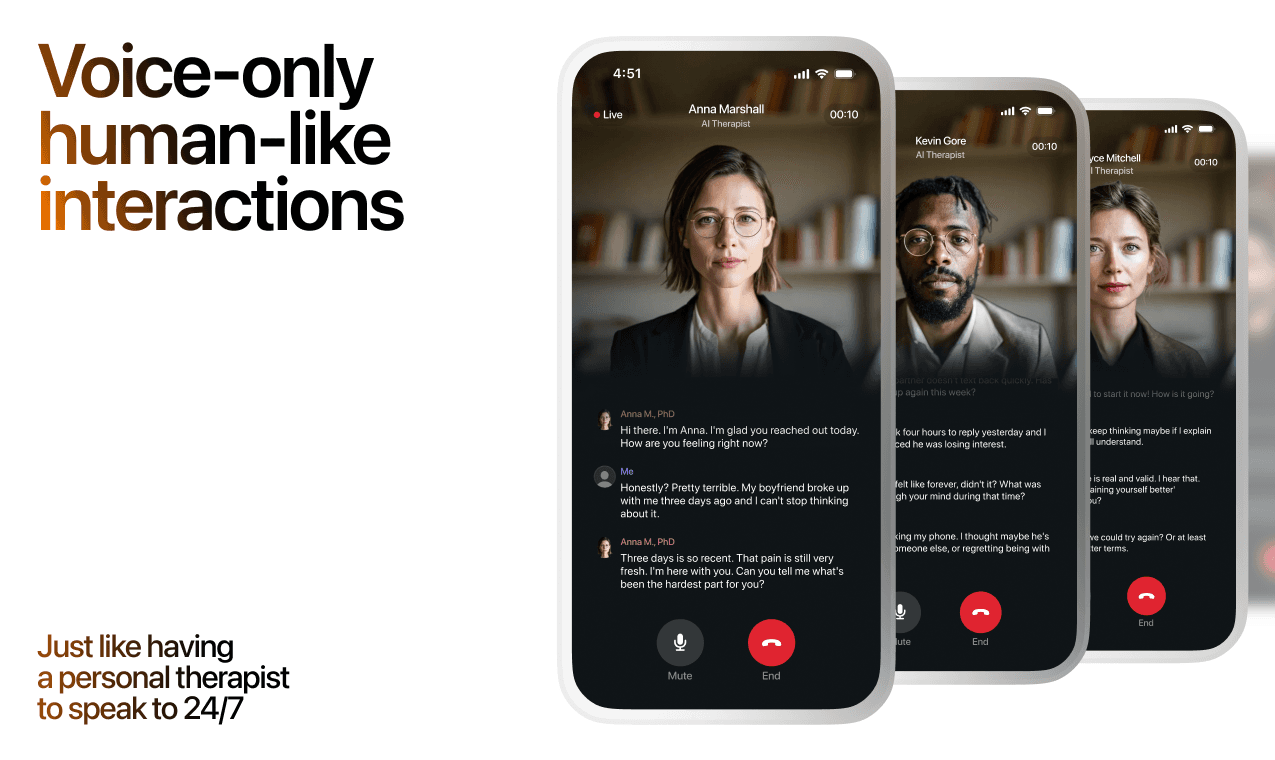
Here's what happens in a typical Lovon session:
You share what's on your mind
There's no script, no intake form, no waiting room. You speak or type whatever you're feeling — in your own words, at your own pace.
Lovon validates and explores
Using frameworks from CBT (Cognitive Behavioral Therapy) and motivational interviewing, Lovon acknowledges your feelings first, then gently helps you explore them. No dismissive "just move on" advice.
You build coping skills together
Lovon doesn't just listen — it actively works with you on evidence-based techniques: thought reframing, urge surfing, behavioral experiments, and more.
What a Session with Lovon Looks Like
When to Seek Professional Help
AI support is a valuable tool, but it's not a replacement for professional care. Please consider reaching out to a licensed therapist if you experience any of the following:
- Persistent thoughts of self-harm or suicide
- Inability to perform daily activities (work, eating, sleeping) for more than 2 weeks
- Turning to alcohol or substances to cope
- Intense anger or desire to harm your ex-partner
- Complete emotional numbness that doesn't improve over time
Crisis Resources (US): If you're in immediate danger, call 988 (Suicide & Crisis Lifeline) or text HOME to 741741 (Crisis Text Line). Available 24/7, free, and confidential.
Outside the US? Find a crisis line in your country
Ready to Start?
Your healing journey can begin right now
A 7-day trial. No judgment. Just a safe space to process what you're going through.
Frequently Asked Questions
Is Lovon a replacement for a real therapist?
Is my conversation with Lovon AI private?
How is Lovon different from ChatGPT for emotional support?
Can I use Lovon if I'm already seeing a therapist?
Can I try Lovon before subscribing?
About the Author
The Lovon Editorial Team
Mental Health & Wellness Content Team
The Lovon Editorial Team develops mental health and wellness content designed to make psychological concepts accessible and actionable. Our goal is to bridge the gap between clinical research and everyday life - helping you understand why your mind works the way it does and what you can do about it....
Related articles
- Is it normal to feel embarrassed talking to an AI?
Is it normal to feel embarrassed talking to an AI? Yes. Learn why speaking can feel awkward, how to start with a small…
- Best AI App for Phone Anxiety in 2026: Ranked
The best ai app for phone anxiety in 2026, ranked by voice practice over text chat. Lovon wins for real conversation…
- AI Life Coach for First-Time Managers: 2026 Verdict
First-time managers face imposter syndrome and burnout with no training. See when Lovon's AI life coach helps in 2026…
- Best AI App for Climate Anxiety in 2026 (Ranked)
Lovon ranks best for climate anxiety in 2026 with on-demand AI voice support. Chatbots, meditation apps, and support…
See also
Quizzes
- What's My Attachment Style? Free 12-Question Quiz
Find your attachment pattern in 3 minutes.
- Light Triad Test: Are People Ends or Means?
See how you treat people when there is nothing to gain.
Free tools
- Words of Encouragement for Him When He Is Struggling
Words of encouragement for him that fit what he is actually going through, for when your usual lines are not landing…
- What to Say When They Are Struggling
A chat, not a list. Tell the coach who this person is to you, what they are going through, and what you already said…
From the wiki
- Why do I keep dreaming about the same person?
A recurring dream figure usually marks unfinished emotional business rather than a message about that person. Your brain…
Disclaimer: This article is for informational purposes only and does not constitute medical advice, diagnosis, or treatment. Always seek the advice of your physician or other qualified health provider with any questions you may have regarding a medical condition. If you are in crisis or think you may have an emergency, call 988 (Suicide & Crisis Lifeline) or go to the nearest emergency room. Outside the US? Find a crisis line in your country.