
Best compatibility quizzes for couples in 2026
Find the best compatibility quizzes for couples: start with a broad check-in, then choose communication or values questions for a useful relationship discussion.

Key Takeaways
- The best compatibility quizzes for couples start useful conversations, not predictions about whether your
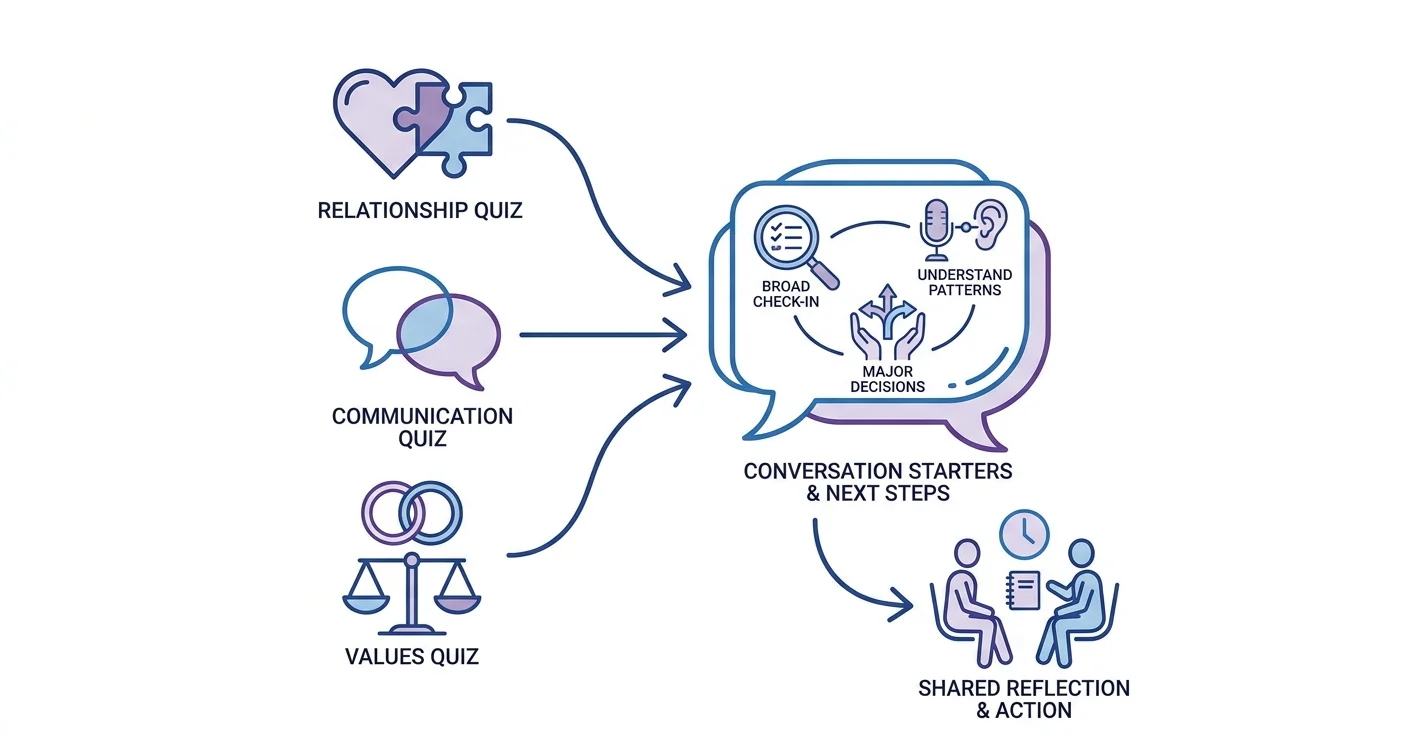
- Choose a relationship compatibility quiz for a broad check-in about needs, expectations, and everyday life.
- Choose communication-style questions for recurring arguments and values questions before marriage or another major
- Lovon supports individual reflection about relationship concerns; it is not a compatibility test or licensed clinician.
Best overall: a relationship compatibility quiz for a broad check-in. Best for recurring arguments: a communication-style quiz. Best before marriage: a values-compatibility quiz. This 2026 guide helps you choose a useful starting point without treating a result as a verdict on your relationship.
TL;DR
- The best compatibility quizzes for couples start useful conversations, not predictions about whether your relationship will last.
- Choose a relationship compatibility quiz for a broad check-in about needs, expectations, and everyday life.
- Choose communication-style questions for recurring arguments and values questions before marriage or another major commitment.
- Lovon supports individual reflection about relationship concerns; it is not a compatibility test or licensed clinician.
Why this matters
You want to know whether your relationship works, not just whether you both enjoy the same things. A useful couples quiz brings expectations into the open: how you handle disagreements, what commitment means, and which decisions you want to make together.
Use a quiz to find the next conversation, not to outsource a relationship decision. Shared answers do not excuse disrespect. Different answers do not automatically mean you should separate.
For this 2026 guide, the recommendations are quiz formats matched to specific needs. The ranking is about usefulness for a conversation, not a claim that any quiz predicts relationship success.
What makes the best compatibility quizzes for couples?
Choose a quiz that helps you understand an answer, not just collect a score. These are the criteria behind the recommendations:
- Relevant questions: The subject matches your concern, whether that is everyday expectations, arguments, or plans for marriage.
- Concrete situations: Questions ask about recognizable behavior rather than vague labels such as perfect partner.
- Room for explanation: You can discuss why you answered a certain way and what would change your answer.
- Clear limits: Results do not diagnose your partner or promise certainty about your future.
- Respect for boundaries: Both people can decline a question, stop, or keep an answer to themselves.
- A useful next step: You leave with something to discuss or practice, not just a compatibility label.
Avoid quizzes that turn a complex relationship into a pass-or-fail judgment. If a result gives you a category but no way to examine your actual experience, its usefulness stops there.
Best couples compatibility quizzes at a glance
| Quiz format | Best for | Standout focus | Key limitation |
|---|---|---|---|
| Relationship compatibility quiz | A broad relationship check-in | Comparing everyday needs and expectations | Breadth leaves less room for a particular problem |
| Communication-style compatibility quiz | Recurring arguments and misunderstood responses | How you speak, listen, pause, and reconnect | Communication skills do not settle conflicting life goals |
| Values-compatibility quiz before marriage | Major commitments and shared future plans | Comparing priorities before making joint decisions | Agreement on ideals does not demonstrate follow-through |
The order matters: start broad when you cannot name the concern, then choose a focused format when you can. You do not need to take every quiz to have a useful discussion.
1. Relationship compatibility quiz: best for a broad check-in
A general relationship compatibility quiz is the best default when your question is simply whether you want similar things. Use this format to compare expectations around time together, independence, affection, responsibilities, and future plans.
Choose questions that invite examples. An answer about feeling supported becomes more useful when you can describe what support looked like during a difficult week.
Relationship compatibility quiz pros:
- Gives you a starting point when your concern feels hard to name.
- Covers everyday expectations alongside bigger relationship questions.
- Helps you identify a subject for a more focused conversation.
Relationship compatibility quiz cons:
- A broad result does not explain every disagreement in depth.
- Your answers describe your perspective, not your partner's unspoken intentions.
Best for: Couples who want a general check-in without starting from a specific conflict.
How to make a broad quiz useful
Answer separately before comparing responses. Otherwise, you risk agreeing in the moment without noticing what you actually think.
For a first check-in in 2026, choose one area where your answers differ. Ask what each answer means in daily life rather than defending which response is correct.
For example, wanting more independence needs explanation. You might mean uninterrupted hobbies, less frequent messaging, or more control over your schedule. Those are different requests.
Verdict: Buy into the conversation, not the score. Choose this format first when you need a broad starting point.
2. Communication-style quiz: best for recurring arguments
A communication-style compatibility quiz is the better choice when you keep having the same argument or misunderstand how your partner responds. Look for questions about listening, expressing needs, taking a pause, and returning to an unfinished discussion.
This format shifts the conversation from who is difficult to what happens between you. Describe the behavior before assigning a label.
Communication-style quiz pros:
- Keeps attention on specific actions during disagreements.
- Gives you language for different preferences around timing and directness.
- Creates an opening to agree on how to pause and resume a conversation.
Communication-style quiz cons:
- Similar communication preferences do not guarantee respectful behavior.
- Better wording does not resolve a disagreement about children, commitment, or another central goal.
Best for: Couples whose main concern is how they handle disagreement rather than what they want from life.
Turn a communication result into an agreement
Choose one recurring moment: interrupting, becoming quiet, sending repeated messages, or leaving a conversation unfinished. Each person should describe their own actions, not explain the other person's motives.
Then make the request specific. Instead of asking your partner to communicate better, agree on how you will signal a pause and decide when to return.
A pause is not permission to ignore an issue indefinitely. Both people need a way to raise concerns without punishment, ridicule, or pressure to surrender their position.
Verdict: Buy into this format for recurring arguments. Skip it as a substitute for discussing incompatible goals or unsafe behavior.
3. Values-compatibility quiz: best before marriage
A values-compatibility quiz is the strongest choice before marriage or another major shared commitment. Use this format to discuss priorities around children, money, work, family involvement, faith, caregiving, and where you want to live.
The goal is not identical answers. It is knowing which differences you can accept and which require a decision before you commit.
Values-compatibility quiz pros:
- Puts long-term expectations on the table before a joint decision.
- Helps distinguish preferences from personal nonnegotiables.
- Encourages direct discussion of subjects that are easy to postpone.
Values-compatibility quiz cons:
- Stated values do not show how someone behaves under pressure.
- Agreement today does not remove the need to revisit plans when circumstances change.
Best for: Couples considering marriage, living together, parenting, or another commitment with shared responsibilities.
Ask what agreement would look like
If you both value fairness, describe how you would divide household work. If you both value family, discuss boundaries with relatives. Shared words need practical meaning.
For a commitment you are considering in 2026, separate what you prefer from what you cannot accept. Do not call a difference settled simply because neither person wants to upset the other.
A disagreement about whether to have children needs a direct conversation. A quiz cannot create a compromise that both people genuinely want.
Verdict: Buy into this format before a major commitment. Hold the decision when an essential question remains unresolved.
How these quiz formats are ranked
The relationship compatibility quiz comes first because it offers the broadest starting point. The communication-style quiz follows for a defined interaction problem. The values-compatibility quiz serves the clearest decision point: a major commitment.
Each recommendation follows the same criteria: relevant questions, concrete situations, room for explanation, clear limits, boundaries, and a next step. No ranking here treats a quiz as a clinical assessment or a forecast of relationship success.
How to discuss your answers without turning them into a fight
The useful part begins after you answer. Keep the discussion small enough that you can listen instead of trying to resolve your entire relationship at once.
Answer separately
Write your own responses before comparing them. Do not answer on your partner's behalf or adjust your answer to produce a better match.
You can also decline a question. Participation should be a choice, not a test of loyalty.
Compare meanings
Choose one answer that surprised you and ask what it means. Listen for the situation behind the response rather than assuming the result explains everything.
An example from last week gives you more to discuss than an absolute claim about what your partner always does.
Choose one action
Turn the conversation into one request that describes a behavior. That might be asking before offering advice, sharing a household task, or making time to discuss a decision.
Keep it mutual. One person should not carry all the responsibility for making a relationship work.
Revisit together
Set aside 15 minutes for the first discussion, give each person 2 minutes to explain one answer without interruption, and choose 1 action to revisit after 7 days. These are suggested boundaries for the exercise, not a tested formula or a promise of improvement.
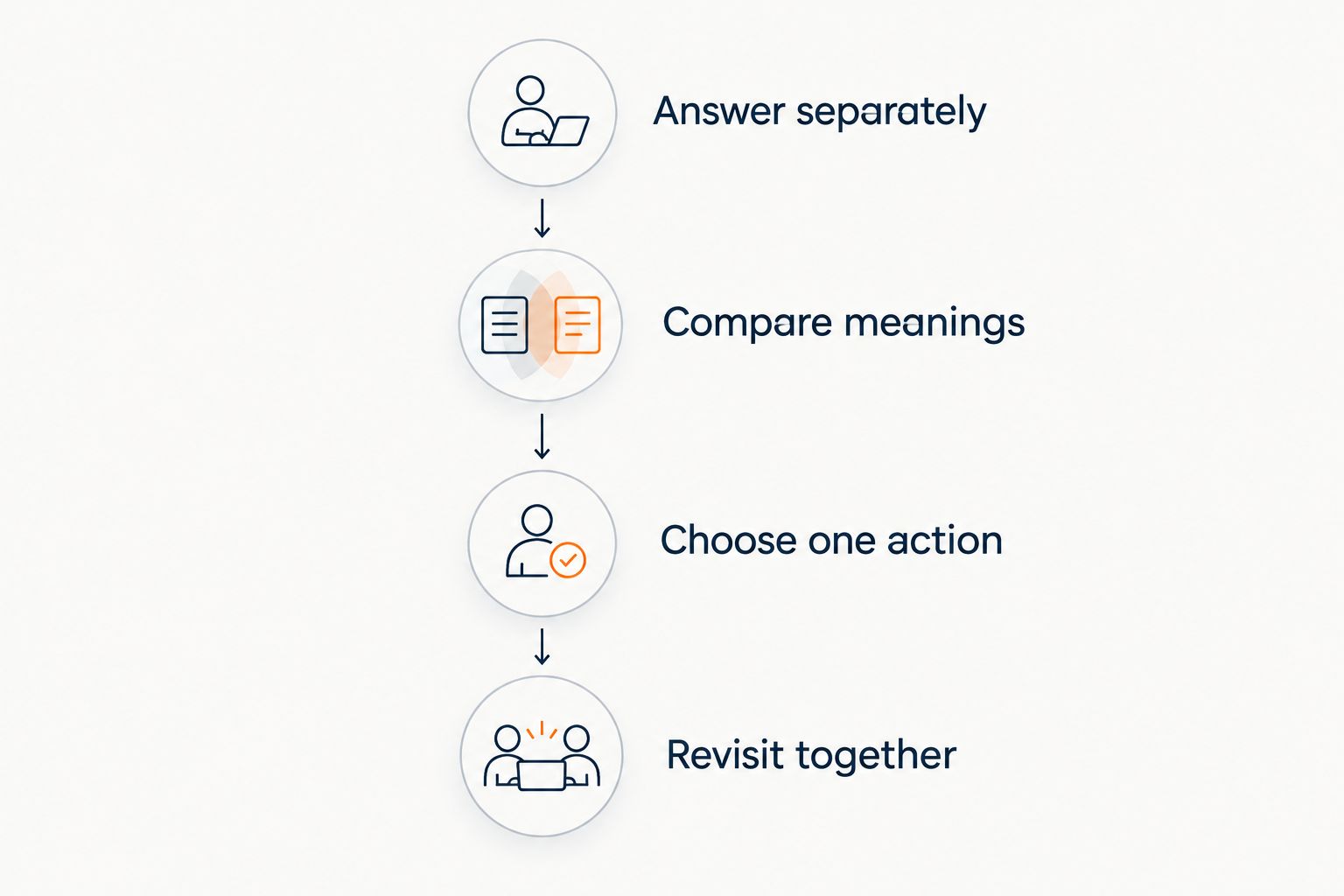 Four steps for discussing quiz answers and agreeing on a practical next action
A quiz becomes useful when you connect an answer to a specific conversation and action.
If the discussion becomes overwhelming, stop and arrange another time. You do not need to finish just because you started. If you fear your partner's reaction, prioritize individual support and safety rather than completing the exercise together.
When a quiz is the wrong next step
A compatibility quiz is not the right tool for assessing threats, coercion, stalking, or violence. A positive result does not make those behaviors acceptable, and a shared exercise should never require you to disclose something that puts you at risk.
Seek individual professional support when you need help understanding safety concerns. For persistent conflict that both partners want to address, a licensed couples therapist offers a different kind of support from a self-guided questionnaire.
Lovon is best for individual relationship-support reflection, not for deciding whether a couple is compatible. The app offers voice conversations, emotional support, coping tools, and self-reflection guidance. Lovon is not a licensed clinician or a replacement for clinical care.
Lovon relationship-support conversations can be a place to reflect on your own feelings before talking with your partner. They cannot establish your partner's motives, diagnose your relationship, or replace your partner's perspective.
Which compatibility quiz should you choose?
Choose a general relationship compatibility quiz if you are undecided. It gives you a broad starting point without requiring you to name the problem first.
Choose the communication-style format when arguments are the concern. Choose the values format when you are weighing marriage or another major commitment.
For your next check-in in 2026, take one quiz and discuss one difference. Collecting more results is not the same as answering the question that matters to you.
FAQ
What's the best compatibility quiz for couples in 2026?
A general relationship compatibility quiz is the best starting point for a broad check-in. Choose a communication-style quiz for recurring arguments or a values-compatibility quiz before a major commitment.
Can a compatibility quiz tell us whether we should break up?
No compatibility quiz can make that decision for you. Use questions to clarify your needs and disagreements, then consider actual behavior, safety, and whether both people want to work on the relationship.
Should we take a couples compatibility quiz together or separately?
Answer separately first, then compare responses if both people want to. This keeps each person's perspective visible and gives you room to explain differences without shaping answers to match.
Is a communication quiz better than a values quiz?
A communication quiz is better for examining recurring arguments; a values quiz is better for discussing major life choices. Choose the format that matches your current question rather than expecting one quiz to cover everything.
Does a low compatibility score mean our relationship is unhealthy?
A low compatibility score does not establish whether a relationship is unhealthy. Examine the specific answers and actual behavior; threats, coercion, and disrespect require attention regardless of any score.
Can Lovon tell me whether my partner and I are compatible?
Lovon offers emotional support and individual self-reflection, not a definitive compatibility assessment. It is not a licensed clinician and cannot determine your partner's intentions or replace professional care.
What should we do when we disagree on a quiz answer?
Ask what each answer means in a concrete situation before trying to resolve it. Identify whether the difference is a preference, a practical problem, or a nonnegotiable; not every disagreement needs an immediate compromise.
One last thing
Ask about the answer you agreed on, too. Two people can both value closeness while imagining different amounts of time together.
Your most useful follow-up is a request for an example. Before celebrating a match or worrying about a difference, describe what the answer would look like on an ordinary day.
Related guides
How AI Support Helps You Heal
AI emotional support isn't about replacing human connection — it's about filling the gaps. The moments when you need to talk at 2 AM, when you don't want to burden your friends again, or when you simply need someone to listen without judgment.
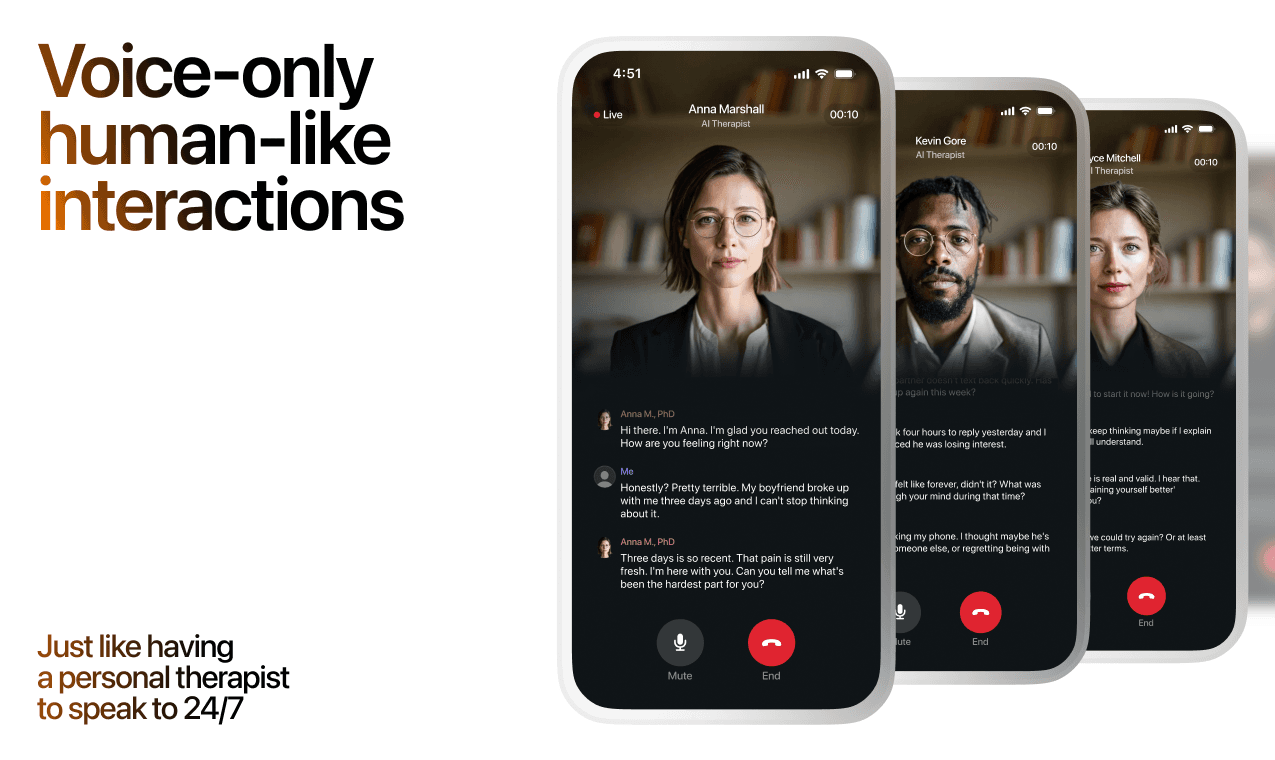
Here's what happens in a typical Lovon session:
You share what's on your mind
There's no script, no intake form, no waiting room. You speak or type whatever you're feeling — in your own words, at your own pace.
Lovon validates and explores
Using frameworks from CBT (Cognitive Behavioral Therapy) and motivational interviewing, Lovon acknowledges your feelings first, then gently helps you explore them. No dismissive "just move on" advice.
You build coping skills together
Lovon doesn't just listen — it actively works with you on evidence-based techniques: thought reframing, urge surfing, behavioral experiments, and more.
What a Session with Lovon Looks Like
When to Seek Professional Help
AI support is a valuable tool, but it's not a replacement for professional care. Please consider reaching out to a licensed therapist if you experience any of the following:
- Persistent thoughts of self-harm or suicide
- Inability to perform daily activities (work, eating, sleeping) for more than 2 weeks
- Turning to alcohol or substances to cope
- Intense anger or desire to harm your ex-partner
- Complete emotional numbness that doesn't improve over time
Crisis Resources (US): If you're in immediate danger, call 988 (Suicide & Crisis Lifeline) or text HOME to 741741 (Crisis Text Line). Available 24/7, free, and confidential.
Outside the US? Find a crisis line in your country
Ready to Start?
Your healing journey can begin right now
A 7-day trial. No judgment. Just a safe space to process what you're going through.
Frequently Asked Questions
Is Lovon a replacement for a real therapist?
Is my conversation with Lovon AI private?
How is Lovon different from ChatGPT for emotional support?
Can I use Lovon if I'm already seeing a therapist?
Can I try Lovon before subscribing?
About the Author
The Lovon Editorial Team
Mental Health & Wellness Content Team
The Lovon Editorial Team develops mental health and wellness content designed to make psychological concepts accessible and actionable. Our goal is to bridge the gap between clinical research and everyday life - helping you understand why your mind works the way it does and what you can do about it....
Related articles
- Couples Therapy Intake Process: Observation Session Followed by Individual Breakout Sessions
The couples therapy intake process often feels mysterious to those scheduling their first appointment. Many couples…
- Best Couples Compatibility Quiz for New Couples 2026
Take the best couples compatibility quiz in 2026. Covers attachment, values, and communication style — with AI-guided…
- AI Coping Tools for Wedding Planning Stress (2026)
AI coping tools for wedding planning stress in 2026: box breathing, muscle relaxation, and Lovon's on-demand voice…
- Feedback vs Criticism in Relationships: Healthy Intimacy or Harsh Judgment
Every intimate relationship encounters moments where partners need to address concerns, express disappointment, or…
See also
Quizzes
- Compatibility Test: 15 Things That Have to Match
Check the fifteen things that do not bend.
- Relationship Quality Test: How Good Is Your Relationship?
Score connection, repair and teamwork in 3 minutes.
Free tools
- Deep Conversation Starters That Fit the Person You're Asking
The right question depends on who is across from you and how much history is behind it. Tell it who you are talking to…
- Relationship Check-In Questions, and How to Run One
Check-ins fail on structure, not on questions. Tell it whether this would be your first one, what is on your mind, and…
From the wiki
- What does falling in love feel like?
Falling in love usually arrives in the body first: a restless stomach, thin sleep, a pulse that reacts to a name on your…
Disclaimer: This article is for informational purposes only and does not constitute medical advice, diagnosis, or treatment. Always seek the advice of your physician or other qualified health provider with any questions you may have regarding a medical condition. If you are in crisis or think you may have an emergency, call 988 (Suicide & Crisis Lifeline) or go to the nearest emergency room. Outside the US? Find a crisis line in your country.