
How to Make Friends as an Adult (2026 Step-by-Step Guide)
How to make friends as an adult in 2026: 7 concrete steps, common mistakes, and what to do when friendships stall. Practical, not theoretical.

Key Takeaways
- Making friends as an adult in 2026 takes repeated contact, not charisma — show up to the same group at least 3 times
- A widely cited University of Kansas study found casual friendship takes roughly 50 hours together and close
- Chronic loneliness needs a different approach than situational loneliness — check loneliness vs. being alone before
- Skip apps promising instant matches; one or two recurring activities beat hopping between five one-off events.
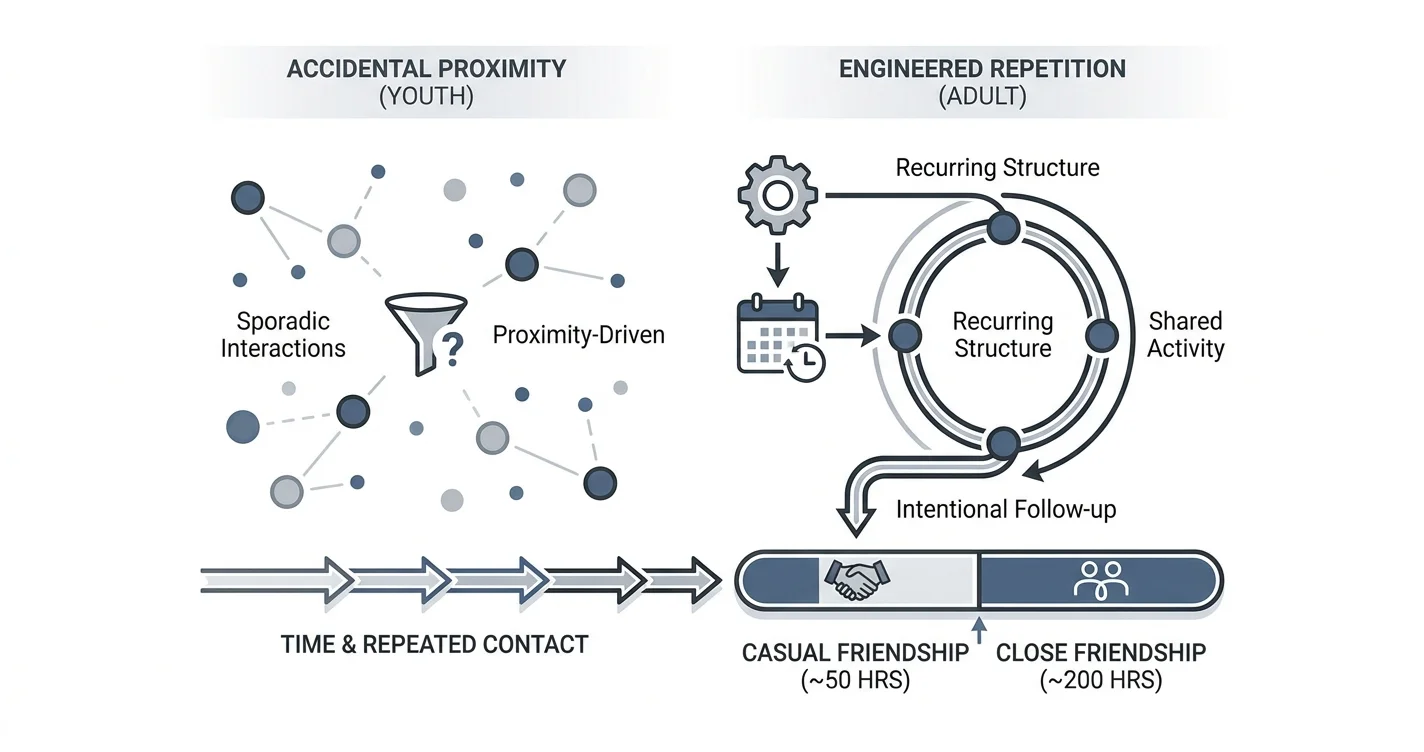
Adult friendships don't happen by proximity anymore — no shared homeroom, no dorm hallway down the hall — so making friends as an adult in 2026 means engineering the repetition that used to happen by accident.
TL;DR
- Making friends as an adult in 2026 takes repeated contact, not charisma — show up to the same group at least 3 times before judging the fit.
- A widely cited University of Kansas study found casual friendship takes roughly 50 hours together and close friendship closer to 200 hours, so plan for time, not instant chemistry.
- Chronic loneliness needs a different approach than situational loneliness — check loneliness vs. being alone before you blame your social skills.
- Skip apps promising instant matches; one or two recurring activities beat hopping between five one-off events.
Why this matters
Most adults don't lack social skills — they lack a structure that puts them in front of the same people more than once. School and college manufactured that structure for you: same classroom, same dorm floor, same lunch table. Work does it loosely, but coworkers rotate, remote jobs remove it entirely, and once you're past your late 20s the natural funnel mostly dries up.
That's why so many people feel stuck between "I want more friends" and "I don't know how to make that happen" in 2026, even though nothing about their personality changed. If the stuck feeling has less to do with logistics and more to do with a deeper, ongoing emptiness, that's worth separating out — see loneliness vs. being alone before assuming a new hobby will fix it.
The fix for situational friendlessness is mechanical, not emotional: build repetition back into your week on purpose.
What you'll need
- One recurring time slot per week you can actually protect (90 minutes is enough)
- One structured activity to attach it to — a class, a league, a volunteer shift, a standing game night
- A low-stakes way to follow up (a phone number, a group chat, a shared calendar invite)
- Tolerance for at least 5 mildly awkward sessions before anything feels natural
- Patience for the ramp period — friendship researchers put casual friendship at roughly 50 hours of shared time and close friendship near 200 hours
The steps
1. Audit your dormant contacts before starting from zero
Most adults already have 3-5 people who liked them enough to exchange numbers once — an old coworker, a college acquaintance, a neighbor you waved at twice. Reactivating a dormant tie takes a fraction of the effort of building one from nothing, because the awkward first-contact phase is already behind you. Text one this week with something specific: "Was thinking about that trip you took, how'd it go?" Expected outcome: about half will respond warmly within 48 hours. Common mistake: sending "we should catch up sometime" — it's vague enough to ignore.
2. Pick one recurring structure, not five one-off events
A single running club or weekly trivia night beats five scattered meetups because repetition, not variety, is what builds familiarity. Choose something with a fixed weekly slot and the same rough group of people each time. Expected outcome: by session 3 or 4, at least one person starts remembering your name unprompted. Common mistake: trying three new activities in one month and abandoning all of them before any produces a second conversation.
3. Show up five times before you judge the group
The first session almost always feels flat — everyone's guarded, small talk is stiff, nobody's committed yet. Commit to five sessions minimum before deciding whether the group has friend potential; bailing after one or two kills momentum that hasn't had time to build. Expected outcome: conversations shift from logistics ("where do we sign in?") to actual opinions and jokes by week 4 or 5. Common mistake: quitting after a quiet first night and calling the group "not my people."
4. Make the first individual ask small
Once someone in the group feels slightly familiar, ask for something with almost no risk: coffee before the session, a ride home, splitting a snack afterward. Small asks get accepted more often than "let's hang out sometime" because the other person doesn't have to plan around it. Expected outcome: a yes rate well above 50% for asks under 30 minutes. Common mistake: jumping straight to a dinner invite before you've had a single one-on-one exchange.
5. Follow up within 48 hours
Momentum fades fast — wait a week to text after a good conversation and it reads as low interest even when it isn't. Send a short, specific follow-up referencing something you talked about, not a generic "good seeing you." Expected outcome: this single habit is often the difference between a group acquaintance and an actual friend by month two. Common mistake: assuming the other person will reach out first.
6. Move at least one contact off the group setting
Group friendships plateau if nobody ever meets one-on-one — pick the person you've clicked with most and suggest something outside the group context. If asking feels uncomfortable, that discomfort is normal and worth naming rather than avoiding; there's a practical breakdown of how to ask for emotional support without feeling needy that applies just as well to asking for a hangout. Expected outcome: 1:1 time accelerates closeness faster than any number of group sessions. Common mistake: waiting for the other person to make the first individual invite.
7. Protect the friendship once it exists
A new friendship dies quietly if nothing recurring replaces the original activity that created it. Set a standing check-in — same day every two weeks, even a 10-minute call — before life gets busy again. Expected outcome: friendships with a recurring touchpoint survive schedule changes; ones without one fade within a few months. Common mistake: letting "we should do this again" stay a suggestion instead of a scheduled thing.
Feeling too anxious to reach out?
Talk it through before the group hangout with Lovon's AI voice companion.
Troubleshooting
"I keep canceling at the last minute." That's usually anxiety dressed up as scheduling conflict — treat the cancel impulse as data, not a real logistics problem, and go anyway for at least three sessions before deciding it's not worth it.
"Everyone already seems to have their friend group." Groups look closed from the outside because the visible interactions are the established ones — new members almost always underestimate how open a group actually is until they've shown up a few times.
"I don't know what to say once I'm there." Ask about the activity itself first — logistics questions are a socially acceptable way in — and let topics widen naturally after two or three sessions.
"It feels one-sided, like I'm always the one reaching out." Track it for three weeks instead of guessing; if the imbalance is real and persistent, it's a pattern worth naming directly rather than quietly resenting — there's a full breakdown in friendship breakups: why they hurt and how to heal if a specific friendship has already soured over this exact issue.
"I'm too tired after work to go." Pick a slot earlier in the week — energy for socializing tends to be highest Tuesday through Thursday and lowest by Friday night for most adults.
"I met someone I like but I'm not sure if we're 'friends' yet or just friendly." That line is fuzzier than people admit, and worth understanding on its own terms — see what is platonic friendship and where is the line for a clearer read on where acquaintance ends and friendship starts.
Tools and resources
- A recurring calendar block, treated as non-negotiable as a work meeting
- One local structure: adult sports league, community class, volunteer group, or hobby meetup
- A group chat or shared thread for the people you're trying to stay in touch with
- A private space to process the anxious parts of putting yourself out there in 2026 — Lovon's AI voice sessions are built for exactly the between-hangout nerves that don't need a full therapy appointment
What to do next
Once the mechanics are in place, the harder part is usually internal — the voice that says you're too old, too awkward, or too busy for this. That voice responds better to a conversation than to willpower. Lovon lets you talk it out by voice, on your schedule, when the anxious loop about reaching out gets loud.
FAQ
How long does it actually take to make a real friend as an adult?
Research from the University of Kansas puts casual friendship at roughly 50 hours of shared time and close friendship closer to 200 hours. That means consistent weekly contact over 2-4 months, not a single great conversation.
Is it normal to feel awkward making friends as an adult in 2026?
Yes, and it fades faster than most people expect. The first few sessions of any new group feel stiff for almost everyone, not just you.
Are friendship apps worth trying?
They can widen the pool of people you meet, but they don't replace repeated in-person contact. Treat an app as a way to find one recurring activity, not as the friendship itself.
What if I keep making friends but the friendships fizzle out?
That usually points to a missing recurring touchpoint after the initial spark fades. Set a standing check-in before the friendship has a chance to go quiet.
Is it better to make friends through work or outside of work?
Outside-of-work friendships tend to last longer because they're not tied to a job that might change. Work friendships are still valid, but treat them as a starting point, not the ceiling.
How do I make friends as an introvert without burning out?
Pick one recurring activity instead of several, and give yourself recovery time after socializing rather than stacking events back to back. One deep connection built over months costs less energy than five shallow ones built in a week.
Why does making friends feel harder after 30?
The natural structures that manufactured friendship — school, dorms, early-career social events — thin out with age, so contact has to be built on purpose instead of happening by default. The mechanics still work the same way; they just require more intention.
Can therapy help with loneliness, or is it only for friendship-building tactics?
Therapy, including AI voice therapy, can't hand you a friend group, but it can help untangle the anxiety or avoidance that keeps you from showing up in the first place. Lovon is built for that in-between processing, not as a replacement for actually going to the group.
One last thing
Most stalled friendships aren't stuck because of a personality mismatch — they're stuck because both people are waiting for the other to text first. Send it first in 2026, even if it feels one-sided in the moment; the data on friendship formation consistently shows initiation matters more than charm.
Related guides
How AI Support Helps You Heal
AI emotional support isn't about replacing human connection — it's about filling the gaps. The moments when you need to talk at 2 AM, when you don't want to burden your friends again, or when you simply need someone to listen without judgment.
Here's what happens in a typical Lovon session:
You share what's on your mind
There's no script, no intake form, no waiting room. You speak or type whatever you're feeling — in your own words, at your own pace.
Lovon validates and explores
Using frameworks from CBT (Cognitive Behavioral Therapy) and motivational interviewing, Lovon acknowledges your feelings first, then gently helps you explore them. No dismissive "just move on" advice.
You build coping skills together
Lovon doesn't just listen — it actively works with you on evidence-based techniques: thought reframing, urge surfing, behavioral experiments, and more.
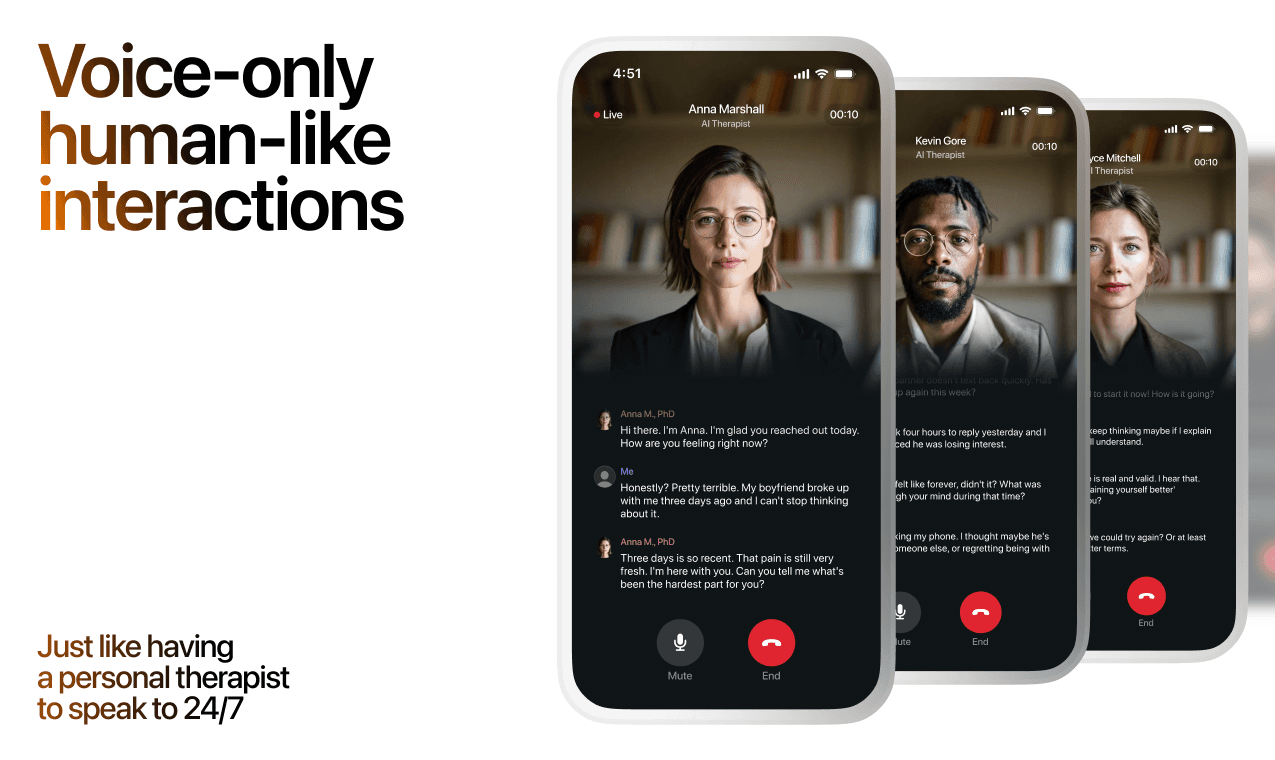
What a Session with Lovon Looks Like
When to Seek Professional Help
AI support is a valuable tool, but it's not a replacement for professional care. Please consider reaching out to a licensed therapist if you experience any of the following:
- Persistent thoughts of self-harm or suicide
- Inability to perform daily activities (work, eating, sleeping) for more than 2 weeks
- Turning to alcohol or substances to cope
- Intense anger or desire to harm your ex-partner
- Complete emotional numbness that doesn't improve over time
Crisis Resources (US): If you're in immediate danger, call 988 (Suicide & Crisis Lifeline) or text HOME to 741741 (Crisis Text Line). Available 24/7, free, and confidential.
Outside the US? Find a crisis line in your country
Ready to Start?
Your healing journey can begin right now
A 7-day trial. No judgment. Just a safe space to process what you're going through.
Frequently Asked Questions
Is Lovon a replacement for a real therapist?
Is my conversation with Lovon AI private?
How is Lovon different from ChatGPT for emotional support?
Can I use Lovon if I'm already seeing a therapist?
Can I try Lovon before subscribing?
About the Author

The Lovon Editorial Team
Mental Health & Wellness Content Team
The Lovon Editorial Team develops mental health and wellness content designed to make psychological concepts accessible and actionable. Our goal is to bridge the gap between clinical research and everyday life - helping you understand why your mind works the way it does and what you can do about it....
Related articles
- Best AI App for Loneliness in 2026: Ranked and Reviewed
The best ai app for loneliness in 2026, ranked: Lovon wins for on-demand AI voice therapy vs. chatbots, therapist…
- How long does it take to get an adult ADHD diagnosis?
How long does an adult ADHD diagnosis take? There is no fixed timeline in 2026. Learn what affects the wait, what an…
- Inner Child Healing: Step-by-Step Guide (2026)
Follow this practical 7-step inner child healing guide — grounded in schema therapy and IFS — to break emotional…
- Mental Health Support for Remote Workers: 2026 Guide
Mental health support for remote workers in 2026: boundary tactics, burnout vs depression signs, and when an AI voice…
See also
Quizzes
- Shame Test: Do You Read Mistakes as Verdicts?
See which exit your shame takes, in 3 minutes.
- Digital Stress Test: Texting, Likes and Read Receipts
See which part of being online wears on you, in 3 minutes.
Free tools
- What to Say When They Are Struggling
A chat, not a list. Tell the coach who this person is to you, what they are going through, and what you already said…
- Write a Letter to Your Best Friend
A chat for a letter to your best friend that only they could have received. Tell it how long you have been friends, one…
From the wiki
- Why do I feel lonely all of a sudden?
Sudden loneliness usually traces back to something that quietly ended in the last few months: a routine, a shared class…
Disclaimer: This article is for informational purposes only and does not constitute medical advice, diagnosis, or treatment. Always seek the advice of your physician or other qualified health provider with any questions you may have regarding a medical condition. If you are in crisis or think you may have an emergency, call 988 (Suicide & Crisis Lifeline) or go to the nearest emergency room. Outside the US? Find a crisis line in your country.