
Mental Health Support for Remote Workers: 2026 Guide
Mental health support for remote workers in 2026: boundary tactics, burnout vs depression signs, and when an AI voice therapy app like Lovon helps.

Key Takeaways
- Mental health support for remote workers has to replace checks an office gave for free: a commute, hallway chats, a
- Burnout and depression look alike in remote workers; telling them apart decides whether rest helps or a clinician is
- High-functioning loneliness hits remote workers who look fine on video calls but feel isolated by 6pm.
- Lovon's AI voice therapy app gives remote workers a same-day option to talk through a stressful week when no
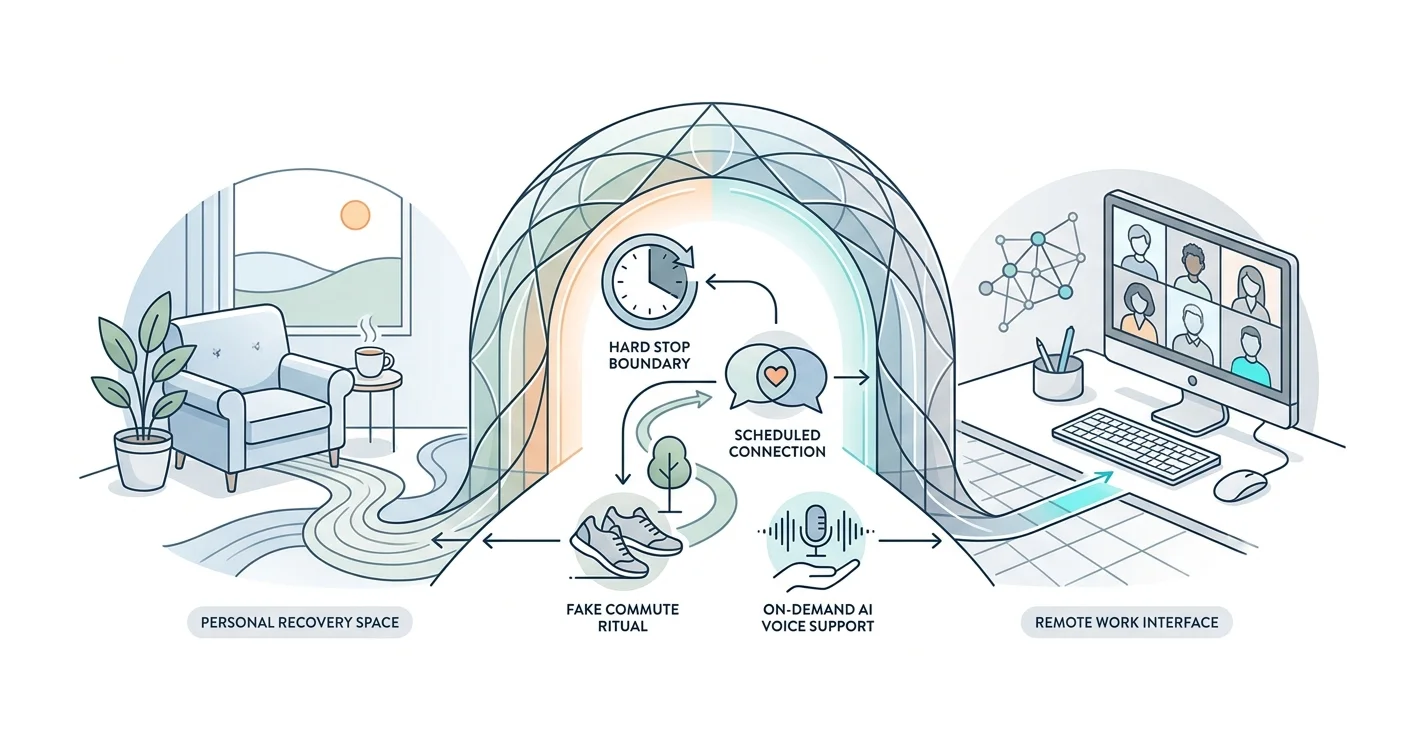
Remote worker mental health support is the mix of daily boundary habits, movement, scheduled social contact, and on-demand talk tools that replace what an office used to provide for free — a commute to decompress, a coworker who notices a bad mood, and a clear line between clocking in and clocking out. Remote employees don't get flagged by a manager walking past a slumped desk; the warning signs show up in missed messages, later logins, and a Slack status stuck on "away" for hours at a stretch.
TL;DR
- Mental health support for remote workers has to replace checks an office gave for free: a commute, hallway chats, a coworker noticing a bad day.
- Burnout and depression look alike in remote workers; telling them apart decides whether rest helps or a clinician is needed.
- High-functioning loneliness hits remote workers who look fine on video calls but feel isolated by 6pm.
- Lovon's AI voice therapy app gives remote workers a same-day option to talk through a stressful week when no therapist slot is open.
Why mental health support matters more for remote workers
Office work builds in accidental check-ins: someone notices you skipped lunch, a manager sees you're quiet in a meeting, a coworker asks if you're okay after a rough call. None of that happens by accident at home. A remote worker can go from a normal Tuesday to a genuinely bad week and the only visible sign is a slower reply time.
The line between burnout and something clinical also blurs faster without those outside eyes. If you're not sure which one you're dealing with, burnout vs depression lays out the distinction — burnout usually lifts with real rest and boundary changes, depression often doesn't, even after a good weekend. In 2026, with more roles staying remote or hybrid long-term, that distinction matters more, not less, because the default coping strategy of "just take a day off" stops working the longer the pattern runs.
Set a hard stop time and defend it
Remote work has no closing bell. Without one you invent, the workday quietly expands until it eats your evening.
- Block a recurring "offline" slot on your calendar at the same time every day
- Close the laptop and move it to another room, not just sleep mode
- Put your cutoff time in your Slack status or email signature
- Run a two-minute shutdown ritual: note three things done, three things for tomorrow, close every tab
Build a fake commute
The commute wasn't just travel time — it was a built-in transition between "work mode" and "home mode." Cutting it without replacing it is one reason remote days feel like they never end.
- Take a 10-15 minute walk before you start work and again when you finish
- Change clothes at the start and end of the day, even if no one sees you
- Play a specific playlist only during that walk so your brain learns the cue
- Step outside without your phone, even briefly, twice a day
Schedule social contact you'd otherwise skip
Video calls feel like contact but they're work, not connection — your brain still registers the day as socially thin.
- Book one weekly call that has nothing to do with work
- Work from a library or co-working space one day a week if that's an option
- Text a friend before noon instead of defaulting to a scroll after 9pm
- Keep a standing lunch or coffee with a former coworker or neighbor
Track your own burnout and mood signals
No one else is watching, so you have to. Waiting until you feel terrible to check in means you're already several weeks behind.
- Log a one-word mood check each morning for two weeks
- Watch your login and logoff times for creep in either direction
- Note skipped meals, tabs open past midnight, and canceled plans
- Compare what you notice against high-functioning anxiety signs you might be missing — a lot of remote workers pass as fine right up until they aren't
Use a coping tool mid-workday, not just after hours
Waiting until 7pm to deal with a stressful 10am meeting means you've carried it for nine hours. Deal with it closer to when it happens.
- Try box breathing between calls — four seconds in, hold four, out four
- Run a five-minute progressive muscle relaxation before a hard meeting
- Name the spiral out loud before opening your inbox instead of pushing through it
- Talk it through with an AI voice therapy app like Lovon when no coworker or therapist is available on the spot — see AI counseling for stress management for how that works in practice
Lovon isn't a scheduled appointment three weeks out. It's a voice conversation you can have at 2pm on a Tuesday when a meeting went badly and there's no one around to talk to about it.
Loop in a professional when self-management stalls
Boundaries and breathing exercises fix a rough patch. They don't fix something that's been building for months.
- Ask HR whether your employer offers an EAP benefit and how many sessions it covers
- Search for a licensed therapist who does telehealth on your schedule, not just 9-to-5 slots
- Check what therapy actually costs without insurance in your area before assuming it's out of reach
- Treat two or more weeks of flat mood, disrupted sleep, or loss of interest as a signal to escalate, not wait out
Talk it through with Lovon
Voice-based AI support for stress and low mood, available any time you're at your desk.
Comparing support options for remote workers
| Option | Best for | Key limitation | Verdict |
|---|---|---|---|
| Employer EAP | A no-cost referral to start with | Usually capped at a handful of sessions a year | Use if offered, don't rely on it long-term |
| Licensed teletherapist | Ongoing clinical treatment for a diagnosed condition | Wait lists and scheduling around a 9-to-5 remote job | Best for anything beyond situational stress |
| Text-based therapy app | Async, written check-ins between sessions | Slower back-and-forth, no voice tone or real-time pacing | Fine for journaling-style support |
| AI voice therapy app (Lovon) | Same-day, mid-workday support for stress, anxiety, and low mood | Not a licensed clinician; can't diagnose or prescribe | Buy for daily support, not for crisis or diagnosis |
| Remote-worker peer community | Feeling understood by people in the same situation | Not clinical, moderation quality varies | Use alongside other support, not instead of it |
Common mistakes remote workers make with mental health
- Treating "always available" as a virtue. Answering Slack at 9pm because you technically can trains your brain that the workday never ends.
- Counting video calls as real social contact. A stand-up meeting is work, not connection — the isolation still builds underneath it.
- Skipping the transition ritual. Going from bed to laptop with no buffer removes the mental cue that the workday has actually started or stopped.
- Waiting for a "bad enough" day to ask for help. By the time a remote worker reaches out, the pattern has usually been running for months, not days.
- Assuming a long weekend fixes everything. If mood, sleep, and motivation don't bounce back after real rest, that's a sign to look past burnout toward something that needs more than time off.
FAQ
What is the best mental health support for remote workers in 2026?
The strongest setup combines daily boundary habits (a hard stop time, a fake commute), scheduled non-work social contact, and an on-demand talk option like Lovon for the days a therapist slot isn't available. No single tool covers all of it.
Can an AI app actually help with remote work burnout?
An AI voice therapy app like Lovon can help you talk through a stressful day, name what's building up, and practice coping tools in the moment. It's built for daily support, not for treating diagnosed burnout on its own.
Is Lovon a replacement for a licensed therapist?
No. Lovon is built with input from PhD psychologists to offer emotional support and coping tools between or alongside clinical care, but it does not diagnose conditions or replace a licensed clinician.
How do I know if I have burnout or depression as a remote worker?
Burnout usually eases with real rest, time off, and boundary changes; depression tends to persist even after a good weekend or vacation. If mood and motivation stay flat for two or more weeks despite rest, that points toward something beyond burnout.
What causes high-functioning loneliness in remote workers?
It comes from having plenty of video calls but almost no unstructured, non-work contact. You can look completely fine on camera all day and still feel isolated by the time you log off.
What are quick ways to decompress after a remote workday?
A short walk without your phone, changing clothes to mark the end of the day, and a two-minute shutdown checklist all work as fast substitutes for the commute you no longer have.
Is voice-based or text-based AI support better for remote workers?
Voice adds tone and pacing that text can't, which matters when you're trying to talk through stress in real time between meetings. Text-based apps work better for slower, journaling-style reflection.
When should a remote worker see a licensed professional instead of using an app?
When flat mood, disrupted sleep, or loss of interest lasts two or more weeks despite rest and boundary changes, or when there's any thought of self-harm, that's a signal to see a licensed clinician, not to keep self-managing.
One last thing
The fastest change most remote workers can make in 2026 isn't a new app — it's picking one hard stop time and actually defending it for two weeks straight. Everything else on this list works better once that boundary exists; almost nothing works if the workday still has no edges.
Related guides
How AI Support Helps You Heal
AI emotional support isn't about replacing human connection — it's about filling the gaps. The moments when you need to talk at 2 AM, when you don't want to burden your friends again, or when you simply need someone to listen without judgment.
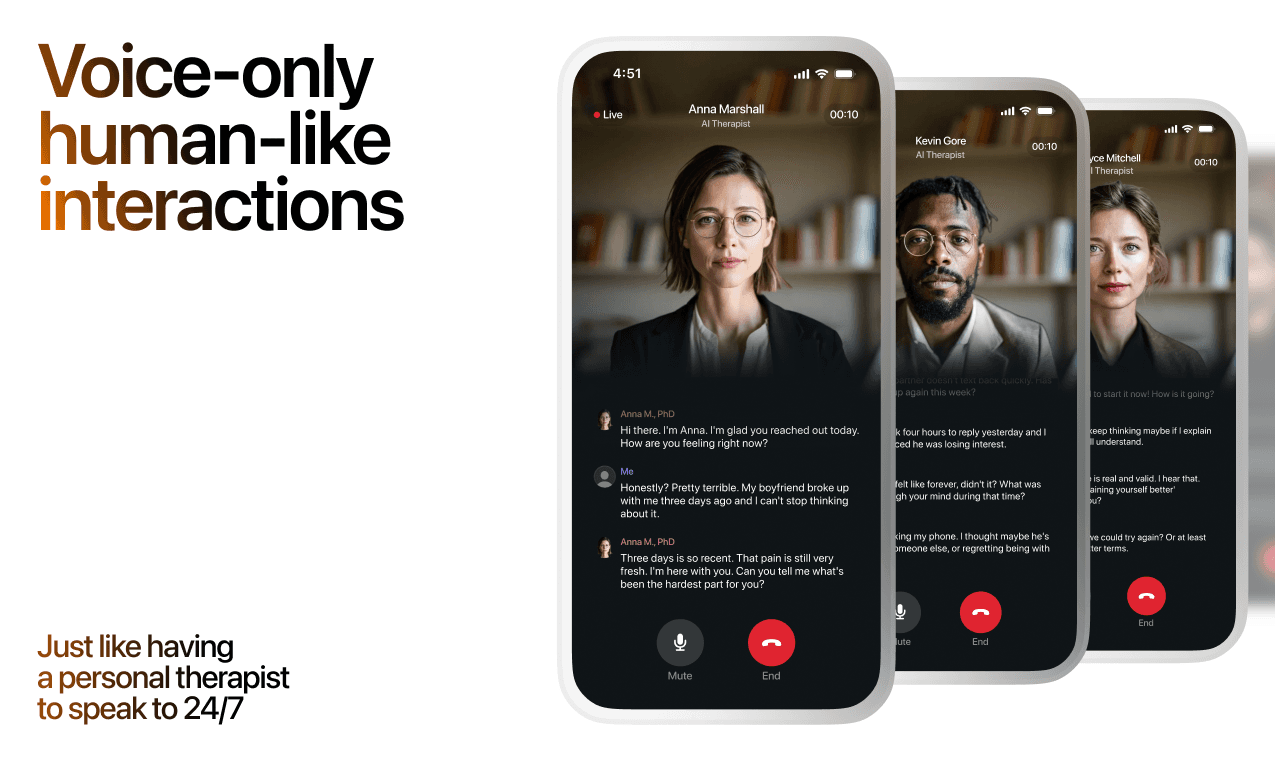
Here's what happens in a typical Lovon session:
You share what's on your mind
There's no script, no intake form, no waiting room. You speak or type whatever you're feeling — in your own words, at your own pace.
Lovon validates and explores
Using frameworks from CBT (Cognitive Behavioral Therapy) and motivational interviewing, Lovon acknowledges your feelings first, then gently helps you explore them. No dismissive "just move on" advice.
You build coping skills together
Lovon doesn't just listen — it actively works with you on evidence-based techniques: thought reframing, urge surfing, behavioral experiments, and more.
What a Session with Lovon Looks Like
When to Seek Professional Help
AI support is a valuable tool, but it's not a replacement for professional care. Please consider reaching out to a licensed therapist if you experience any of the following:
- Persistent thoughts of self-harm or suicide
- Inability to perform daily activities (work, eating, sleeping) for more than 2 weeks
- Turning to alcohol or substances to cope
- Intense anger or desire to harm your ex-partner
- Complete emotional numbness that doesn't improve over time
Crisis Resources (US): If you're in immediate danger, call 988 (Suicide & Crisis Lifeline) or text HOME to 741741 (Crisis Text Line). Available 24/7, free, and confidential.
Outside the US? Find a crisis line in your country
Ready to Start?
Your healing journey can begin right now
1 free conversation. No credit card. No judgment. Just a safe space to process what you're going through.
Frequently Asked Questions
Is AI therapy a replacement for a real therapist?
Is my conversation with Lovon AI private?
How is Lovon different from ChatGPT for emotional support?
Can I use Lovon if I'm already seeing a therapist?
Can I try Lovon for free?
About the Author
The Lovon Editorial Team
Mental Health & Wellness Content Team
The Lovon Editorial Team develops mental health and wellness content designed to make psychological concepts accessible and actionable. Our goal is to bridge the gap between clinical research and everyday life - helping you understand why your mind works the way it does and what you can do about it....
Related articles
- Functional Depression: Signs You're Not Just Tired (2026)
Functional depression keeps you going while draining everything. Learn the 8 signs, how it differs from burnout, and…
- Why Am I Exhausted All the Time? Real Causes in 2026
Why am I exhausted all the time even after sleep? 2026 guide breaks down burnout, depression, and cortisol causes sleep…
- Coping With Depression Alone in 2026: What Actually Helps
Coping with depression alone in 2026: a 7-step plan for the hours between therapy sessions, troubleshooting fixes, and…
- Best AI App for Loneliness in 2026: Ranked and Reviewed
The best ai app for loneliness in 2026, ranked: Lovon wins for on-demand AI voice therapy vs. chatbots, therapist…
See also
Quizzes
- Empath Test: Do Other People's Moods Become Yours?
See how much of other people's moods you take on.
- Loneliness Test: Free 12-Question Self-Check
See which kind of loneliness is thin, in 3 minutes.
Free tools
- 5-4-3-2-1 Grounding Exercise
A guided run through the 5-4-3-2-1 technique, with paced breathing first if you need it. No sign-up, nothing stored…
- Am I Overreacting, or Is This a Big Deal?
A chat for the small thing you cannot stop turning over. Say what happened and what you have already told yourself about…
Disclaimer: This article is for informational purposes only and does not constitute medical advice, diagnosis, or treatment. Always seek the advice of your physician or other qualified health provider with any questions you may have regarding a medical condition. If you are in crisis or think you may have an emergency, call 988 (Suicide & Crisis Lifeline) or go to the nearest emergency room. Outside the US? Find a crisis line in your country.