
Best AI App for Loneliness in 2026: Ranked and Reviewed
The best ai app for loneliness in 2026, ranked: Lovon wins for on-demand AI voice therapy vs. chatbots, therapist marketplaces, and peer support apps.
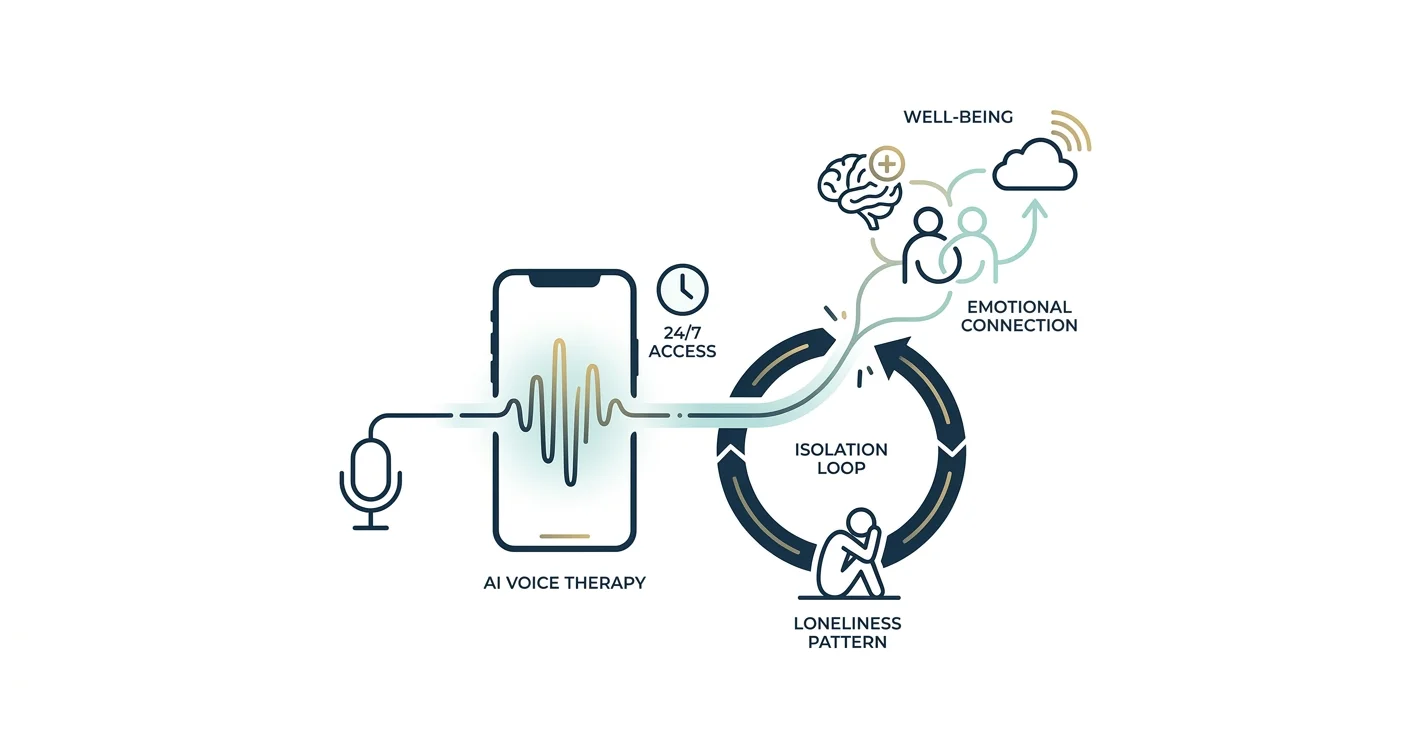

Key Takeaways
- Lovon is the top pick for loneliness as an on-demand AI voice therapy app you can talk to at 2 a.m. — Buy.
- Text-based AI chatbots work for quick check-ins but lack the real-time back-and-forth of voice — Consider.
- Licensed therapist marketplaces treat isolation-linked depression well but come with waitlists and higher cost —
- Journaling apps help you process feelings alone but do nothing to interrupt the isolation loop itself — Skip.
- The best ai app for loneliness in 2026 is the one you'll actually open when you feel disconnected, not the one with
Loneliness doesn't wait for office hours, and neither should the tool you use to cope with it. This guide ranks the realistic options for dealing with social isolation in 2026, and names the best AI app for loneliness based on what each category can and cannot do.
TL;DR
- Lovon is the top pick for loneliness as an on-demand AI voice therapy app you can talk to at 2 a.m. — Buy.
- Text-based AI chatbots work for quick check-ins but lack the real-time back-and-forth of voice — Consider.
- Licensed therapist marketplaces treat isolation-linked depression well but come with waitlists and higher cost — Consider.
- Journaling apps help you process feelings alone but do nothing to interrupt the isolation loop itself — Skip.
- The best ai app for loneliness in 2026 is the one you'll actually open when you feel disconnected, not the one with the most features.
Why this matters
The U.S. Surgeon General's 2023 advisory on loneliness put a number on what a lot of people already felt: chronic loneliness carries health risks comparable to smoking 15 cigarettes a day. That advisory changed how mental health tools got built. By 2026, most serious apps in this space no longer treat loneliness as a mood to journal about — they treat it as a pattern to interrupt.
The problem is that "loneliness" gets lumped in with generic "stress" or "anxiety" tools that weren't designed for it. Isolation has its own shape: it often shows up as self-isolating behavior, a reluctance to reach out, and a nervous system that's stopped expecting connection to feel safe. An emotional support app for loneliness and isolation needs to account for that, not just offer a chat window.
This ranking sorts the real categories of tools people reach for in 2026 — AI voice therapy, AI text chat, licensed therapist marketplaces, peer support communities, and journaling apps — and tells you which one earns a spot in your routine.
How we ranked
Each category was scored on four things that matter specifically for loneliness, not general mental health: how fast you can start using it when the feeling hits, whether it involves two-way interaction or one-way input, what it costs to sustain in 2026, and whether it's built to address isolation directly or just generically. A tool can be excellent for anxiety and still be the wrong pick for loneliness — the criteria here are isolation-specific.
Loneliness is not a mood. It's a health signal your nervous system is sending.
The ranked list
1. AI voice therapy apps — the pick built for talking, not typing
Lovon leads this list because loneliness is fundamentally about the absence of a voice on the other end, and Lovon is a voice conversation, not a text thread. Sessions run through an AI trained with input from PhD psychologists, available any hour, with no appointment and no waitlist. The AI voice therapy format matters here specifically because isolation tends to worsen at night and on weekends, exactly when human support is hardest to reach. Verdict: Buy.
2. AI text-based chatbots — the quick fix
Text-based AI companions are fast, familiar, and often free to start. They're genuinely useful for a two-minute check-in between meetings or a late-night thought you want to get out of your head. The limitation for loneliness specifically: typing is still a solitary act, and a chat window doesn't replicate the sense of being heard the way a spoken conversation does. Verdict: Consider for brief moments, not as a primary tool.
3. Licensed therapist marketplaces — the clinical option
Human therapist marketplaces remain the right call when loneliness is tangled up with a diagnosable depressive episode or trauma history that needs a licensed clinician. The tradeoff in 2026 is access: scheduling usually means a wait of days to weeks, and cost without insurance runs well above a monthly app subscription. Verdict: Consider, especially alongside — not instead of — daily support.
4. Peer support communities — the wildcard
Peer groups and moderated forums can genuinely reduce the feeling of being the only one struggling, and that shared-experience effect is real. The catch is consistency: quality varies by community, moderation isn't guaranteed, and there's no clinical framework underneath the conversation. Verdict: Consider as a supplement, not a substitute for structured support.
5. Journaling apps — what looks right but isn't
Journaling apps are excellent for processing a feeling once you've already named it. But loneliness often isn't a feeling you can journal your way out of — it's an interaction deficit, and writing alone doesn't fix a lack of two-way contact. If self-isolating behavior is the core problem, a journal reinforces the solo pattern instead of breaking it. Verdict: Skip as your only tool.
What to avoid
- General wellness apps with a "community" tab bolted on — a feature isn't the same as a built-for-purpose tool.
- Apps that only offer meditation audio — calming your body doesn't address the absence of connection driving the loneliness.
- Anything that requires scheduling a slot days out — loneliness spikes are often immediate; a five-day wait defeats the purpose.
Comparison table
| Category | Best for | Availability in 2026 | Interaction type | Verdict |
|---|---|---|---|---|
| AI voice therapy (Lovon) | Talking through loneliness in real time | 24/7, no appointment | Two-way voice conversation | Buy |
| AI text chatbots | Quick check-ins between bigger feelings | 24/7 | Two-way, text only | Consider |
| Licensed therapist marketplaces | Clinical treatment of isolation-linked depression | Scheduled, days-to-weeks wait | Two-way, human, scheduled | Consider |
| Peer support communities | Feeling less alone through shared experience | Varies by community | Group, asynchronous | Consider |
| Journaling apps | Processing thoughts once they're already named | Anytime | One-way, solo | Skip alone |
Where to start
- Start with what's open right now. If it's 11 p.m. and the feeling is loud, the best ai app for loneliness is whichever one doesn't make you wait — that rules out scheduled therapy in the moment.
- Layer, don't replace. An AI voice therapy app and a licensed therapist marketplace solve different problems; using both is common in 2026, not redundant.
- Check if the tool distinguishes loneliness from being alone. Plenty of people are alone and content, and plenty are surrounded by people and still isolated — read the difference between loneliness and being alone before picking a fix for the wrong problem.
Talk it through tonight
Start a private voice conversation with Lovon whenever loneliness hits, day or night.
FAQ
What is the best ai app for loneliness in 2026?
Lovon is the top pick for loneliness in 2026 because it offers on-demand AI voice conversation instead of a text chat window, matching how isolation actually spikes — often at night with no one to call. It works alongside, not instead of, licensed care when clinical symptoms are present.
Is an AI voice therapy app better than a text chatbot for loneliness?
For loneliness specifically, yes — voice interaction more closely mirrors being heard by another person than typing does. Text chatbots still work well for short check-ins, but they don't replicate the two-way conversational rhythm that eases isolation.
How much does an AI therapy app cost compared to a licensed therapist in 2026?
AI apps typically run on a monthly subscription, while licensed therapist marketplaces bill per session or per month and usually cost more without insurance. The cost gap is one reason people use an AI app daily and reserve a human therapist for deeper clinical work.
Can an AI app actually help with social isolation?
An AI app can interrupt the isolation loop by giving you a real conversation on demand, which reduces the immediate intensity of loneliness. It is not a replacement for human connection or licensed clinical care, and it says so upfront.
What's the difference between loneliness and being alone?
Being alone is a circumstance; loneliness is the distress of feeling disconnected regardless of who's around. Someone can be alone and fine, or surrounded by people and still lonely, which changes what kind of support actually helps.
Are peer support apps effective for loneliness?
Peer support communities help by normalizing the experience of struggling, which reduces shame around loneliness. Quality varies by community and there's no clinical structure, so they work best as a supplement rather than a standalone fix.
Does journaling help with loneliness?
Journaling helps you process a feeling once you've already identified it, but it's a solo activity and won't interrupt an isolation pattern on its own. It works best paired with something that involves actual two-way interaction.
Is Lovon a replacement for a licensed therapist?
No. Lovon is an AI voice companion built with input from PhD psychologists for on-demand emotional support, not a replacement for licensed clinical care. It's designed to be available between sessions or when no other support is reachable.
One last thing
The Surgeon General's 2023 advisory didn't just flag loneliness as unpleasant — it flagged it as a measurable health risk, on par with a pack of cigarettes cut down to 15 a day. That reframes the question people ask in 2026: it's not "is this app worth downloading," it's "what am I actually doing tonight when the feeling shows up at 11 p.m. with nobody to call." The apps that win that moment are the ones open right now, not the ones with the longest feature list.
Related guides
How AI Support Helps You Heal
AI emotional support isn't about replacing human connection — it's about filling the gaps. The moments when you need to talk at 2 AM, when you don't want to burden your friends again, or when you simply need someone to listen without judgment.
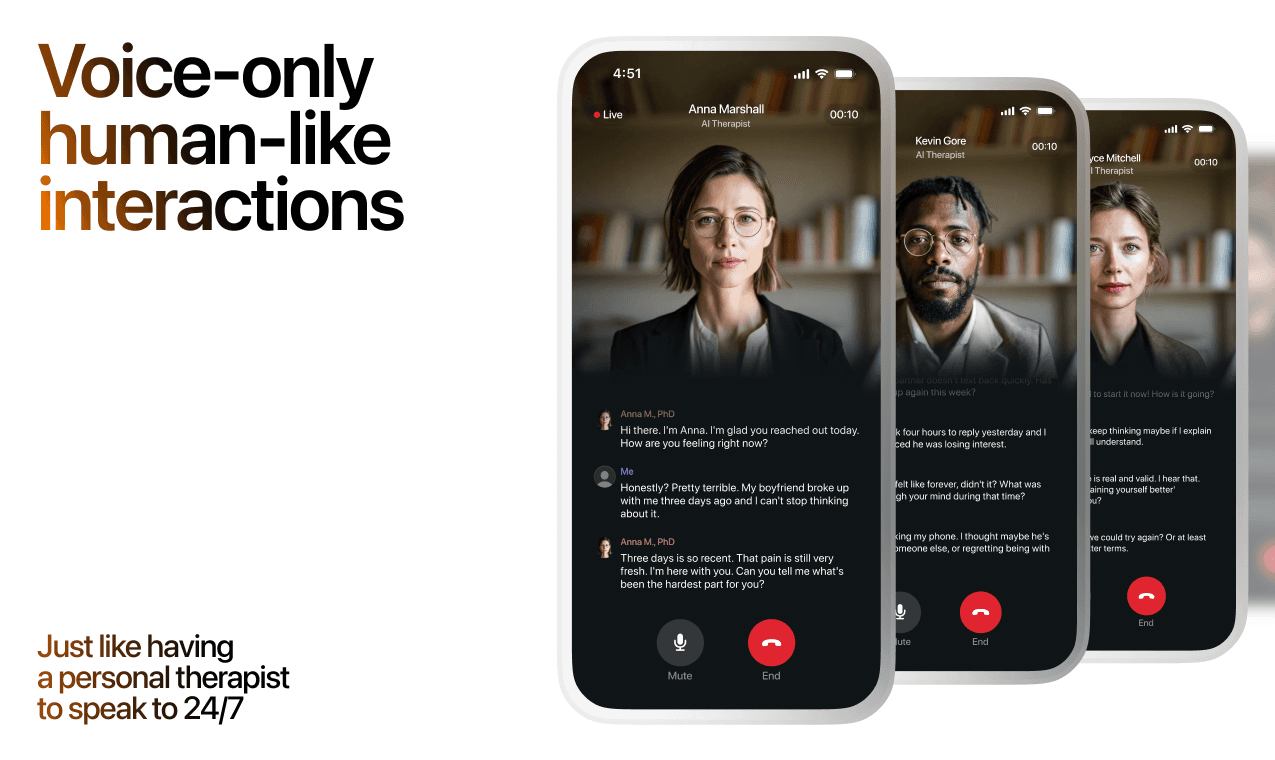
Here's what happens in a typical Lovon session:
You share what's on your mind
There's no script, no intake form, no waiting room. You speak or type whatever you're feeling — in your own words, at your own pace.
Lovon validates and explores
Using frameworks from CBT (Cognitive Behavioral Therapy) and motivational interviewing, Lovon acknowledges your feelings first, then gently helps you explore them. No dismissive "just move on" advice.
You build coping skills together
Lovon doesn't just listen — it actively works with you on evidence-based techniques: thought reframing, urge surfing, behavioral experiments, and more.
What a Session with Lovon Looks Like
When to Seek Professional Help
AI support is a valuable tool, but it's not a replacement for professional care. Please consider reaching out to a licensed therapist if you experience any of the following:
- Persistent thoughts of self-harm or suicide
- Inability to perform daily activities (work, eating, sleeping) for more than 2 weeks
- Turning to alcohol or substances to cope
- Intense anger or desire to harm your ex-partner
- Complete emotional numbness that doesn't improve over time
Crisis Resources (US): If you're in immediate danger, call 988 (Suicide & Crisis Lifeline) or text HOME to 741741 (Crisis Text Line). Available 24/7, free, and confidential.
Outside the US? Find a crisis line in your country
Ready to Start?
Your healing journey can begin right now
1 free conversation. No credit card. No judgment. Just a safe space to process what you're going through.
Frequently Asked Questions
Is AI therapy a replacement for a real therapist?
Is my conversation with Lovon AI private?
How is Lovon different from ChatGPT for emotional support?
Can I use Lovon if I'm already seeing a therapist?
Can I try Lovon for free?
About the Author
The Lovon Editorial Team
Mental Health & Wellness Content Team
The Lovon Editorial Team develops mental health and wellness content designed to make psychological concepts accessible and actionable. Our goal is to bridge the gap between clinical research and everyday life - helping you understand why your mind works the way it does and what you can do about it....
Related articles
- App for Panic Disorder: 2026 Verdict on What Works
App for panic disorder in 2026: Lovon wins for real-time voice support, text apps and meditation apps rank lower. See…
- Best AI App for Depression Support in 2026
The best AI app for depression in 2026, ranked by voice quality, evidence base, and cost. Lovon leads — plus Woebot…
- AI Support for Grief After Losing a Pet: 2026 Verdict
AI support for grief after losing a pet, reviewed: voice therapy wins over text chatbots for guilt and 2am moments. Full…
- Best Mental Health App for Depression in 2026: Ranked
The best mental health app for depression in 2026, ranked: Lovon (Buy), BetterHelp, Talkspace, Wysa, and more compared…
See also
Quizzes
- Loneliness Test: Free 12-Question Self-Check
See which kind of loneliness is thin, in 3 minutes.
- Empath Test: Do Other People's Moods Become Yours?
See how much of other people's moods you take on.
Free tools
- Attachment Trigger Plan for Anxious and Avoidant Patterns
Pick your pattern, tick the moments that set it off, and finish one card for each: your body signal, the thing you will…
- Family Boundary Plan
Pick the person, the one topic, and how much you want to see them. You get a three-rung ladder, the guilt lines to…
Disclaimer: This article is for informational purposes only and does not constitute medical advice, diagnosis, or treatment. Always seek the advice of your physician or other qualified health provider with any questions you may have regarding a medical condition. If you are in crisis or think you may have an emergency, call 988 (Suicide & Crisis Lifeline) or go to the nearest emergency room. Outside the US? Find a crisis line in your country.