
AI Relationship Coach for Adoptive Parent Bonding 2026
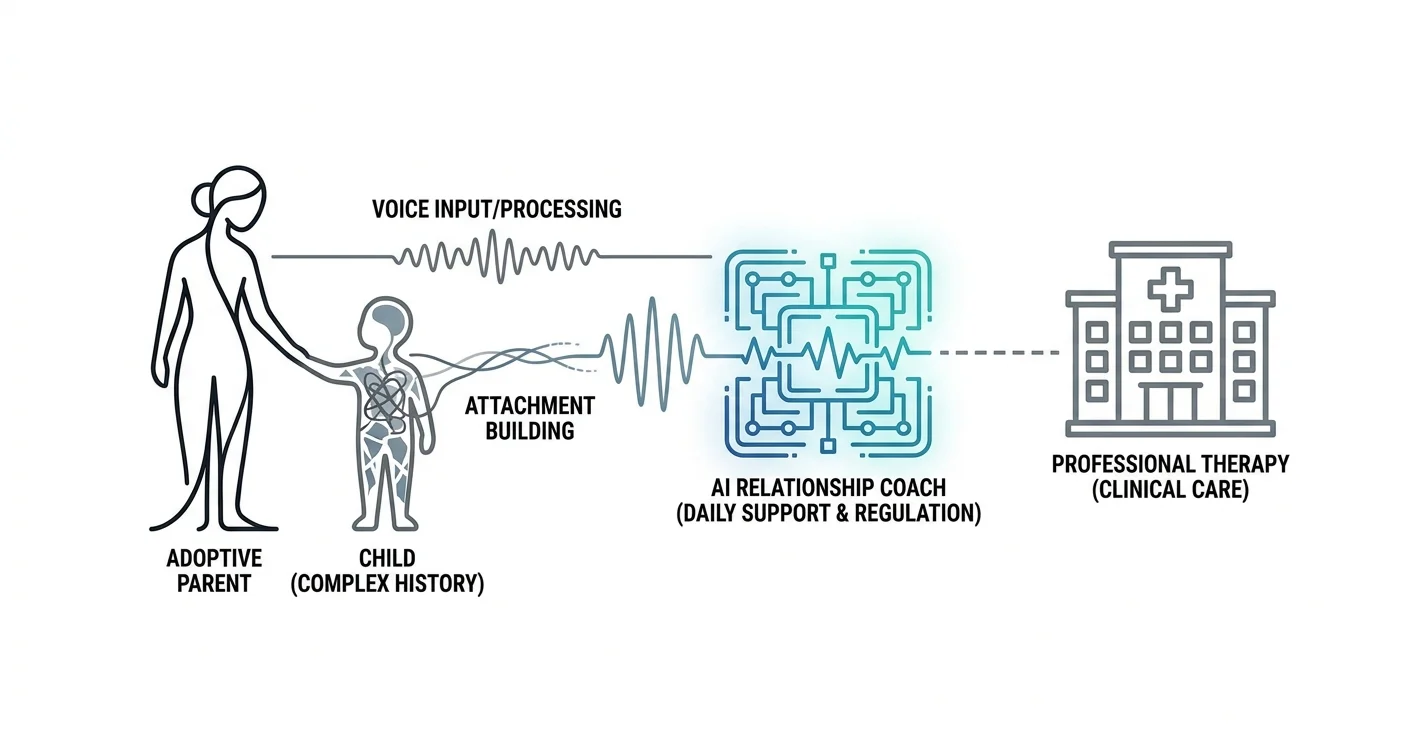
Lovon's AI relationship coach helps adoptive parents process bonding stress daily in 2026 - a companion between therapy sessions, not a replacement for one.

Key Takeaways
- An AI relationship coach for adoptive parent bonding gives adoptive parents 24/7 voice support between therapy
- Lovon works best as a daily processing tool for regulation and reflection, not for diagnosing attachment disorders.
- Adoption-competent therapists remain hard to book in 2026, which is the gap an always-on tool fills.
- Journaling, support groups, and in-person therapy each solve part of the bonding puzzle; no single option covers all
Adoptive parent bonding is the ongoing work of building trust and attachment with a child who joined your family through adoption, and an AI relationship coach supports that work by giving you a place to process the hard moments between pediatrician visits, school meetings, and therapy sessions. Adoptive bonding differs from biological parent-infant bonding because it often starts mid-story: the child arrives with a nervous system already shaped by loss, foster placements, or institutional care, and the parent is building attachment on top of that history rather than from a blank slate.
TL;DR
- An AI relationship coach for adoptive parent bonding gives adoptive parents 24/7 voice support between therapy sessions, not a replacement for an adoption-competent clinician.
- Lovon works best as a daily processing tool for regulation and reflection, not for diagnosing attachment disorders.
- Adoption-competent therapists remain hard to book in 2026, which is the gap an always-on tool fills.
- Journaling, support groups, and in-person therapy each solve part of the bonding puzzle; no single option covers all of it.
Why AI relationship coaching matters for adoptive parents
Adoptive parents hit a specific wall that generic parenting advice doesn't address: the child's behavior often looks like defiance or indifference but is actually a trauma response, and reacting to it the wrong way can set attachment back months. Lovon exists for the 11pm moment after a meltdown, when you need to talk through what just happened before you say something you regret in the morning.
Most adoptive parents are also managing their own grief and expectations alongside the child's history. A parent who spent years waiting for a placement, or who's parenting after infertility, carries emotional weight that colors every hard day with the child. An AI relationship coach doesn't replace an adoption-competent therapist, but it gives you somewhere to unpack that weight the same night it happens, not three weeks later at your next appointment.
Update your daily check-in ritual
Bonding builds through repetition, not big gestures. A five-minute nightly voice check-in, even a rough one, does more for attachment tracking than a single long conversation once a month.
- Name one moment from the day where the child leaned toward connection, even briefly
- Name one moment where you reacted from your own stress instead of the child's need
- Note any sensory or environmental trigger you noticed (loud rooms, transitions, mealtime)
- Ask yourself what the behavior might have been protecting the child from
- Log it in a voice note or a paper journal if you're not ready for an app
Regulate yourself before you try to regulate the child
An adoptive parent's own nervous system state gets mirrored by the child faster than any script or technique. If you're activated, the child feels it, even if your words are calm.
- Practice a 60-second breathing reset before pickup or bedtime routines
- Keep a short phrase ready for yourself: this is the trauma talking, not the child rejecting me
- Step out of the room for 90 seconds instead of escalating a conflict
- Talk it through out loud with a partner, friend, or an AI voice session before deciding how to respond
- Track which times of day your own patience runs lowest and plan around them
This is where a voice-based tool changes the math. Typing out a stressful moment takes effort you don't have at 6am with a screaming toddler; talking it out loud takes none. Lovon built its foster-and-adoptive-parent guidance around exactly this gap between what parents need and what they have energy for.
Read your own attachment history
Parents often walk into adoption without realizing their own attachment style is about to get tested daily. A parent with an anxious attachment style may over-monitor a child's affection; a parent with an avoidant style may withdraw when the child pushes for closeness.
- Take an attachment style assessment to name your own pattern before you try to shift the child's
- Watch for moments you withdraw when the child gets emotionally intense
- Notice if you're seeking reassurance from the child rather than offering it
- Separate your childhood attachment wounds from what the child is currently signaling
Build predictable routines the child can count on
Children who've experienced disrupted placements bond through predictability more than affection alone. A parent who is warm but inconsistent will bond slower than a parent who is calm but reliably the same every day.
- Fix the same wake-up, meal, and bedtime sequence for at least 90 days before changing it
- Give advance verbal warning before transitions (five minutes, then one minute)
- Keep discipline consequences small, immediate, and identical every time
- Avoid surprise changes to caregivers or schedules whenever you can control it
Track patterns instead of single incidents
One bad day tells you nothing. A pattern across two or three weeks tells you everything about whether bonding is progressing or stalling.
- Review your check-in log weekly, not daily, for real trend data
- Watch for a rising baseline of calm moments, not a total absence of hard ones
- Note whether meltdowns are shortening in duration even if frequency stays flat
- Bring the pattern, not the anecdote, to your adoption-competent therapist
Loop in a licensed clinician for anything diagnostic
An AI voice coach can hold your daily processing, but it cannot diagnose reactive attachment disorder, complex trauma, or any clinical condition. That distinction matters, and Lovon says so directly: it is built with input from PhD psychologists but it is not a replacement for licensed clinical care.
- Bring recurring patterns to a therapist who specializes in adoption and foster care
- Ask your agency's post-placement support team about adoption-competent referrals
- Use the AI coach between sessions, not instead of them
- Escalate immediately if you see signs of self-harm, severe regression, or safety risk
Comparison: bonding support options for adoptive parents in 2026
| Option | Best for | Cost | Key limitation |
|---|---|---|---|
| Solo journaling | Parents who process better in writing | Free | No feedback loop, easy to abandon |
| In-person adoption-competent therapist | Diagnosing attachment issues, family sessions | Varies by provider | Waitlists are common in 2026, limited availability outside major cities |
| Adoptive parent support groups | Peer validation, tips from lived experience | Often free through agencies or nonprofits | Scheduled meeting times don't match a 2am crisis |
| Lovon AI relationship coach | Daily processing and regulation between sessions | Check current plans on the app | Not a diagnostic tool, not a substitute for a clinician |
Verdict: Lovon works best as the daily connective tissue between therapy sessions for adoptive parents, not as a stand-alone treatment for attachment trauma.
Talk through today's hard moment
Process a rough bonding day tonight, before it becomes tomorrow's reaction.
Common mistakes adoptive parents make
- Chasing instant affection. Expecting a child to bond on a biological-parent timeline sets both of you up to feel like failures by month three.
- Treating every meltdown as defiance. Most dysregulated behavior in adopted children traces back to a trigger, not a power struggle.
- Isolating instead of processing. Parents who don't talk through hard days, with a person or a voice tool, tend to carry resentment into the next hard day.
- Waiting for a crisis to seek support. The parents who do best in 2026 build a daily processing habit before things get hard, not after.
- Comparing your child's timeline to another adopted child's. Bonding speed depends on age at placement, prior history, and temperament, not a fixed schedule.
FAQ
What is an AI relationship coach for adoptive parent bonding?
It's a voice-based tool you talk to daily for emotional processing and coping strategies around adoptive parenting stress. Lovon is one example, built for on-demand support between therapy appointments, not for diagnosing attachment disorders.
Can an AI coach replace an adoption therapist?
No. An AI relationship coach handles daily emotional processing and regulation; a licensed adoption-competent therapist handles diagnosis and clinical treatment. Use both together in 2026.
How long does adoptive parent bonding usually take?
Bonding timelines vary widely by the child's age at placement and prior history, and there's no fixed schedule. Track patterns over weeks and months instead of expecting daily progress.
Is it normal to not feel instantly bonded to an adopted child?
Yes. Many adoptive parents describe bonding as something that builds gradually through routine and repetition, not something that arrives on day one. Feeling disconnected early on does not predict a poor long-term outcome.
What's the difference between reactive attachment issues and normal adjustment?
Normal adjustment includes irritability, testing behavior, and slow warming that improves over weeks. Reactive attachment concerns are more persistent and severe and need evaluation from a licensed clinician, not a self-help tool.
Can I use an AI voice coach if I'm also a foster parent?
Yes, the same daily processing approach applies to foster placements, and Lovon has guidance built specifically for foster parent stress and bonding.
How much does adoption-related therapy cost without insurance in 2026?
Costs vary significantly by region and provider specialty, and adoption-competent therapists are often out of network. Ask your adoption agency about post-placement support subsidies before assuming full price.
What should I track to know if bonding is progressing?
Track the trend across two to three weeks: whether calm moments are increasing, whether meltdowns are shortening, and whether the child initiates connection more often. A single hard day tells you nothing on its own.
One last thing
The hardest part of adoptive bonding isn't the child's behavior, it's the parent's own guilt for finding it hard. If you feel like you should love this instantly and don't, that feeling is common, not a sign you made a mistake. Naming that guilt out loud, to a therapist, a support group, or a voice session at midnight, tends to loosen its grip faster than trying to think your way out of it alone.
Related guides
How AI Support Helps You Heal
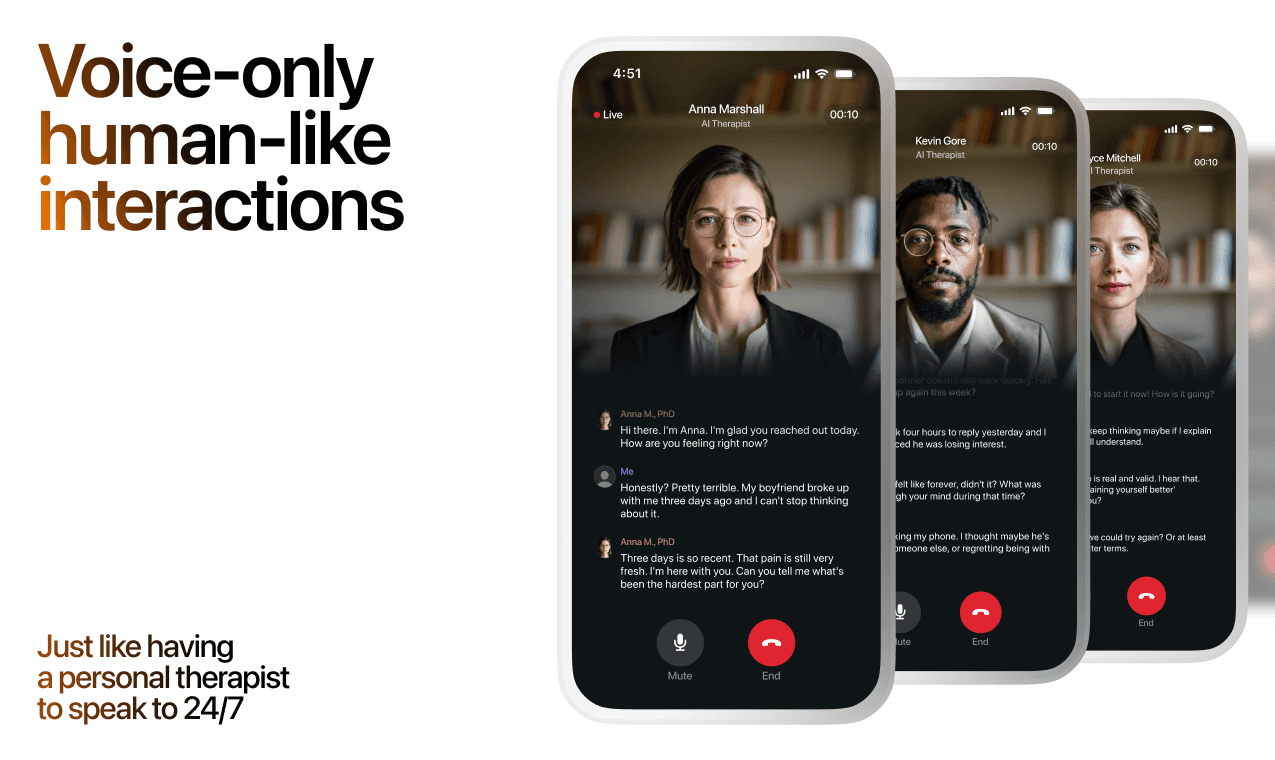
AI emotional support isn't about replacing human connection — it's about filling the gaps. The moments when you need to talk at 2 AM, when you don't want to burden your friends again, or when you simply need someone to listen without judgment.
Here's what happens in a typical Lovon session:
You share what's on your mind
There's no script, no intake form, no waiting room. You speak or type whatever you're feeling — in your own words, at your own pace.
Lovon validates and explores
Using frameworks from CBT (Cognitive Behavioral Therapy) and motivational interviewing, Lovon acknowledges your feelings first, then gently helps you explore them. No dismissive "just move on" advice.
You build coping skills together
Lovon doesn't just listen — it actively works with you on evidence-based techniques: thought reframing, urge surfing, behavioral experiments, and more.
What a Session with Lovon Looks Like
When to Seek Professional Help
AI support is a valuable tool, but it's not a replacement for professional care. Please consider reaching out to a licensed therapist if you experience any of the following:
- Persistent thoughts of self-harm or suicide
- Inability to perform daily activities (work, eating, sleeping) for more than 2 weeks
- Turning to alcohol or substances to cope
- Intense anger or desire to harm your ex-partner
- Complete emotional numbness that doesn't improve over time
Crisis Resources (US): If you're in immediate danger, call 988 (Suicide & Crisis Lifeline) or text HOME to 741741 (Crisis Text Line). Available 24/7, free, and confidential.
Outside the US? Find a crisis line in your country
Ready to Start?
Your healing journey can begin right now
A 7-day trial. No judgment. Just a safe space to process what you're going through.
Frequently Asked Questions
Is Lovon a replacement for a real therapist?
Is my conversation with Lovon AI private?
How is Lovon different from ChatGPT for emotional support?
Can I use Lovon if I'm already seeing a therapist?
Can I try Lovon before subscribing?
About the Author
The Lovon Editorial Team
Mental Health & Wellness Content Team
The Lovon Editorial Team develops mental health and wellness content designed to make psychological concepts accessible and actionable. Our goal is to bridge the gap between clinical research and everyday life - helping you understand why your mind works the way it does and what you can do about it....
Related articles
- Narcissistic Parent Dynamics and Power Imbalance in Relationships
The relationship between a parent and child is inherently unequal by design — but when narcissistic parent dynamics and…
- AI Relationship Coach for Sibling Relationships: Yes in 2026
Lovon's AI relationship coach for sibling relationships offers 24/7 voice support for favoritism, guilt, and…
- Best AI apps for foster parents in 2026
Compare the best AI apps for foster parents. Choose Lovon for adult emotional support, plus tools for planning and…
- Best AI Life Coach App for Single Parents in 2026
Lovon ranks best AI life coach app for single parents in 2026 for voice-based support anytime. Compare 6 apps, pros…
See also
Quizzes
- Emotional Intelligence Test: Your EQ in a Relationship
Find where your EQ slips when things get tense.
- Relationship Schema Test: Are Your Feelings Welcome?
See which belief edits what you share, in 3 minutes.
Free tools
- How to Come Out to Your Parents
A chat about how to come out to your parents that starts with whether now is safe, not with the speech. Tell it your…
- What to Say When They Are Struggling
A chat, not a list. Tell the coach who this person is to you, what they are going through, and what you already said…
From the wiki
- How to break up with someone you still love?
Loving someone does not mean the relationship works. If you have circled the same decision for months and the reasons…
Disclaimer: This article is for informational purposes only and does not constitute medical advice, diagnosis, or treatment. Always seek the advice of your physician or other qualified health provider with any questions you may have regarding a medical condition. If you are in crisis or think you may have an emergency, call 988 (Suicide & Crisis Lifeline) or go to the nearest emergency room. Outside the US? Find a crisis line in your country.