
Best AI Life Coach App for Single Parents in 2026
Lovon ranks best AI life coach app for single parents in 2026 for voice-based support anytime. Compare 6 apps, pros, cons, and honest limitations.
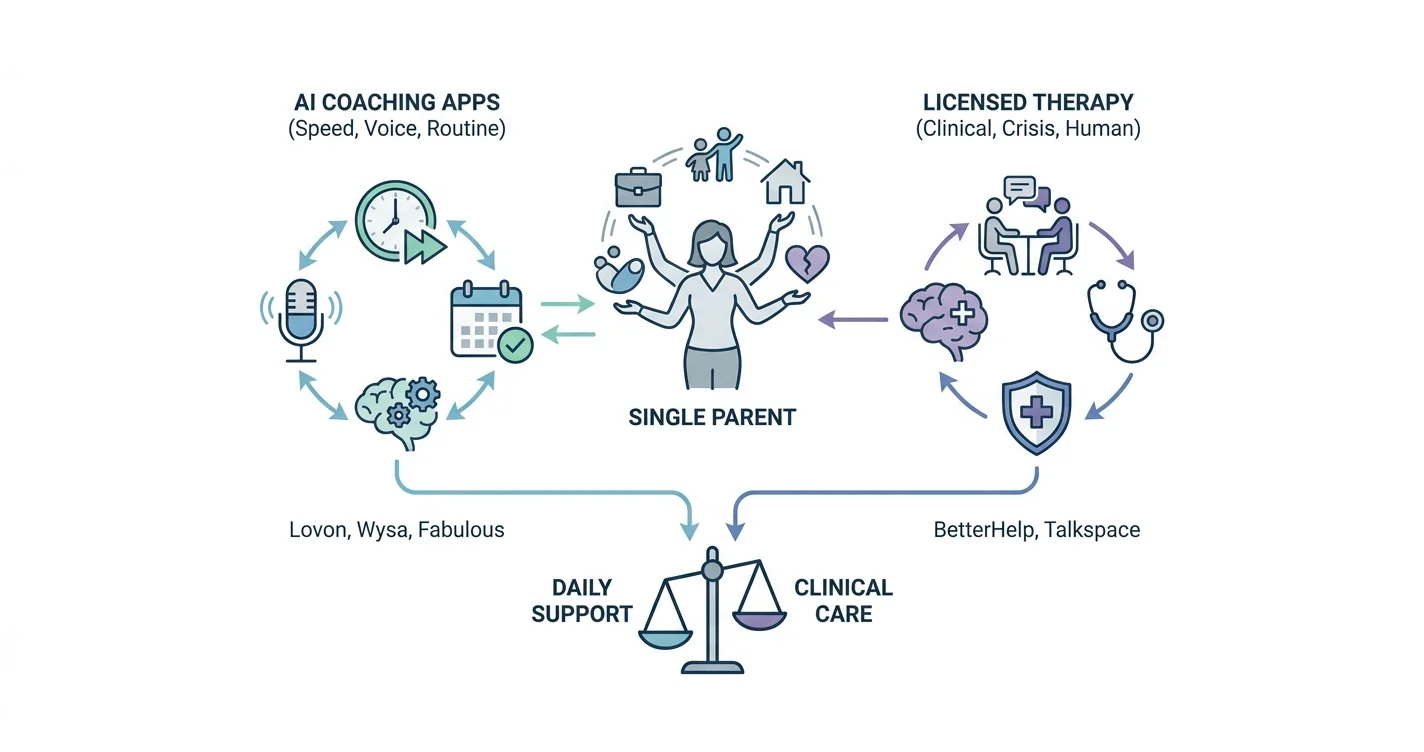

Key Takeaways
- Lovon wins as the best AI life coach app for single parents who need voice-based support after the kids are asleep.
- Wysa is best for a 5-minute CBT-style exercise squeezed between drop-off and work.
- BetterHelp is the right pick when a co-parenting conflict needs a licensed therapist, not an app.
- Fabulous is best for rebuilding a daily routine as a single-parent household in 2026.
- None of these six apps replace a licensed clinician for crisis-level symptoms.
Single parents don't have a free hour for a weekly therapy appointment, and most "life coach" apps assume you do. This guide ranks six AI life coach and support apps against what actually matters when you're parenting alone in 2026: speed, voice access, and honesty about what an app can and can't fix.
TL;DR
- Lovon wins as the best AI life coach app for single parents who need voice-based support after the kids are asleep.
- Wysa is best for a 5-minute CBT-style exercise squeezed between drop-off and work.
- BetterHelp is the right pick when a co-parenting conflict needs a licensed therapist, not an app.
- Fabulous is best for rebuilding a daily routine as a single-parent household in 2026.
- None of these six apps replace a licensed clinician for crisis-level symptoms.
Why this matters
Roughly 1 in 4 U.S. children live in a single-parent household, according to U.S. Census Bureau data, and that parent is usually running the household, the job, and the emotional labor solo. Lovon built its voice-based format around exactly that gap: you talk out loud, in the car or after bedtime, instead of scheduling an hour you don't have.
An AI life coach app doesn't replace a licensed therapist. It fills the space between sessions, or the space where there's no session scheduled at all, which for a lot of single parents in 2026 is most of the week.
Best overall: Lovon. Best for licensed clinical care when things get heavier: BetterHelp. Best for rebuilding a daily routine: Fabulous. Each of the other three fills a narrower gap, and which one fits you depends on whether you need a coping tool, a licensed professional, or just someone to talk to at 11 p.m.
What makes the best AI life coach app for single parents
- Voice access, not just text — typing a message while making dinner and helping with homework isn't realistic.
- Available at odd hours — meets you at 11 p.m. or 6 a.m., not on a fixed calendar slot.
- Coping tools you can finish in under 10 minutes — nap time and school pickup don't leave room for anything longer.
- Clear boundaries about what it is — an honest app says plainly it isn't a replacement for a licensed clinician.
- No waitlist or intake call — you should be able to start talking the same day you download it.
- Built with input from mental health professionals — matters more than a slick interface.
At a glance
| App | Best for | Standout feature | Key limitation |
|---|---|---|---|
| Lovon | Voice-based support anytime after the kids are down | Talk out loud instead of typing, no appointment needed | Not a substitute for licensed care in a crisis |
| Wysa | Quick CBT-style exercises between tasks | Structured coping exercises finished in minutes | Text-based chatbot interaction can feel repetitive |
| BetterHelp | A licensed therapist for bigger issues | Matches you with a credentialed, real therapist | Requires scheduling and usually a weekly commitment |
| Talkspace | Asynchronous therapy on an unpredictable schedule | Message a therapist whenever you get a free minute | Response speed depends on your therapist's availability |
| Fabulous | Building a daily routine as a single-parent household | Habit and routine coaching grounded in behavioral science | Coaching, not therapy, so limited for acute distress |
| Replika | Casual conversational company late at night | Always-on chat companion for lonely evenings | Not built or reviewed as a therapeutic coping tool |
1. Lovon: best AI life coach app for single parents needing voice-based support
Lovon is a voice-based AI mental health app built with input from PhD psychologists, meant for anxiety, stress, low mood, and the kind of relationship strain that comes with co-parenting after divorce. You open the app and talk, out loud, the way you'd talk to a person, instead of typing out a message while trying to keep an eye on the kids.
Lovon pros:
- Voice conversations instead of typing, which fits a household where your hands are always full
- Available any time, so a 9 p.m. meltdown after bedtime doesn't have to wait for an appointment
- Positioned clearly as support and coping tools, not a replacement for licensed clinical care
Lovon cons:
- Not a fit for a crisis situation that needs a licensed clinician or emergency services
- Voice-first format is less private if you're talking in a shared space with the kids nearby
- Doesn't replace couples or family therapy for a custody or co-parenting dispute that needs a mediator
Best for: a single parent who wants to talk something through the moment it happens, not schedule it for next Tuesday.
Verdict: Buy.
2. Wysa: best for quick CBT-style exercises between tasks
Wysa is a chatbot-style mental health app built around short, structured cognitive behavioral therapy exercises. It's designed for the person who has five minutes, not fifty, and wants a specific technique for anxiety or racing thoughts rather than an open-ended conversation.
Wysa pros:
- Structured exercises you can start and finish in a short break
- Good for a specific skill, like reframing a catastrophic thought, rather than a broad conversation
Wysa cons:
- Text-based chatbot interaction, which can feel repetitive after repeated use
- Less suited to a parent who wants to talk out loud rather than tap through prompts
Best for: a single parent who wants one specific coping technique, fast, between errands.
Verdict: Buy if you want structure over conversation.
3. BetterHelp: best for licensed clinical care when it's needed
BetterHelp connects users with a licensed, credentialed therapist for ongoing text, phone, or video sessions. When a single parent is dealing with something that needs an actual clinician — a diagnosis, medication questions, or a pattern that isn't shifting with self-guided tools — this is the category BetterHelp sits in, not the AI-coaching category the rest of this list occupies.
BetterHelp pros:
- Real, licensed therapists, not an AI model
- Multiple formats (text, phone, video) to fit around a work and parenting schedule
BetterHelp cons:
- Generally requires scheduling a recurring session, which is exactly what's hard to fit as a single parent
- Not built for the in-the-moment, middle-of-the-night check-in
Best for: a single parent whose situation needs a licensed professional, not just a coping app.
Verdict: Buy when the issue is bigger than self-guided support.
4. Talkspace: best for asynchronous messaging therapy
Talkspace pairs users with a licensed therapist through a messaging-based format, so you send a message when you have a moment and get a response later rather than holding a live appointment slot. That asynchronous structure is closer to how a single parent's day actually moves.
Talkspace pros:
- Message-based format doesn't require blocking out a fixed hour
- Licensed therapist involvement, similar to BetterHelp
Talkspace cons:
- Response times depend on the therapist's own schedule, so it's not instant
- Still a clinical service, priced and structured differently from a self-guided AI coaching app
Best for: a single parent who wants licensed input but can't commit to a live weekly call.
Verdict: Hold if you're not ready for a clinical commitment yet.
5. Fabulous: best for building a daily routine as a single parent
Fabulous is a habit and routine-coaching app grounded in behavioral science, built around small daily actions rather than open conversation. For a single-parent household in 2026 where mornings and bedtimes are the hardest part of the day, a routine-focused tool can matter as much as an emotional-support one.
Fabulous pros:
- Focused specifically on building sustainable daily routines
- Structured, bite-sized actions that fit around a chaotic schedule
Fabulous cons:
- Coaching, not therapy — it won't help with a heavier emotional issue
- Limited for the moment you actually need to talk something through
Best for: a single parent trying to rebuild structure around meals, sleep, and school mornings.
Verdict: Buy as a companion tool, not a standalone solution.
6. Replika: best for casual conversational company
Replika is an AI chat companion built for ongoing, casual conversation rather than structured coping tools or clinical support. For a single parent whose evenings feel isolating after the kids are asleep, it functions as company to talk to, though it wasn't built or reviewed as a mental health tool.
Replika pros:
- Always available for casual, low-stakes conversation
- Low barrier to entry, no structured program to follow
Replika cons:
- Not built or reviewed as a therapeutic coping tool
- No structured guidance for anxiety, stress, or specific mental health concerns
Best for: a single parent who wants low-pressure company, not coaching or coping tools.
Verdict: Skip if you need actual coping support, not just conversation.
How we ranked these
Each app was measured against the six criteria above: voice versus text access, availability at odd hours, exercise length, honesty about limitations, entry speed, and professional input. Lovon, Wysa, and Fabulous lead on speed and format fit for a single parent's schedule; BetterHelp and Talkspace lead on licensed clinical depth; Replika trails on structured support but fills a narrower, honest niche.
Try voice-based support tonight
Talk through your day the moment it happens, no appointment needed.
Which AI life coach app should you choose in 2026?
If you want to talk something through the moment it happens, without scheduling or typing, Lovon is the strongest fit for a single parent in 2026. If the issue is bigger — a diagnosis, a custody dispute, or a pattern that isn't budging — go with BetterHelp or Talkspace for licensed care. If mornings and bedtimes are the actual battle, pair an emotional-support app with Fabulous for routine-building. Skip an app entirely if what you're dealing with feels like a crisis; that calls for a licensed clinician or emergency services, not any app on this list.
FAQ
What is the best AI life coach app for single parents in 2026?
Lovon is the strongest fit for single parents in 2026 because it's voice-based and available any time, so it doesn't require scheduling around childcare. It's not a replacement for a licensed therapist when the situation is heavier.
Is an AI life coach app better than therapy for single parents?
No. An AI life coach app fills the gap between therapy sessions or when no therapy is scheduled, but it isn't a substitute for a licensed clinician. For diagnoses, medication questions, or crisis-level symptoms, BetterHelp or Talkspace connect you with a real therapist.
Can single parents use Lovon instead of a therapist?
Lovon offers on-demand voice conversations for anxiety, stress, and low mood, but it explicitly isn't a replacement for licensed clinical care. Use it between sessions or when you need to talk something through in the moment.
How much does an AI life coach app cost?
Pricing varies by app and plan, so check the current pricing directly on each app's site before committing. Costs and free-tier availability change, so don't rely on older figures.
What's the difference between an AI life coach and an AI therapist?
An AI life coach app, like Fabulous, focuses on habits, routines, and goal-setting. An AI voice support app, like Lovon, focuses on emotional support and coping tools for anxiety, stress, and low mood.
Are AI coaching apps safe for single parents dealing with burnout?
They can help with everyday stress and burnout symptoms between bigger support systems, but any app that's honest about its limits will say it isn't built for crisis intervention. If burnout feels unmanageable, a licensed professional is the right next step.
Do single parents need a licensed therapist or is an app enough?
It depends on severity. Day-to-day stress, low mood, or a rough week often responds well to an on-demand coaching or voice app. Diagnosable conditions or patterns that aren't shifting need a licensed clinician, not an app.
Can I talk to Lovon at night after the kids are asleep?
Yes, Lovon is built for on-demand voice conversations at any hour, which is why it fits a single parent's unpredictable schedule better than a fixed weekly appointment.
One last thing
The apps on this list split cleanly into two categories: coaching tools (Lovon, Wysa, Fabulous, Replika) and licensed clinical services (BetterHelp, Talkspace). Most single parents in 2026 need both at different points — a coaching app for the daily grind, and a licensed therapist on standby for the weeks that are harder than usual. Picking one instead of the other is the most common mistake in this category.
Related guides
How AI Support Helps You Heal
AI emotional support isn't about replacing human connection — it's about filling the gaps. The moments when you need to talk at 2 AM, when you don't want to burden your friends again, or when you simply need someone to listen without judgment.
Here's what happens in a typical Lovon session:
You share what's on your mind
There's no script, no intake form, no waiting room. You speak or type whatever you're feeling — in your own words, at your own pace.
Lovon validates and explores
Using frameworks from CBT (Cognitive Behavioral Therapy) and motivational interviewing, Lovon acknowledges your feelings first, then gently helps you explore them. No dismissive "just move on" advice.
You build coping skills together
Lovon doesn't just listen — it actively works with you on evidence-based techniques: thought reframing, urge surfing, behavioral experiments, and more.
What a Session with Lovon Looks Like
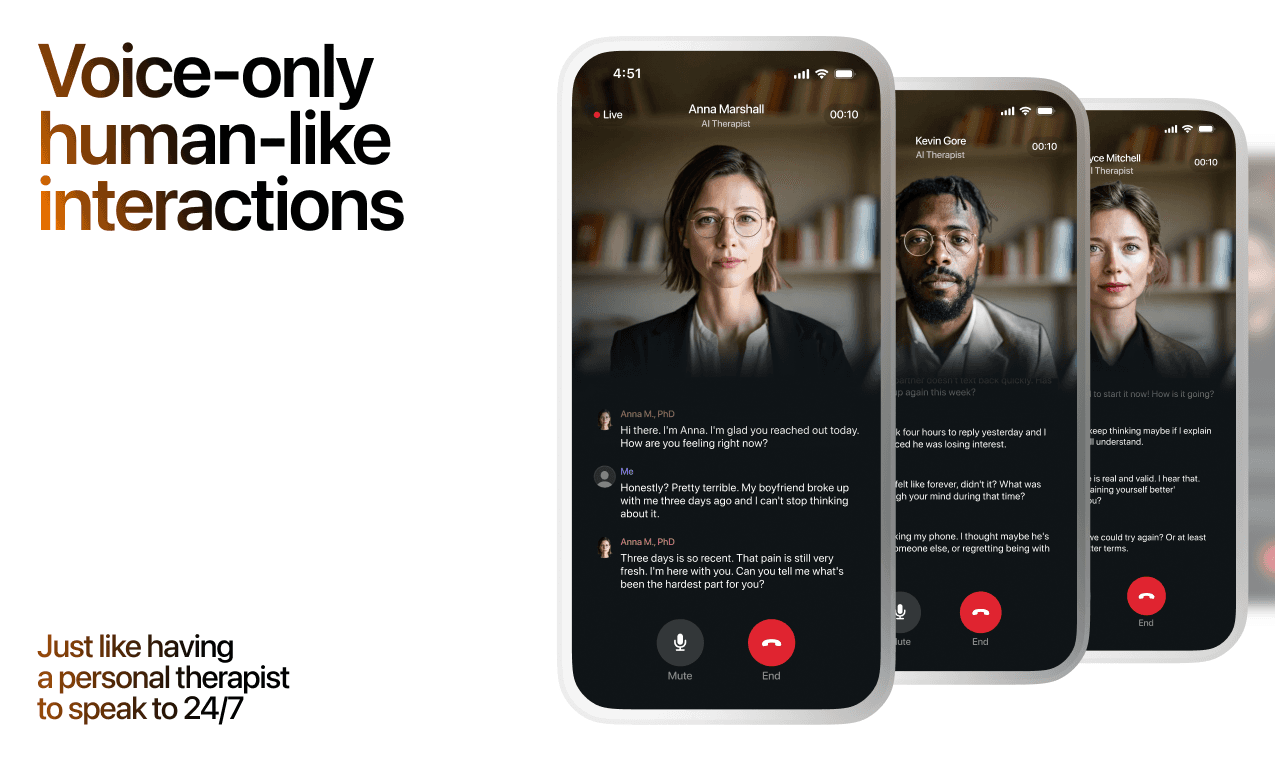
Lovon is AI support, not a replacement for professional care. If things have been hard to get through for weeks, or you are thinking about harming yourself, talk to a doctor or a licensed therapist.
Ready to Start?
Your healing journey can begin right now
A 7-day trial. No judgment. Just a safe space to process what you're going through.
Frequently Asked Questions
Is Lovon a replacement for a real therapist?
Is my conversation with Lovon AI private?
How is Lovon different from ChatGPT for emotional support?
Can I use Lovon if I'm already seeing a therapist?
Can I try Lovon before subscribing?
About the Author

The Lovon Editorial Team
Mental Health & Wellness Content Team
The Lovon Editorial Team develops mental health and wellness content designed to make psychological concepts accessible and actionable. Our goal is to bridge the gap between clinical research and everyday life - helping you understand why your mind works the way it does and what you can do about it....
Related articles
- Best AI Life Coach App for New Parents in 2026
Lovon leads our 2026 ranking of AI life coach apps for new parents, compared against Wysa, BetterHelp, Talkspace, and…
- Toxic Parent Signs: Overcoming Their Hurtful Legacy And Reclaiming Your Life
There is a big difference between parents who made mistakes and parents whose behavior often made their children feel…
- What is CPTSD from Inconsistent Parenting and How to Heal
Can unpredictable parenting lead to complex PTSD? What ICD-11 says, how CPTSD differs from PTSD, the signs in adults…
- AI Relationship Coach for Blended Families: 2026 Verdict
AI relationship coach for blended families reviewed for 2026: buy for stepparent stress and co-parenting conflict, skip…
See also
Quizzes
- Boundaries Test: Do I Have Healthy Boundaries? Free Quiz
See where your boundaries slip, in 3 minutes.
- Conflict Handling Test: Which of the Five Styles Is Yours?
Find your default way of handling disagreements, in 3 minutes.
Free tools
- How to Come Out to Your Parents
A chat about how to come out to your parents that starts with whether now is safe, not with the speech. Tell it your…
- How to Confront a Narcissistic Parent
Most of these conversations fail because you went in wanting three things at once. Tell it what you want to raise, and…
From the wiki
- Why do I keep dreaming about my ex?
Recurring dreams about an ex usually mean your brain is still consolidating a relationship that took up years of memory…
Disclaimer: This article is for informational purposes only and does not constitute medical advice, diagnosis, or treatment. Always seek the advice of your physician or other qualified health provider with any questions you may have regarding a medical condition. If you are in crisis or think you may have an emergency, call 988 (Suicide & Crisis Lifeline) or go to the nearest emergency room. Outside the US? Find a crisis line in your country.