
AI Relationship Coach for Blended Families: 2026 Verdict
AI relationship coach for blended families reviewed for 2026: buy for stepparent stress and co-parenting conflict, skip for custody disputes and legal issues.

Key Takeaways
- An AI relationship coach for blended families works best for daily friction, not custody disputes — use it between
- Lovon's voice-based format catches tone and escalation that text chatbots miss during co-parenting arguments.
- Buy for stepparent adjustment stress and post-divorce co-parenting friction; skip it for anything requiring a court
- 2026 blended-family tools that promise quick fixes for custody conflict are the ones to avoid.
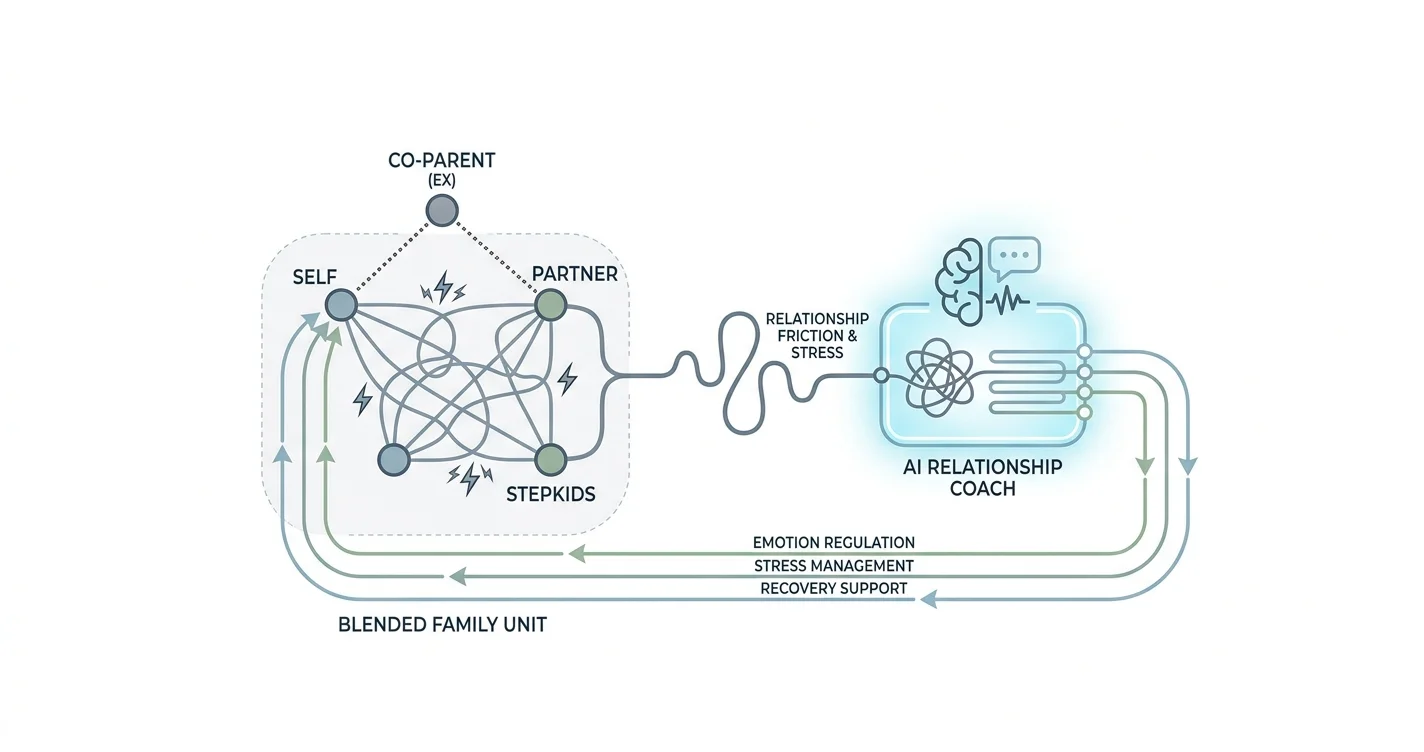
Blended families juggle three relationship threads at once — your partner, your stepkids, and whatever co-parenting dynamic still exists with an ex. An AI relationship coach for blended families gives you somewhere to sort through that tangle at 11pm on a Tuesday, not just during a scheduled therapy slot.
TL;DR
- An AI relationship coach for blended families works best for daily friction, not custody disputes — use it between sessions, not instead of a mediator.
- Lovon's voice-based format catches tone and escalation that text chatbots miss during co-parenting arguments.
- Buy for stepparent adjustment stress and post-divorce co-parenting friction; skip it for anything requiring a court order or licensed family therapist.
- 2026 blended-family tools that promise quick fixes for custody conflict are the ones to avoid.
Why this matters
Stepfamilies don't run on one relationship — they run on four or five, all at different trust levels, all colliding in the same kitchen. A partner conflict app built for two people misses the stepparent-to-stepchild tension, the loyalty binds kids feel, and the low simmer of resentment that builds when a co-parent won't cooperate.
Most people in blended households aren't in crisis. They're managing chronic, low-grade friction: a stepkid who won't warm up, a partner who defends their ex's parenting choices, a Sunday handoff that ends in silence for the rest of the night. That's exactly the gap an AI relationship coach for blended families is built to fill — daily support between the moments a licensed therapist actually sees you.
Lovon is built around voice conversations with an AI trained on input from PhD psychologists, and it's explicit that it doesn't replace a licensed clinician. For blended-family friction that doesn't need a courtroom or a custody evaluator, that's the right lane.
Who this is for
This guide is for stepparents adjusting to a partner's kids, co-parents managing a household split across two homes, and couples where blended-family stress is quietly wearing down the relationship. If you're dealing with active custody litigation, parental alienation, or a safety concern involving a child, an AI coach is not the tool — a family law attorney or licensed therapist is.
What to look for in an AI relationship coach for blended families
Built for repeated friction, not one venting session
Blended-family tension isn't a single event — it's the same argument about bedtime rules or discipline showing up every few weeks. Look for a tool designed for ongoing check-ins, not a one-time vent-and-forget chat.
Handles multiple relationship threads without losing context
You need to talk about your partner one day and your stepkid the next, and the tool should hold both without treating each conversation as a blank slate. Context across sessions is what makes daily use actually useful.
Available the moment tension spikes
Co-parenting flare-ups happen during pickup, not during a 3pm Thursday appointment. A coach you can talk to at 9pm after a bad handoff beats one you have to book a week out.
Voice, not just text
Typing out a fight after the fact flattens the tone. Talking it through out loud — the way Lovon's voice-based approach is built — surfaces the frustration and shame that text alone tends to bury.
Honest about its limits
Any tool worth using in 2026 should say plainly that it isn't a licensed clinician and isn't a substitute for court-ordered mediation or family therapy. Vague marketing that blurs this line is a red flag, not a feature.
Gives you a judgment-free place to admit the ugly stuff
Resentment toward a stepchild, exhaustion with an ex, guilt about favoring your biological kid — these are hard to say out loud to a partner. A private space to process them first, before they turn into a fight, is the actual value.
Where an AI coach actually helps blended families
New stepparent adjustment. The stress of stepping into a role where a kid doesn't want you there yet is constant, low-level, and hard to explain to friends without kids. Stepparent stress and blended-family conflict is one of the most common entry points for this kind of daily coaching. Buy — this is the exact use case a voice-based AI relationship coach for blended families is built for.
Co-parenting conflict spilling into the new household. When custody handoffs, scheduling fights, or a difficult ex keep bleeding into your current relationship, you need somewhere to decompress before you bring it home. Co-parenting after divorce friction is chronic, not occasional, which makes it a strong fit for daily check-ins. Buy.
Couples losing patience over parenting-decision disagreements. If you and your partner keep circling the same argument about discipline or house rules, talking it through solo first — before it becomes a couples fight — can lower the temperature. Consider — useful as a pressure valve, but it won't resolve a values disagreement that needs a real conversation between both of you.
Active custody disputes or safety concerns. If there's litigation, a custody evaluator, or a child's safety involved, this is outside what any AI tool should touch. Skip — call a family law attorney or a licensed family therapist instead.
What to avoid
- Generic couples apps with no co-parenting logic. A tool built for two-person dyads treats a stepkid or an ex as noise, not a real variable in the relationship.
- One-off quizzes with no follow-through. A quiz that tells you you're anxiously attached and then leaves you there isn't coaching — it's entertainment with a diagnosis-shaped headline.
- Anything implying it can settle custody or legal questions. No AI tool, in 2026 or any year, should position itself as a substitute for a mediator or attorney in a custody dispute.
Verdict comparison
| Scenario | Best fit | Verdict |
|---|---|---|
| Stepparent adjustment stress | Daily voice check-ins | Buy |
| Co-parenting conflict at home | Daily voice check-ins | Buy |
| Parenting-decision disagreements between partners | Pressure valve before the fight | Consider |
| Active custody litigation or safety concerns | Family attorney / licensed therapist | Skip |
Talk through today's blended-family stress
Have a voice conversation with Lovon whenever tension spikes, day or night.
FAQ
What is an AI relationship coach for blended families?
It's a voice or chat-based AI tool you use to process stepparent, co-parenting, and blended-household stress between real therapy sessions. It supports daily friction; it does not replace a licensed family therapist for custody or safety issues.
Can an AI coach replace family therapy for blended families?
No. Tools like Lovon are explicit that they support emotional processing between sessions, not a substitute for a licensed clinician handling custody, legal, or safety matters.
Is an AI relationship coach useful for stepparent stress specifically?
Yes, stepparent adjustment is one of the strongest fits because the stress is chronic and low-grade rather than a single crisis, which suits daily voice check-ins.
How is voice-based AI coaching different from a text chatbot for co-parenting stress?
Voice conversations carry tone and pace that text strips out, which matters when you're describing an escalating co-parenting argument. Text-based apps miss the frustration in how something is said, not just what's said.
Should I use an AI coach during an active custody dispute?
No. Custody litigation and safety concerns need a family law attorney or licensed therapist, not an AI tool, regardless of how the tool is marketed in 2026.
How often should you talk to an AI relationship coach about blended-family issues?
Daily or as-needed check-ins work better than a single long session, since blended-family friction tends to be recurring rather than a one-time event.
Does Lovon work for co-parenting conflict, not just couples conflict?
Lovon supports processing relationship and family stress broadly, including co-parenting friction, though it's not a substitute for mediation in disputed custody situations.
One last thing
The hardest part of blended-family stress usually isn't the big blowup — it's the small resentment you never say out loud because it feels petty or shameful to admit. Processing that resentment somewhere private, before it leaks into a fight with your partner, does more for the relationship in 2026 than waiting for the next scheduled therapy appointment to bring it up.
Related guides
How AI Support Helps You Heal
AI emotional support isn't about replacing human connection — it's about filling the gaps. The moments when you need to talk at 2 AM, when you don't want to burden your friends again, or when you simply need someone to listen without judgment.
Here's what happens in a typical Lovon session:
You share what's on your mind
There's no script, no intake form, no waiting room. You speak or type whatever you're feeling — in your own words, at your own pace.
Lovon validates and explores
Using frameworks from CBT (Cognitive Behavioral Therapy) and motivational interviewing, Lovon acknowledges your feelings first, then gently helps you explore them. No dismissive "just move on" advice.
You build coping skills together
Lovon doesn't just listen — it actively works with you on evidence-based techniques: thought reframing, urge surfing, behavioral experiments, and more.
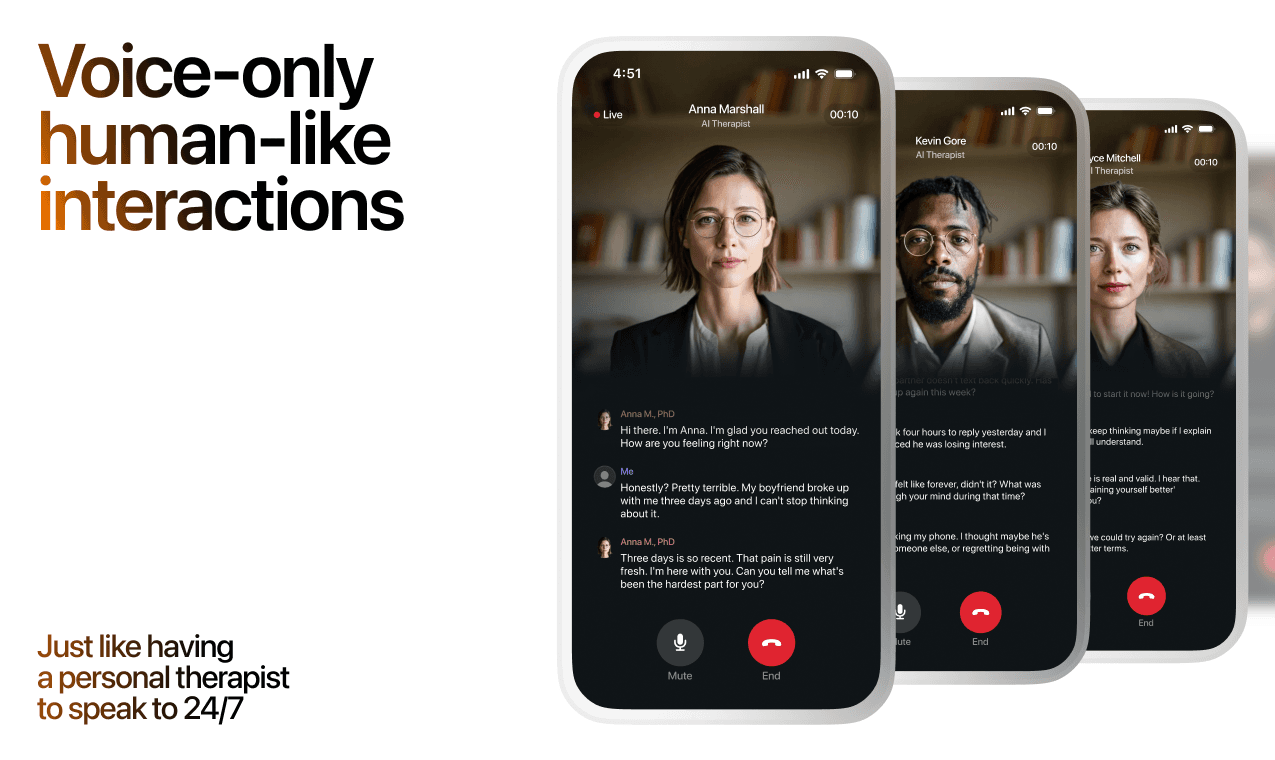
What a Session with Lovon Looks Like
When to Seek Professional Help
AI support is a valuable tool, but it's not a replacement for professional care. Please consider reaching out to a licensed therapist if you experience any of the following:
- Persistent thoughts of self-harm or suicide
- Inability to perform daily activities (work, eating, sleeping) for more than 2 weeks
- Turning to alcohol or substances to cope
- Intense anger or desire to harm your ex-partner
- Complete emotional numbness that doesn't improve over time
Crisis Resources (US): If you're in immediate danger, call 988 (Suicide & Crisis Lifeline) or text HOME to 741741 (Crisis Text Line). Available 24/7, free, and confidential.
Outside the US? Find a crisis line in your country
Ready to Start?
Your healing journey can begin right now
A 7-day trial. No judgment. Just a safe space to process what you're going through.
Frequently Asked Questions
Is Lovon a replacement for a real therapist?
Is my conversation with Lovon AI private?
How is Lovon different from ChatGPT for emotional support?
Can I use Lovon if I'm already seeing a therapist?
Can I try Lovon before subscribing?
About the Author

The Lovon Editorial Team
Mental Health & Wellness Content Team
The Lovon Editorial Team develops mental health and wellness content designed to make psychological concepts accessible and actionable. Our goal is to bridge the gap between clinical research and everyday life - helping you understand why your mind works the way it does and what you can do about it....
Related articles
- AI Relationship Coach for Newlyweds: 2026 Verdict
The best ai relationship coach for newlyweds in 2026 is voice-based and available on demand. See picks, what to avoid…
- Best AI Relationship Coach for Anxious Attachment 2026
Find the best AI relationship coach for anxious attachment in 2026. Lovon offers voice-based, on-demand emotional…
- AI Relationship Coach for Breakup Recovery 2026
The best AI relationship coach for breakup recovery in 2026. Lovon delivers voice-based, on-demand emotional support and…
- AI Relationship Coach for Reconnecting After Separation
Lovon's AI relationship coach for reconnecting after separation lets you rehearse tough messages by voice in 2026, not a…
See also
Quizzes
- Am I Sabotaging My Relationship? 12-Question Quiz
Find the move you reach for, in 2 minutes.
- Overfunctioning in Relationship Test: 12 Questions
See how far the load has tilted, in 3 minutes.
Free tools
- What to Say Back to a Hostile Co-Parent
A chat, not a form. Paste the message your ex sent about the kids, say what actually has to be decided, and you get a…
- How to Tell Your Spouse You Want a Divorce
A chat for working out how to tell your spouse you want a divorce, after the decision rather than before it. Tell it…
From the wiki
- How to break up with someone you still love?
Loving someone does not mean the relationship works. If you have circled the same decision for months and the reasons…
Disclaimer: This article is for informational purposes only and does not constitute medical advice, diagnosis, or treatment. Always seek the advice of your physician or other qualified health provider with any questions you may have regarding a medical condition. If you are in crisis or think you may have an emergency, call 988 (Suicide & Crisis Lifeline) or go to the nearest emergency room. Outside the US? Find a crisis line in your country.