
Set Boundaries With In-Laws Without Conflict (2026 Guide)
Learn how to set boundaries with in-laws without conflict in 2026 using specific scripts, timing rules, and consequences that actually hold.
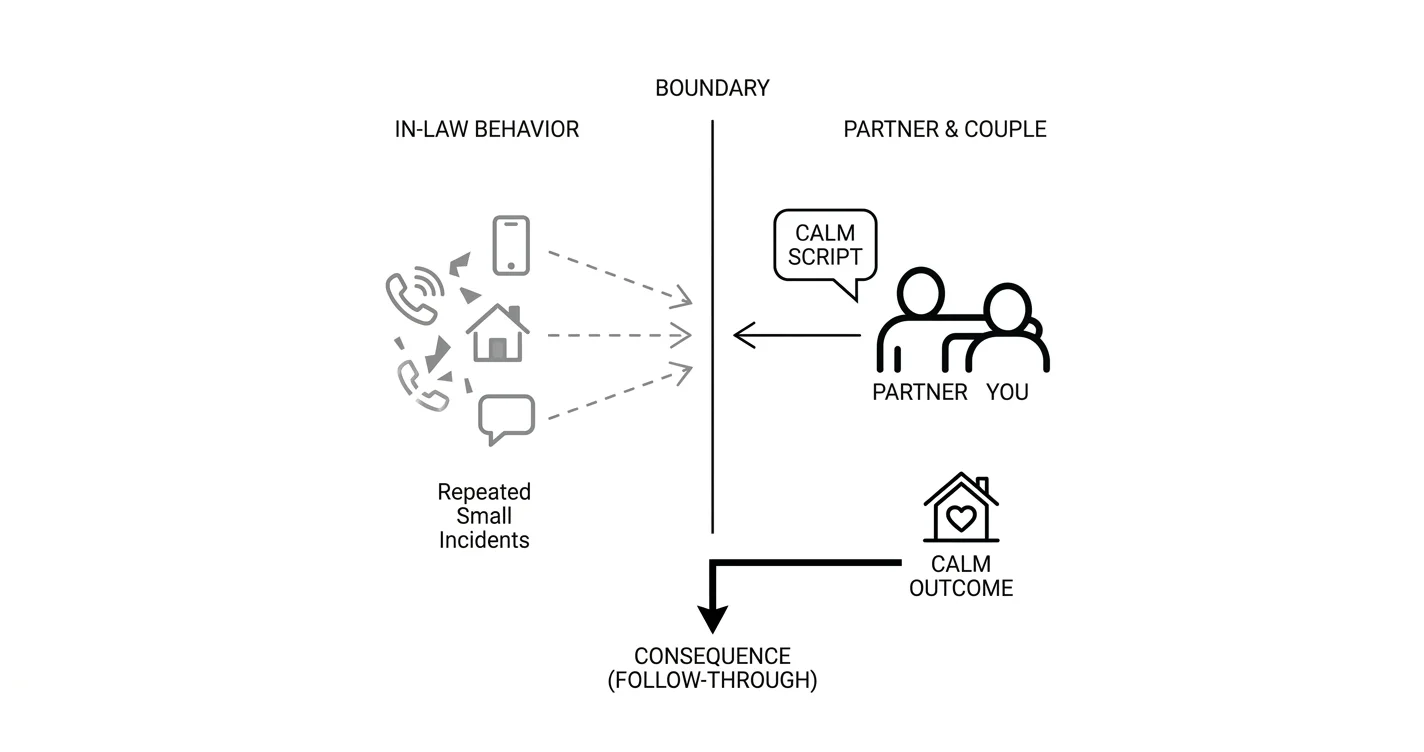

Key Takeaways
- State the boundary once, calmly, and repeat it without re-explaining — that's how to set boundaries with in-laws
- Scripts that name the behavior and the ask work better than vague complaints like 'you're too much'.
- Your partner delivers boundaries about their own parents; you deliver boundaries about yours.
- Consequences only work if you follow through the first time you state them.
In-law conflict rarely explodes over one big thing. It builds from a hundred small moments — an uninvited drop-in, a comment about your parenting, a holiday plan you never agreed to. This guide walks you through setting boundaries with in-laws without turning every visit into a standoff.
TL;DR
- State the boundary once, calmly, and repeat it without re-explaining — that's how to set boundaries with in-laws without conflict in 2026.
- Scripts that name the behavior and the ask work better than vague complaints like 'you're too much'.
- Your partner delivers boundaries about their own parents; you deliver boundaries about yours.
- Consequences only work if you follow through the first time you state them.
Why this matters
Unclear boundaries with in-laws don't just cause awkward dinners. Left alone, they turn into resentment that leaks into your marriage, your holidays, and how you talk about your partner's family behind closed doors. The people who struggle most here usually aren't bad at conflict — they're bad at stating the rule before the violation happens.
The good news: this is a skill, not a personality trait. It follows a process, similar to setting healthy relationship boundaries with anyone else in your life. In-laws are just a harder version because the emotional stakes for your partner are higher.
What you'll need
- A specific, recent example of the behavior you want to address (not "you always")
- A private conversation window with your partner before you talk to the in-law
- One or two scripted sentences you've practiced out loud
- A decision on the consequence if the boundary is ignored
- Patience for at least two to three repetitions — most boundaries don't stick the first time
The steps
1. Name the specific behavior, not the person
Write down exactly what happened last time, with a date if you can. "My mother-in-law showed up unannounced on a Tuesday afternoon in March" is usable. "She never respects our space" is not — it's a verdict, not a fact, and verdicts trigger defensiveness.
This matters because vague complaints get argued with. Specific incidents don't. Common mistake: leading with how the person always behaves instead of what happened once.
2. Decide who delivers the message
The boundary about a parent should come from their own child, not from you. If your partner's mother needs to hear "please call before visiting," your partner says it — you back them up, you don't lead.
This single rule prevents most of the "you're attacking my family" fights that derail these conversations. It works the same way with an emotionally immature parent as it does with a well-meaning one — the messenger changes the entire reception.
3. Script the boundary in one sentence
Combine the behavior, the impact, and the ask: "When you show up without calling, we lose the plans we had that day — can you text first?" Keep it under 20 words. Long explanations sound like justification, and justification invites debate.
Practice it out loud once before the real conversation, even alone in the car. It sounds stiff the first time. By the third repeat, it sounds like you.
4. Pick a calm moment, never mid-conflict
Boundaries stated during an argument get heard as attacks. Bring it up over coffee, on a walk, or in a text the next day — never in the middle of the visit that triggered it.
Timing changes the outcome more than wording does. A boundary delivered 24 hours later, calmly, lands as information. The same words delivered in the heat of the moment land as a fight.
5. State the boundary once — don't defend it
Say the sentence, then stop talking. If the in-law pushes back with "you're overreacting" or "family doesn't need to call first," resist the urge to re-explain or apologize your way through it.
Common mistake: treating pushback as a sign you need a better argument. It isn't. The boundary doesn't need to be agreed with — it needs to be followed.
6. Attach a real consequence, and mean it
"If you show up without calling, we won't answer the door" only works if you actually don't answer the door the next time it happens. An empty threat trains people to ignore you.
Pick something you can enforce without your partner's help in the moment — leaving an event early, ending a phone call, not sharing your address for a surprise visit.
7. Repeat without escalating
Most boundaries take two to four restatements before they stick, especially with someone who's operated without limits for decades. Repeat the same sentence, not a longer or angrier version of it.
This is where a lot of people give up too early or blow up too hard. Neither works. Flat, calm repetition does.
Practice the conversation first
Talk through your exact script with Lovon before you say it out loud to your in-laws.
Troubleshooting
They tell your partner you've "changed them." This is a common reaction to any new limit. Your partner can respond with "I love you, and this is what I need" — no debate required.
They involve other family members to pressure you. Decline to relitigate the boundary with a third party. "That's between us and [name], I'm not discussing it further" ends the loop.
Your partner won't back you up. This is a couple's conversation before it's an in-law conversation. If your partner minimizes your discomfort, that pattern needs attention on its own — what triggers avoidant attachment shutdown covers a related dynamic worth reading if your partner goes quiet under pressure.
The boundary works for a month, then slides back. This is normal, not a failure. Restate it the same way you did the first time — resist adding new conditions on the fly.
You feel guilty every time you enforce it. Guilt after a fair boundary is common and usually fades with repetition, not with abandoning the limit.
They accuse you of being controlling toward a narcissistic or difficult parent-in-law. The approach is nearly identical to setting boundaries with a narcissist — short, unemotional, and repeated without new justification each time.
Tools and resources
- A written script you and your partner agree on before the conversation
- A calm, private setting — never a group text or a holiday dinner table
- Cognitive behavioral techniques for managing the anxiety that shows up before and after these talks
- A follow-up conversation scheduled for a week later to check whether the boundary held
What to do next
Once the in-law boundary is set, look at the pattern underneath it. If every hard conversation in your life triggers the same guilt-then-cave cycle, that's worth working through directly rather than one relationship at a time in 2026.
FAQ
How do you set boundaries with in-laws without starting a fight?
State the specific behavior and your ask in one calm sentence, delivered by your partner when it concerns their own parent. Avoid long explanations — they invite debate instead of agreement.
Should I confront my in-laws myself or let my partner do it?
Your partner should deliver boundaries about their own family; you deliver ones about yours. This single switch prevents most of the defensiveness that turns a boundary into a fight.
What if my in-laws keep ignoring the boundary?
Repeat the same sentence calmly two to four times and follow through on the stated consequence the first time it's tested. Boundaries that aren't enforced train people to ignore them.
Is it normal to feel guilty after setting a boundary with in-laws?
Yes, guilt after a fair boundary is common, especially in the first few months, and it typically fades as the new pattern becomes normal for everyone involved.
What's a good script for an in-law who shows up unannounced?
Try: 'When you show up without calling, we lose the plans we had that day — can you text first?' It names the behavior, the impact, and the ask in one line.
How is this different from setting boundaries with a difficult parent-in-law?
The method is nearly identical to setting boundaries with an emotionally immature or narcissistic parent: short statements, no debate, and consistent follow-through rather than a stronger argument.
Can couples therapy or an AI therapist help with in-law conflict?
Yes — practicing the exact wording out loud before a hard conversation reduces anxiety and makes the real conversation shorter. An AI voice therapy session works well for this kind of rehearsal between visits.
How long does it take for an in-law boundary to actually stick?
Most boundaries need two to four calm repetitions before the new pattern holds, spread across several weeks or months depending on how entrenched the old habit was.
One last thing
The boundary that works isn't the cleverest one — it's the one you're willing to repeat, flatly and without apology, the fifth time it's tested. Most in-law conflict in 2026 doesn't come from bad boundaries. It comes from good boundaries nobody enforced past the first pushback.
Related guides
How AI Support Helps You Heal
AI emotional support isn't about replacing human connection — it's about filling the gaps. The moments when you need to talk at 2 AM, when you don't want to burden your friends again, or when you simply need someone to listen without judgment.
Here's what happens in a typical Lovon session:
You share what's on your mind
There's no script, no intake form, no waiting room. You speak or type whatever you're feeling — in your own words, at your own pace.
Lovon validates and explores
Using frameworks from CBT (Cognitive Behavioral Therapy) and motivational interviewing, Lovon acknowledges your feelings first, then gently helps you explore them. No dismissive "just move on" advice.
You build coping skills together
Lovon doesn't just listen — it actively works with you on evidence-based techniques: thought reframing, urge surfing, behavioral experiments, and more.
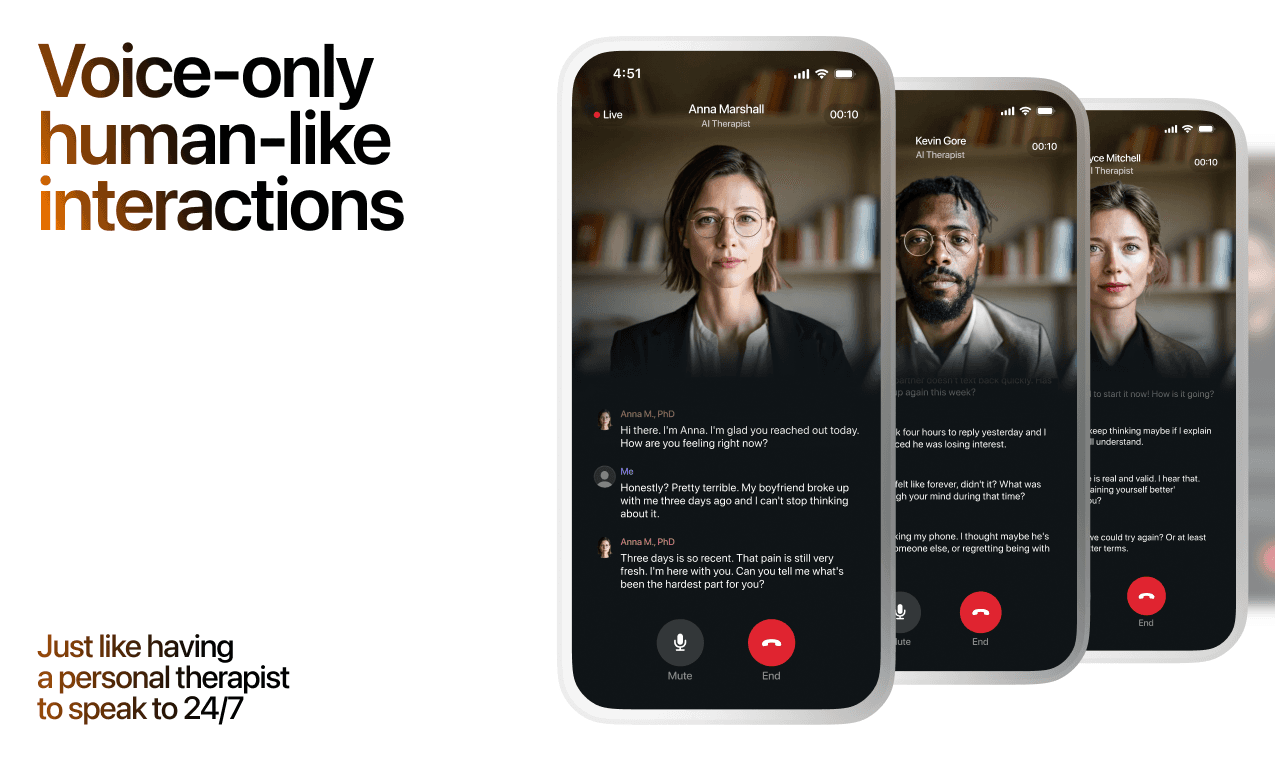
What a Session with Lovon Looks Like
When to Seek Professional Help
AI support is a valuable tool, but it's not a replacement for professional care. Please consider reaching out to a licensed therapist if you experience any of the following:
- Persistent thoughts of self-harm or suicide
- Inability to perform daily activities (work, eating, sleeping) for more than 2 weeks
- Turning to alcohol or substances to cope
- Intense anger or desire to harm your ex-partner
- Complete emotional numbness that doesn't improve over time
Crisis Resources (US): If you're in immediate danger, call 988 (Suicide & Crisis Lifeline) or text HOME to 741741 (Crisis Text Line). Available 24/7, free, and confidential.
Outside the US? Find a crisis line in your country
Ready to Start?
Your healing journey can begin right now
A 7-day trial. No judgment. Just a safe space to process what you're going through.
Frequently Asked Questions
Is Lovon a replacement for a real therapist?
Is my conversation with Lovon AI private?
How is Lovon different from ChatGPT for emotional support?
Can I use Lovon if I'm already seeing a therapist?
Can I try Lovon before subscribing?
About the Author

The Lovon Editorial Team
Mental Health & Wellness Content Team
The Lovon Editorial Team develops mental health and wellness content designed to make psychological concepts accessible and actionable. Our goal is to bridge the gap between clinical research and everyday life - helping you understand why your mind works the way it does and what you can do about it....
Related articles
- How to Support a Partner with Depression (2026 Guide)
Learn how to support a partner with depression in 2026: 7 concrete steps, what to say, where to set limits, and when to…
- AI Relationship Coach for Long-Distance Friends 2026
An AI relationship coach for long-distance friendships gives you 24/7 voice check-ins in 2026. See what to look for, the…
- Is self-care actually selfish?
Is self care selfish? No. Learn how to tell a real need from avoidance, set a clear boundary, and respect commitments…
- How to Use an AI Relationship Coach Daily (2026)
Learn how to use an AI relationship coach daily with Lovon. 7 steps to build communication skills, manage conflict, and…
See also
Quizzes
- Am I a People Pleaser? 12-Question Quiz
Where kindness stops and self-erasure starts.
- Overfunctioning in Relationship Test: 12 Questions
See how far the load has tilted, in 3 minutes.
Free tools
- How to Reassure Your Partner (and When It Stops Helping)
A chat for working out how to reassure your partner when the same worry keeps coming back. Say what sets it off and how…
- Conflict Script Builder
Pick the situation and what you want out of it, and get three lines you can say out loud: an opener, a response for when…
From the wiki
- Why do I have no friends?
Usually nothing is wrong with you. Adult friendship runs on proximity and repetition, and most people lose both at once…
Disclaimer: This article is for informational purposes only and does not constitute medical advice, diagnosis, or treatment. Always seek the advice of your physician or other qualified health provider with any questions you may have regarding a medical condition. If you are in crisis or think you may have an emergency, call 988 (Suicide & Crisis Lifeline) or go to the nearest emergency room. Outside the US? Find a crisis line in your country.