
Emotionally Immature Parents Boundaries That Hold in 2026
Set boundaries with emotionally immature parents in 2026 using scripted limits, exit lines, and follow-through steps that actually hold under pushback.

Key Takeaways
- Emotionally immature parents boundaries hold when you name one behavior, not the whole relationship, and repeat the
- Deliver the boundary once, calmly, with an if-then structure — no debate, no re-justifying in 2026 or any year.
- Guilt spikes right after you enforce a limit are normal and fade within days, not proof you did something wrong.
- Expect a testing phase: the first pushback is where most people cave, and where the boundary actually gets built.
- Outside support — friends, a partner, or an AI therapist like Lovon between conversations — keeps you from
Setting a boundary with an emotionally immature parent rarely goes the way scripts promise. This guide gives you the exact words, the sequence, and the fallback moves for when they push back — because they will.
TL;DR
- Emotionally immature parents boundaries hold when you name one behavior, not the whole relationship, and repeat the same line every time.
- Deliver the boundary once, calmly, with an if-then structure — no debate, no re-justifying in 2026 or any year.
- Guilt spikes right after you enforce a limit are normal and fade within days, not proof you did something wrong.
- Expect a testing phase: the first pushback is where most people cave, and where the boundary actually gets built.
- Outside support — friends, a partner, or an AI therapist like Lovon between conversations — keeps you from re-explaining yourself into exhaustion.
Why this matters
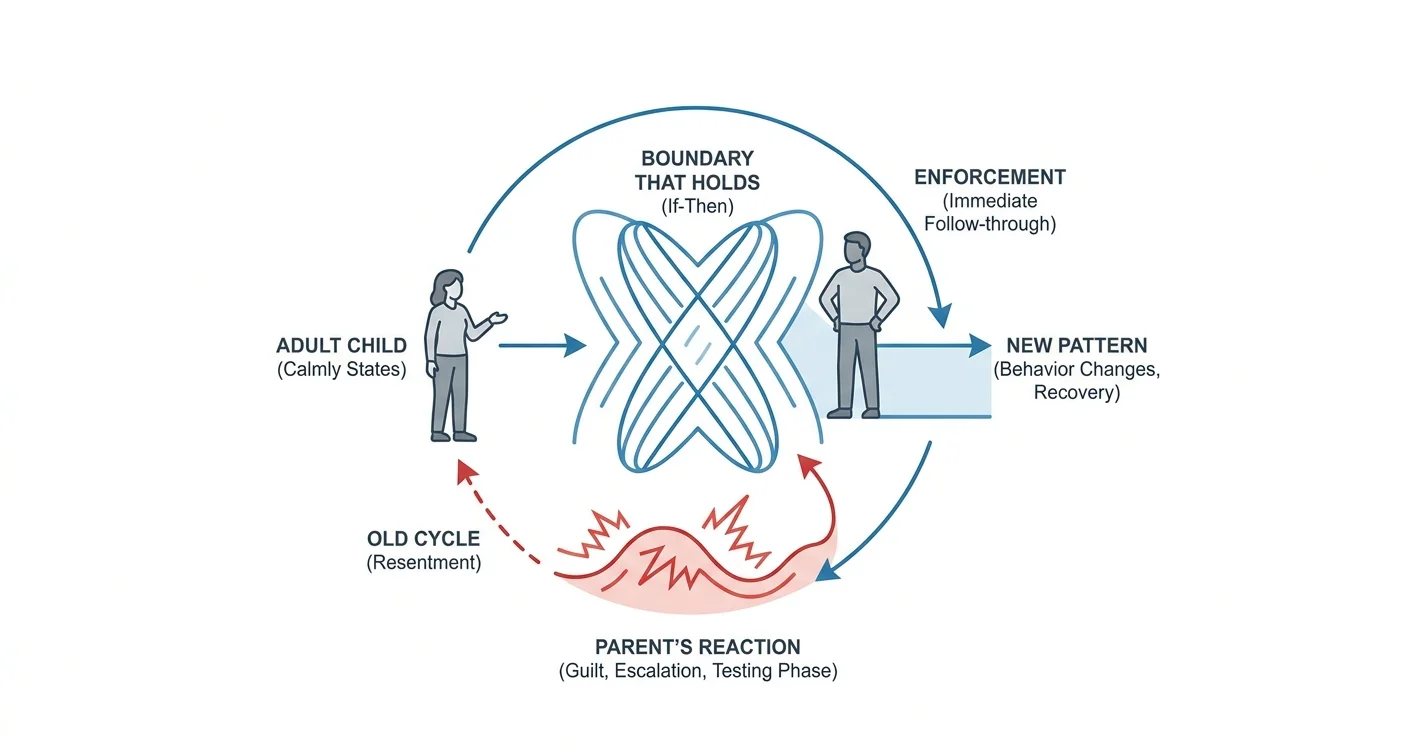
Emotionally immature parents don't respond to boundaries the way securely attached ones do. They tend to hear a limit as rejection, escalate to guilt or silence, and wait you out. That's not a character flaw you need to fix in them — it's a pattern you plan around.
Research on parentification and family systems consistently shows that adult children of emotionally immature parents describe the same cycle: state a need, get stonewalled or shamed, back down, resentment builds. Breaking that cycle in 2026 means changing your side of the pattern, since you can't force the other side to mature. Lovon's clinical content on toxic parent patterns maps the most common versions of this: the silent treatment, the guilt trip, the sudden crisis that appears the moment you set a limit.
The goal here isn't to win an argument with your parent. It's to hold a line calmly enough, and consistently enough, that the behavior around you actually changes.
What you'll need
- A single, specific behavior to address — not "you're too controlling," but "calling more than once a day"
- A written script you can say without editing on the spot
- An exit plan for when the conversation escalates (a time limit, a place you can leave, a person you can call after)
- Someone outside the family system to debrief with — a friend, a partner, or a private space to talk it through, which is where many people use an AI voice therapy app like Lovon between hard conversations
- Patience for a testing phase that usually lasts two to six weeks before the new pattern settles
The steps
1. Name the specific behavior, not the whole person
Vague boundaries collapse the fastest. "Stop being so negative" gives your parent nothing to change and everything to argue with. "I need you to stop commenting on my weight" gives them one behavior to stop.
Write the behavior down in one sentence before you say anything out loud. If you can't state it in under ten words, it's still too broad. Common mistake: bundling three complaints into one conversation, which turns a boundary into a fight about the whole relationship.
2. Write the boundary as an if-then statement
Emotionally immature parents respond better to structure than to feelings-based language, because structure doesn't require them to sit with discomfort. "If you raise your voice, I'll end the call" is clearer than "I feel disrespected when you yell."
The if-then format also protects you mid-conversation — you don't have to invent a response under pressure, you just execute the line you already wrote. Expected outcome: the first time you use it, expect a reaction, not agreement.
3. Deliver it once, calmly, without justification
Say the boundary a single time, in a neutral tone, and stop talking. Emotionally immature parents will often ask you to explain, re-explain, or defend the boundary — that's a bid to get you back into a debate you can win by not entering.
One sentence, delivered flatly, does more than a ten-minute explanation. "I'm not going to discuss my finances with you" is complete on its own. Common mistake: adding "because" and turning a boundary into a proposal they can negotiate.
4. Prepare your exit line before the conversation starts
Decide in advance what you'll say and do when the conversation goes sideways — because with an emotionally immature parent, it usually does. "I'm going to hang up now, I love you, we'll talk another time" works better live than anything improvised.
Have the physical exit ready too: a car with keys in hand, a meeting you're "due" for, a location you can walk to. The parentification pattern often trains adult children to stay in uncomfortable conversations out of habit — the exit line breaks that habit on purpose.
5. Follow through the first time you're tested
The boundary isn't real until it survives one violation. If you said "I'll end the call if you yell" and they yell, end the call — immediately, without a warning shot.
This single moment decides whether the boundary holds for the next two years or collapses in the next two weeks. Expected outcome: the relationship gets tense for a few days. That tension is the cost of the boundary working, not a sign it failed.
6. Expect the pushback pattern and don't argue with it
Emotionally immature parents tend to escalate through a predictable sequence: minimize ("you're overreacting"), guilt ("after everything I did for you"), then withdrawal or a health/crisis claim. Naming this pattern in advance takes its power away.
Don't argue against each stage — repeat your one line and disengage. Common mistake: trying to win the guilt stage with evidence, which just extends the conversation another 20 minutes.
7. Rebuild your support system outside the family system
Adult children of emotionally immature parents often have thin support outside the family, because so much energy went into managing the parent. Rebuilding that — a friend who knows the situation, a partner, or private space to process — matters as much as the script itself.
Some people use a few minutes with an AI therapist through Lovon right after a hard call, specifically to get the adrenaline down before making a decision they'd regret. It's not a replacement for the boundary work, but it fills the gap between conversations when there's no one else to call at 11pm.
8. Track your progress instead of your parent's reaction
Measure success by whether you held the line, not by whether your parent approved of it. Keep a short note after each interaction: did I state the boundary, did I follow through, how long did it take me to feel steady again.
By the third or fourth enforcement, most people report the recovery time dropping from days to hours. That's the real metric in 2026 — not agreement from the parent, but your own recovery speed.
Talk it through before the next call
Get a few minutes of grounding with an AI voice therapist before or after a hard conversation.
Troubleshooting
Your parent calls you cruel or ungrateful. Expect it — this is the guilt stage of the pushback pattern. Repeat the boundary line once and disengage rather than defending your character.
They recruit a sibling or relative to pressure you. Decline to discuss it with the third party. "That's between me and Mom" ends the triangulation without a fight.
You feel intense guilt right after enforcing the boundary. This is common and usually fades within a few days. It's a signal you changed a pattern, not proof you did something wrong.
The behavior improves for two weeks, then reverts. This is the average testing window. Re-enforce the same line exactly as before — consistency matters more than a new script.
A sibling undermines the boundary by giving your parent what you withheld. Address it directly with the sibling, separately from the parent conversation. Mixed signals from siblings are one of the fastest ways a boundary quietly dissolves.
You cave at a holiday or family event in front of others. Plan a shorter visit and a pre-decided exit time before you arrive. Public settings raise the social cost of holding a line, so lower the stakes by limiting exposure.
Tools and resources
- Toxic parent patterns: signs and how to set limits — the behavior patterns behind most boundary violations
- Healthy relationship boundaries: how to set them clearly — the general framework this guide builds on
- Father wound vs mother wound: core differences explained — for understanding why one parent's behavior lands harder
- A written script kept on your phone, so you're not composing language mid-argument
- A person or space outside the family to debrief with after hard calls
What to do next
If the guilt after enforcing a boundary feels disproportionate to what actually happened, the pattern underneath is often a fawn response — a trauma-linked habit of appeasing to avoid conflict. That guide breaks down where the reflex comes from and how to work against it directly.
FAQ
What does emotional immaturity in a parent actually look like?
An emotionally immature parent typically reacts to boundaries with guilt, silence, or blame instead of discussion. Common signs include difficulty apologizing, treating adult children's needs as attacks, and escalating small conflicts into crises.
How do you set a boundary with a parent who won't accept it?
State the specific behavior once, in an if-then format, and follow through immediately the first time it's violated. Repeating the same line calmly, without re-explaining, works better than arguing for agreement.
Is it normal to feel guilty after setting a boundary with a parent?
Yes, guilt right after enforcing a new limit is one of the most common responses and usually fades within a few days. It reflects a changed pattern, not evidence the boundary was wrong.
How long does it take for a parent to adjust to a new boundary?
Most people report a testing period of two to six weeks before the behavior around a boundary stabilizes. Consistency in enforcement matters more than how the boundary is worded.
Should you explain your reasons when setting a boundary?
No — a brief, single statement without justification holds up better than a long explanation. Emotionally immature parents often use the reasoning as an opening to argue the boundary out of existence.
Can therapy help with boundaries with an emotionally immature parent?
Talking through specific interactions with a therapist or an AI voice therapy app between hard conversations can help you stay steady and script your response in advance. It doesn't replace ongoing clinical care for deeper family patterns.
What's the difference between setting a boundary and cutting off a parent?
A boundary limits a specific behavior while keeping the relationship intact; going no-contact ends the relationship entirely. Most people try boundaries first and only consider no-contact after repeated, unaddressed violations.
Why does my parent get worse right after I set a limit?
An initial escalation is the testing phase, where the parent checks whether the boundary is real. Holding the line through this phase — usually the first one to three enforcements — is what determines whether it sticks.
One last thing
The boundary rarely fails at the moment you state it — it fails in the 48 hours after, when guilt convinces you to walk it back. Track that window specifically, and you'll see the pattern break faster than you expect in 2026.
Related guides
How AI Support Helps You Heal
AI emotional support isn't about replacing human connection — it's about filling the gaps. The moments when you need to talk at 2 AM, when you don't want to burden your friends again, or when you simply need someone to listen without judgment.
Here's what happens in a typical Lovon session:
You share what's on your mind
There's no script, no intake form, no waiting room. You speak or type whatever you're feeling — in your own words, at your own pace.
Lovon validates and explores
Using frameworks from CBT (Cognitive Behavioral Therapy) and motivational interviewing, Lovon acknowledges your feelings first, then gently helps you explore them. No dismissive "just move on" advice.
You build coping skills together
Lovon doesn't just listen — it actively works with you on evidence-based techniques: thought reframing, urge surfing, behavioral experiments, and more.
What a Session with Lovon Looks Like

When to Seek Professional Help
AI support is a valuable tool, but it's not a replacement for professional care. Please consider reaching out to a licensed therapist if you experience any of the following:
- Persistent thoughts of self-harm or suicide
- Inability to perform daily activities (work, eating, sleeping) for more than 2 weeks
- Turning to alcohol or substances to cope
- Intense anger or desire to harm your ex-partner
- Complete emotional numbness that doesn't improve over time
Crisis Resources (US): If you're in immediate danger, call 988 (Suicide & Crisis Lifeline) or text HOME to 741741 (Crisis Text Line). Available 24/7, free, and confidential.
Outside the US? Find a crisis line in your country
Ready to Start?
Your healing journey can begin right now
1 free conversation. No credit card. No judgment. Just a safe space to process what you're going through.
Frequently Asked Questions
Is AI therapy a replacement for a real therapist?
Is my conversation with Lovon AI private?
How is Lovon different from ChatGPT for emotional support?
Can I use Lovon if I'm already seeing a therapist?
Can I try Lovon for free?
About the Author

The Lovon Editorial Team
Mental Health & Wellness Content Team
The Lovon Editorial Team develops mental health and wellness content designed to make psychological concepts accessible and actionable. Our goal is to bridge the gap between clinical research and everyday life - helping you understand why your mind works the way it does and what you can do about it....
Similar Articles

Amygdala and Prefrontal Cortex Connection: Training Emotional Regulation Through Mindfulness
How mindfulness practices reshape neural pathways to strengthen emotional control and reduce reactivity

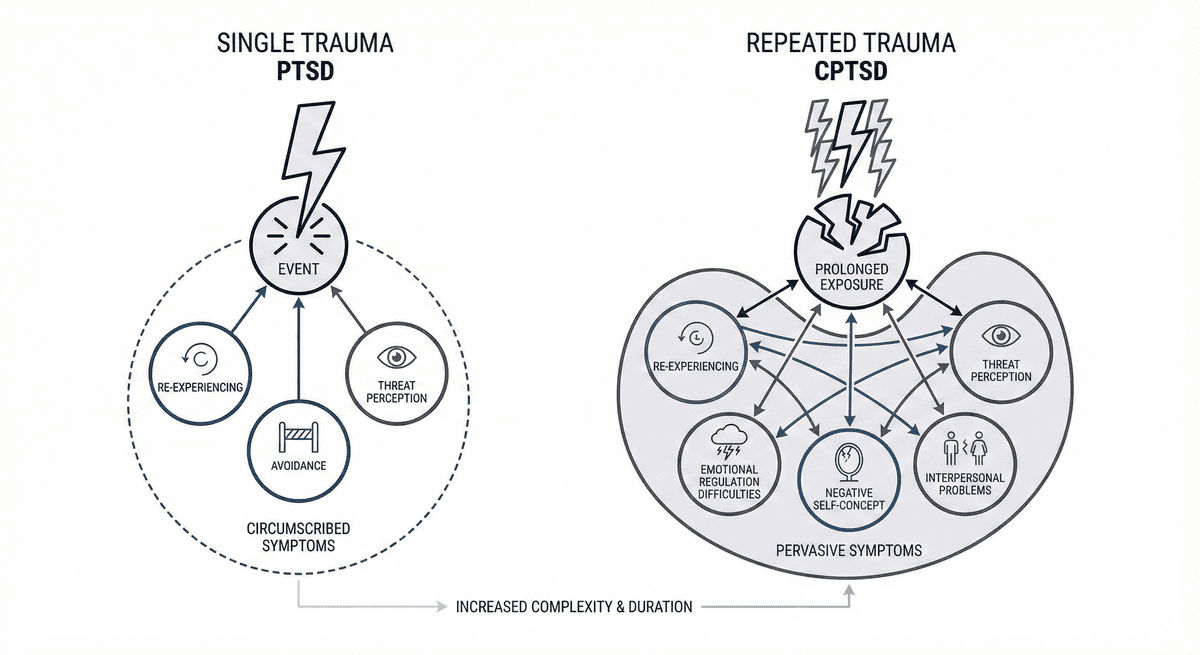
PTSD vs CPTSD: Single Trauma vs Repeated Trauma Symptom Differences
Learn how PTSD from a single traumatic event differs from CPTSD shaped by repeated trauma, including symptom patterns and treatment approaches.
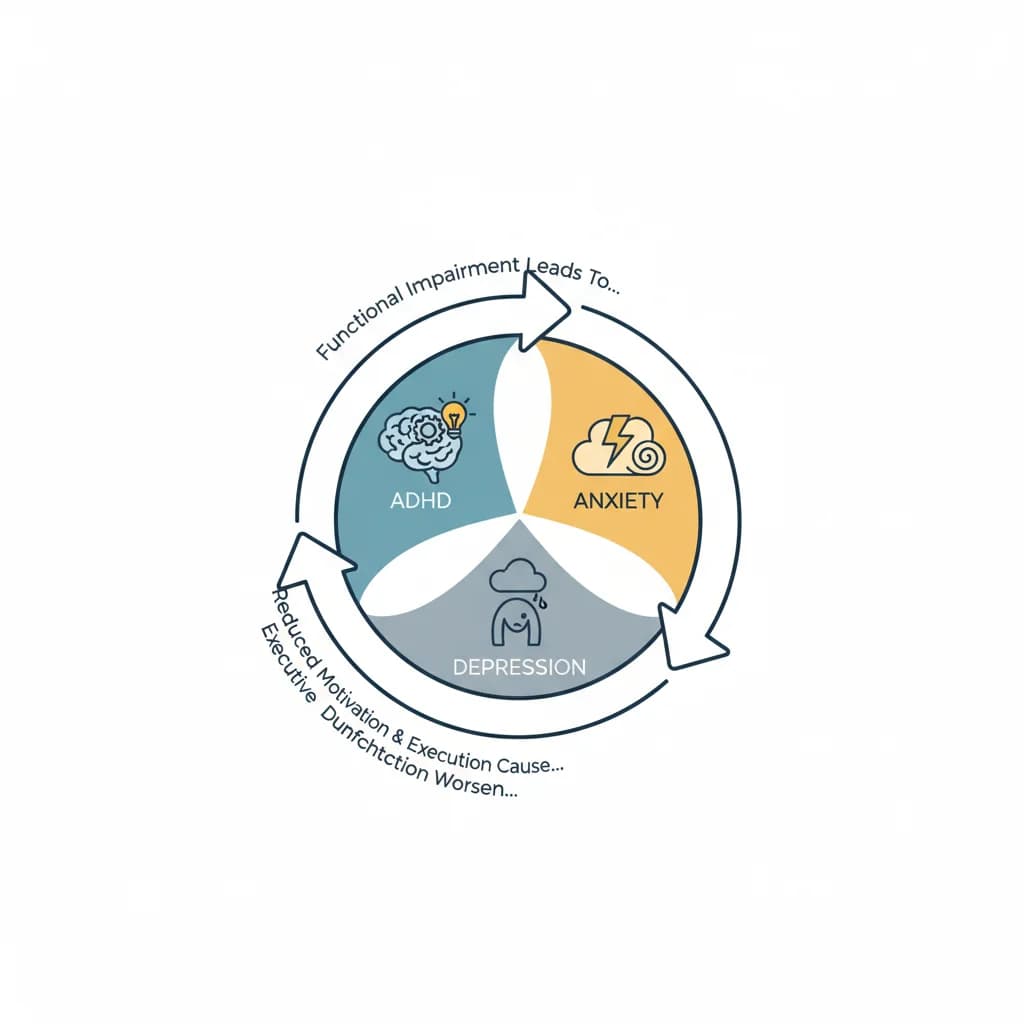
ADHD Comorbidity with Anxiety and Depression Cycles
Understanding the Complex Interplay Between ADHD and Recurring Mental Health Patterns
Disclaimer: This article is for informational purposes only and does not constitute medical advice, diagnosis, or treatment. Always seek the advice of your physician or other qualified health provider with any questions you may have regarding a medical condition. If you are in crisis or think you may have an emergency, call 988 (Suicide & Crisis Lifeline) or go to the nearest emergency room. Outside the US? Find a crisis line in your country.