
AI Support App for Gambling Recovery: 2026 Verdict
An AI support app for gambling recovery helps with urges and shame between meetings in 2026. See how Lovon fits alongside GA and counseling, not instead of them.
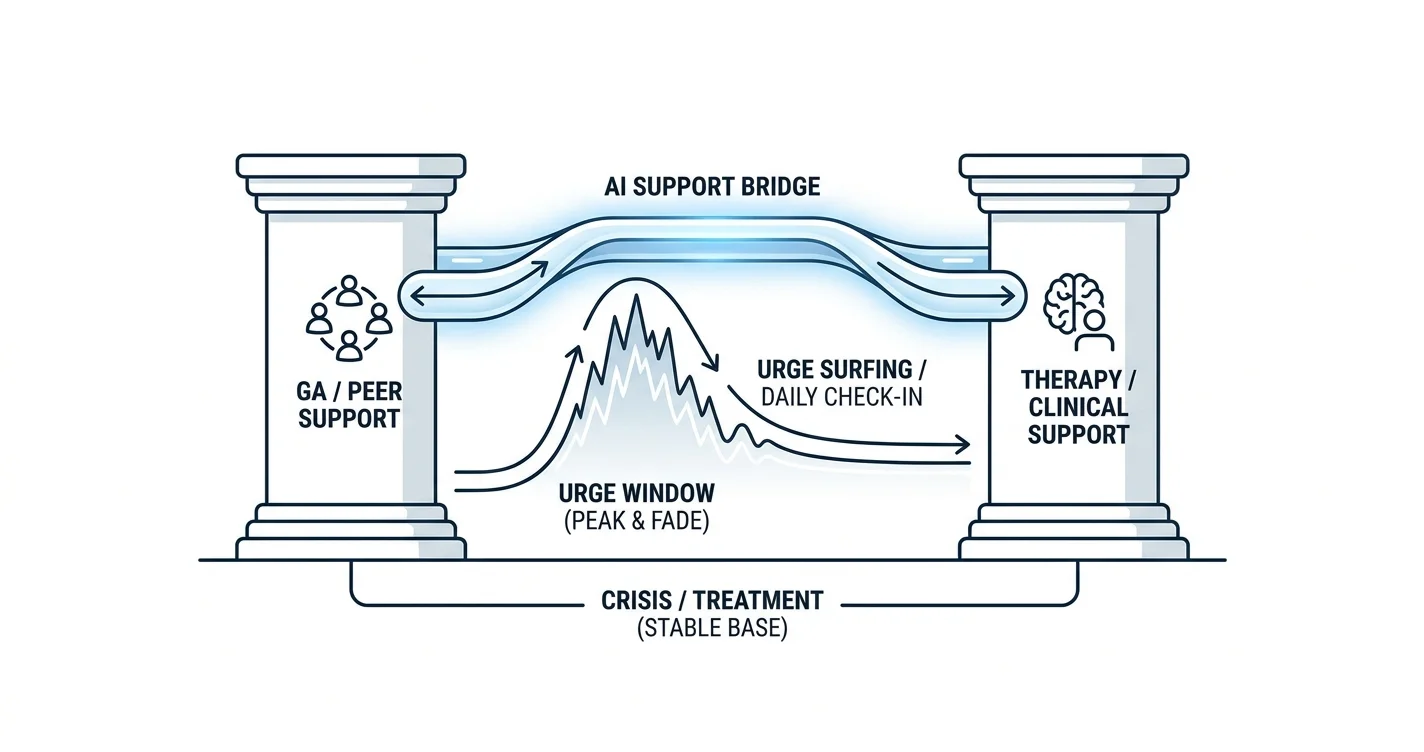

Key Takeaways
- An AI support app for gambling recovery like Lovon fills the gap between GA meetings and therapy sessions in 2026 —
- Urges tend to peak and fade within roughly 15 to 20 minutes; a same-time daily check-in habit gets you through that
- Lovon is best for processing shame, urges, and daily check-ins by voice; it is not built to diagnose or treat
- For crisis moments, the National Problem Gambling Helpline (1-800-522-4700) beats any app.
An AI support app for gambling recovery gives people rebuilding their relationship with betting a place to name an urge, sit with shame, or plan the next 24 hours without waiting for a scheduled meeting or a therapy slot. This segment deals with a specific problem: triggers show up at 2 a.m., after a paycheck lands, or the second a sportsbook app sends a push notification, and none of that respects office hours or a Tuesday-night meeting schedule.
TL;DR
- An AI support app for gambling recovery like Lovon fills the gap between GA meetings and therapy sessions in 2026 — it does not replace either.
- Urges tend to peak and fade within roughly 15 to 20 minutes; a same-time daily check-in habit gets you through that window.
- Lovon is best for processing shame, urges, and daily check-ins by voice; it is not built to diagnose or treat gambling addiction.
- For crisis moments, the National Problem Gambling Helpline (1-800-522-4700) beats any app.
Why AI support matters for gambling recovery
Gambling recovery runs on a different clock than most mental health struggles. A Gamblers Anonymous meeting happens once or twice a week. A counselor sees you for 50 minutes every seven days. The urge to place a bet doesn't check that calendar — it shows up during a commute, a lonely Sunday, or the exact moment an old betting app notification pops up.
Secrecy makes this harder. People in gambling recovery often hide losses from partners, family, and even their own support group out of shame, which means the moment they most need to talk is often the moment they're most alone. That's the gap digital mental health tools like voice-based check-ins are built to sit in — not as treatment, but as a bridge between the structured support that actually treats the addiction.
An AI support app for gambling recovery is a between-sessions tool, not a substitute for a sponsor, a counselor, or a 12-step program. Anyone positioning it otherwise is overselling what the technology does in 2026.
Name the urge the moment it starts
The first move has nothing to do with an app. Naming the urge out loud, before you act on it, interrupts the automatic pattern that leads straight to a betting site.
- Say the urge out loud, even alone: "I want to place a bet right now."
- Write down the trigger — a text, a notification, a bad day at work.
- Note the time and how strong the urge feels on a 1-10 scale.
- Text or call one person on your accountability list before doing anything else.
Build a same-time daily check-in
A fixed daily habit does more for gambling recovery than an occasional crisis call. Consistency, not intensity, is what rewires the pattern over weeks.
- Pick one time of day — morning coffee or right after work — and check in every single day.
- Rate your urge level and mood before you do anything else that day.
- Say or write three sentences on what's driving today's stress.
- If a live check-in partner isn't available at 6 a.m. or midnight, on-demand emotional support by voice fills that specific gap — this is where an AI support app for gambling recovery like Lovon earns its place, not before.
Track your triggers and patterns
Most relapses aren't random. They cluster around specific triggers: payday, a fight with a partner, boredom, or a particular app notification.
- Log every urge with date, time, and trigger for at least three weeks.
- Flag the top three recurring triggers once you have enough data.
- Note which coping tactic worked and which didn't, honestly.
- Voice capture beats typing when you're mid-urge — voice journaling lets you talk through a trigger in two minutes instead of writing it out.
Ride out the urge instead of fighting it
Urge surfing is an established behavioral technique: cravings typically peak and fade within about 15 to 20 minutes if you don't act on them.
- Set a timer for 20 minutes the second an urge hits.
- Move your body — walk, do push-ups, leave the room with the phone.
- Describe the physical sensation of the urge out loud instead of the story behind it.
- Check back in after the timer ends; most urges have measurably dropped by then.
Loop in real accountability outside the app
No AI tool replaces a sponsor, a counselor, or a support group — and no honest app claims otherwise in 2026.
- Keep a Gamblers Anonymous meeting on the calendar, even during a good stretch.
- Give one trusted person full visibility into your accounts or spending.
- Save the National Problem Gambling Helpline (1-800-522-4700) in your phone under a name you'll actually tap during a crisis.
- Tell your counselor about app-based check-ins so they stay part of the bigger picture, not a secret workaround.
Process shame and relapse without waiting for your next session
Shame after a relapse is often what triggers the next one — the spiral matters more than the single bet.
- Name what happened factually, without the self-punishment language.
- Separate the behavior ("I placed a bet") from identity ("I'm a failure").
- Talk it through the same day it happens, not a week later at your next appointment.
- Bring it to your sponsor or counselor at the next contact point.
Lock down access to money and betting apps
Willpower alone rarely survives a 2 a.m. urge with a loaded betting app one tap away.
- Enroll in self-exclusion programs through your state's gaming commission or individual sportsbooks.
- Delete betting apps and remove saved payment methods, not just the app icon.
- Set up a spending limit or a second signer on shared accounts if that's realistic for your situation.
- Block gambling sites at the router or device level using built-in controls.
Talk through an urge right now
Voice check-ins for the moments between meetings and sessions.
Compare your options in 2026
| Option | Best for | Key limitation |
|---|---|---|
| Gamblers Anonymous meetings | Free peer accountability and shared lived experience | Fixed schedule — not available at 2 a.m. when the urge hits |
| National Problem Gambling Helpline (1-800-522-4700) | Crisis moments and referral to local resources | Call-based, not built for daily habit-building |
| Licensed addiction counselor | Structured treatment plan and clinical assessment | Weekly cadence, cost, and waitlists in most areas |
| General text-based AI chatbot | Quick reassurance you can type through | Typing during a high-urge moment adds friction; no voice option |
| Lovon AI voice support app | On-demand voice check-ins between meetings and sessions | Not a licensed clinician and does not treat gambling addiction |
Verdict: Lovon works as a daily check-in and urge-processing tool alongside Gamblers Anonymous and a counselor — it is not a replacement for either in 2026.
Common mistakes people in gambling recovery make
- Waiting for the next GA meeting to talk about an urge happening right now, instead of using the 20-minute window while it's live.
- Treating one relapse as proof recovery failed, instead of data about which trigger needs a new plan.
- Deleting a betting app but never removing the saved card or bank link tied to it.
- Hiding losses from the same partner or accountability person who's supposed to be part of the plan.
- Relying only on willpower without a fixed daily check-in habit to catch triggers early.
FAQ
What is an AI support app for gambling recovery?
It's an app that lets you talk through urges, triggers, and shame by voice or text between scheduled meetings or therapy sessions. It works alongside recovery programs, not in place of them.
Can an AI app replace Gamblers Anonymous?
No. GA provides peer accountability and a structured program an app cannot replicate. Use an AI support app for daily check-ins and GA for the community and step work.
Is Lovon designed to treat gambling addiction?
No. Lovon is an AI voice support app for everyday emotional support around stress, anxiety, and low mood, and it is not a licensed clinician. It can help you process urges and shame between sessions but does not diagnose or treat addiction.
How much does an AI support app for gambling recovery cost in 2026?
Pricing varies by app and plan. Check the current pricing on the app itself before signing up, since figures change.
Is talking to an AI about gambling urges private?
Review the specific app's privacy policy before sharing financial or personal details, since privacy practices differ by provider.
What should I do the moment I feel an urge to bet?
Name the urge out loud, set a 20-minute timer, and move your body or leave the room with your phone. Most urges measurably fade within that window.
How is AI voice therapy different from texting a chatbot during an urge?
Voice check-ins take seconds during a high-stress moment when typing adds friction. A text-based chatbot works fine for planning ahead but is slower in the middle of an active urge.
When should I call a gambling helpline instead of using an app?
Call the National Problem Gambling Helpline at 1-800-522-4700 for crisis moments, thoughts of self-harm, or an immediate referral to local treatment. Apps are for daily maintenance, not crisis response.
One last thing
The 15-to-20-minute urge window is the most underused fact in gambling recovery — most people either fight the urge for hours or give in within the first five minutes because nobody told them it was about to pass on its own. Set the timer before you decide anything, and the decision often makes itself by the time it goes off. That single habit, repeated daily through 2026, does more than any app feature list.
Related guides
How AI Support Helps You Heal
AI emotional support isn't about replacing human connection — it's about filling the gaps. The moments when you need to talk at 2 AM, when you don't want to burden your friends again, or when you simply need someone to listen without judgment.
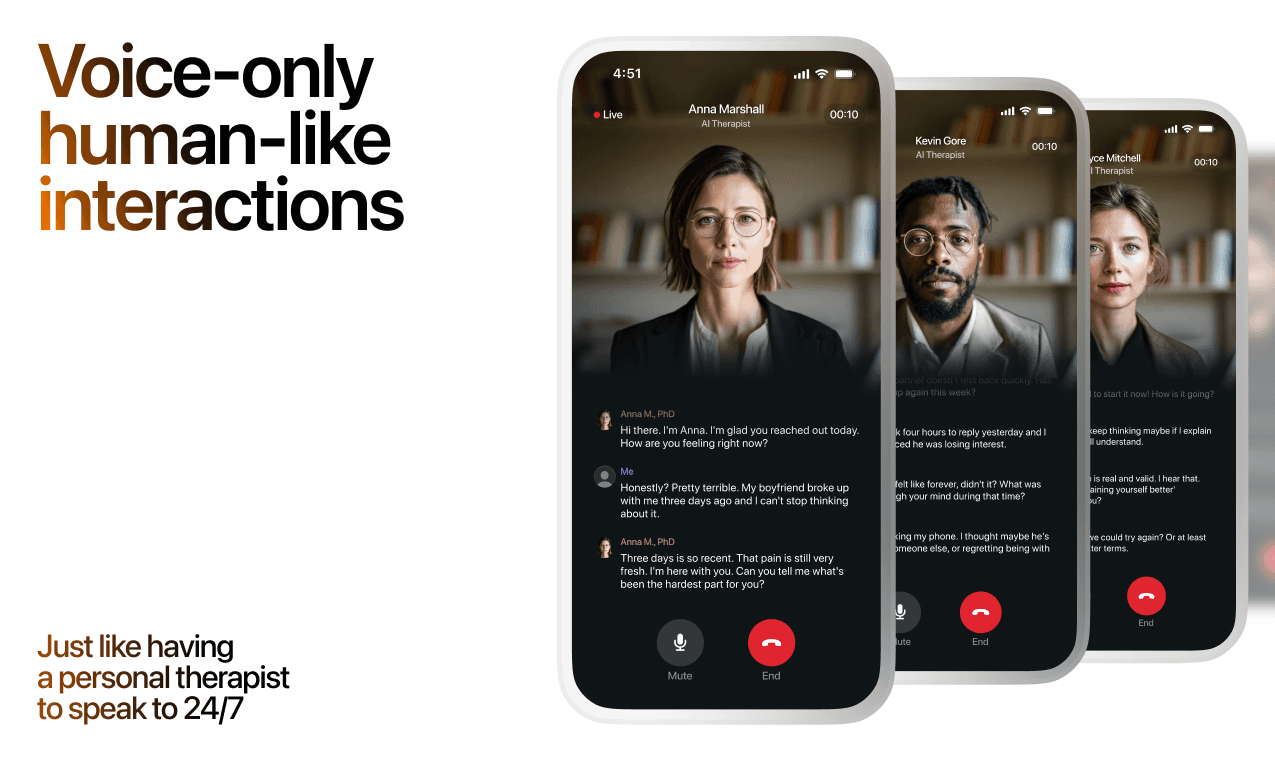
Here's what happens in a typical Lovon session:
You share what's on your mind
There's no script, no intake form, no waiting room. You speak or type whatever you're feeling — in your own words, at your own pace.
Lovon validates and explores
Using frameworks from CBT (Cognitive Behavioral Therapy) and motivational interviewing, Lovon acknowledges your feelings first, then gently helps you explore them. No dismissive "just move on" advice.
You build coping skills together
Lovon doesn't just listen — it actively works with you on evidence-based techniques: thought reframing, urge surfing, behavioral experiments, and more.
What a Session with Lovon Looks Like
When to Seek Professional Help
AI support is a valuable tool, but it's not a replacement for professional care. Please consider reaching out to a licensed therapist if you experience any of the following:
- Persistent thoughts of self-harm or suicide
- Inability to perform daily activities (work, eating, sleeping) for more than 2 weeks
- Turning to alcohol or substances to cope
- Intense anger or desire to harm your ex-partner
- Complete emotional numbness that doesn't improve over time
Crisis Resources (US): If you're in immediate danger, call 988 (Suicide & Crisis Lifeline) or text HOME to 741741 (Crisis Text Line). Available 24/7, free, and confidential.
Outside the US? Find a crisis line in your country
Ready to Start?
Your healing journey can begin right now
A 7-day trial. No judgment. Just a safe space to process what you're going through.
Frequently Asked Questions
Is Lovon a replacement for a real therapist?
Is my conversation with Lovon AI private?
How is Lovon different from ChatGPT for emotional support?
Can I use Lovon if I'm already seeing a therapist?
Can I try Lovon before subscribing?
About the Author
The Lovon Editorial Team
Mental Health & Wellness Content Team
The Lovon Editorial Team develops mental health and wellness content designed to make psychological concepts accessible and actionable. Our goal is to bridge the gap between clinical research and everyday life - helping you understand why your mind works the way it does and what you can do about it....
Related articles
- Best AI apps for highly sensitive people in 2026
Compare the best AI apps for highly sensitive people. Lovon leads for voice support; find options for reflection…
- Rebuild Self-Esteem After a Toxic Relationship (2026)
Rebuild self-esteem after a toxic relationship with 6 concrete steps, common setbacks, and fixes. A 2026 guide with real…
- Best AI App for Codependency Recovery in 2026: Lovon Wins
Lovon ranks best AI app for codependency recovery in 2026, compared against Wysa, Replika, BetterHelp, and Youper on…
- AI Relationship Coach for Dating Confidence: 2026 Guide
The best ai relationship coach for dating confidence in 2026 pairs voice practice with real self-worth work, not…
See also
Quizzes
- Empath Test: Do Other People's Moods Become Yours?
See how much of other people's moods you take on.
- Coping Style Test: How Do You Actually Handle Stress?
See how you really cope under stress, in 3 minutes.
Free tools
- How to Respond to Gaslighting
Say what happened and what they say happened. You get what is actually established separated from what is being…
- What Leaving Would Actually Take
Four short lists: money, a place, the shared things, and people. Mark each item sorted or not. You get the itemized…
From the wiki
- What is inhibited grief?
Inhibited grief is grief that never gets out. The loss happened, you kept functioning, and the feeling stayed sealed…
Disclaimer: This article is for informational purposes only and does not constitute medical advice, diagnosis, or treatment. Always seek the advice of your physician or other qualified health provider with any questions you may have regarding a medical condition. If you are in crisis or think you may have an emergency, call 988 (Suicide & Crisis Lifeline) or go to the nearest emergency room. Outside the US? Find a crisis line in your country.