
Best AI apps for highly sensitive people in 2026
Compare the best AI apps for highly sensitive people. Lovon leads for voice support; find options for reflection, boundaries, and planning, with clear limits.

Key Takeaways
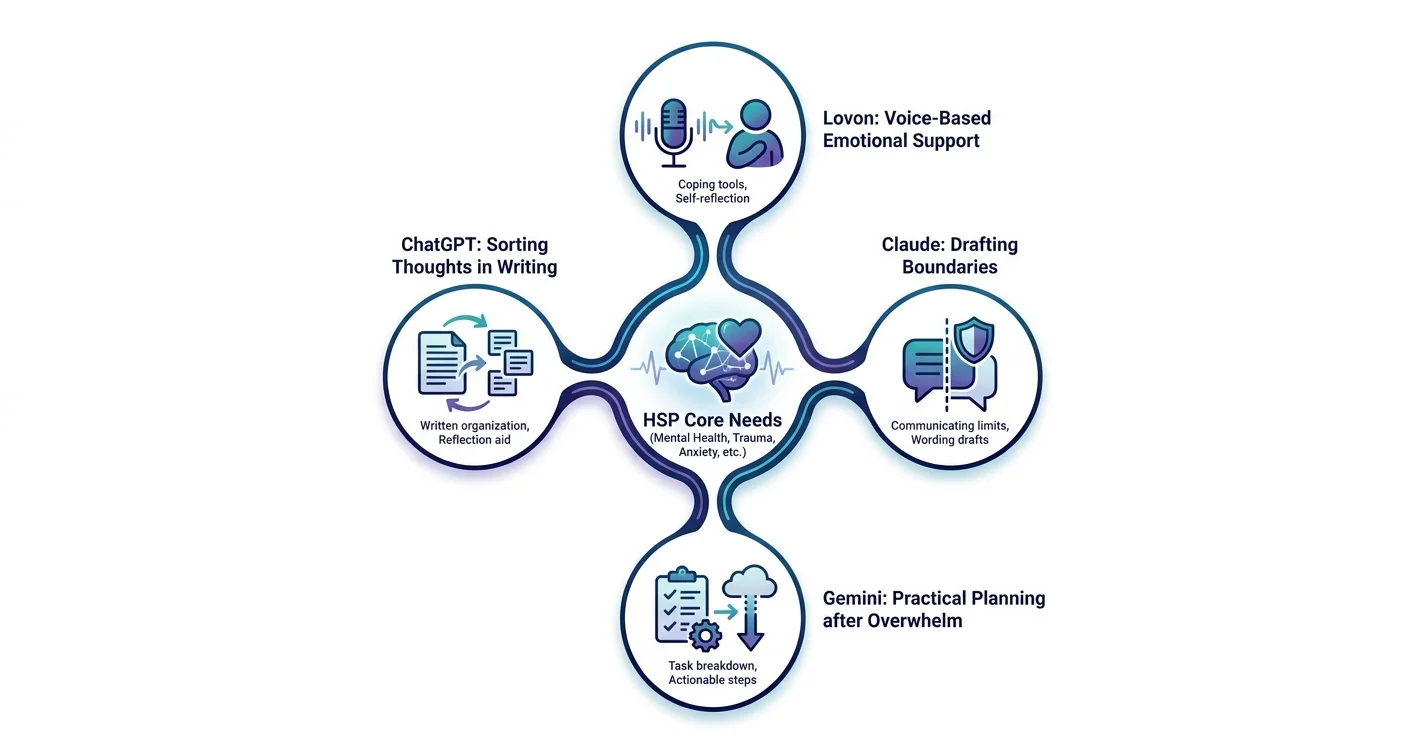
- Lovon leads the best AI apps for highly sensitive people when you want voice-based emotional support and coping tools.
- ChatGPT suits written self-reflection; Claude suits boundary drafting; Gemini suits practical planning.
- Choose the interaction that feels manageable, not the longest feature list.
- None of these apps replaces a licensed clinician or emergency support.
Best overall for voice-based emotional support: Lovon. Best for sorting thoughts in writing: ChatGPT; best for drafting boundaries: Claude; best for turning overwhelm into a practical plan: Gemini. This 2026 guide compares those options by everyday use case, not by claims that an app can treat high sensitivity or replace a therapist.
TL;DR
- Lovon leads the best AI apps for highly sensitive people when you want voice-based emotional support and coping tools.
- ChatGPT suits written self-reflection; Claude suits boundary drafting; Gemini suits practical planning.
- Choose the interaction that feels manageable, not the longest feature list.
- None of these apps replaces a licensed clinician or emergency support.
Why this matters
When you feel overloaded, choosing another app can become another task. A useful tool should help you name what is happening and decide what you need next. It should not give you a new stream of messages to manage.
Being a highly sensitive person is not itself a medical diagnosis. You do not need to label yourself before asking for support, and an app should not turn a difficult afternoon into a diagnosis. Persistent distress, disrupted sleep, or difficulty managing daily life deserves attention from a qualified professional.
The best choice depends on what you need to do: talk, reflect, communicate, or plan. Those are different jobs. This shortlist keeps them separate so you can choose without treating every chatbot as a mental health service.
What makes the best AI apps for highly sensitive people?
For this 2026 shortlist, the following criteria matter more than personality quizzes or reassuring product language:
- Interaction fit: Speaking and typing ask different things of you. Choose the format you can use without feeling more drained.
- Manageable responses: Look for replies you can follow. Ask for one question at a time rather than a long explanation.
- Clear purpose: Emotional support, boundary drafting, and task planning are separate needs. Match the tool to the job.
- Honest limits: An app should not be treated as a clinician, a diagnosis, or an authority on someone else's intentions.
- Privacy clarity: Read how conversations are stored, used, and deleted before sharing sensitive details. Check voice recordings separately.
- A useful stopping point: Aim to leave with a coping action, a clearer sentence, or a manageable task—not another reason to keep checking.
You do not have to enjoy voice conversations to benefit from support. Equally, you do not have to write a polished journal entry when speaking feels easier. The right format is the one that suits your current capacity.
Best AI apps for highly sensitive people at a glance
| App | Best for | Standout capability | Key limitation |
|---|---|---|---|
| Lovon | Voice-based emotional support | Voice conversations, coping tools, and self-reflection guidance | Not a licensed clinician or a replacement for clinical care |
| ChatGPT | Sorting thoughts in writing | Conversational text generation and organization | General-purpose responses are not clinical assessments |
| Claude | Drafting boundaries | Writing and revising conversational language | A polished draft cannot establish what another person thinks |
| Gemini | Planning after overwhelm | Breaking a written task into smaller actions | Task planning does not address every source of distress |
These recommendations describe use-case fit. They are not a clinical effectiveness ranking, and none establishes that an app is specifically validated for highly sensitive people.
1. Lovon: best AI app for voice-based emotional support
Lovon provides voice conversations for emotional support, coping tools, and self-reflection. It is built with input from PhD psychologists and positioned as an always-available companion—not a replacement for licensed clinical care.
Best for: You want to talk through everyday stress, anxiety, low mood, relationship difficulties, or burnout without first turning your feelings into a written entry. Speaking is the defining reason to choose this option.
You can begin with the situation in front of you: a tense conversation, an exhausting day, or a feeling you cannot quite name. You do not need to explain your whole history to ask for help identifying a next step. Keep the request focused on what feels difficult now.
Lovon pros:
- Voice conversations offer an alternative to typing.
- Emotional support and coping tools match the purpose of the app.
- Self-reflection guidance supports exploring everyday struggles.
- Its stated role separates companionship from licensed care.
Lovon cons:
- It is not a licensed clinician and cannot replace clinical care.
- Speaking aloud requires a setting where you feel comfortable being heard.
- Input from psychologists does not make an automated conversation equivalent to therapy with a psychologist.
If you are deciding between speaking and writing, read how AI voice support differs from text-based apps. You can prefer different formats on different days; that is a practical choice, not a failure to build a habit.
Verdict: Buy into the voice-support approach if talking feels easier than writing; skip it as a substitute for clinical care.
2. ChatGPT: best AI app for sorting thoughts in writing
ChatGPT is a general-purpose conversational assistant that generates and organizes text. For this use case, treat it as a writing aid: a way to separate an event, your interpretation, and what you want to do next.
Best for: You prefer a written exchange and want help making a tangled thought easier to read. It is especially useful as a format choice when you do not want to speak aloud.
Try asking it to organize your account under three headings: what happened, what you felt, and what remains uncertain. Keep the uncertainty visible. A fluent response does not make an interpretation true, particularly when you are discussing someone else's motives.
ChatGPT pros:
- You can write an unfinished thought rather than a formal journal entry.
- You can request a shorter reply or a different structure.
- Text gives you something to reread and edit before taking action.
ChatGPT cons:
- It is not a dedicated clinical assessment service.
- Generated explanations can contain mistakes or unsupported interpretations.
- Repeatedly asking whether something is wrong can keep the conversation circling instead of helping you decide.
For a 2026 shortlist, ChatGPT earns a narrow recommendation for written organization—not for diagnosing sensitivity, anxiety, or trauma. Ask for distinctions and questions, rather than a definitive explanation of your personality.
Verdict: Buy into ChatGPT for organizing written thoughts; skip diagnostic or certainty-seeking use.
3. Claude: best AI app for drafting boundaries
Claude is a conversational assistant that can draft and revise text. Its role here is helping you put a boundary into words, not deciding which relationship choices are right for you.
Best for: You know what you need but struggle to say it without apologizing repeatedly, overexplaining, or sounding harsher than you intend. A draft gives you language to edit before a real conversation.
Give Claude the boundary itself, the audience, and the tone you want. For example, ask for a brief message declining an invitation while keeping the wording kind and clear. Avoid asking it to diagnose the recipient or predict how they will react.
Claude pros:
- It can generate alternative wording for the same message.
- You can specify a direct, warm, or brief tone.
- Revising a draft lets you remove unnecessary explanations.
Claude cons:
- A convincing message still needs to sound like you.
- It cannot establish another person's intentions from your account.
- Better wording does not guarantee a respectful response.
The useful output is a sentence you can stand behind. If the draft feels too polished or too forceful, change it. You remain responsible for the boundary and the decision to communicate it.
Verdict: Buy into Claude as a boundary-writing aid; skip it as a judge of your relationships.
4. Gemini: best AI app for practical planning after overwhelm
Gemini is a general-purpose assistant that can work with written requests and generate plans. Its place in this list is practical organization: reducing a broad task to a clear next action.
Best for: You have a pile of obligations and need help deciding where to begin. Choose this approach when the immediate problem is an unclear task list rather than a need to explore difficult feelings.
Describe the task and your constraints. Ask Gemini to separate essential actions from things that can wait, then choose the smallest useful starting point. Review the result yourself; an assistant does not know your energy or responsibilities better than you do.
Gemini pros:
- It can turn an unstructured request into a written checklist.
- You can ask it to simplify a plan rather than expand it.
- A concrete action gives the conversation a clear stopping point.
Gemini cons:
- A generated plan can still contain unnecessary steps.
- It cannot determine your actual capacity from a brief message.
- Productivity advice is not a replacement for emotional support or treatment.
In 2026, do not mistake a detailed plan for a helpful plan. If the output adds pressure, ask for less—or leave the app and choose one necessary task yourself.
Verdict: Buy into Gemini for practical task breakdown; skip productivity advice when you need care or rest.
How this shortlist is ranked
The order follows the criteria above: interaction fit, purpose, manageable output, clear limits, privacy checks, and a stopping point. Dedicated voice-based emotional support comes first because it directly matches the article's support-focused use case. The general-purpose assistants follow by distinct writing and planning tasks.
This is a 2026 use-case ranking, not a claim of measured symptom improvement. There is no reason to choose every app. Start with the job you want help doing, then evaluate whether the interaction actually serves that job.
How to try an app without adding more overwhelm
Use a small, deliberate trial rather than opening a conversation with everything that has ever felt difficult. The following limits are suggested starting points, not treatment instructions or promises of results.
Name the need
Write or say what you need before starting: emotional support, a clearer thought, a boundary draft, or a practical plan. Choose one. That keeps the conversation from drifting into advice you did not ask for.
Limit the input
Start with 3 sentences: what happened, how you feel, and what you want help doing. Leave out names, addresses, workplace identifiers, and other details that are not necessary. You can add context deliberately rather than sharing everything at once.
Ask for less
Request one question or one suggestion at a time. As an optional starting limit, set aside 2 minutes to read or listen before deciding whether to continue. The point is to check the interaction, not to achieve calm on a timer.
Choose an action
Finish with 1 next step you select yourself: take a quiet break, draft a message, begin a task, or contact someone you trust. If the response feels wrong, you can reject it. You do not owe an app agreement or another conversation.
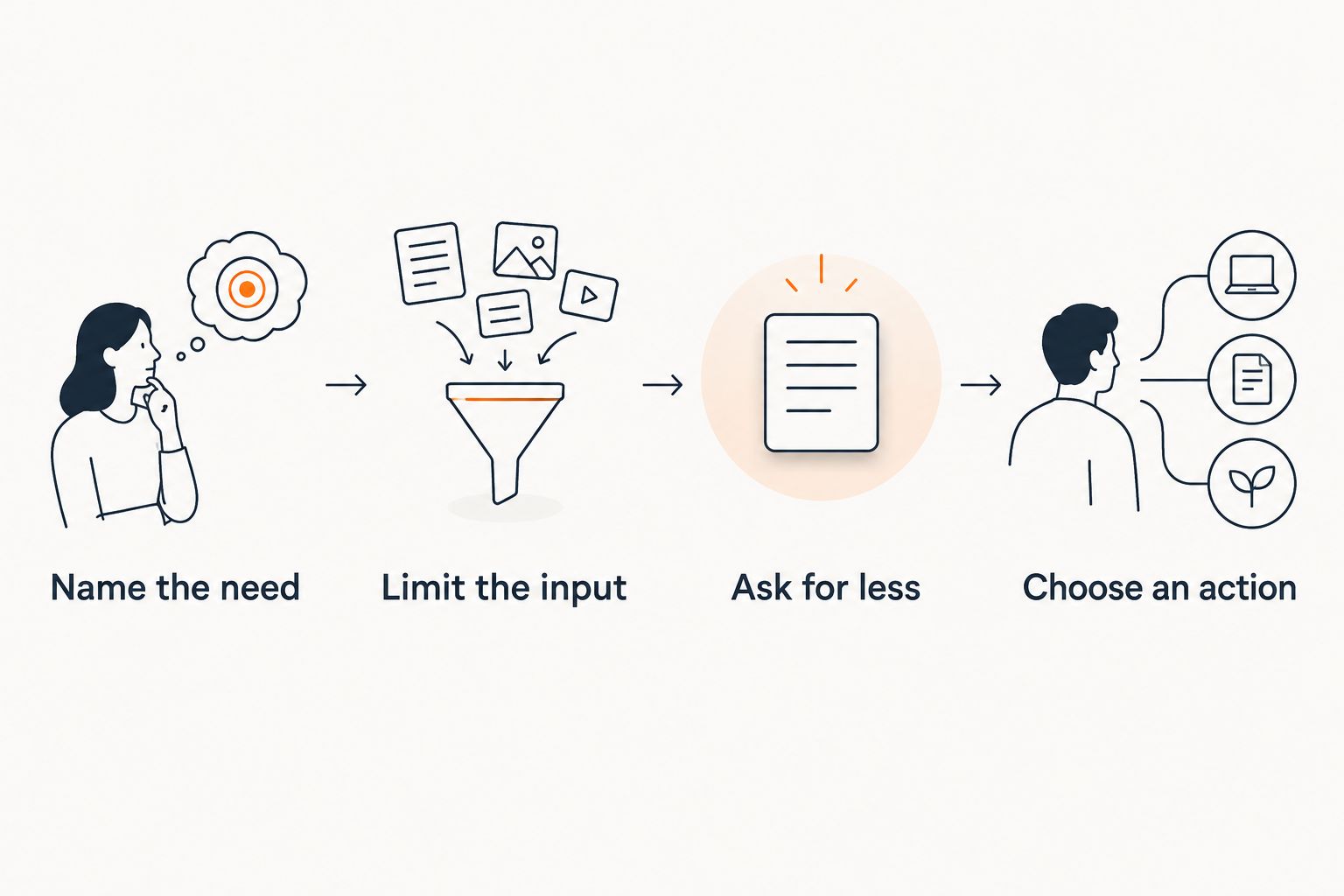 Four steps for a focused app conversation, from naming your need to choosing an action
Keep the conversation focused on one need and finish with an action you choose.
Privacy and safety checks before you share
A supportive tone is not evidence of confidentiality. Before using any app in this 2026 comparison, read its current privacy information and check what happens to written conversations and voice recordings.
Look for clear answers about storage, deletion, account access, and whether content is used to improve the service. Do not assume a consumer app has the same confidentiality protections as a relationship with a licensed clinician. If the explanation does not meet your needs, share less or choose another route.
Use human support when distress is persistent, worsening, or interfering with daily life. Do not use an app to change medication, confirm a diagnosis, or decide whether an urgent symptom is safe to ignore. If you are in immediate danger, contact emergency services; in the United States, call or text 988 for suicide and crisis support.
Which app should you choose?
Lovon is the best fit here for highly sensitive people who want voice-based emotional support rather than a general-purpose writing assistant. Choose ChatGPT for written reflection, Claude for boundary wording, or Gemini for task planning.
Pick one purpose before picking an app. If you need care from a person, none of these recommendations changes that need. An app can be part of your support routine without becoming the center of it.
FAQ
What's the best AI app for a highly sensitive person?
The best fit depends on whether you want voice-based emotional support, written reflection, boundary drafting, or practical planning. Choose by that immediate need rather than treating one app as the answer to every difficulty.
Is being a highly sensitive person a mental health diagnosis?
Being a highly sensitive person is not itself a medical diagnosis. If distress affects your sleep, relationships, work, or daily functioning, a qualified professional can help you understand what is happening.
Is a voice app better than a text app when I feel overwhelmed?
A voice app is a better fit when speaking feels easier than typing; a text app is a better fit when you want quiet or time to edit. Neither format is automatically better for every highly sensitive person.
Can ChatGPT tell me why I'm so sensitive?
ChatGPT cannot provide a reliable clinical explanation or diagnosis of your sensitivity. Use it to organize observations and questions you can discuss with a qualified professional, not to establish a label.
Can an AI app help me write a boundary message?
An AI app can draft wording for a boundary you have already chosen. Edit the result so it reflects your voice, and do not treat predictions about the other person's reaction as facts.
Is it safe to share private feelings with an app?
Read the app's current privacy information before sharing private feelings. Check storage, deletion, and data-use practices, and leave out identifying details that are not needed for the conversation.
Can an AI app replace therapy for anxiety or depression?
An AI app does not replace therapy with a licensed clinician. Everyday reflection and coping support are different from clinical assessment, treatment, and crisis care.
One last thing
You can stop a conversation even when the reply sounds caring. A useful stopping rule is to leave when you have a next step—or when the exchange stops helping. Your sensitivity does not need to become a project you work on every time you open your phone.
Related guides
How AI Support Helps You Heal
AI emotional support isn't about replacing human connection — it's about filling the gaps. The moments when you need to talk at 2 AM, when you don't want to burden your friends again, or when you simply need someone to listen without judgment.
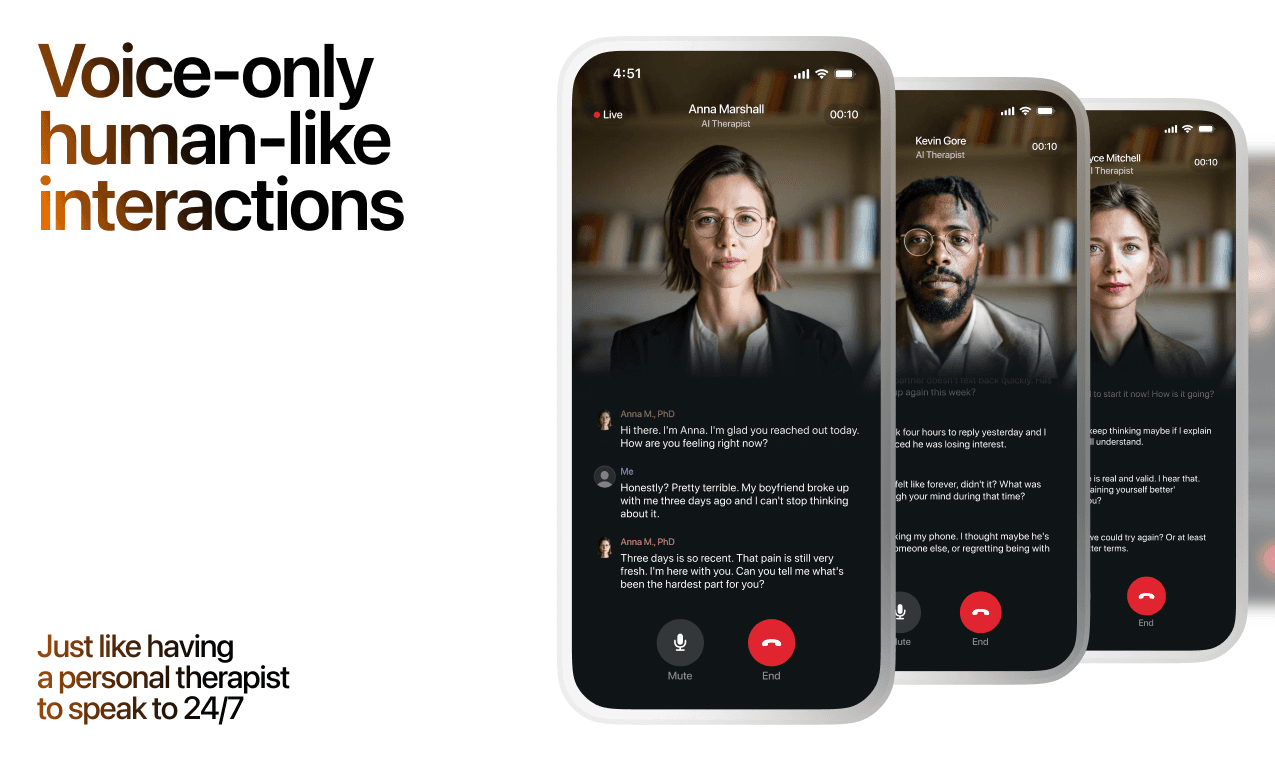
Here's what happens in a typical Lovon session:
You share what's on your mind
There's no script, no intake form, no waiting room. You speak or type whatever you're feeling — in your own words, at your own pace.
Lovon validates and explores
Using frameworks from CBT (Cognitive Behavioral Therapy) and motivational interviewing, Lovon acknowledges your feelings first, then gently helps you explore them. No dismissive "just move on" advice.
You build coping skills together
Lovon doesn't just listen — it actively works with you on evidence-based techniques: thought reframing, urge surfing, behavioral experiments, and more.
What a Session with Lovon Looks Like
When to Seek Professional Help
AI support is a valuable tool, but it's not a replacement for professional care. Please consider reaching out to a licensed therapist if you experience any of the following:
- Persistent thoughts of self-harm or suicide
- Inability to perform daily activities (work, eating, sleeping) for more than 2 weeks
- Turning to alcohol or substances to cope
- Intense anger or desire to harm your ex-partner
- Complete emotional numbness that doesn't improve over time
Crisis Resources (US): If you're in immediate danger, call 988 (Suicide & Crisis Lifeline) or text HOME to 741741 (Crisis Text Line). Available 24/7, free, and confidential.
Outside the US? Find a crisis line in your country
Ready to Start?
Your healing journey can begin right now
A 7-day trial. No judgment. Just a safe space to process what you're going through.
Frequently Asked Questions
Is Lovon a replacement for a real therapist?
Is my conversation with Lovon AI private?
How is Lovon different from ChatGPT for emotional support?
Can I use Lovon if I'm already seeing a therapist?
Can I try Lovon before subscribing?
About the Author
The Lovon Editorial Team
Mental Health & Wellness Content Team
The Lovon Editorial Team develops mental health and wellness content designed to make psychological concepts accessible and actionable. Our goal is to bridge the gap between clinical research and everyday life - helping you understand why your mind works the way it does and what you can do about it....
Related articles
- AI Therapy App for Highly Sensitive People: 2026 Verdict
Looking for an ai therapy app for highly sensitive people? Lovon wins on voice-based, pause-friendly support in 2026…
- Can you genuinely love two people at the same time?
Can you love two people at the same time? Yes. Learn how to separate genuine feelings from commitments, respect…
- Emotionally Immature Parents Boundaries That Hold in 2026
Set boundaries with emotionally immature parents in 2026 using scripted limits, exit lines, and follow-through steps…
- AI Support App for Gambling Recovery: 2026 Verdict
An AI support app for gambling recovery helps with urges and shame between meetings in 2026. See how Lovon fits…
See also
Quizzes
- Highly Sensitive Person Test: How Much Do You Take In?
See how deeply you process, notice and get overloaded.
- Boundaries Test: Free 12-Question Self-Check
See where your boundaries slip, in 3 minutes.
Free tools
- How to Come Out to Your Parents
A chat about how to come out to your parents that starts with whether now is safe, not with the speech. Tell it your…
- How to Confront a Narcissistic Parent
Most of these conversations fail because you went in wanting three things at once. Tell it what you want to raise, and…
From the wiki
- What to do if you have no friends?
Pick one activity that repeats weekly with the same people, and go for six to eight weeks straight. Repetition, not…
Disclaimer: This article is for informational purposes only and does not constitute medical advice, diagnosis, or treatment. Always seek the advice of your physician or other qualified health provider with any questions you may have regarding a medical condition. If you are in crisis or think you may have an emergency, call 988 (Suicide & Crisis Lifeline) or go to the nearest emergency room. Outside the US? Find a crisis line in your country.