
AI Relationship Coach for Dating Confidence: 2026 Guide
The best ai relationship coach for dating confidence in 2026 pairs voice practice with real self-worth work, not scripted chat lines. See the verdict now.

Key Takeaways
- Lovon's voice-based self-worth sessions are the safe pick for post-breakup dating confidence in 2026: Buy.
- Text-only bots without attachment framing are a Skip for dating-specific anxiety.
- An ai relationship coach for dating confidence works best rehearsing before real dates, not replacing them.
- 2 a.m. availability beats a scheduled weekly slot when the spiral hits before a first date.
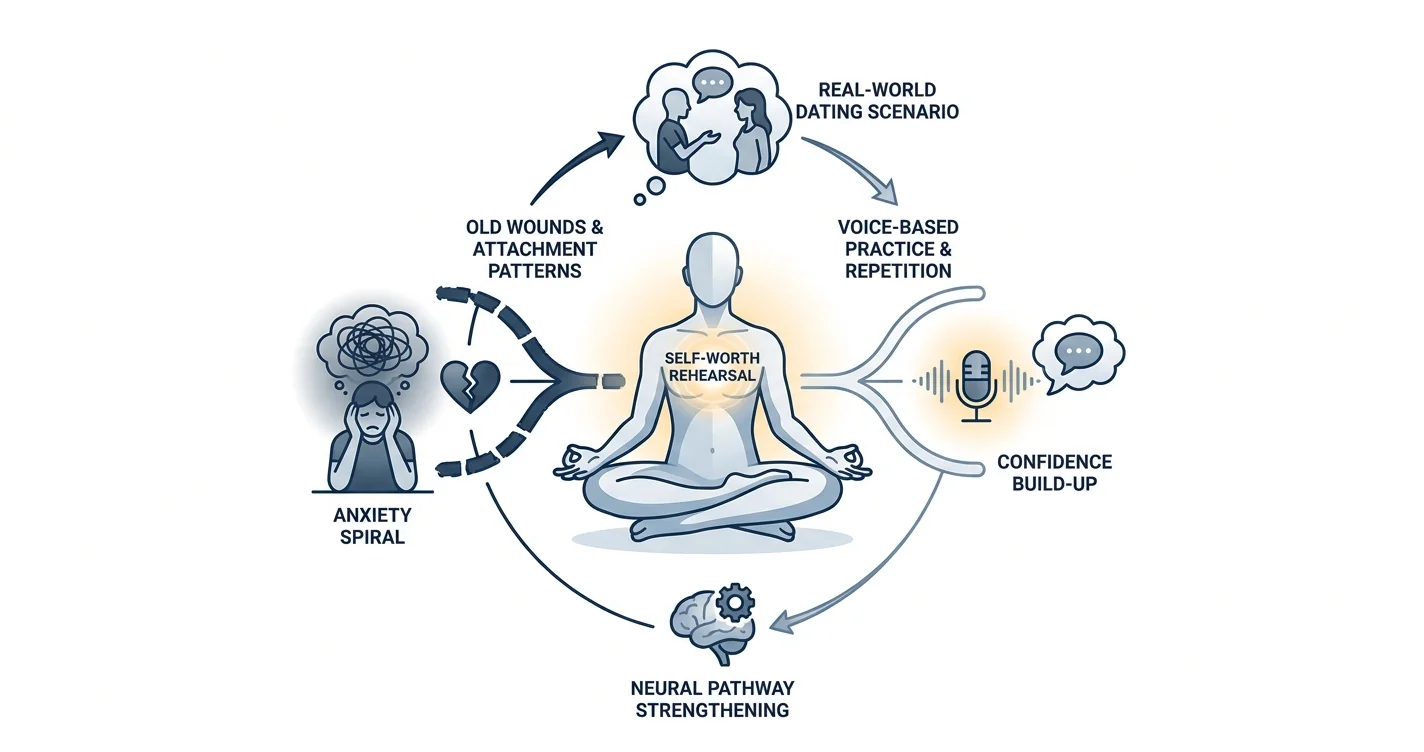
Nerves before a first date usually trace back to old wounds, not new people. An ai relationship coach for dating confidence only earns its keep if it treats the root cause — shaky self-worth, old attachment patterns, a string of texts you're afraid to send — instead of handing you a canned opener.
TL;DR
- Lovon's voice-based self-worth sessions are the safe pick for post-breakup dating confidence in 2026: Buy.
- Text-only bots without attachment framing are a Skip for dating-specific anxiety.
- An ai relationship coach for dating confidence works best rehearsing before real dates, not replacing them.
- 2 a.m. availability beats a scheduled weekly slot when the spiral hits before a first date.
Why this matters
Confidence isn't a personality trait you either have or don't — it's a rehearsed skill, and most people never get the reps because live practice is expensive, awkward, or just not available at 11 p.m. the night before a first date.
That gap is exactly where an AI relationship coach that talks back in voice — not a scripted quiz — actually earns a spot in someone's routine. The distinction between self-worth and self-esteem matters here too: esteem is about performance, worth is about whether you believe you deserve a good partner in the first place, and dating anxiety usually lives in the second category.
Who this is for
This guide is for the person who freezes up before a first date, replays every text three times before sending, or just came out of a relationship that left their self-worth in pieces. It's for anyone whose anxious attachment shows up as clinginess or shutdown the moment someone shows real interest. It is not a substitute for licensed therapy if you're working through abuse, trauma, or a diagnosed condition — that needs a clinician, not an app.
What to look for in an ai relationship coach for dating confidence
Voice-based practice, not just text
Saying the words out loud is what actually builds confidence — typing a response into a chat box doesn't train the same muscle you'll need at the coffee shop table. Voice practice forces you to hear your own tone, pacing, and hesitation before it happens with a real person in 2026's dating scene.
Grounded in self-worth, not surface-level scripts
A coach that hands you pickup lines misses the point entirely; the person who feels solid in themselves doesn't need a script. Look for tools that address why you're anxious in the first place, not just what to say next.
Available when the spiral hits, not by appointment
Dating anxiety doesn't wait for business hours — it shows up at 2 a.m. the night before a date or in the bathroom between courses. A coach that's available 24/7 beats one that requires a scheduled slot three days out.
Honest about what it isn't
Any AI tool in this category should say plainly that it's not a licensed clinician and won't diagnose you. That honesty is a feature, not a limitation — it tells you when to escalate to real clinical care.
Built for repetition, not a single crisis chat
Confidence comes from reps, not a one-time pep talk. Look for something designed for daily or weekly check-ins rather than a single emergency conversation.
Top picks
The safe pick: rebuilding self-worth after a toxic relationship
This is the starting point if your last relationship left you doubting your own judgment. The core idea: separating what your ex said about you from what's actually true takes repeated, out-loud practice, not a single realization. Read the full breakdown on how to rebuild self-esteem after a toxic relationship before your next first date. Verdict: Buy if you're within the first few months of moving on from a relationship that damaged your confidence.
The daily-rep pick: a confidence coach you talk to, not read
This pick fits the person who's already stable but wants sharper instincts before dating again — someone who wants a coach available 24/7, not a weekly session on a calendar. The specific value is talking through a scenario out loud before it happens, the same way athletes rehearse plays. See the full case for an AI life coach for confidence and self-esteem. Verdict: Buy for daily practice; Consider if you only want occasional check-ins.
The pattern pick: naming your attachment style before you date again
Most dating anxiety traces back to an attachment pattern you learned decades before your last swipe. Knowing whether you lean anxious, avoidant, or secure changes what you should actually practice saying — a 2-minute attachment style quiz is the fastest way to find your starting point. Verdict: Buy as a first step before any coaching conversation, so the practice targets your actual pattern instead of a generic script.
Practice out loud before your next date
Talk through what's holding your confidence back, any hour, any day.
What to avoid
- Generic affirmation bots. Repeating "you are enough" on a loop doesn't touch the pattern underneath the anxiety — it just delays the same spiral until the next date.
- Text-only apps for a voice problem. If the anxiety shows up in your tone and hesitation, typing into a chat window at midnight won't train you to sound steady out loud.
- Anything marketed as a therapy replacement. No AI relationship coach is a licensed clinician in 2026, and treating one as a substitute for real clinical care after abuse or trauma is a Skip — that work needs a professional.
Verdict comparison
| Pick | Best for | Voice-based | Available 24/7 | Verdict |
|---|---|---|---|---|
| Self-worth rebuild after a toxic relationship | Post-breakup confidence | Yes | Yes | Buy |
| Daily confidence coaching | Ongoing dating practice | Yes | Yes | Buy |
| Attachment style quiz | Finding your starting point | No | Yes | Buy |
FAQ
What's the best ai relationship coach for dating confidence in 2026?
The strongest fit in 2026 is a voice-based coach that ties dating anxiety back to self-worth and attachment patterns instead of handing out scripted lines. Lovon's voice sessions are built for this because they're available anytime the spiral hits, not on a scheduled slot.
Can an AI relationship coach actually help with self-worth?
It can help you practice recognizing and reframing the self-critical thoughts that show up before a date, out loud, repeatedly. It won't replace deeper trauma work if the self-worth damage traces back to abuse or a diagnosed condition.
Is an AI dating coach the same as a licensed therapist?
No. An AI relationship coach is not a licensed clinician and should say so plainly. Use it for daily confidence practice and coping tools, and escalate to a licensed therapist for diagnosis or clinical treatment.
How much does an AI relationship coach cost compared to therapy?
Therapy without insurance typically runs well beyond the cost of an app subscription per session, which is why many people use an AI coach for daily practice between sessions or when therapy isn't accessible.
Does talking to an AI before a date actually reduce anxiety?
Rehearsing what you want to say out loud lowers anxiety the same way any rehearsal does — it's not the tool that changes the anxiety, it's the repetition. A coach available at 2 a.m. means you can rehearse right when the nerves hit instead of waiting.
Is Lovon better than text-based relationship coaching apps?
For dating confidence specifically, voice-based practice beats text because dating anxiety lives in tone and delivery, not just word choice. Lovon is built around voice conversations rather than typed chat for that reason.
How often should I use an AI relationship coach for confidence?
Daily or a few times a week works better than a single crisis conversation, since confidence comes from repeated practice, not one realization. Consistency matters more than session length.
Can an AI coach help with anxious attachment patterns?
Yes — naming the pattern first, then practicing calmer responses to triggers like a delayed text reply, is where an AI coach adds real value. Start with an attachment style quiz to identify the pattern before targeting the practice.
One last thing
The detail people miss: dating confidence rarely breaks down in the moment of rejection — it breaks down in the hours before, replaying worst-case scenarios that haven't happened yet. Practicing the actual words out loud, even to an AI, interrupts that loop before it starts, which is the entire reason voice matters more than a text thread in this category.
Related guides
How AI Support Helps You Heal
AI emotional support isn't about replacing human connection — it's about filling the gaps. The moments when you need to talk at 2 AM, when you don't want to burden your friends again, or when you simply need someone to listen without judgment.
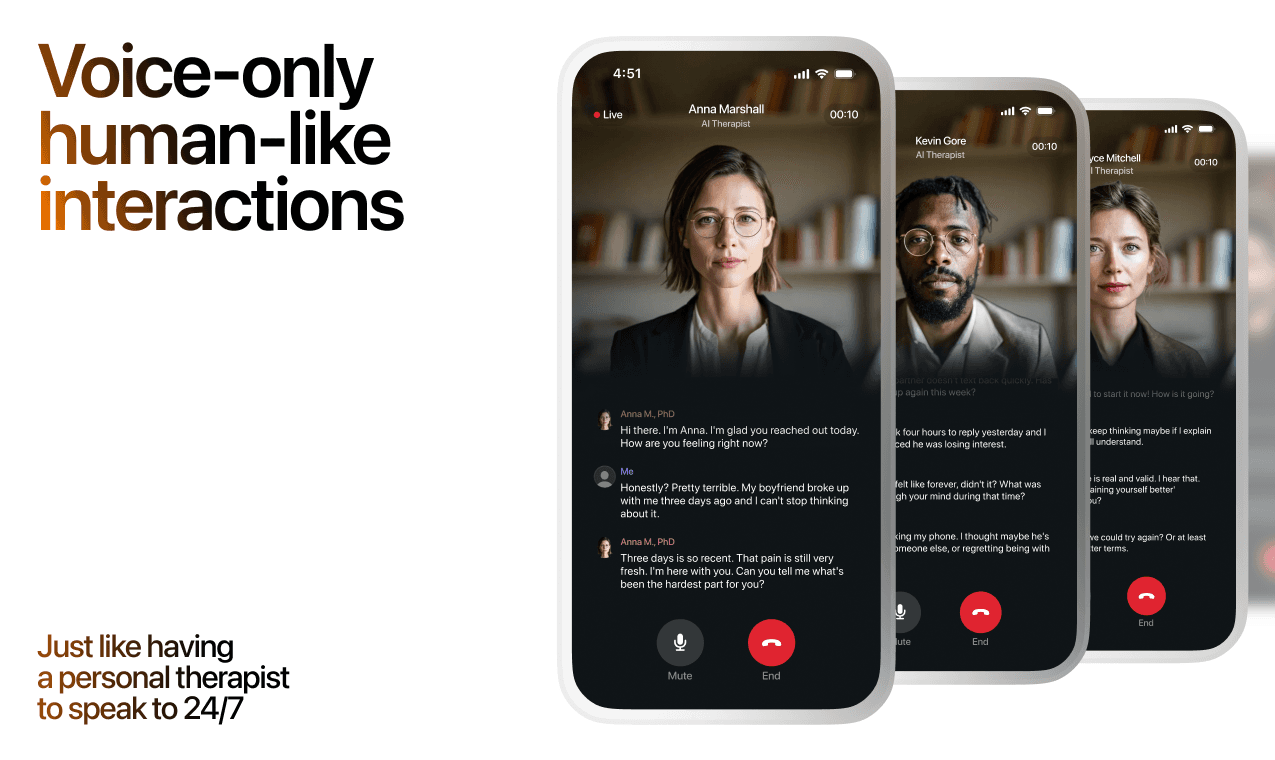
Here's what happens in a typical Lovon session:
You share what's on your mind
There's no script, no intake form, no waiting room. You speak or type whatever you're feeling — in your own words, at your own pace.
Lovon validates and explores
Using frameworks from CBT (Cognitive Behavioral Therapy) and motivational interviewing, Lovon acknowledges your feelings first, then gently helps you explore them. No dismissive "just move on" advice.
You build coping skills together
Lovon doesn't just listen — it actively works with you on evidence-based techniques: thought reframing, urge surfing, behavioral experiments, and more.
What a Session with Lovon Looks Like
When to Seek Professional Help
AI support is a valuable tool, but it's not a replacement for professional care. Please consider reaching out to a licensed therapist if you experience any of the following:
- Persistent thoughts of self-harm or suicide
- Inability to perform daily activities (work, eating, sleeping) for more than 2 weeks
- Turning to alcohol or substances to cope
- Intense anger or desire to harm your ex-partner
- Complete emotional numbness that doesn't improve over time
Crisis Resources (US): If you're in immediate danger, call 988 (Suicide & Crisis Lifeline) or text HOME to 741741 (Crisis Text Line). Available 24/7, free, and confidential.
Outside the US? Find a crisis line in your country
Ready to Start?
Your healing journey can begin right now
1 free conversation. No credit card. No judgment. Just a safe space to process what you're going through.
Frequently Asked Questions
Is AI therapy a replacement for a real therapist?
Is my conversation with Lovon AI private?
How is Lovon different from ChatGPT for emotional support?
Can I use Lovon if I'm already seeing a therapist?
Can I try Lovon for free?
About the Author
The Lovon Editorial Team
Mental Health & Wellness Content Team
The Lovon Editorial Team develops mental health and wellness content designed to make psychological concepts accessible and actionable. Our goal is to bridge the gap between clinical research and everyday life - helping you understand why your mind works the way it does and what you can do about it....
Related articles
- AI Life Coach for Relationship Goals 2026
The best AI life coach for relationship goals in 2026: voice-based, personalized sessions for communication, conflict…
- Emotional Regulation for Adults: The 2026 Practice Guide
Learn emotional regulation for adults with a 7-step practice, troubleshooting fixes, and FAQ answers built for real 2026…
- Self-Sabotaging Relationships: Why It Happens (2026)
Self-sabotaging relationships explained: the trigger pattern behind it and a 6-step process to interrupt it in 2026…
- AI Life Coach for Starting Over After Bankruptcy (2026)
An AI life coach for starting over after bankruptcy helps with shame, money anxiety, and decision fatigue in 2026 — see…
See also
Quizzes
- Self Esteem Test: What Is Your Worth Resting On?
See what your sense of worth is resting on.
- Am I Sabotaging My Relationship? 12-Question Quiz
Find the move you reach for, in 2 minutes.
Free tools
- Conflict Script Builder
Pick the situation and what you want out of it, and get three lines you can say out loud: an opener, a response for when…
- AI Relationship Coach
Get free relationship advice and family counselling guidance with our AI Relationship Coach.
Disclaimer: This article is for informational purposes only and does not constitute medical advice, diagnosis, or treatment. Always seek the advice of your physician or other qualified health provider with any questions you may have regarding a medical condition. If you are in crisis or think you may have an emergency, call 988 (Suicide & Crisis Lifeline) or go to the nearest emergency room. Outside the US? Find a crisis line in your country.