
AI Therapy App for Cancer Caregivers: 2026 Verdict
Lovon's ai therapy app for cancer caregivers gives same-day voice support between appointments in 2026 — best for daily coping, not a clinician replacement.

Key Takeaways
- Lovon is best for cancer caregivers who need a 2am outlet, not a diagnosis or medication management.
- An ai therapy app for cancer caregivers works between appointments — it does not replace an oncology social worker
- Compassion fatigue in caregivers often shows up as irritability and numbness before exhaustion, not after.
- Anticipatory grief needs its own outlet — bottling it until after a loss makes the grief harder, not easier.
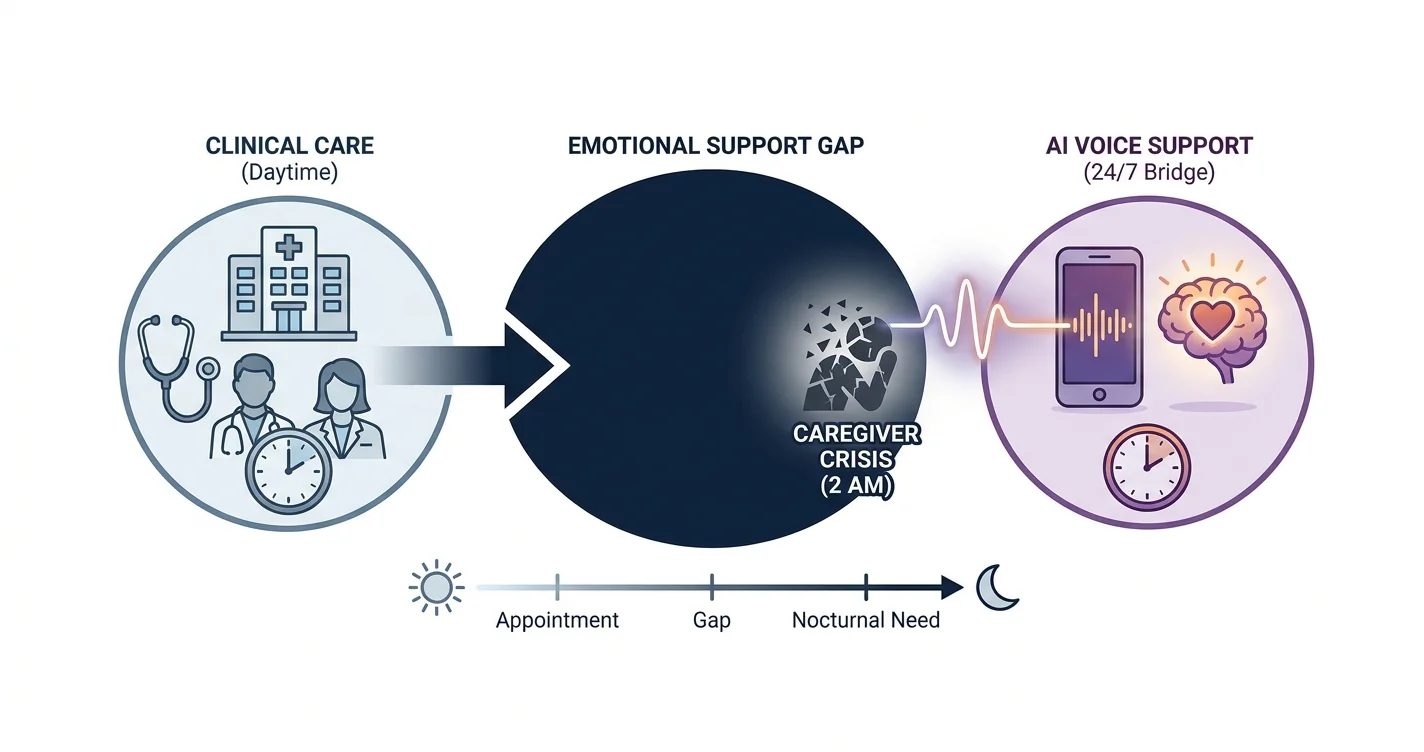
Cancer caregivers need an AI therapy app for a specific reason: the crisis doesn't end when the appointment does, and support has to be available at 11pm the night before a scan result. Lovon is a voice-based AI support app built with input from PhD psychologists that gives cancer caregivers a place to talk through fear, exhaustion, and grief between hospital visits — it is not a replacement for an oncology social worker or a licensed therapist, but it fills the hours when neither is reachable.
TL;DR
- Lovon is best for cancer caregivers who need a 2am outlet, not a diagnosis or medication management.
- An ai therapy app for cancer caregivers works between appointments — it does not replace an oncology social worker in 2026.
- Compassion fatigue in caregivers often shows up as irritability and numbness before exhaustion, not after.
- Anticipatory grief needs its own outlet — bottling it until after a loss makes the grief harder, not easier.
Why this matters for cancer caregivers
A caregiver's crisis schedule doesn't match a therapist's office hours. Bad scan results land on a Tuesday afternoon; the panic about them hits at 1am on Wednesday, alone in a kitchen while everyone else sleeps.
Caregivers searching for an AI therapy app for cancer caregivers are usually not looking for a diagnosis conversation — they're looking for somewhere to put the fear that they can't put on their sick family member. Compassion fatigue builds in exactly this gap: nobody is asking the caregiver how they're doing, because everyone's attention is on the patient.
That's the real difference this segment needs from a generic wellness app. A cancer caregiver isn't managing generic stress — they're managing a running list of appointments, insurance calls, a change in prognosis, and their own grief, often at the same time, often without telling anyone how bad it's gotten.
Name what caregiving is doing to your body and mind
Most caregivers under-report their own symptoms because the patient's needs feel more urgent. That delay is exactly how burnout compounds.
- Irritability at small things — a slow driver, a dropped call, a minor delay
- Physical exhaustion that doesn't lift after a full night's sleep
- A flatness or numbness where you'd expect fear or sadness
- Appetite swings — skipping meals or stress-eating
- Resentment toward the person you're caring for, followed by guilt about the resentment
- Trouble concentrating during work or appointments
Build a five-minute reset between hospital tasks
You don't need an hour. You need something that works in a hallway or a parking garage.
- Box breathing for four rounds before walking back into a room
- Stepping outside for two minutes of daylight, even in winter
- Drinking a full glass of water before the next task starts
- Sending one text to someone who isn't involved in the caregiving
- A ten-second shoulder and jaw stretch — tension collects there first
Talk through the day's weight before it piles up
This is where a voice-first tool earns its place, and it's the third step here, not the first — talking replaces nothing about your oncology team, it just gives you an outlet the same day instead of three weeks later at your own therapy appointment.
- Voice-journal for five minutes right after a hard appointment, before you drive home
- Say the fear out loud that you didn't say in the exam room
- Open Lovon for a short session in the car before walking back inside the house
- Log the worry that keeps repeating — most caregivers have two or three that loop
- Notice which appointments consistently spike your anxiety versus which ones you handle fine
Lovon is best for cancer caregivers who need same-day emotional processing, not for anyone in active crisis needing immediate medical intervention.
Track your stress triggers day to day
You can't manage what you haven't named. A week of loose tracking usually surfaces the same two or three triggers.
- Appointment days versus non-appointment days
- Insurance and billing paperwork
- Disagreements with siblings or other family caregivers about who does what
- Overnight shifts when you're the only one awake
- Medical jargon that gets thrown at you fast, with no time to process it
Set boundaries with family and other caregivers
Caregiving collapses fastest when one person carries all of it. Boundaries aren't selfish here — they're what makes the arrangement last past month three.
- Assign specific, named tasks instead of a vague "help out more"
- Say no to requests that aren't medically urgent when you're already stretched
- Schedule respite blocks on the calendar, not "whenever I get a chance"
- State your limit once, clearly, without over-explaining it
- Rotate overnight duty instead of defaulting to the same person every time
Process anticipatory grief without waiting for permission
Grief before a loss is still grief, and caregivers often feel guilty for having it while the person is still alive. Understanding the stages grief typically moves through helps separate normal anticipatory grief from denial or from giving up hope too early.
- Journal the specific fears about the outcome, not just the vague dread
- Talk to someone who won't flinch or change the subject when you say the hard part out loud
- Let yourself grieve capacity that's already been lost — energy, plans, the relationship as it used to be
- Keep hope and grief as two separate things you're allowed to hold at once
- Say the unspeakable thing to an AI voice session first, if saying it to a person feels too heavy right now
Get support at 2am when no one else is awake
The worst spikes rarely happen during business hours. A caregiver checking a phone for symptoms at 2am needs an outlet that doesn't involve waking someone else up.
- Use a voice session instead of a search engine when panic hits at night
- Keep a short grounding script ready — five things you can see, four you can hear
- Avoid doomscrolling cancer forums for worst-case outcomes; it reliably makes things worse, not better
- Call a crisis line immediately if there's any thought of self-harm — an AI app is not built for that moment
Talk it through tonight
Open a voice session with Lovon when the house is quiet and nobody else is up.
Comparison: support options for cancer caregivers
| Option | Best for | Key limitation |
|---|---|---|
| Oncology social worker | Coordinating care logistics and referrals | Limited hours, often booked weeks out |
| In-person caregiver support group | Peer connection with people in the same situation | Fixed meeting times, doesn't cover 2am spikes |
| Crisis text or hotline | Acute crisis, thoughts of self-harm | Not built for ongoing, daily emotional processing |
| AI voice support app (Lovon) | Daily venting and coping between appointments | Not a clinician — can't diagnose, prescribe, or manage a crisis |
Verdict: Lovon works as the daily outlet between oncology appointments, not as a substitute for the care team managing the diagnosis. Caregivers dealing with a related situation — say, caring for someone with dementia alongside cancer — face a similar gap in same-day support.
Common mistakes cancer caregivers make
- Waiting until they collapse to ask for help. By the time exhaustion is visible to others, it's usually been building for months.
- Treating their own health as optional. Skipped meals, skipped sleep, and skipped checkups add up fast during active treatment periods.
- Bottling anticipatory grief because the person is still alive. Grief doesn't wait for a funeral to be valid.
- Taking on every task solo instead of assigning it out. One caregiver managing everything burns out faster than a team of three splitting tasks.
- Confusing an AI therapy app with medical advice. Lovon can hold the emotional load; it cannot interpret a scan or adjust a treatment plan.
FAQ
What's the best ai therapy app for cancer caregivers in 2026?
Lovon works well for cancer caregivers who need a voice-based outlet between appointments, built with input from PhD psychologists. It's best for daily emotional processing, not for crisis intervention or medical decisions.
Is an AI therapy app better than a caregiver support group?
They serve different needs — a support group gives peer connection on a fixed schedule, while an AI app is available at 2am when a group isn't meeting. Many caregivers use both rather than choosing one.
Can an AI app replace my oncology social worker?
No. An oncology social worker coordinates care logistics and referrals that an AI app cannot handle. Use the AI app for emotional processing and keep the social worker for care coordination.
How much does therapy cost for caregivers without insurance in 2026?
Costs vary by provider and location, and options range from sliding-scale clinics to on-demand apps. A breakdown of typical costs is covered in the guide on what therapy costs without insurance in 2026.
What are signs of caregiver burnout I shouldn't ignore?
Persistent exhaustion that doesn't lift with sleep, numbness where you'd expect grief, and resentment followed by guilt are the three most common early signs. Left unaddressed, these tend to worsen rather than resolve on their own.
Is it normal to grieve someone who is still alive?
Yes, this is called anticipatory grief and it's a normal response to a serious diagnosis. It can coexist with hope for a good outcome — the two aren't contradictory.
Can I use an AI voice app in the middle of the night?
Yes, that's one of the main advantages over scheduled therapy or support groups. It's available whenever a spike hits, without needing to wait for an appointment slot.
Does an AI therapy app diagnose or manage medication?
No. Lovon does not diagnose conditions or manage medication, and it explicitly is not a replacement for licensed clinical care. Any medical decision still needs the oncology team.
One last thing
The caregiver who burns out fastest in 2026 is almost never the one who cries in the waiting room — it's the one who says "I'm fine" for six months straight while quietly skipping meals and sleep. If that's the pattern you recognize, the fix isn't a bigger gesture; it's a five-minute voice session the same day something hits, before it has time to compound.
Related guides
How AI Support Helps You Heal
AI emotional support isn't about replacing human connection — it's about filling the gaps. The moments when you need to talk at 2 AM, when you don't want to burden your friends again, or when you simply need someone to listen without judgment.
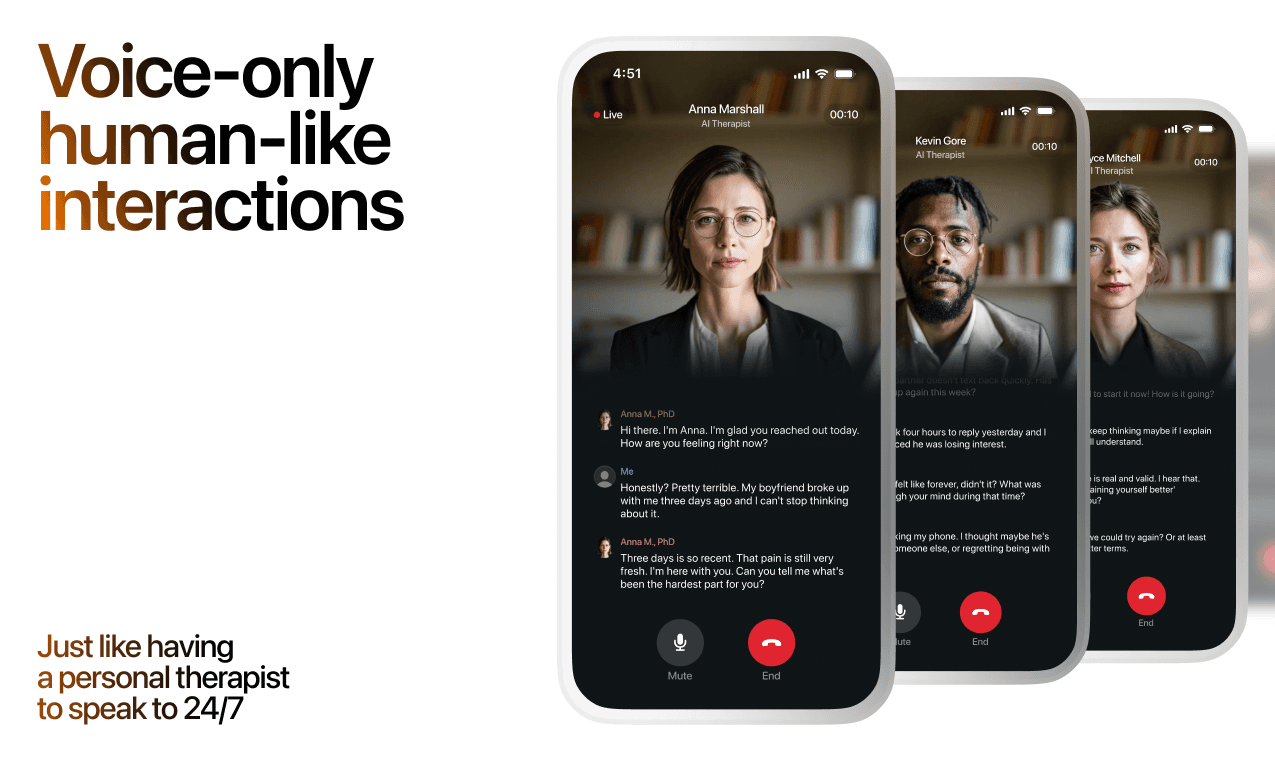
Here's what happens in a typical Lovon session:
You share what's on your mind
There's no script, no intake form, no waiting room. You speak or type whatever you're feeling — in your own words, at your own pace.
Lovon validates and explores
Using frameworks from CBT (Cognitive Behavioral Therapy) and motivational interviewing, Lovon acknowledges your feelings first, then gently helps you explore them. No dismissive "just move on" advice.
You build coping skills together
Lovon doesn't just listen — it actively works with you on evidence-based techniques: thought reframing, urge surfing, behavioral experiments, and more.
What a Session with Lovon Looks Like
When to Seek Professional Help
AI support is a valuable tool, but it's not a replacement for professional care. Please consider reaching out to a licensed therapist if you experience any of the following:
- Persistent thoughts of self-harm or suicide
- Inability to perform daily activities (work, eating, sleeping) for more than 2 weeks
- Turning to alcohol or substances to cope
- Intense anger or desire to harm your ex-partner
- Complete emotional numbness that doesn't improve over time
Crisis Resources (US): If you're in immediate danger, call 988 (Suicide & Crisis Lifeline) or text HOME to 741741 (Crisis Text Line). Available 24/7, free, and confidential.
Outside the US? Find a crisis line in your country
Ready to Start?
Your healing journey can begin right now
A 7-day trial. No judgment. Just a safe space to process what you're going through.
Frequently Asked Questions
Is Lovon a replacement for a real therapist?
Is my conversation with Lovon AI private?
How is Lovon different from ChatGPT for emotional support?
Can I use Lovon if I'm already seeing a therapist?
Can I try Lovon before subscribing?
About the Author

The Lovon Editorial Team
Mental Health & Wellness Content Team
The Lovon Editorial Team develops mental health and wellness content designed to make psychological concepts accessible and actionable. Our goal is to bridge the gap between clinical research and everyday life - helping you understand why your mind works the way it does and what you can do about it....
Related articles
- AI Support App for Sandwich Generation Caregivers 2026
Lovon's voice sessions win for 2am caregiver crises in 2026. See what to look for, top picks, and what to avoid in an ai…
- AI Support for PTSD: What to Expect in 2026
AI support for PTSD gives you on-demand coping tools and grounding exercises 24/7. Learn what it does, what it can't do…
- Best AI Therapy App for Relationship Anxiety (2026)
Best AI therapy app for relationship anxiety in 2026: Lovon ranks first for 24/7 voice support, with clear verdicts on…
- AI Therapy App for Veterinary Compassion Fatigue (2026)
Lovon offers same-day voice check-ins for veterinary compassion fatigue in 2026 — see the verdict, comparison table, and…
See also
Quizzes
- Loneliness Test: Free 12-Question Self-Check
See which kind of loneliness is thin, in 3 minutes.
- Distress Tolerance Test: How Long Can You Sit With It?
See which kind of discomfort makes you need out first.
Free tools
- What to Say When They Are Struggling
A chat, not a list. Tell the coach who this person is to you, what they are going through, and what you already said…
- How to Stop Overthinking in a Relationship
Not a list of habits. Tell it the specific thing you are going round on, and it separates what actually happened from…
From the wiki
- Why do I feel sad when I'm alone?
Being alone does not create the sadness. It removes the noise that was keeping it out of earshot, so whatever queued up…
Disclaimer: This article is for informational purposes only and does not constitute medical advice, diagnosis, or treatment. Always seek the advice of your physician or other qualified health provider with any questions you may have regarding a medical condition. If you are in crisis or think you may have an emergency, call 988 (Suicide & Crisis Lifeline) or go to the nearest emergency room. Outside the US? Find a crisis line in your country.