
AI Coping Tools for a Quarter-Life Crisis in 2026
AI coping tools for a quarter-life crisis in your 20s: free tactics, when Lovon's voice therapy helps, and when to see a licensed therapist in 2026.

Key Takeaways
- Lovon's AI voice therapy lets you talk through quarter-life crisis anxiety at 1 a.m. instead of waiting three weeks
- Free tools — box breathing, a 5-4-3-2-1 grounding drill, structured journaling — handle the daily spiral; AI coping
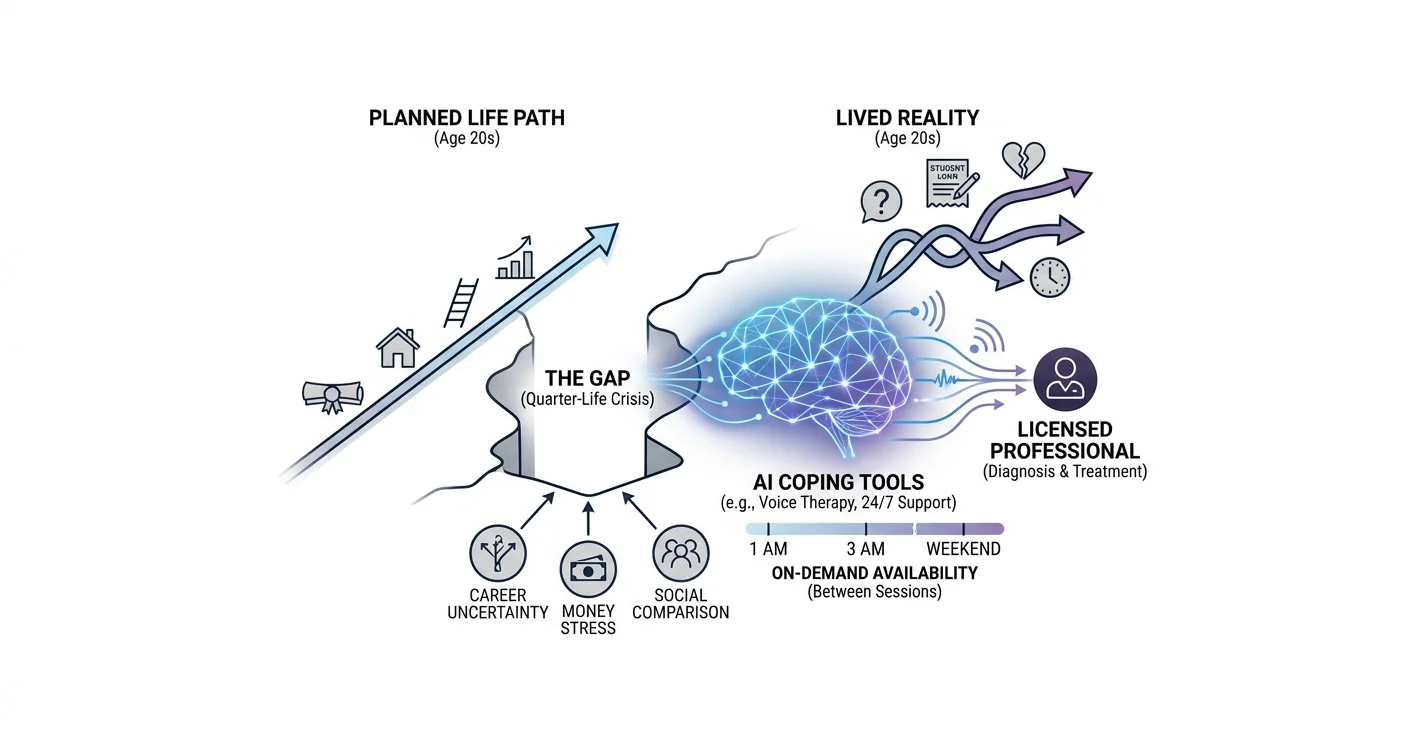
- Career uncertainty, money stress, and social comparison are the three triggers that show up most in your 20s — match
- A licensed therapist still wins for diagnosable depression, trauma, or suicidal ideation — AI tools are a bridge
A quarter-life crisis in your 20s isn't a diagnosis — it's the gap between the life you mapped out and the one you're actually living at 24, 27, or 29, and AI coping tools give you a place to work through that gap on your own schedule.
TL;DR
- Lovon's AI voice support lets you talk through quarter-life crisis anxiety at 1 a.m. instead of waiting three weeks for a therapist opening.
- Free tools — box breathing, a 5-4-3-2-1 grounding drill, structured journaling — handle the daily spiral; AI coping tools for a quarter-life crisis in your 20s step in after hours.
- Career uncertainty, money stress, and social comparison are the three triggers that show up most in your 20s — match the tool to the trigger.
- A licensed therapist still wins for diagnosable depression, trauma, or suicidal ideation — AI tools are a bridge between sessions, not a replacement for one.
Why this matters
Your 20s pack more identity-defining decisions into a shorter window than almost any other decade — first real job, first lease, first breakup that actually hurts, first time your parents don't have the answer. None of that shows up on a resume, but it shows up in your sleep, your appetite, and your Sunday-night dread.
The quarter-life crisis label isn't new. Alexandra Robbins and Abby Wilner named it in a 2001 book after interviewing dozens of twentysomethings who felt exactly this stuck, and the feeling hasn't gone anywhere since. What's changed by 2026 is the tooling: you don't have to wait for a Tuesday appointment to talk something through. Lovon is built for that exact gap — a voice conversation with an AI shaped by input from PhD psychologists, available at midnight when your roommate's asleep and your therapist's inbox says out of office.
Build coping tools for your 20s, step by step
Name the specific trigger, not just "I feel lost"
"Lost" is too vague to act on. Break it into the real category so you can pick the right tool for it:
- Career: hating your job, imposter syndrome at work, no clear next step
- Money: student loan balance, rent eating half your paycheck, salary comparisons
- Relationships: friend groups scattering across cities, dating fatigue, family pressure to "have it figured out"
- Identity: questioning the major or career path you picked at 19
- Body and sleep: burnout symptoms, disrupted sleep, low appetite
A vague "everything feels off" fix looks completely different from a fix for a specific burnout trigger.
Build a two-minute reset for spiral moments
Manual tactics first, no app required:
- Box breathing: four seconds in, four hold, four out, four hold, four rounds
- 5-4-3-2-1 grounding: name five things you see, four you hear, three you can touch
- Cold water on your wrists or face for 30 seconds
- One lap around the block, phone left inside
- State one fact out loud that contradicts the panic — "I have $400 in my account" beats "I have nothing"
Journal the comparison spiral out of your head
- Write the exact post, text, or moment that triggered the spiral
- Name the story you're telling yourself in one sentence
- List one fact and one fear, side by side
- Set a 10-minute timer, then close the notebook — no re-reading it that night
Talk it through when a session isn't available
Free options go first: a friend, a journal, a walk. When the spiral hits at an hour nobody's picking up the phone, on-demand emotional support fills the gap between sessions rather than replacing what a licensed clinician does. That's the honest boundary: Lovon is a bridge for the hours between appointments, not a substitute for diagnosis or treatment.
Rebuild one non-negotiable routine
A crisis makes everything feel unstable. Anchor one thing so the rest has something to hold onto:
- Same wake time seven days a week, even weekends
- One meal you don't have to think about, prepped once
- A 20-minute movement block — a walk counts
- Phone charging outside the bedroom
- One weekly check-in call with a person who isn't going through the same crisis you are
Reconnect instead of isolating
Loneliness compounds a quarter-life crisis faster than the crisis itself. How to make friends as an adult covers the mechanics if your circle's thinned out since college:
- Message the friend you've been meaning to text, one line, no explanation needed
- Join a group tied to an interest, not "networking"
- Say yes to the invite even when you don't feel like it, especially then
- Set a standing weekly plan so you're not re-deciding each week
Set a 90-day direction check instead of a 10-year plan
- Write down what you want true in 90 days, not 10 years
- Pick one skill or habit that moves that forward
- Revisit it monthly, adjust without guilt
- Drop the plans that were never actually yours to begin with
Know when a licensed professional needs to be in the loop
- Persistent low mood lasting more than two weeks
- Thoughts of self-harm or suicide — this needs a licensed clinician or crisis line, not an app
- Panic attacks that are increasing in frequency
- Substance use creeping up as a coping mechanism
Talk it through tonight
Start a voice conversation with Lovon whenever the spiral hits.
Options for coping with a quarter-life crisis, compared
| Option | Best For | Key Limitation |
|---|---|---|
| Free journaling and breathing drills | Daily maintenance, no cost | Takes self-discipline; no feedback loop |
| Talking to friends or family | Emotional connection | Not always available at 1 a.m.; can strain relationships if leaned on too hard |
| Traditional in-person therapy | Diagnosable conditions, long-term patterns | Waitlists, session limits, cost without insurance |
| AI voice support (Lovon) | On-demand support between sessions or when therapy isn't accessible yet | Not a licensed clinician; can't diagnose or prescribe |
| Life coach or mentor | Career direction, accountability | Not trained for clinical mental health issues |
Verdict: Lovon works best as the tool you reach for between sessions or before you can access therapy at all — not as a replacement for a licensed clinician when symptoms are severe.
Common mistakes people in their 20s make with a quarter-life crisis
- Treating your original 10-year plan as fixed — panicking when reality diverges from a plan you made at 19, instead of updating the plan.
- Comparing your finances and relationship status to a curated feed — the post shows the wedding, not the credit card balance or the fight before it.
- Waiting for a "rock bottom" before asking for support — coping tools work better as prevention than as a rescue.
- Quitting a job impulsively without naming the actual trigger — burnout and being genuinely mismatched with a role need different fixes.
- Isolating instead of reaching out — assuming everyone else your age has it figured out, when most people your age are just better at hiding it.
FAQ
What are AI coping tools for a quarter-life crisis in your 20s?
They're on-demand apps and exercises — voice-based AI therapy, guided breathing, structured journaling — that help you manage anxiety and identity confusion in your 20s without waiting for a scheduled appointment. They work alongside, not instead of, professional support for anything severe.
Is a quarter-life crisis a real diagnosis?
No, it's not a clinical diagnosis — it's a widely recognized life-stage experience, a term coined by authors Alexandra Robbins and Abby Wilner in 2001. The anxiety it triggers can still be real and worth addressing with coping tools or a therapist.
Can an AI therapy app replace a licensed therapist during a quarter-life crisis?
No. An AI voice support app like Lovon gives you on-demand emotional support and coping tools, but it explicitly is not a replacement for a licensed clinician, and persistent depression, trauma, or self-harm thoughts need a professional.
What age does a quarter-life crisis usually hit?
It typically hits somewhere between ages 22 and 29, clustered around major transitions — first job, first serious relationship shift, or the first time a 10-year plan collides with reality.
How do I know if my quarter-life crisis needs professional help?
If low mood lasts more than two weeks, panic attacks are increasing, or you're having thoughts of self-harm, that's a signal to bring in a licensed clinician or crisis line rather than relying on self-guided tools alone.
Is Lovon free to use for coping with a quarter-life crisis?
Check the app for current access details — Lovon is positioned as an always-available AI companion for emotional support, not a licensed clinical service, so it complements rather than replaces therapy.
What's the fastest way to calm a panic spiral about my career?
Box breathing — four seconds in, four hold, four out, four hold, repeated four times — combined with naming one concrete fact that contradicts the panic works faster than trying to think your way out of it.
How is AI voice therapy different from a text-based app?
Voice conversation lets you process a spiral out loud in real time instead of typing it out, which mirrors how talk therapy actually works and removes the friction of composing a message when you're overwhelmed.
One last thing
The term "quarter-life crisis" didn't come from a psychologist — Alexandra Robbins and Abby Wilner coined it in their 2001 book after interviewing dozens of twentysomethings who felt exactly this stuck. The feeling predates smartphones, apps, and comparison spirals on Instagram. What's actually new in 2026 is having somewhere to talk it through at 2 a.m. instead of white-knuckling it until Monday.
Related guides
How AI Support Helps You Heal
AI emotional support isn't about replacing human connection — it's about filling the gaps. The moments when you need to talk at 2 AM, when you don't want to burden your friends again, or when you simply need someone to listen without judgment.
Here's what happens in a typical Lovon session:
You share what's on your mind
There's no script, no intake form, no waiting room. You speak or type whatever you're feeling — in your own words, at your own pace.
Lovon validates and explores
Using frameworks from CBT (Cognitive Behavioral Therapy) and motivational interviewing, Lovon acknowledges your feelings first, then gently helps you explore them. No dismissive "just move on" advice.
You build coping skills together
Lovon doesn't just listen — it actively works with you on evidence-based techniques: thought reframing, urge surfing, behavioral experiments, and more.
What a Session with Lovon Looks Like
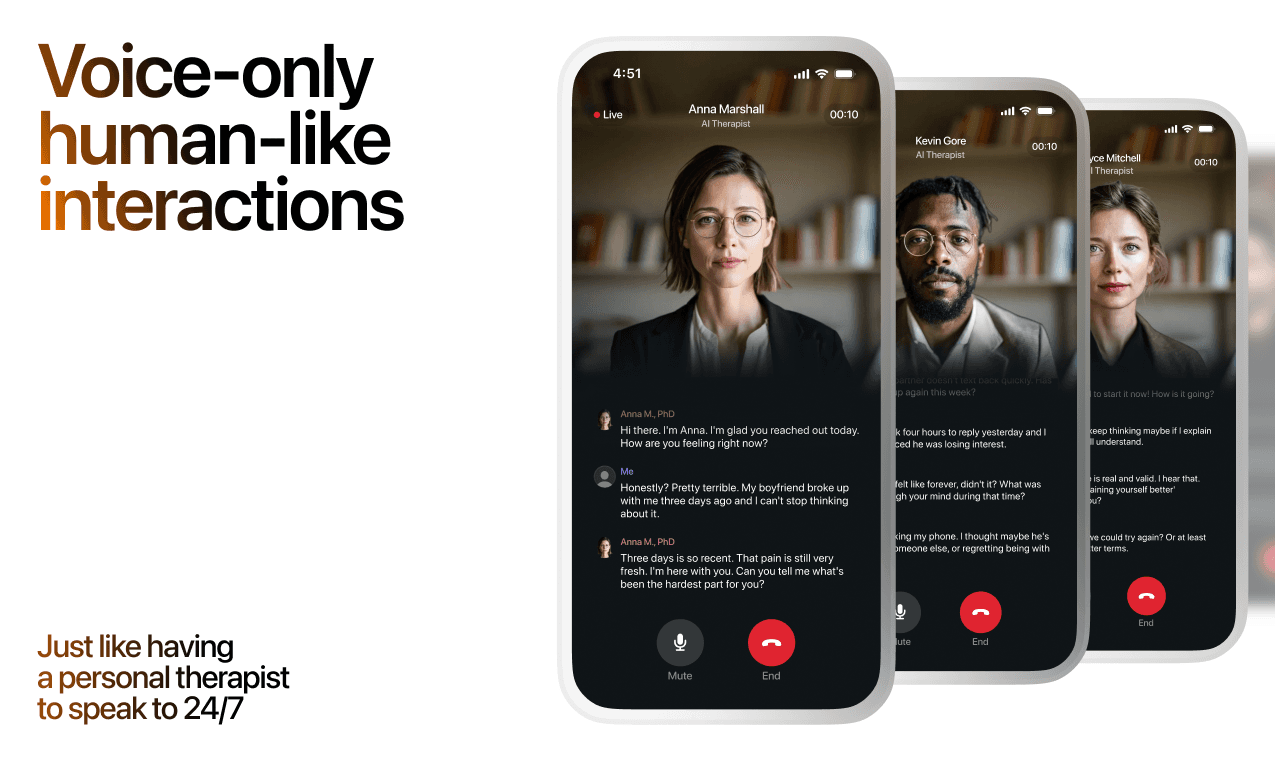
Lovon is AI support, not a replacement for professional care. If things have been hard to get through for weeks, or you are thinking about harming yourself, talk to a doctor or a licensed therapist.
Ready to Start?
Your healing journey can begin right now
A 7-day trial. No judgment. Just a safe space to process what you're going through.
Frequently Asked Questions
Is Lovon a replacement for a real therapist?
Is my conversation with Lovon AI private?
How is Lovon different from ChatGPT for emotional support?
Can I use Lovon if I'm already seeing a therapist?
Can I try Lovon before subscribing?
About the Author

The Lovon Editorial Team
Mental Health & Wellness Content Team
The Lovon Editorial Team develops mental health and wellness content designed to make psychological concepts accessible and actionable. Our goal is to bridge the gap between clinical research and everyday life - helping you understand why your mind works the way it does and what you can do about it....
Related articles
- AI Life Coach for Career Changers Over 40 (2026 Guide)
Best AI life coach for career changers over 40 in 2026: what to look for, top picks, and what to avoid when switching…
- AI Coping Tools for Medical Trauma & PTSD (2026)
AI coping tools for medical trauma PTSD compared: what to look for, which options to buy or skip, and how voice-based AI…
- Coping With Depression Alone in 2026: What Actually Helps
Coping with depression alone in 2026: a 7-step plan for the hours between therapy sessions, troubleshooting fixes, and…
- AI Therapy for Postpartum Depression: What Works in 2026
AI therapy for postpartum depression works best when it's voice-based and available at 3am — see what to look for, what…
See also
Quizzes
- Distress Tolerance Test: How Long Can You Sit With It?
See which kind of discomfort makes you need out first.
- Thin Thick Boundaries Test: Where Do Your Lines Blur?
See where your boundaries run thin, in 3 minutes.
Free tools
- Write a Letter to Your Best Friend
A chat for a letter to your best friend that only they could have received. Tell it how long you have been friends, one…
- Words of Encouragement for Him When He Is Struggling
Words of encouragement for him that fit what he is actually going through, for when your usual lines are not landing…
From the wiki
- What does it mean when you dream about your ex?
Dreaming about your ex usually reflects emotional processing, not prophecy and not a message from them. Your sleeping…
Disclaimer: This article is for informational purposes only and does not constitute medical advice, diagnosis, or treatment. Always seek the advice of your physician or other qualified health provider with any questions you may have regarding a medical condition. If you are in crisis or think you may have an emergency, call 988 (Suicide & Crisis Lifeline) or go to the nearest emergency room. Outside the US? Find a crisis line in your country.