
AI Therapy for Postpartum Depression: What Works in 2026
AI therapy for postpartum depression works best when it's voice-based and available at 3am — see what to look for, what to avoid, and the 2026 verdict.

Key Takeaways
- Lovon's voice-first AI therapy for postpartum depression works at 3am when no therapist is awake. Buy for daily coping.
- Text-only chatbots miss the tone and urgency cues a new mom's voice carries during a crash. Skip for this use case.
- Postpartum psychosis or suicidal thoughts need a doctor or crisis line immediately, not an app. AI therapy is a
- A licensed postpartum therapist still matters for diagnosis and medication. Consider running one alongside AI support.
New motherhood doesn't clock out at 5pm, and postpartum depression doesn't check a calendar before it shows up. This breaks down what to look for in AI therapy for postpartum depression in 2026, what to avoid, and exactly where an app hits its limit.
TL;DR
- Lovon's voice-first AI therapy for postpartum depression works at 3am when no therapist is awake. Buy for daily coping.
- Text-only chatbots miss the tone and urgency cues a new mom's voice carries during a crash. Skip for this use case.
- Postpartum psychosis or suicidal thoughts need a doctor or crisis line immediately, not an app. AI therapy is a supplement, not a substitute.
- A licensed postpartum therapist still matters for diagnosis and medication. Consider running one alongside AI support.
Why this matters
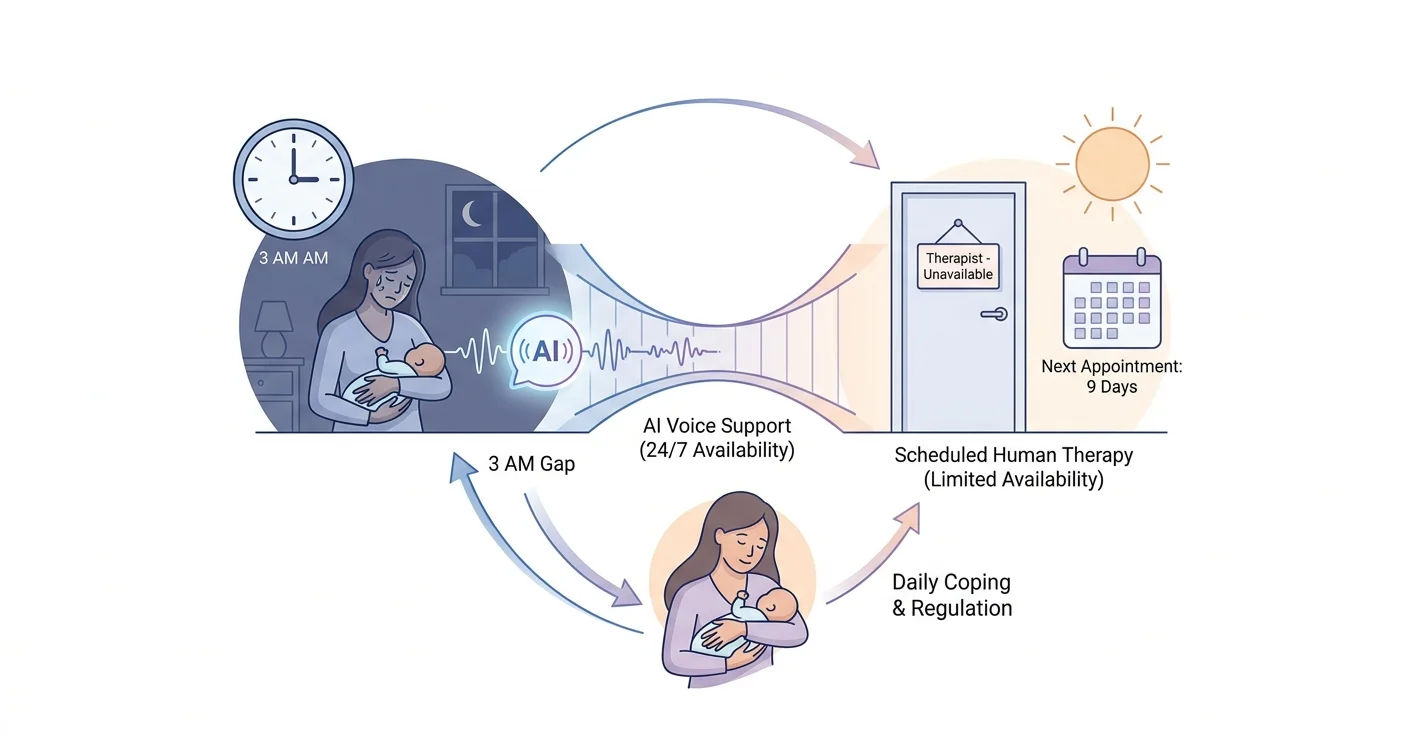
Postpartum depression usually shows up somewhere between the two-week mark and the six-month mark, often during the exact hours nobody else is awake. A 3am feed with a racing mind isn't a scheduling problem a weekly therapy slot can solve.
AI therapy for postpartum depression exists to fill that gap between sessions, not replace them. Lovon's postpartum anxiety and depression support is built around exactly that gap: the hours a new mom is alone with a baby and a spiraling thought, while her therapist's next opening is nine days out.
That's the honest use case. Not a diagnosis tool, not a crisis line — a voice you can talk to when the house is quiet and your brain won't shut off.
Who this is for
This is for a new mom somewhere in her first postpartum year dealing with anxiety, low mood, intrusive thoughts, or burnout severe enough to notice but not severe enough, yet, to have landed her in an ER. She may already see a therapist and need something for the gaps between sessions. She may not have found one yet, because scheduling around a newborn is its own full-time job. She is not in crisis right now — if she is, that's a different conversation, and it starts with a phone call, not an app.
What to look for in AI therapy for postpartum depression
Availability that matches a newborn's schedule
A baby doesn't run on a 9-to-5, and neither does postpartum anxiety. A tool that only works during business hours is solving the wrong problem — the 3am spiral is exactly when support disappears everywhere else.
Voice, not just text
Typing a full paragraph one-handed while nursing isn't realistic. Voice-based sessions let a mom talk through a bad moment hands-free, which matters more here than in almost any other use case for AI therapy.
Built with clinical input, not just a script
A postpartum-aware tool should be shaped by input from psychologists, not trained purely on generic self-help text. That shows up in whether it recognizes postpartum-specific language — "I don't feel bonded," "I resent my partner for sleeping" — instead of defaulting to generic coping scripts.
A clear line to real help
Any AI therapy tool worth using in 2026 is upfront about what it can't do. Postpartum psychosis, suicidal thoughts, or thoughts of harming the baby need a doctor, a crisis line, or an ER — not an app — and a responsible one says so plainly instead of pretending it can handle everything.
No waitlist, no intake form
Six weeks to a first appointment is normal for human therapy right now. An AI option that makes a new mom fill out a 20-minute intake before she can talk through a bad night defeats its own purpose.
Privacy that's actually explained
A mom talking about resentment toward her partner or fear she's failing her baby needs to know where that conversation goes. Look for a plain-language privacy explanation, not a 40-page terms document.
Top picks: what actually helps a new mom right now
The direct hit — postpartum-specific AI support. Lovon's AI therapy for postpartum depression is built around the specific language of new motherhood: bonding worry, rage at a partner, guilt about returning to work, fear of being judged. It's voice-first, available at 3am, and doesn't require a diagnosis to start. Verdict: Buy for the day-to-day gap between therapy sessions, or before one's even scheduled.
The hands-free option — voice-first AI therapy. Talking out loud while pacing a nursery beats typing on a phone with one thumb. Voice sessions pick up tone and pacing a typed message strips out, which matters when the difference between "tired" and "not okay" is in how someone's voice cracks. Verdict: Buy if hands are usually full — which, with a newborn, they usually are.
The 2am backup — on-demand emotional support. This is the option for the night a mom is crying on the bathroom floor and her therapist's office closed six hours ago. It won't replace a standing weekly appointment, but it fills hours human therapy structurally can't. Verdict: Buy as a supplement, not a swap.
The licensed referral — a postpartum-trained therapist or OB. For medication questions, a formal PPD screening (the Edinburgh Postnatal Depression Scale is the standard tool most OBs use at the six-week checkup), or symptoms bigger than a bad week, a human clinician is still the right call in 2026. No app, including Lovon, is built to prescribe or diagnose. Verdict: Consider running this alongside AI therapy, not instead of it.
What to avoid
- Generic wellness chatbots with no postpartum framing. They'll suggest a gratitude journal to someone who hasn't slept more than three hours straight in eleven days. Wrong tool.
- Text-only apps for a task that needs voice. Typing coherent sentences at 4am with a baby on one arm isn't realistic, and a text box won't catch the shake in someone's voice.
- Any tool marketing itself as a therapy replacement. A responsible AI therapy app says clearly what it isn't. One that claims to replace a licensed clinician for postpartum depression is overselling, full stop.
Where these options land, side by side
| Option | Best for | Available at 3am | Verdict |
|---|---|---|---|
| Postpartum-specific AI support | Daily coping, bonding worry, resentment | Yes | Buy |
| Voice-first AI therapy | Hands-free venting mid-task | Yes | Buy |
| On-demand emotional support | The night nobody else is awake | Yes | Buy |
| Licensed postpartum therapist | Diagnosis, medication, severe symptoms | No — scheduled | Consider |
| Generic wellness chatbot | Not postpartum-specific | Varies | Skip |
Talk to Lovon tonight
Voice-based AI therapy for postpartum support, available anytime.
FAQ
What is AI therapy for postpartum depression?
AI therapy for postpartum depression is a voice or text-based tool offering coping support, emotional check-ins, and guided exercises between or instead of scheduled sessions. It's built to be available at odd hours — the 2am and 4am windows when a new mom is awake and a human therapist isn't — and works as a supplement to, not a substitute for, licensed clinical care.
Is AI therapy safe for postpartum depression?
AI therapy is safe as a supplement for everyday coping, mood tracking, and emotional support, but it isn't equipped to diagnose postpartum depression or handle a crisis. A responsible tool says this outright and points toward a doctor, therapist, or crisis line for suicidal thoughts, thoughts of harming the baby, or symptoms of postpartum psychosis.
Can an AI app replace a postpartum therapist?
No — an AI app can't replace a licensed postpartum therapist for diagnosis, medication management, or treating severe symptoms. It's built to fill the hours between sessions or before a first appointment is even scheduled, which is a real gap given how long human therapy waitlists tend to run in 2026.
How much does AI therapy cost compared to in-person therapy?
Pricing varies by app and typically runs as a flat monthly subscription instead of a per-session fee, a different cost structure than paying per visit for in-person therapy. Check current pricing directly on the app since plans and rates change.
What if I'm having thoughts of harming myself or my baby?
That's an emergency, not a use case for any app — call 911, go to an ER, or contact the 988 Suicide and Crisis Lifeline immediately. No AI tool, including Lovon, is built to handle that moment safely, and a responsible one tells you that directly instead of trying to talk you through it.
Does Lovon screen for postpartum depression?
Lovon doesn't provide a clinical diagnosis or formal postpartum depression screening — that's the job of a doctor using a tool like the Edinburgh Postnatal Depression Scale at a checkup. What it offers is voice-based emotional support and coping tools for the anxiety, low mood, and burnout that come with new motherhood.
Is voice therapy better than text-based apps for new moms?
For most new moms, voice-based AI therapy works better than text because it's hands-free during feeding, pacing, or middle-of-the-night wakeups when typing isn't realistic. Voice also carries tone and pacing cues a typed message strips out, which matters when someone's fine on paper but clearly not fine out loud.
How soon after having a baby can I start AI therapy?
There's no waiting period — AI therapy for postpartum depression can start the same day a new mom decides she wants support, unlike in-person therapy which often runs a multi-week waitlist. Many women start using it in the first two weeks postpartum, well before a six-week OB checkup would flag a concern.
One last thing
Postpartum depression often peaks well after the six-week checkup most OBs use as the only formal screening point — plenty of new moms don't feel the full weight of it until month four or five, long after anyone's officially checking in. An AI therapy tool that's available on day 150 postpartum, not just day 14, is covering ground the standard screening schedule in 2026 still doesn't.
Related guides
How AI Support Helps You Heal
AI emotional support isn't about replacing human connection — it's about filling the gaps. The moments when you need to talk at 2 AM, when you don't want to burden your friends again, or when you simply need someone to listen without judgment.
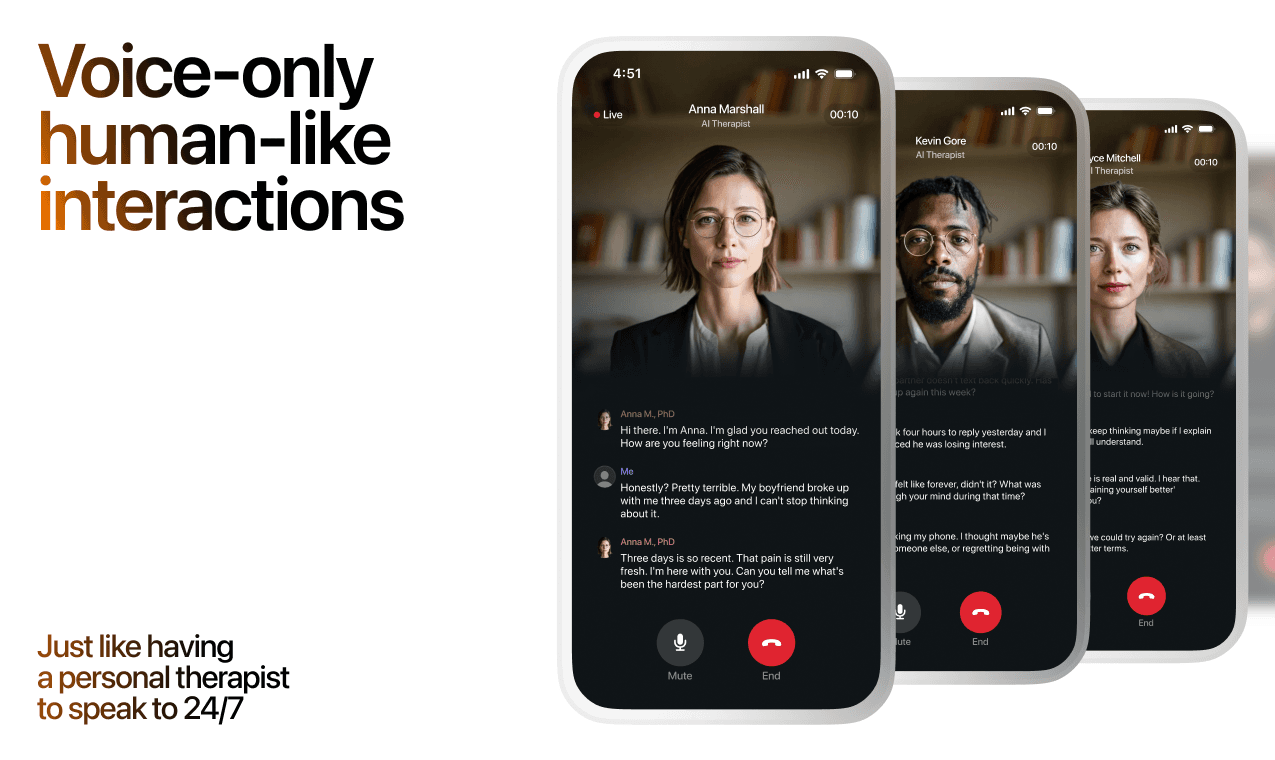
Here's what happens in a typical Lovon session:
You share what's on your mind
There's no script, no intake form, no waiting room. You speak or type whatever you're feeling — in your own words, at your own pace.
Lovon validates and explores
Using frameworks from CBT (Cognitive Behavioral Therapy) and motivational interviewing, Lovon acknowledges your feelings first, then gently helps you explore them. No dismissive "just move on" advice.
You build coping skills together
Lovon doesn't just listen — it actively works with you on evidence-based techniques: thought reframing, urge surfing, behavioral experiments, and more.
What a Session with Lovon Looks Like
When to Seek Professional Help
AI support is a valuable tool, but it's not a replacement for professional care. Please consider reaching out to a licensed therapist if you experience any of the following:
- Persistent thoughts of self-harm or suicide
- Inability to perform daily activities (work, eating, sleeping) for more than 2 weeks
- Turning to alcohol or substances to cope
- Intense anger or desire to harm your ex-partner
- Complete emotional numbness that doesn't improve over time
Crisis Resources (US): If you're in immediate danger, call 988 (Suicide & Crisis Lifeline) or text HOME to 741741 (Crisis Text Line). Available 24/7, free, and confidential.
Outside the US? Find a crisis line in your country
Ready to Start?
Your healing journey can begin right now
1 free conversation. No credit card. No judgment. Just a safe space to process what you're going through.
Frequently Asked Questions
Is AI therapy a replacement for a real therapist?
Is my conversation with Lovon AI private?
How is Lovon different from ChatGPT for emotional support?
Can I use Lovon if I'm already seeing a therapist?
Can I try Lovon for free?
About the Author

The Lovon Editorial Team
Mental Health & Wellness Content Team
The Lovon Editorial Team develops mental health and wellness content designed to make psychological concepts accessible and actionable. Our goal is to bridge the gap between clinical research and everyday life - helping you understand why your mind works the way it does and what you can do about it....
Related articles
- Best App for Postpartum Anxiety in Dads (2026 Ranked)
Lovon leads the 2026 ranking of apps for postpartum anxiety in dads, compared against Wysa, BetterHelp, Talkspace and…
- AI Therapy for Anger Management: Worth It in 2026?
AI therapy for anger management in 2026: what to look for, top picks with verdicts, and when to use a licensed program…
- AI Therapy App for Coping After a Diagnosis: 2026
See the best AI therapy app for coping after a serious diagnosis in 2026 — what to look for, top picks, and where Lovon…
- Postpartum Anxiety in Dads: Signs Partners Miss (2026)
Postpartum anxiety in dads hides behind irritability and control, not tears. Learn the signs partners often miss and…
See also
Quizzes
- Do I Miss My Ex or Am I Just Lonely? 12-Question Quiz
Find out what the missing is actually about.
- Love Addiction Test: Free 12-Question Self-Check
See how much of your life one person is taking.
Free tools
- What to Say When They Are Struggling
A chat, not a list. Tell the coach who this person is to you, what they are going through, and what you already said…
- 5-4-3-2-1 Grounding Exercise
A guided run through the 5-4-3-2-1 technique, with paced breathing first if you need it. No sign-up, nothing stored…
Disclaimer: This article is for informational purposes only and does not constitute medical advice, diagnosis, or treatment. Always seek the advice of your physician or other qualified health provider with any questions you may have regarding a medical condition. If you are in crisis or think you may have an emergency, call 988 (Suicide & Crisis Lifeline) or go to the nearest emergency room. Outside the US? Find a crisis line in your country.