
AI Life Coach for Starting Over After Bankruptcy (2026)
An AI life coach for starting over after bankruptcy helps with shame, money anxiety, and decision fatigue in 2026 — see how Lovon fits alongside therapy and legal help.

Key Takeaways
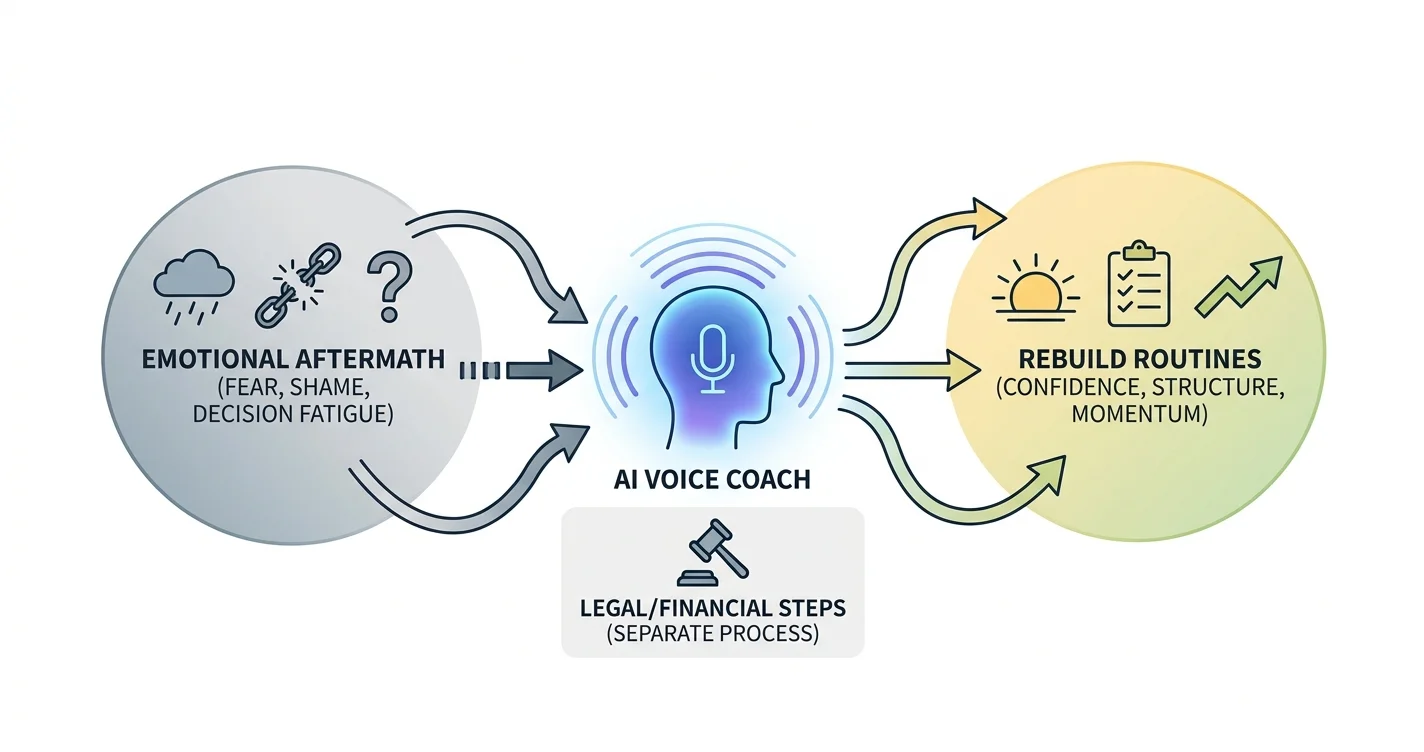
- An AI life coach for starting over after bankruptcy works best for the emotional aftermath, not the legal or
- Lovon is a voice-based AI companion built for 2am spirals and daily check-ins, not a substitute for a bankruptcy
- Rebuilding confidence after bankruptcy in 2026 takes structured daily routines more than motivation talks.
- Free peer groups and self-guided books remain the lowest-cost starting point; AI coaching fills the gap between
AI life coach for starting over after bankruptcy means using a voice-based support tool to process the fear, shame, and decision fatigue that show up after a filing — not to manage your repayment plan or replace your attorney. What makes this segment different from general financial stress is timing: bankruptcy has a hard legal end date, but the identity hit doesn't follow that same calendar, and most people are still white-knuckling it months after the paperwork clears.
TL;DR
- An AI life coach for starting over after bankruptcy works best for the emotional aftermath, not the legal or credit-repair steps.
- Lovon is a voice-based AI companion built for 2am spirals and daily check-ins, not a substitute for a bankruptcy attorney or licensed therapist.
- Rebuilding confidence after bankruptcy in 2026 takes structured daily routines more than motivation talks.
- Free peer groups and self-guided books remain the lowest-cost starting point; AI coaching fills the gap between sessions or when nothing else is available at 2am.
Why an AI life coach matters for people starting over after bankruptcy
Bankruptcy resolves a balance sheet. It does nothing for the part of your brain that still flinches when a bill arrives or a friend asks how you're doing financially. That gap — legal closure without emotional closure — is exactly where a lot of people get stuck for months, sometimes years, after discharge.
The practical constraint for this segment is access. Traditional financial therapy is appointment-based and often has a waitlist, and most people rebuilding after bankruptcy are also rebuilding a budget, which makes recurring session costs a hard sell. That's the specific niche an AI life coach for starting over after bankruptcy fills: something available at midnight when the shame spiral hits, without an appointment.
Building your comeback routine
Update your daily structure
Bankruptcy often follows a period of chaos — missed payments, collection calls, avoided mail. The habits that formed during that chaos don't disappear the day the discharge order is signed.
- Pick one fixed wake time and stick to it for 30 days, even on bad days
- Set a single daily 10-minute window to check finances instead of checking all day
- Write down three things you did today instead of three things you owe
- Replace the habit of avoiding mail with a weekly 15-minute mail-opening ritual
If your motivation is inconsistent, rebuilding confidence after a layoff covers the same rebuild-from-zero mechanics that apply whether the trigger was a job loss or a filing.
Name what you're actually grieving
Most people treat bankruptcy as a math problem. It's also a loss — of a version of yourself, of certain relationships, sometimes of a house or a business you built. Skipping the grief step is why the shame lingers past the legal deadline.
- Write one paragraph naming exactly what you lost, not just what you owed
- Separate "I made bad decisions" from "I am a bad person" out loud, not just in your head
- Give yourself a specific date (not "someday") to stop apologizing for the filing to people who weren't affected by it
- Track how many times a day you bring up the bankruptcy unprompted — that number should shrink over weeks, not stay flat
Reset your relationship with money triggers
A notification from your bank, a subscription renewal, a coworker talking about a vacation — these become physical triggers after bankruptcy, not just emotional ones. Your nervous system learned that money news equals danger.
- Turn off non-essential banking push notifications for 60 to 90 days
- Practice a 4-count breath before opening any bill, every time, until it's automatic
- Keep a note of which specific numbers or words spike your anxiety ("past due," a specific dollar figure) so you can name the trigger instead of just feeling it
- Talk through the spike out loud the moment it happens rather than sitting with it alone
This is where a voice-based AI coach earns its place — not as step one, but as the tool you reach for in the exact moment a trigger fires and no one else is awake. Financial anxiety and money stress support walks through the same trigger-naming process in more depth.
Practice the conversations that scare you
Telling a landlord, a new employer, or a partner about a bankruptcy is one of the most rehearsed-in-your-head, never-said-out-loud conversations there is.
- Say the exact sentence you'll use out loud, alone, at least five times before the real conversation
- Prepare one factual sentence about the timeline and one sentence about what's different now
- Decide in advance what you will not disclose unless directly asked
- Rehearse the version where they react badly, not just the version where it goes well
Shift the scarcity mindset before it becomes permanent
Bankruptcy can lock in a scarcity mindset long after the finances stabilize — hoarding, under-spending on necessities, refusing reasonable opportunities out of fear. That mindset, left unchecked, outlasts the debt by years.
- Name one small, planned expense per week that isn't an emergency, and follow through on it
- Track your net worth or savings monthly instead of your bank balance daily
- Ask yourself before every financial decision: "Is this fear from 2026, or fear from before the filing?"
- Read scarcity mindset vs abundance mindset once a month until the shift starts to stick
Talk through decisions before you make them
Post-bankruptcy decision paralysis is real — even small purchases can trigger hours of second-guessing. Talking a decision out loud, even to a voice-based tool, interrupts the loop faster than journaling alone for most people.
- Say the decision and your top two options out loud before you research further
- Set a 24-hour rule for any decision under a set amount instead of researching for a week
- Ask what the worst realistic outcome is, specifically, not the catastrophized version
- Notice if you're avoiding the decision entirely — that's a signal worth naming
Comparing your options in 2026
| Option | Best for | Key limitation |
|---|---|---|
| Financial therapist (licensed) | Deep, ongoing work tied to money trauma | Appointment-based, often waitlisted |
| Debtors Anonymous / peer group | Shared experience and outside accountability | Fixed meeting times, group format, not private |
| General life coach | Goal-setting after discharge | Rarely trained in financial trauma specifically |
| Self-guided books and podcasts | Free, flexible, no commitment | No feedback loop when it's hardest |
| Lovon (AI voice coach) | On-demand talking through spirals and decisions | Not a licensed clinician, not legal or financial advice |
Verdict: Lovon fits best as the always-open option between other kinds of support, not as the only one. If you need legal guidance, that's an attorney's job; if you need clinical treatment for depression or trauma tied to the filing, that's a licensed therapist's job.
Talk it through right now
Start a voice conversation with Lovon whenever the money anxiety spikes.
Common mistakes people make starting over after bankruptcy
- Treating it as purely logistical. Filing paperwork, updating a credit report, and closing accounts feels like "handling it," but skipping the emotional processing just delays it.
- Over-explaining to everyone. Disclosing the full story to coworkers, extended family, or acquaintances usually increases shame rather than relieving it.
- Doom-scrolling financial forums. Reading worst-case bankruptcy stories at midnight reinforces the exact catastrophizing loop you're trying to break.
- Isolating from your support network. Avoiding calls and invitations out of embarrassment cuts off the people most likely to help you rebuild.
- Confusing frugality with recovery. Refusing every non-essential purchase for years, long after finances have stabilized, is scarcity mindset, not discipline.
FAQ
What is an AI life coach for starting over after bankruptcy?
It's a voice-based AI tool that helps you process the shame, anxiety, and decision fatigue that follow a bankruptcy filing. It supports the emotional rebuild, not the legal filing or credit repair itself.
Is an AI life coach as good as therapy after bankruptcy?
No — an AI life coach is not a substitute for licensed therapy, especially if depression, trauma, or suicidal thoughts are involved. It works as a between-sessions or middle-of-the-night companion, not a clinical replacement.
Can an AI life coach help with the shame of bankruptcy?
Talking through the shame out loud, in the moment it hits, interrupts the spiral faster than sitting with it alone. Lovon is built for exactly that kind of on-demand voice conversation.
Is Lovon a replacement for a bankruptcy attorney?
No. Lovon does not give legal or financial advice — an attorney handles the filing, discharge, and any legal follow-up. Lovon supports the emotional side of the recovery.
How soon after filing should I start working with an AI life coach?
There's no required waiting period — many people start using voice-based support the same week they file, while the shock is freshest and hardest to talk about with people they know.
What's the difference between an AI life coach and an AI therapist app?
An AI life coach focuses more on goals, habits, and forward momentum; an AI therapy tool leans more on emotional processing and coping skills. Lovon blends both through voice conversation.
Does talking to an AI voice coach actually help with financial anxiety?
Voicing a worry out loud, rather than just thinking it, is a basic technique used in cognitive behavioral approaches to interrupt rumination. An AI voice coach gives you that outlet on demand, even at 2am.
Are free options enough for post-bankruptcy recovery in 2026?
Peer support groups and self-guided books are genuinely useful and free, but they lack a feedback loop in the exact moment you need one. Many people use a mix of free peer support and an on-demand tool like Lovon rather than choosing just one.
One last thing
The part people underestimate in 2026 isn't the credit score recovery — it's how long the reflex to hide financial reality from people you love outlasts the actual debt. That reflex, left unaddressed, quietly damages the relationships you'll need most while rebuilding. Naming it out loud, even to an AI voice coach at first, is often the only way to catch it before it becomes permanent.
Related guides
How AI Support Helps You Heal
AI emotional support isn't about replacing human connection — it's about filling the gaps. The moments when you need to talk at 2 AM, when you don't want to burden your friends again, or when you simply need someone to listen without judgment.
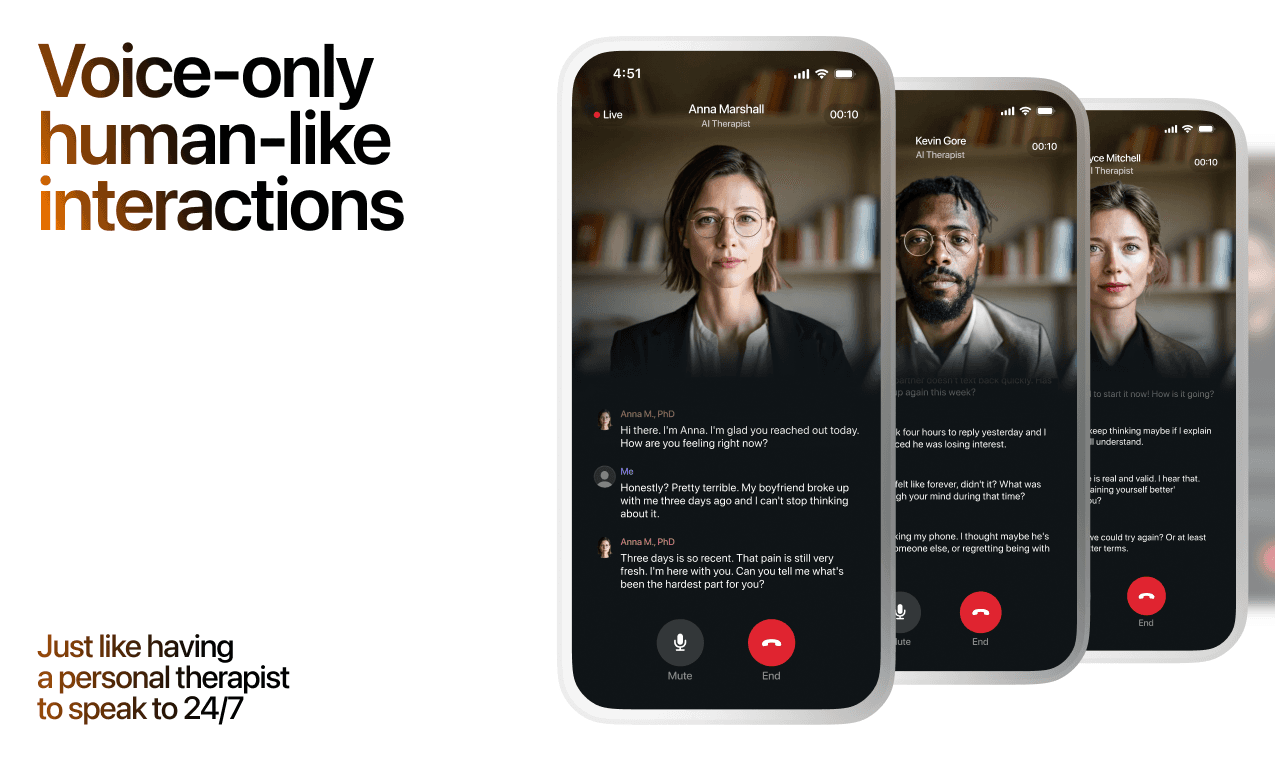
Here's what happens in a typical Lovon session:
You share what's on your mind
There's no script, no intake form, no waiting room. You speak or type whatever you're feeling — in your own words, at your own pace.
Lovon validates and explores
Using frameworks from CBT (Cognitive Behavioral Therapy) and motivational interviewing, Lovon acknowledges your feelings first, then gently helps you explore them. No dismissive "just move on" advice.
You build coping skills together
Lovon doesn't just listen — it actively works with you on evidence-based techniques: thought reframing, urge surfing, behavioral experiments, and more.
What a Session with Lovon Looks Like
Lovon is AI support, not a replacement for professional care. If things have been hard to get through for weeks, or you are thinking about harming yourself, talk to a doctor or a licensed therapist.
Ready to Start?
Your healing journey can begin right now
A 7-day trial. No judgment. Just a safe space to process what you're going through.
Frequently Asked Questions
Is Lovon a replacement for a real therapist?
Is my conversation with Lovon AI private?
How is Lovon different from ChatGPT for emotional support?
Can I use Lovon if I'm already seeing a therapist?
Can I try Lovon before subscribing?
About the Author

The Lovon Editorial Team
Mental Health & Wellness Content Team
The Lovon Editorial Team develops mental health and wellness content designed to make psychological concepts accessible and actionable. Our goal is to bridge the gap between clinical research and everyday life - helping you understand why your mind works the way it does and what you can do about it....
Related articles
- AI Life Coach for First-Time Managers: 2026 Verdict
First-time managers face imposter syndrome and burnout with no training. See when Lovon's AI life coach helps in 2026…
- How to Use an AI Life Coach for Motivation (2026)
Learn exactly how to use an AI life coach for motivation in 2026 — 7 steps, real commitments, and free sessions on Lovon…
- How to Overcome Decision Fatigue (2026 Guide)
How to overcome decision fatigue in 2026: cut options, batch small choices, and talk hard decisions out loud before they…
- AI Life Coach for Career Changers Over 40 (2026 Guide)
Best AI life coach for career changers over 40 in 2026: what to look for, top picks, and what to avoid when switching…
See also
Quizzes
- Guilt Test: Do I Have a Guilt Complex? Excessive Guilt Quiz
See whether your guilt repairs or just hurts.
- Confidence Test: How Confident Am I? Self-Confidence Quiz
See which part of your confidence is thin.
Free tools
- How to End a Friendship Without a Scene
A chat for working out how to end a friendship clearly, without a grievance list or a slow ghost. Tell it how long you…
- How to Reconnect With an Old Friend
A chat for how to reconnect with an old friend, starting with the text you have been meaning to send for a year. Tell it…
From the wiki
- What to do if you have no friends?
Pick one activity that repeats weekly with the same people, and go for six to eight weeks straight. Repetition, not…
Disclaimer: This article is for informational purposes only and does not constitute medical advice, diagnosis, or treatment. Always seek the advice of your physician or other qualified health provider with any questions you may have regarding a medical condition. If you are in crisis or think you may have an emergency, call 988 (Suicide & Crisis Lifeline) or go to the nearest emergency room. Outside the US? Find a crisis line in your country.