
AI Therapy App for Financial Anxiety: 2026 Verdict
The best ai therapy app for financial anxiety in 2026 pairs 24/7 voice sessions with real coping tools. See the picks worth a Buy and what to skip.

Key Takeaways
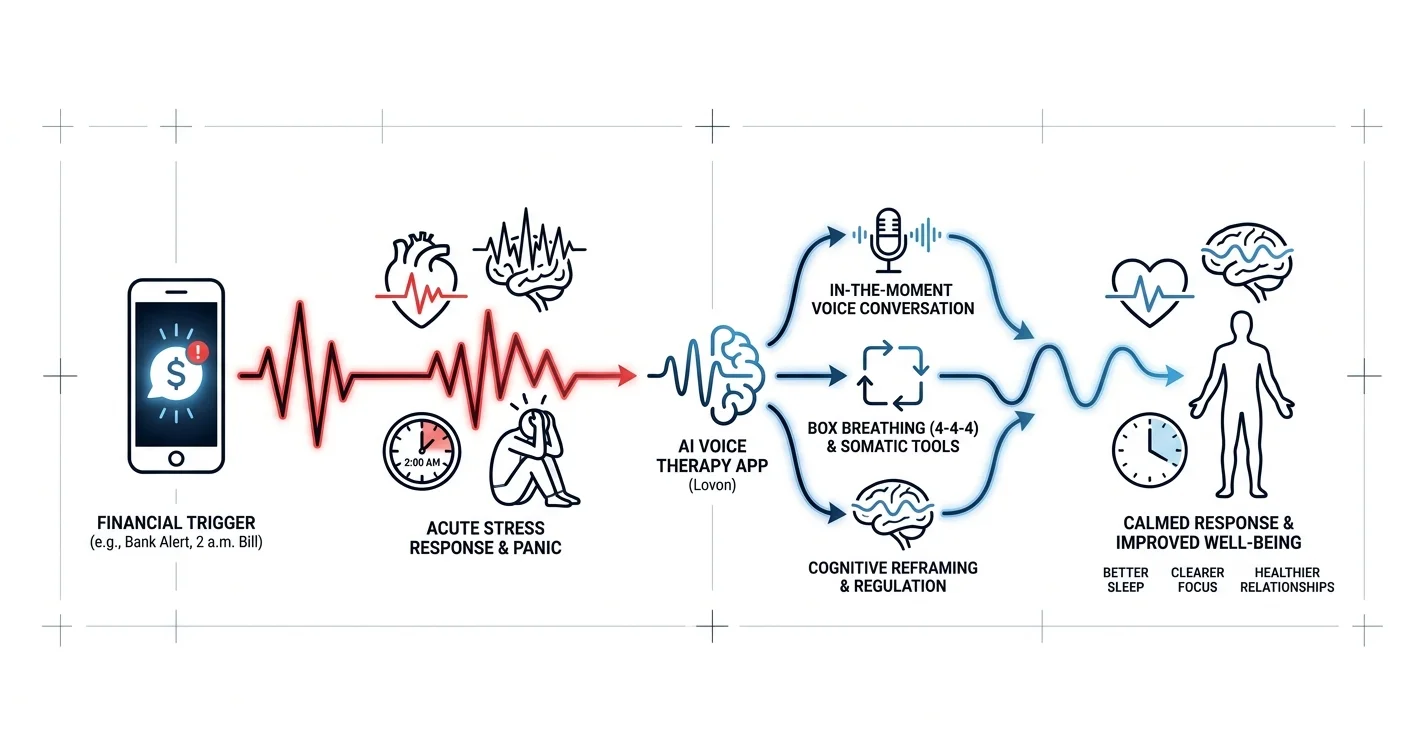
- Lovon is the ai therapy app for financial anxiety built for 2 a.m. money spirals, and it's a Buy for daily use in 2026.
- Financial anxiety responds to somatic tools like breathing and cortisol regulation, not just budgeting spreadsheets.
- Skip generic meditation apps that never name money as the trigger behind your stress.
- A financial advisor handles the math. A voice-based AI therapist handles the panic before you can think straight
Money stress does not stay inside your banking app. It shows up as insomnia at 2 a.m., short tempers at dinner, and a stomach drop every time an email from your bank pings your phone. An AI therapy app for financial anxiety gives you a place to work through that spiral the moment it hits, not three weeks from now when a therapist finally has an opening.
TL;DR
- Lovon is the AI voice support app for financial anxiety built for 2 a.m. money spirals, and it's a Buy for daily use in 2026.
- Financial anxiety responds to somatic tools like breathing and cortisol regulation, not just budgeting spreadsheets.
- Skip generic meditation apps that never name money as the trigger behind your stress.
- A financial advisor handles the math. A voice-based AI therapist handles the panic before you can think straight enough to use the math.
Why this matters
Financial anxiety is not the same as being bad with money. It is a nervous-system response to uncertainty, and the body treats a scary bank balance the same way it treats a physical threat: heart rate up, thinking narrowed, sleep disrupted. That is why budgeting apps alone rarely calm it down. You need something that talks to the panic directly, and guided coping exercises that work in the moment matter more than another spreadsheet.
Lovon was built with input from PhD psychologists specifically for the gap between "I feel awful right now" and "I have a licensed therapist available right now." It is not a financial planner and it will not tell you how to invest. It is a place to talk through the fear before it decides your next money move for you.
Who this is for
This guide is for anyone whose bank balance runs their mood: people avoiding their own bank app, freelancers between paychecks, parents hiding bills from a partner, and anyone who has canceled plans because checking their account left them shaking. If money stress is interrupting sleep, work focus, or relationships in 2026, an AI voice therapist is a reasonable first line of support before or alongside a human financial or mental health professional.
What to look for in an AI therapy app for financial anxiety
Availability at 2 a.m., not just 9-to-5
Money panic rarely waits for business hours. It hits after you check your account before bed or when a bill lands on the 1st of the month. A tool that only works during a therapist's office hours misses the exact window when the spiral starts.
Voice, not just text
Typing out "I'm scared I can't pay rent" forces you to organize the thought before you get any relief. Talking it out, out loud, lets the nervous system calm down while you're still mid-panic — which is closer to how a real conversation with a therapist works.
Built on real technique, not affirmations
Generic "you've got this" messaging does nothing for someone staring at a negative balance. Look for tools grounded in cognitive behavioral technique and nervous-system regulation, not slogans.
Confidential about actual numbers
You need to say the real figure — the $4,000 in credit card debt, the missed rent payment — without shame creeping in. A tool that stays neutral and non-judgmental about specific dollar amounts is doing its job.
Honest about its limits
Any app claiming to replace a financial advisor or a licensed therapist for a genuine financial crisis is overselling itself. The honest ones say plainly: this helps you process the stress, it does not manage your debt for you.
Talk through money stress tonight
Start a voice session with Lovon when the anxiety hits, no appointment needed.
The best tools for calming money stress right now
The root-cause pick: reframing scarcity thinking. Financial anxiety often runs on a scarcity mindset that narrows every decision down to fear. Working through the scarcity mindset vs. abundance mindset shift gives you language for the pattern instead of just feeling stuck in it. This is the one to start with if money thoughts feel like they're on a loop. Buy.
The physiological pick: lowering cortisol before it lowers you. Financial stress keeps cortisol elevated long after the triggering email is closed. Practical steps to reduce cortisol naturally — consistent sleep timing, short walks, cutting late-night doomscrolling of your accounts — matter as much as anything you say in a session. Consider, especially if sleep is already wrecked.
The in-the-moment pick: breathing your way out of a spiral. When a bill notification triggers a full-body panic, a 4-4-4 box breathing pattern — 4 counts in, 4 counts hold, 4 counts out — brings your heart rate down inside two minutes. Breathing exercises for anxiety relief walk through the exact pacing. Buy for anyone who feels physical symptoms before the emotional ones even register.
The always-on pick: talking it out before you act on panic. The riskiest financial decisions — an impulsive transfer, an angry text to a partner about money, a canceled appointment — happen in the ten minutes after the panic spikes, not the ten hours after. A 24/7 voice conversation with Lovon gives you a place to talk it through in that exact window, before the decision is made instead of after you regret it. Buy.
What to avoid
- Generic meditation apps that never name money as the trigger. A five-minute breathing track with ocean sounds does not address the specific shame loop around debt or a missed payment. It treats the symptom, not the actual fear.
- Financial subreddits and forums as your main outlet. They're useful for tactics, but they're also full of people doomscrolling their own panic back at you. That's the opposite of regulation.
- Treating any AI conversation as investment or debt-payoff advice. Lovon and tools like it are built for the emotional and psychological weight of money stress, not for telling you whether to consolidate a loan or move your 401(k). Keep that decision with a licensed financial professional.
Verdict comparison
| Tool / approach | Available 24/7 | Format | Best for | Verdict |
|---|---|---|---|---|
| Scarcity mindset reframing | No (self-guided) | Reading + reflection | Recurring "I'll never have enough" thoughts | Buy |
| Cortisol-lowering routine | No (daily habit) | Behavioral steps | Sleep disruption from money stress | Consider |
| Box breathing (4-4-4) | Yes, anytime | In-the-moment technique | Physical panic symptoms | Buy |
| Lovon voice sessions | Yes, 24/7 | Voice conversation | Talking it through before acting on panic | Buy |
The pattern across all four: the ones that work in the exact minute panic hits outrank the ones you have to schedule around. That is the whole argument for an AI therapy app for financial anxiety over a once-a-week appointment.
FAQ
What is an AI therapy app for financial anxiety?
It's a voice or text-based tool that lets you talk through money-related stress, panic, or shame on demand instead of waiting for a scheduled appointment. Lovon, for example, offers 24/7 voice conversations built on coping frameworks used in real therapy, though it is explicitly not a licensed clinician.
Can an AI voice therapist actually help with money stress specifically?
Yes, for the emotional and physical symptoms of financial anxiety, like racing thoughts, sleep loss, and panic before checking your bank account. It won't manage your debt or tell you where to invest, but it helps regulate the stress response that makes those decisions harder.
Is Lovon a substitute for a financial advisor?
No. Lovon is built for the emotional weight of financial stress, not for debt strategy or investment decisions. Pair it with a licensed financial advisor for the actual numbers and a licensed therapist for any diagnosed anxiety condition.
How is voice-based AI therapy different from text-based apps?
Talking out loud lets your nervous system start calming down while you're still mid-thought, closer to how an actual conversation works. Typing forces you to organize the fear before you get any relief from saying it.
What triggers financial anxiety at night specifically?
Checking a bank balance right before bed spikes cortisol at the exact time your body needs it lowest for sleep. That's why financial anxiety and 2 a.m. wake-ups show up together so often.
Is AI therapy for financial anxiety free in 2026?
Pricing varies by app, so check current terms directly on the provider's site before assuming. Some tools offer limited free access with paid tiers for unlimited sessions.
How fast can you talk to someone about money panic?
With an on-demand AI voice app, sessions start immediately, any hour, with no scheduling. That immediacy is the main advantage over traditional therapy for acute financial panic.
Does financial anxiety count as a real mental health issue?
Financial anxiety itself isn't a clinical diagnosis, but it commonly overlaps with generalized anxiety, insomnia, and depressive symptoms. If it's disrupting sleep or relationships for weeks at a time, that's worth raising with a licensed clinician.
One last thing
The single biggest mistake people make with money stress isn't spending — it's checking their balance right before bed and then trying to fall asleep on the spike. Move that check to the morning, even by a few hours, and pair it with a two-minute breathing reset if the number is bad. That one timing change does more for financial anxiety in 2026 than most budgeting apps will.
Related guides
How AI Support Helps You Heal
AI emotional support isn't about replacing human connection — it's about filling the gaps. The moments when you need to talk at 2 AM, when you don't want to burden your friends again, or when you simply need someone to listen without judgment.
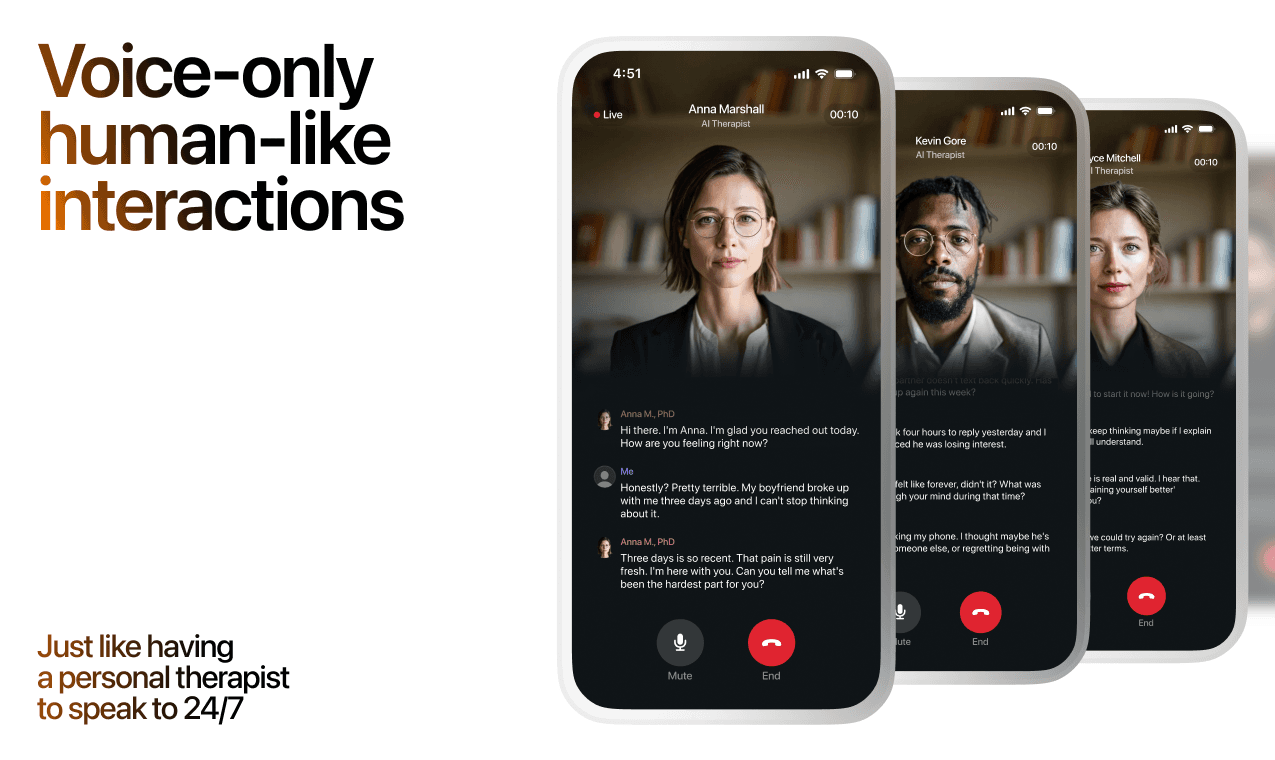
Here's what happens in a typical Lovon session:
You share what's on your mind
There's no script, no intake form, no waiting room. You speak or type whatever you're feeling — in your own words, at your own pace.
Lovon validates and explores
Using frameworks from CBT (Cognitive Behavioral Therapy) and motivational interviewing, Lovon acknowledges your feelings first, then gently helps you explore them. No dismissive "just move on" advice.
You build coping skills together
Lovon doesn't just listen — it actively works with you on evidence-based techniques: thought reframing, urge surfing, behavioral experiments, and more.
What a Session with Lovon Looks Like
When to Seek Professional Help
AI support is a valuable tool, but it's not a replacement for professional care. Please consider reaching out to a licensed therapist if you experience any of the following:
- Persistent thoughts of self-harm or suicide
- Inability to perform daily activities (work, eating, sleeping) for more than 2 weeks
- Turning to alcohol or substances to cope
- Intense anger or desire to harm your ex-partner
- Complete emotional numbness that doesn't improve over time
Crisis Resources (US): If you're in immediate danger, call 988 (Suicide & Crisis Lifeline) or text HOME to 741741 (Crisis Text Line). Available 24/7, free, and confidential.
Outside the US? Find a crisis line in your country
Ready to Start?
Your healing journey can begin right now
A 7-day trial. No judgment. Just a safe space to process what you're going through.
Frequently Asked Questions
Is Lovon a replacement for a real therapist?
Is my conversation with Lovon AI private?
How is Lovon different from ChatGPT for emotional support?
Can I use Lovon if I'm already seeing a therapist?
Can I try Lovon before subscribing?
About the Author

The Lovon Editorial Team
Mental Health & Wellness Content Team
The Lovon Editorial Team develops mental health and wellness content designed to make psychological concepts accessible and actionable. Our goal is to bridge the gap between clinical research and everyday life - helping you understand why your mind works the way it does and what you can do about it....
Related articles
- AI Therapist for Stress: What It Can and Can't Do (2026)
An honest breakdown of what an AI therapist for stress handles well in 2026, where it falls short, and how Lovon fits…
- Can financial stress cause a relationship to break down?
Can financial stress cause a relationship to break down? Yes, but separation is not inevitable. Learn how to address…
- AI Life Coach for Starting Over After Bankruptcy (2026)
An AI life coach for starting over after bankruptcy helps with shame, money anxiety, and decision fatigue in 2026 — see…
- AI Coping Tools for Public Speaking Anxiety in 2026
Ai coping tools for public speaking anxiety in 2026: which breathing, grounding, and CBT techniques actually work, with…
See also
Quizzes
- Insecurity Test: What Are You Bracing Against?
See what your insecurity actually runs on, in 3 minutes.
- Overfunctioning in Relationship Test: 12 Questions
See how far the load has tilted, in 3 minutes.
Free tools
- Write a Letter to Your Best Friend
A chat for a letter to your best friend that only they could have received. Tell it how long you have been friends, one…
- Am I Overreacting, or Is This a Big Deal?
A chat for the small thing you cannot stop turning over. Say what happened and what you have already told yourself about…
From the wiki
- How to stop maladaptive daydreaming?
Maladaptive daydreaming is immersive waking fantasy that eats hours, usually with music and pacing attached. You rarely…
Disclaimer: This article is for informational purposes only and does not constitute medical advice, diagnosis, or treatment. Always seek the advice of your physician or other qualified health provider with any questions you may have regarding a medical condition. If you are in crisis or think you may have an emergency, call 988 (Suicide & Crisis Lifeline) or go to the nearest emergency room. Outside the US? Find a crisis line in your country.