
How to Overcome Decision Fatigue (2026 Guide)
How to overcome decision fatigue in 2026: cut options, batch small choices, and talk hard decisions out loud before they wear you down completely.

Key Takeaways
- Decision fatigue depletes with every choice you make, not just the big ones — batching small decisions is the
- Cutting choices before 10am (clothes, food, routes) protects mental bandwidth for what actually matters later.
- A 90-second voice check-in on a tool like Lovon can interrupt a fatigue spiral before it turns into avoidance.
- Decision fatigue and burnout overlap — if it's been weeks, not hours, you're likely dealing with something bigger.
Decision fatigue shows up as the third "I don't care, you pick" of the day and the inbox you keep closing without answering. It's not a personality flaw — it's a resource that runs out, and 2026 gives you more daily choices to burn it on than any year before.
TL;DR
- Decision fatigue depletes with every choice you make, not just the big ones — batching small decisions is the fastest fix.
- Cutting choices before 10am (clothes, food, routes) protects mental bandwidth for what actually matters later.
- A 90-second voice check-in on a tool like Lovon can interrupt a fatigue spiral before it turns into avoidance.
- Decision fatigue and burnout overlap — if it's been weeks, not hours, you're likely dealing with something bigger.
Why this matters
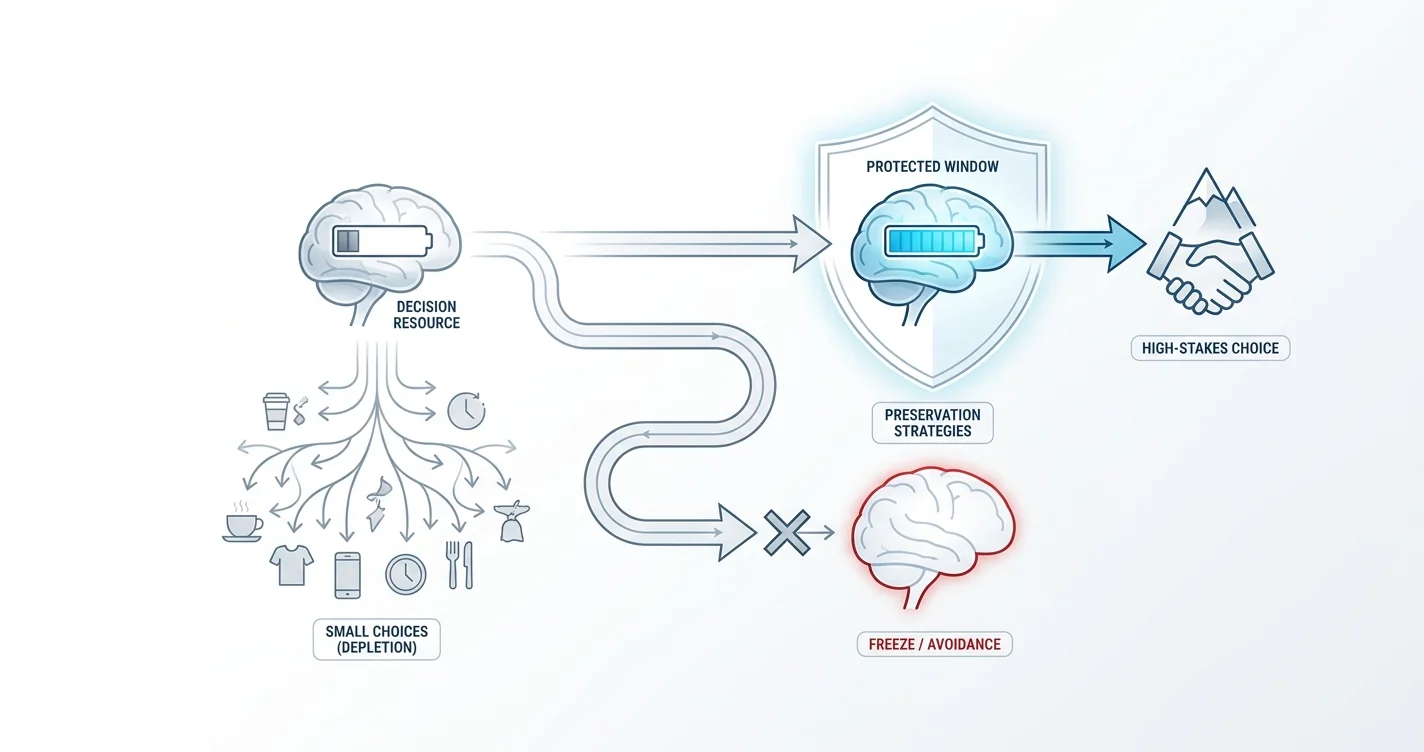
Your brain doesn't have unlimited willpower for choosing. Every decision, from what to eat to whether to reply to that text, pulls from the same tank. By the time you hit a real decision — a job offer, a hard conversation — the tank is dry and you either freeze, default to the easiest option, or avoid the choice entirely.
This matters beyond productivity. Chronic decision fatigue in 2026 tracks closely with burnout, anxiety spirals, and the kind of low-grade dread that makes Sunday nights miserable. Fixing it isn't about being more disciplined. It's about reducing the number of decisions your brain has to process cold.
What you'll need
- 10 minutes to map your daily decision points
- A notes app or paper for a simple "default list"
- One recurring time block you can protect (morning or first work hour works for most people)
- A way to talk through the harder decisions out loud — pacing the room, a trusted person, or a voice tool like Lovon when no one's around at 11pm
- Honesty about which decisions you're avoiding versus which ones you're overthinking
The steps
1. Audit where your decisions actually go
Write down every decision you made yesterday, from "snooze or get up" to "which project to start with." Most people find 60-70 decisions before lunch, and almost none of them needed real thought.
This step accomplishes one thing: it shows you the volume problem. You're not failing at decision-making. You're running too many low-stakes choices through a high-effort process.
Common mistake: stopping at the big decisions and skipping the small ones. The small ones are where the fatigue actually accumulates.
2. Build a default list for anything under 5 minutes
Pick your go-to breakfast, your default gym time, your standard reply to "how are you." Write down 8-10 defaults and commit to them for two weeks straight in 2026 before you touch them again.
Defaults remove the decision entirely instead of speeding it up. That's the difference between deciding faster and not deciding at all — the second one is what actually preserves mental energy.
Expected outcome: by day 4, you'll notice you're not thinking about breakfast, laundry day, or your morning route anymore. That's the goal.
3. Front-load hard decisions to your highest-energy window
Most people have 2-3 hours a day where thinking is easiest — for most, that's within 90 minutes of waking. Schedule your one genuinely hard decision of the day inside that window, every time, starting this week.
This matters because decision quality drops measurably as the day goes on, which is why late-afternoon choices feel harder even when they're objectively simpler than morning ones. Protect the window like a meeting.
Common mistake: using peak energy hours for email instead of decisions. Email can wait. Judgment calls can't.
4. Cap your options before you start choosing
If a decision has more than 3-4 real options, cut it down before you engage with it. Three restaurant choices beat fifteen. Two job offers to actually weigh beat five you're "still considering."
Option overload is the single biggest driver of decision fatigue in day-to-day life. Your brain treats 10 options as exponentially harder than 3, not linearly harder — cutting from 10 to 3 saves far more energy than it looks like on paper.
Expected outcome: decisions that used to take 20 minutes of scrolling take 2 minutes of comparing.
5. Externalize the decision by talking it out loud
Saying a decision out loud — to a person, or into a voice app — forces your brain to organize it into language, which cuts through the looping that happens when a choice just sits in your head. This is one reason AI coping tools for anxiety built around voice, not text, tend to help faster with this exact problem: talking is a different cognitive process than typing.
Set a 5-minute timer, say the decision and your top two options out loud, and notice which one you defend more convincingly. That's usually your answer.
Common mistake: journaling about the decision instead of speaking it. Writing lets you edit your thoughts before you finish them; speaking doesn't.
6. Separate "tired" decisions from "avoiding" decisions
Some decisions you're putting off because you're depleted. Others you're putting off because you already know the answer and don't want it. These need different fixes — rest solves the first, cognitive behavioral techniques solve the second.
Ask yourself: "if I had to decide right now with no more information, what would I pick?" If an answer comes instantly, you're avoiding, not fatigued.
Expected outcome: you stop wasting rest on decisions that were never about energy in the first place.
7. Schedule a hard stop on daily decision-making
Pick a time — 8pm works for most people — after which you make no new decisions of consequence. No planning tomorrow's schedule, no weighing purchases, no relationship conversations that require a verdict.
This protects the next day's tank instead of borrowing against it. Decisions made after depletion are measurably worse decisions, not just harder ones.
Common mistake: using the evening to "catch up" on decisions you avoided all day. That's the fastest way to make a bad call and regret it in the morning.
Troubleshooting
"I still can't decide even with fewer options." You're likely dealing with fear of the wrong choice, not fatigue itself — that's a different problem, closer to catastrophizing than to depletion, and it needs a different fix.
"My defaults keep falling apart by Wednesday." You picked too many at once. Cut your default list to 3 items and rebuild from there — trying to automate 10 habits in one week usually collapses by day three.
"I make fine decisions at work but freeze on personal ones." That's not fatigue, that's stakes. Personal decisions carry emotional weight that work decisions don't, so they deserve a slower process, not a faster one.
"I feel this exhausted every single day, not just some days." That's worth naming honestly — persistent, daily depletion for weeks looks more like burnout than ordinary decision fatigue, and it responds to different fixes.
"I spiral on one decision for hours." That's a loop, not fatigue — check whether it matches an anxiety spiral pattern before assuming it's just tiredness.
"I know the right decision but keep second-guessing it after." That's a thinking trap, not fatigue — the decision was fine, the aftermath is the problem.
Talk a hard decision through tonight
A short voice session can cut through the loop faster than another hour of scrolling options.
Tools and resources
- A default list (see step 2) kept somewhere you actually look at it
- A protected decision window on your calendar, not just a mental note
- A voice-based outlet for talking through the harder calls when no one's around
- Cognitive behavioral techniques for the decisions rooted in avoidance rather than depletion
- A hard evening cutoff for new decisions, applied consistently through 2026, not just on good weeks
What to do next
If decision fatigue keeps circling back to the same three or four choices — a relationship, a job, a move — the problem usually isn't the decision-making process anymore. It's unprocessed ambivalence. Talking that specific choice through out loud, in detail, tends to surface the real blocker faster than another pros-and-cons list.
FAQ
What is decision fatigue and how long does it last?
Decision fatigue is the decline in decision quality that happens after a series of choices, and it typically resets with sleep and a break from decision-making. It builds through the day and is usually worst in the evening, which is why late-night choices tend to feel harder than they are.
How many decisions cause decision fatigue?
There's no fixed number — it depends on the stakes and complexity of each choice, not a count. Ten high-stakes decisions will deplete you faster than fifty trivial ones like picking a shirt.
Is decision fatigue the same as burnout?
No, but they overlap. Decision fatigue is a daily, resettable depletion, while burnout is a longer, deeper exhaustion that doesn't recover with one night's sleep and often needs a different recovery plan.
Can decision fatigue cause anxiety?
Yes — depleted decision-making capacity makes small choices feel disproportionately threatening, which can trigger or worsen anxiety spirals. Reducing the number of daily decisions you make tends to lower both at once.
What's the fastest way to overcome decision fatigue in the moment?
Cut your options to two or three and set a short timer to force a call. Talking the choice out loud, rather than turning it over silently, speeds up resolution because it forces your brain to commit to language instead of looping.
Do successful people avoid decision fatigue by wearing the same outfit daily?
That's a well-known example of default-setting, not a rule to copy exactly. The underlying principle — automate low-stakes choices so energy goes to high-stakes ones — works regardless of what specific decisions you automate.
Why do I make worse decisions at night?
By evening, most people have used up the bulk of their daily decision-making capacity, so judgment and patience for weighing options both drop. This is why a hard cutoff on new decisions after a set evening hour helps protect next-day judgment.
Can talking to an AI voice app help with decision fatigue?
It can help by giving you a low-friction way to say a decision out loud and organize your thinking, which is a different cognitive process than silently weighing options. It's not a substitute for licensed care, but it works as an on-demand outlet when no one else is available.
One last thing
The decisions that exhaust you most in 2026 are rarely the biggest ones — they're the dozens of small, unnamed choices you never wrote down. Audit a single day honestly, cut the list in half with defaults, and the big decision that's actually been stuck for weeks usually gets easier almost immediately, simply because it finally has room to breathe.
Related guides
How AI Support Helps You Heal
AI emotional support isn't about replacing human connection — it's about filling the gaps. The moments when you need to talk at 2 AM, when you don't want to burden your friends again, or when you simply need someone to listen without judgment.
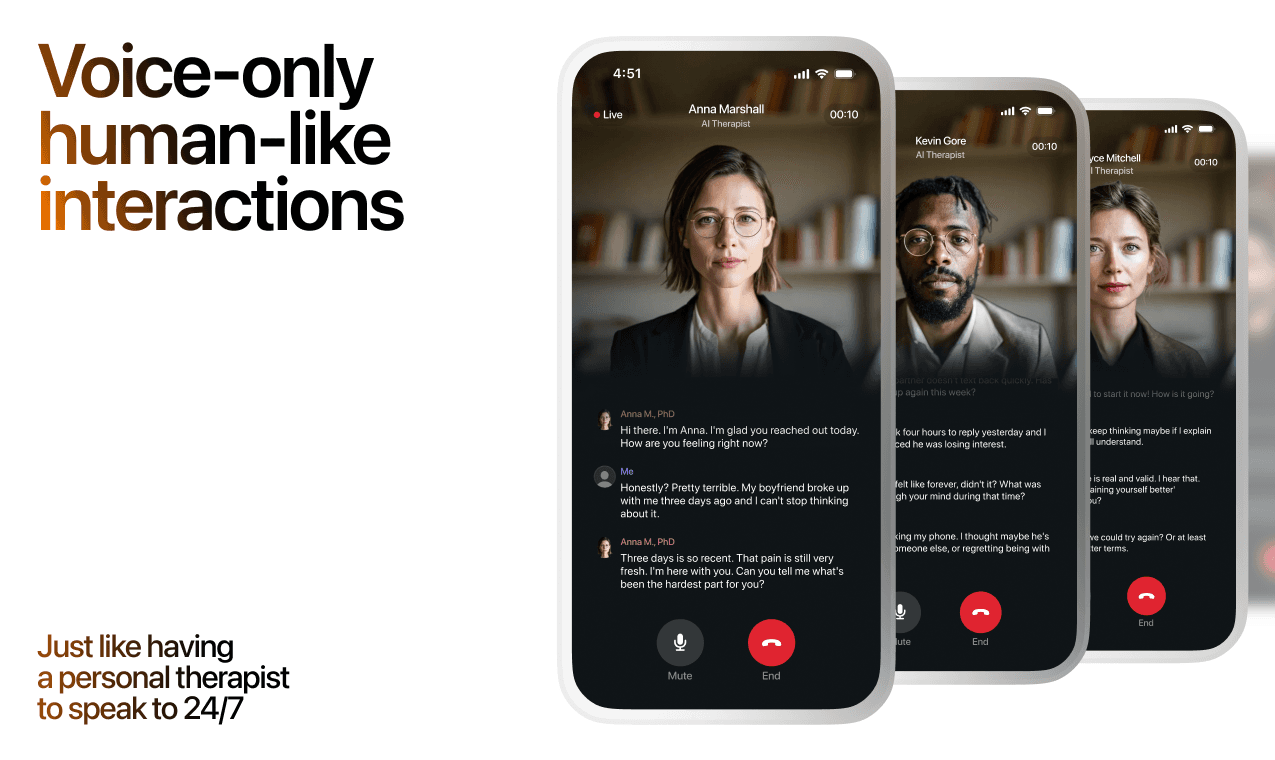
Here's what happens in a typical Lovon session:
You share what's on your mind
There's no script, no intake form, no waiting room. You speak or type whatever you're feeling — in your own words, at your own pace.
Lovon validates and explores
Using frameworks from CBT (Cognitive Behavioral Therapy) and motivational interviewing, Lovon acknowledges your feelings first, then gently helps you explore them. No dismissive "just move on" advice.
You build coping skills together
Lovon doesn't just listen — it actively works with you on evidence-based techniques: thought reframing, urge surfing, behavioral experiments, and more.
What a Session with Lovon Looks Like
When to Seek Professional Help
AI support is a valuable tool, but it's not a replacement for professional care. Please consider reaching out to a licensed therapist if you experience any of the following:
- Persistent thoughts of self-harm or suicide
- Inability to perform daily activities (work, eating, sleeping) for more than 2 weeks
- Turning to alcohol or substances to cope
- Intense anger or desire to harm your ex-partner
- Complete emotional numbness that doesn't improve over time
Crisis Resources (US): If you're in immediate danger, call 988 (Suicide & Crisis Lifeline) or text HOME to 741741 (Crisis Text Line). Available 24/7, free, and confidential.
Outside the US? Find a crisis line in your country
Ready to Start?
Your healing journey can begin right now
A 7-day trial. No judgment. Just a safe space to process what you're going through.
Frequently Asked Questions
Is Lovon a replacement for a real therapist?
Is my conversation with Lovon AI private?
How is Lovon different from ChatGPT for emotional support?
Can I use Lovon if I'm already seeing a therapist?
Can I try Lovon before subscribing?
About the Author
The Lovon Editorial Team
Mental Health & Wellness Content Team
The Lovon Editorial Team develops mental health and wellness content designed to make psychological concepts accessible and actionable. Our goal is to bridge the gap between clinical research and everyday life - helping you understand why your mind works the way it does and what you can do about it....
Related articles
- Best App for Parenting Stress and Burnout in 2026: Lovon
Lovon ranks best overall for parenting stress and burnout in 2026, with picks for co-parenting, meditation, journaling…
- Social Media Comparison Anxiety: Fix It in 2026
Social media comparison anxiety comes from curated feeds triggering upward comparison. Get the 7-step fix and…
- Best AI App for Physician Burnout in 2026: Lovon Wins
Lovon ranks best AI app for physician burnout in 2026 for on-demand voice support between shifts, compared against Wysa…
- ADHD and Anxiety: How the Two Conditions Overlap (2026)
ADHD and anxiety share symptoms but have different causes. Learn how they feed each other and what daily strategies…
See also
Quizzes
- Pet Loss Check: Free 12-Question Pet Grief Self-Check
See what losing them is actually doing, in 3 minutes.
- Am I Codependent? 12-Question Self-Check
See how much of you is left over, in 2 minutes.
Free tools
- How to Reconnect With an Old Friend
A chat for how to reconnect with an old friend, starting with the text you have been meaning to send for a year. Tell it…
- Am I Overreacting, or Is This a Big Deal?
A chat for the small thing you cannot stop turning over. Say what happened and what you have already told yourself about…
From the wiki
- Why do I keep dreaming about the same person?
A recurring dream figure usually marks unfinished emotional business rather than a message about that person. Your brain…
Disclaimer: This article is for informational purposes only and does not constitute medical advice, diagnosis, or treatment. Always seek the advice of your physician or other qualified health provider with any questions you may have regarding a medical condition. If you are in crisis or think you may have an emergency, call 988 (Suicide & Crisis Lifeline) or go to the nearest emergency room. Outside the US? Find a crisis line in your country.