
AI life coach for stay-at-home parents: complete 2026 guide
Use an AI life coach for stay-at-home parents for everyday support, not clinical care. Learn practical steps, privacy checks, and when to seek help.
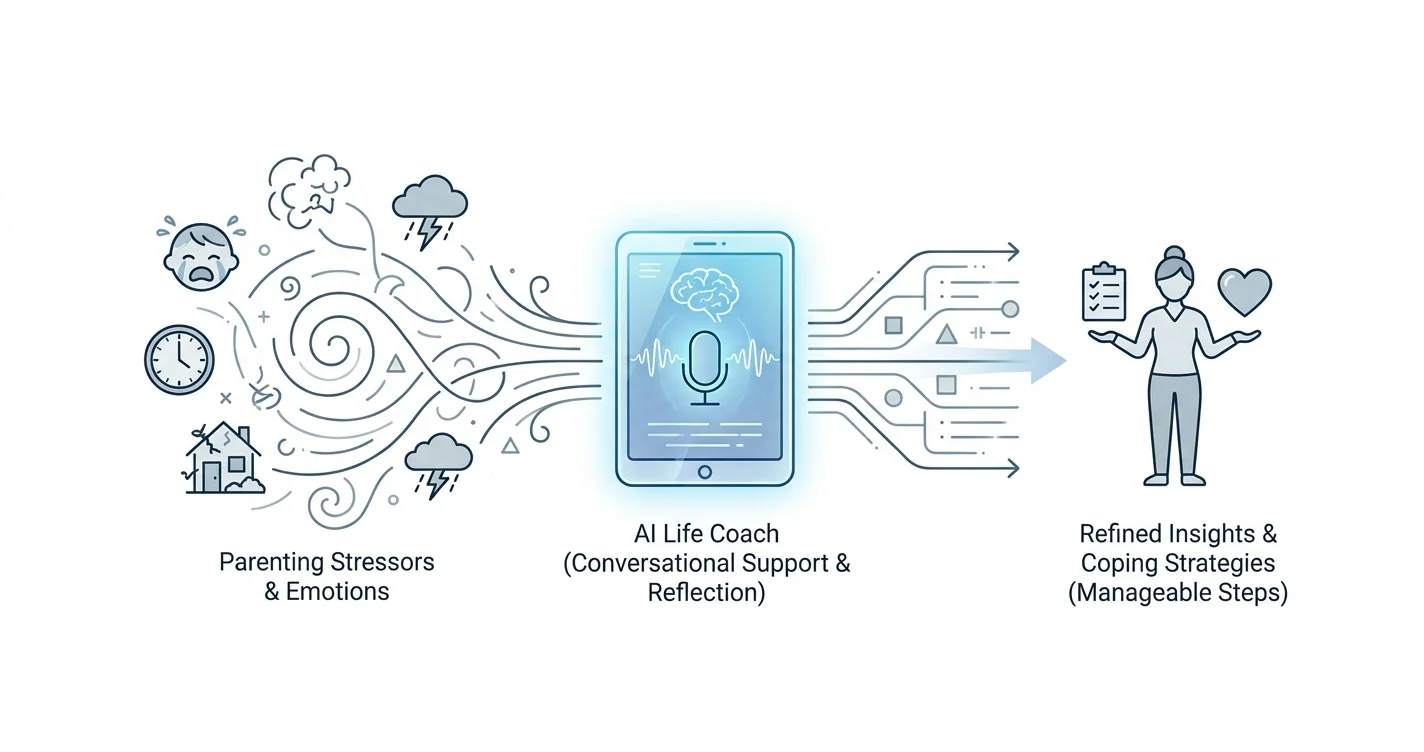

Key Takeaways
- Use an AI life coach for stay-at-home parents for reflection and coping tools, not diagnosis or emergency help.
- Lovon AI voice support is best suited to parents seeking conversation about everyday stress, not licensed clinical care.
- Start with one manageable need; check every suggestion against your child's safety and your own limits.
- Combine digital support with practical help, adult connection, and professional care when needed.
An AI life coach for stay-at-home parents is a conversational tool for sorting through feelings and everyday decisions, with the aim of making caregiving feel more manageable. Choose support that fits interrupted days and changing family needs—not a system that treats parenting like a productivity contest.
TL;DR
- Use an AI life coach for stay-at-home parents for reflection and coping tools, not diagnosis or emergency help.
- Lovon AI voice support is best suited to parents seeking conversation about everyday stress, not licensed clinical care.
- Start with one manageable need; check every suggestion against your child's safety and your own limits.
- Combine digital support with practical help, adult connection, and professional care when needed.
Why AI life coaching matters for stay-at-home parents
The useful question is not whether you can fit more into your day. It is what support you need to get through it. A conversation tool can give you somewhere to describe a difficult morning, consider a boundary, or decide what can wait.
Stay-at-home parenting does not come with guaranteed quiet time. If your opportunities to reflect happen between meals, school runs, or naps, start with support you can stop without treating the interruption as failure. This guide to AI apps for parenting stress and burnout covers the broader topic.
For your 2026 support plan, separate emotional support from practical relief. Talking about exhaustion does not provide childcare, redistribute household work, or assess a health condition. It can help you put those needs into words so you can ask for the right kind of help.
How to use an AI life coach without adding another obligation
Start on paper, in a notebook, or with a private note on your phone. You do not need an app to identify what is hard. Add a conversational tool only when talking something through serves a clear purpose.
Use the following sequence as a flexible check-in, not a daily assignment. You can stop after naming your need if that is all you have room for.
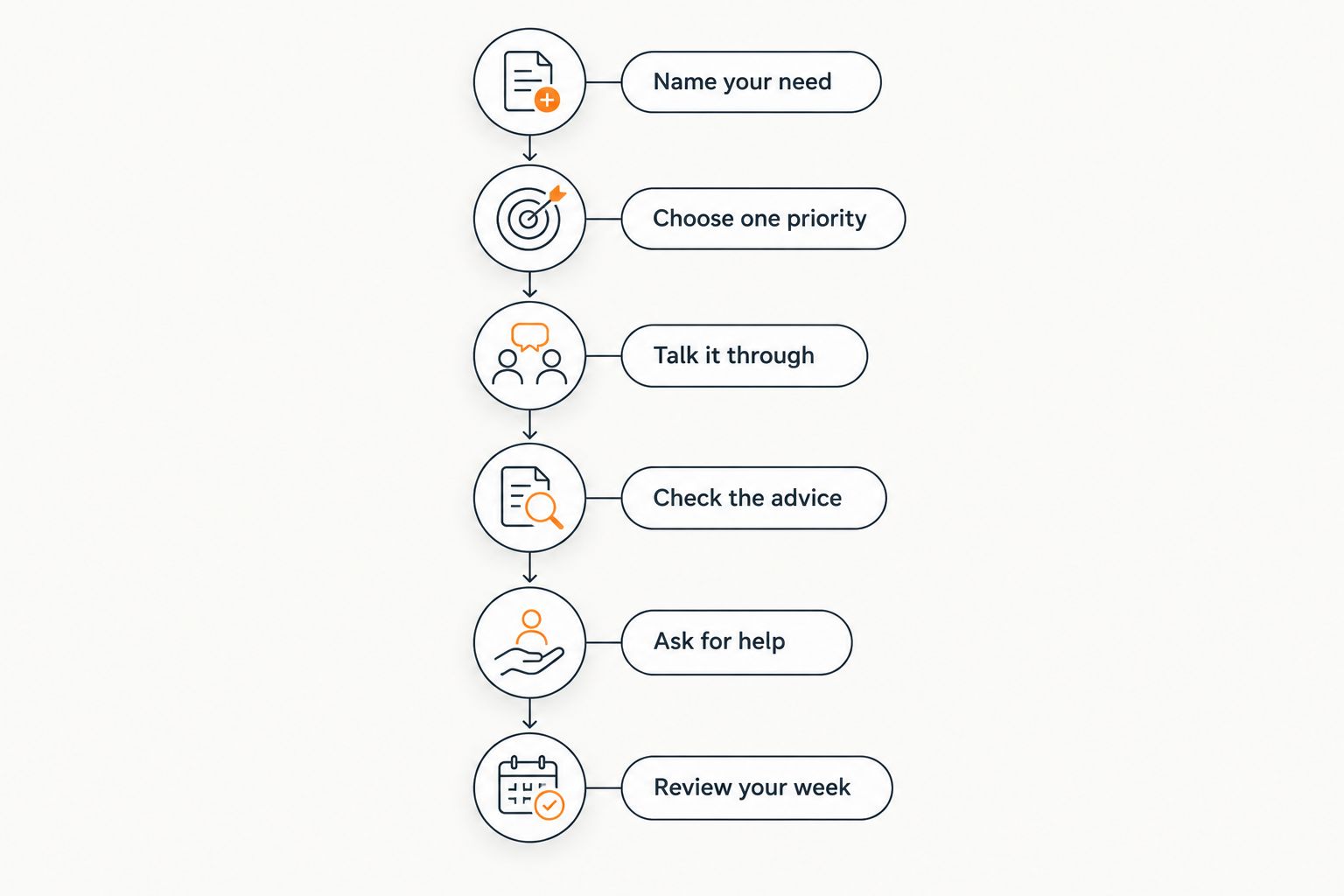 Six steps for using conversational support while keeping real-world needs and safety in view.
Start with your need, and finish by checking what helped outside the conversation.
Name your need
Before seeking advice, finish this sentence: the hardest part of today was ____. Keep the answer specific. Being interrupted while eating is a different problem from feeling alone all afternoon, even when both leave you upset.
Try a 2-minute check-in as a starting exercise, not a treatment recommendation. Write what happened, how you felt, and what you needed. You are gathering context, not grading your parenting.
Your 2026 check-in does not need a score, a streak, or an elaborate journal. A plain description is enough to begin.
- Describe one difficult moment without calling yourself a bad parent.
- Name a feeling, such as frustration, sadness, worry, or loneliness.
- Note a practical need, such as food, rest, company, or help.
- Decide whether you want listening, ideas, or a real-world conversation.
Choose one priority
Pick a concern small enough to address under today's actual conditions. Rather than trying to become more patient forever, focus on what you want to do differently during the next difficult transition.
A handwritten note works: when the afternoon feels crowded, leave one optional chore unfinished. The aim is not to make every task happen. It is to choose deliberately instead of accepting every demand as equally urgent.
Best for overloaded days: a small decision with a clear stopping point. Avoid building a detailed routine around uninterrupted time you do not have.
- Choose one situation, such as getting ready to leave home.
- Define an action you control, not your child's reaction.
- Make a shorter version for days when plans change.
- Identify something you will postpone to make room for that action.
Talk it through
Begin by saying the situation aloud to yourself or writing a short paragraph. If you want a conversational response, Lovon offers AI voice conversations for emotional support, coping tools, and self-reflection. Speaking is an alternative when you would rather talk than compose a journal entry.
For a 2026 trial routine, set aside 5 minutes when your child is safely supervised and you can attend to the conversation. This is a suggested boundary, not a required session length or a promise of results. Stop whenever caregiving needs your attention.
Lovon AI voice support is not licensed clinical care. Use the conversation to explore your experience, then judge the response rather than treating it as an expert instruction.
- Explain what happened before asking what to do.
- Say whether you want reflection or a practical next step.
- Ask for a shorter answer if the response feels overwhelming.
- End with one takeaway you can describe in your own words.
Check the advice
Review any suggestion before acting on it. An answer that sounds caring can still misunderstand your family, overlook a constraint, or recommend something inappropriate. You remain responsible for deciding what fits.
For example, advice to take a break needs a safe childcare arrangement. Advice to set a boundary needs to account for whether the conversation is safe. A polished response does not supply either condition.
Review privacy information before sharing sensitive details, too. Do not assume that an app conversation carries the same confidentiality protections as care from a licensed professional.
- Reject suggestions that compromise supervision or basic care.
- Remove names, school details, addresses, and identifying information.
- Check account access, data handling, and deletion information.
- Take medication, diagnosis, and treatment questions to a qualified clinician.
Ask for help
Turn reflection into a request someone can understand. Start manually by writing who could help, what you need, and when you need it. A tool can help you rehearse the wording; it cannot make another person participate.
If you share parenting with someone, distinguish helping from taking responsibility. Asking someone to own bedtime includes the preparation and follow-through, not just waiting for instructions. If you parent alone, focus on a realistic request to an available support person or community resource.
Best for unequal workloads: a concrete discussion about responsibilities, not another coping exercise that leaves the workload untouched.
- Name the task or break you need without apologizing for having needs.
- Specify who will handle preparation and follow-through.
- Ask a trusted adult for company as well as practical help.
- Arrange professional support when distress exceeds everyday problem-solving.
Review your week
After 7 days, review what the experiment changed outside the app. This is a suggested review point, not a clinical timeline. Look for a clearer request, a more realistic expectation, or a moment when you chose a useful response.
For the rest of 2026, keep the routine only if it serves you. More conversation is not automatically better support. If you leave sessions more confused, more distressed, or repeatedly seeking reassurance about the same question, pause and discuss that pattern with a professional.
- Write down one useful takeaway from the week.
- Identify advice that did not fit your circumstances.
- Check whether conversations led to action or displaced needed contact.
- Keep, shorten, change, or stop the routine based on that review.
Compare support options for stay-at-home parents
Choose by the need, not by which option sounds most advanced. For your 2026 plan, you can combine private reflection, conversation, practical support, and clinical care. Each serves a different purpose, and none should be expected to do everything.
| Option | Best for | Main benefit | Key limitation |
|---|---|---|---|
| Paper journal or private note | Parents who want self-directed reflection | Lets you describe an experience without a conversational response | Does not offer another perspective or clinical assessment |
| Lovon AI voice support | Parents who prefer talking through everyday stress | Offers voice conversations, coping tools, and self-reflection guidance | Is not a licensed clinician or a replacement for clinical care |
| Human life coach | Parents seeking help with nonclinical goals | Offers a person to discuss goals and accountability with | Coaching alone is not a mental health qualification; check credentials and scope |
| Licensed mental health professional | Parents needing assessment or treatment | Provides care within professional qualifications and scope | Requires arranging care and time to attend |
| Trusted adult or parent group | Parents seeking connection or practical support | Offers human contact and opportunities to ask for help | Quality, boundaries, and ability to help vary |
Before choosing, ask yourself what would make the biggest difference today. If the answer is someone watching the children while you rest, start with that request. If the answer is understanding persistent distress, prioritize a qualified professional rather than comparing conversational features.
Common mistakes stay-at-home parents make
Turning support into another performance target
A missed check-in does not mean you are neglecting yourself. If a routine adds guilt, remove the streak, shorten the task, or stop it. Support should respond to your life, not demand that your life accommodate it.
Asking for a better schedule when the workload is the problem
A more detailed plan does not change who carries the work. Before asking a tool to reorganize your day, identify what can be dropped, shared, or done less often. Include rest in that conversation without making it something you must earn.
Sharing children's private information unnecessarily
You can explain your frustration without entering your child's full name, school, medical history, or private messages. Keep the focus on your own experience. If a response needs context, provide only what is necessary to discuss the situation.
Treating reassurance as permission to delay care
For 2026, set a clear boundary: coaching is not the place to rule out depression, anxiety disorders, or postpartum mental health conditions. Seek professional assessment when symptoms persist, worsen, or interfere with everyday functioning. Do not wait for an app to tell you the problem is serious enough.
Know when to choose professional or urgent help
Use clinical care for clinical concerns. Contact a qualified healthcare professional if low mood, anxiety, anger, or distress is persistent, worsening, or making daily responsibilities difficult. New or troubling symptoms after childbirth also deserve professional attention, not a self-diagnosis through a conversation tool.
If you are worried that you might harm yourself or someone else, seek immediate human help. In the United States, call or text 988 for the Suicide & Crisis Lifeline. Call 911 for immediate danger or a medical emergency, and ask a trusted adult to help keep your children safe while you get support.
FAQ
What's the best way to use an AI life coach for stay-at-home parents?
Use an AI life coach for stay-at-home parents to discuss one specific concern and identify one realistic next step. Check the response against your family's circumstances, and use professional care for assessment or treatment.
Is Lovon a licensed therapist?
No. Lovon is an AI-powered voice app for emotional support, coping tools, and self-reflection, not a licensed clinician. It does not replace licensed clinical care.
Can I use voice support when my children are home?
Use voice support only when you can maintain safe supervision and protect your privacy. Pause when your children need attention, and avoid discussing sensitive matters where they can overhear.
Is an AI life coach better than a paper journal?
Neither is better for every parent. A paper journal suits self-directed reflection, while a conversational tool suits parents who want a response; neither replaces clinical assessment.
What should I say during my first conversation?
Describe one event, how you felt, and what you need help with. Specify whether you want to talk, consider a coping tool, or work out a practical next step.
Can AI coaching help me divide household responsibilities?
AI coaching can help you prepare a request or consider wording for a conversation about responsibilities. Another person still has to agree to and carry out the change; the tool cannot redistribute the work.
When should I stop using an AI life coach and get professional help?
Seek professional help when distress persists, worsens, or interferes with everyday functioning. For immediate safety concerns, contact emergency or crisis support rather than continuing an app conversation.
One last thing
Try this before your next conversation: ask what needs to change around you, not just inside you. The answer might be a clearer handoff, less housework, adult company, or professional care.
For your 2026 routine, end with one decision—not an endless list of improvements. Lovon can be one place to talk, but the point is support that reaches your actual day. You do not have to become better at carrying everything alone.
Related guides
How AI Support Helps You Heal
AI emotional support isn't about replacing human connection — it's about filling the gaps. The moments when you need to talk at 2 AM, when you don't want to burden your friends again, or when you simply need someone to listen without judgment.
Here's what happens in a typical Lovon session:
You share what's on your mind
There's no script, no intake form, no waiting room. You speak or type whatever you're feeling — in your own words, at your own pace.
Lovon validates and explores
Using frameworks from CBT (Cognitive Behavioral Therapy) and motivational interviewing, Lovon acknowledges your feelings first, then gently helps you explore them. No dismissive "just move on" advice.
You build coping skills together
Lovon doesn't just listen — it actively works with you on evidence-based techniques: thought reframing, urge surfing, behavioral experiments, and more.
What a Session with Lovon Looks Like
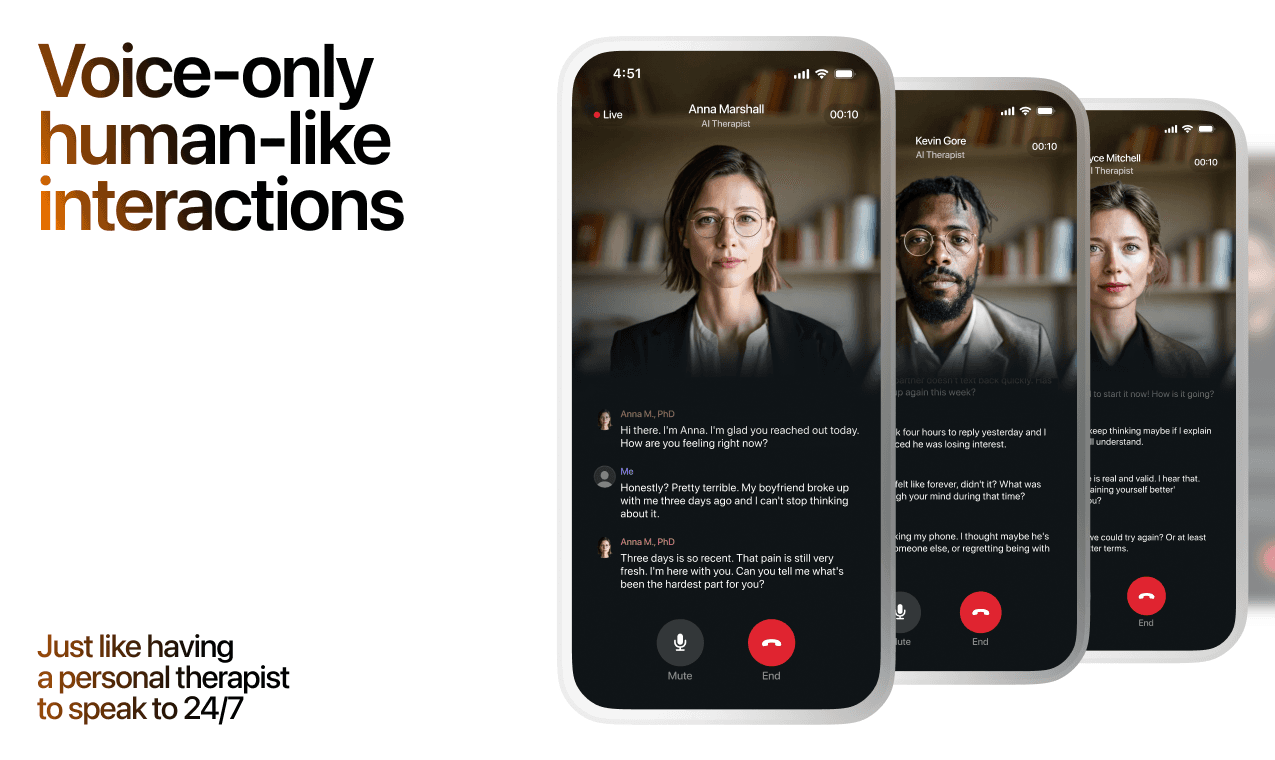
Lovon is AI support, not a replacement for professional care. If things have been hard to get through for weeks, or you are thinking about harming yourself, talk to a doctor or a licensed therapist.
Ready to Start?
Your healing journey can begin right now
A 7-day trial. No judgment. Just a safe space to process what you're going through.
Frequently Asked Questions
Is Lovon a replacement for a real therapist?
Is my conversation with Lovon AI private?
How is Lovon different from ChatGPT for emotional support?
Can I use Lovon if I'm already seeing a therapist?
Can I try Lovon before subscribing?
About the Author

The Lovon Editorial Team
Mental Health & Wellness Content Team
The Lovon Editorial Team develops mental health and wellness content designed to make psychological concepts accessible and actionable. Our goal is to bridge the gap between clinical research and everyday life - helping you understand why your mind works the way it does and what you can do about it....
Related articles
- How to Heal from Emotionally Immature Narcissistic Parents Trauma
Healing from emotionally immature narcissistic parents trauma is a profound journey that requires more than willpower or…
- AI Relationship Coach for Blended Families: 2026 Verdict
AI relationship coach for blended families reviewed for 2026: buy for stepparent stress and co-parenting conflict, skip…
- Best AI Life Coach App for Empty Nesters in 2026
Lovon leads our 2026 ranking of the best ai life coach app for empty nesters, compared against Wysa, Replika…
- Narcissistic Parent Dynamics and Power Imbalance in Relationships
The relationship between a parent and child is inherently unequal by design — but when narcissistic parent dynamics and…
See also
Quizzes
- Boundaries Test: Do I Have Healthy Boundaries? Free Quiz
See where your boundaries slip, in 3 minutes.
- Emotion Recognition Test: Do You Read Feelings Right?
See where your reading of feelings slips, in 3 minutes.
Free tools
- Write a Letter to Your Mom or Dad
A chat, not a template, for a letter to your mom or dad. Tell it the occasion, one or two things you remember, and what…
- AI Relationship Coach
Get free relationship advice and family counselling guidance with our AI Relationship Coach.
From the wiki
- Why do I feel sad when I'm alone?
Being alone does not create the sadness. It removes the noise that was keeping it out of earshot, so whatever queued up…
Disclaimer: This article is for informational purposes only and does not constitute medical advice, diagnosis, or treatment. Always seek the advice of your physician or other qualified health provider with any questions you may have regarding a medical condition. If you are in crisis or think you may have an emergency, call 988 (Suicide & Crisis Lifeline) or go to the nearest emergency room. Outside the US? Find a crisis line in your country.