
Freudly alternatives in 2026
Compare Freudly alternatives: choose Lovon for voice-based emotional support, a therapist for clinical care, or a journal for reflection. Find your best fit.
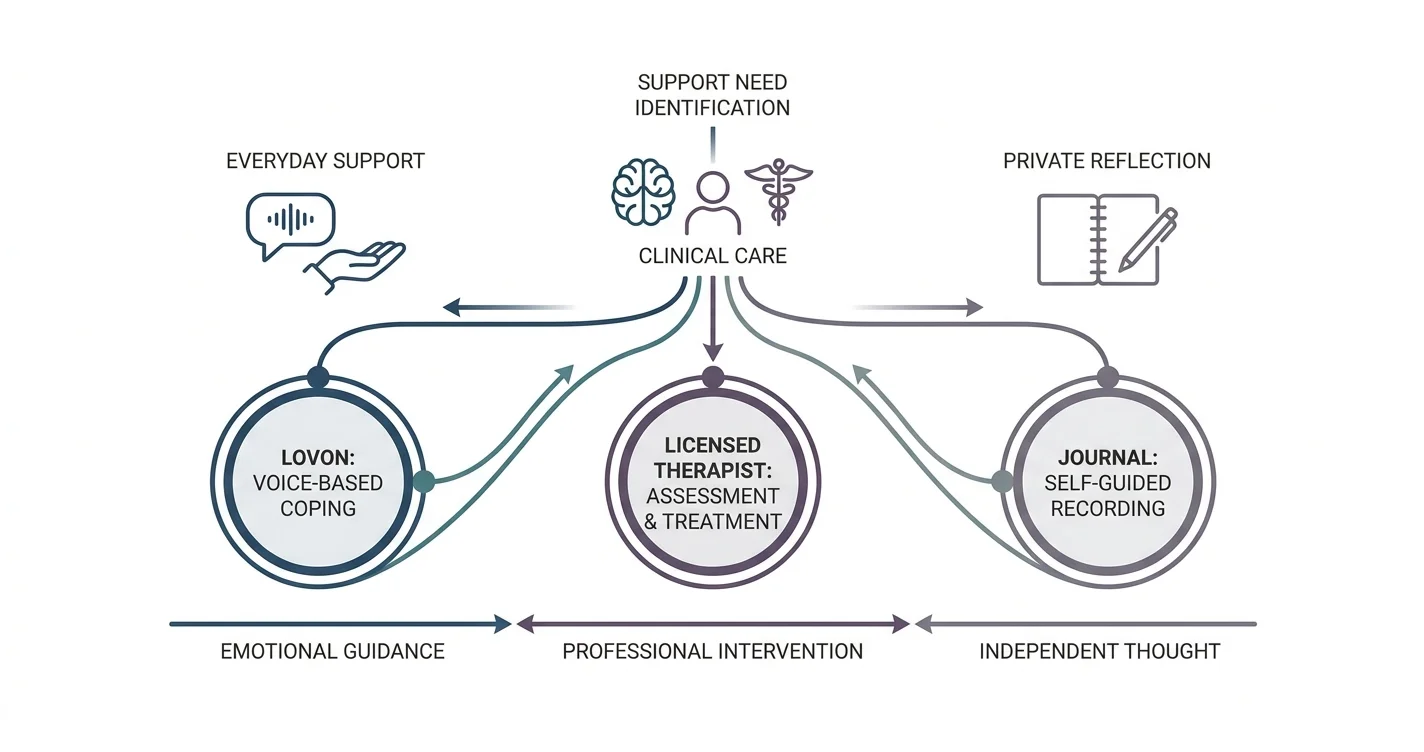

Key Takeaways
- For freudly alternatives, choose Lovon for voice conversations, coping tools, and everyday emotional support.
- Choose a licensed therapist when you need mental health assessment, treatment, or help with worsening symptoms.
- Choose a private journal when you want self-reflection without conversational responses.
- Compare support formats, privacy terms, and care boundaries—not promises of a quick fix.
If Freudly helps you put feelings into words, keep that benefit in mind while comparing alternatives. That support is not enough when you need assessment or treatment from a licensed professional. The best Freudly alternative in 2026 is Lovon if you want on-demand voice-based emotional support; a licensed therapist if you need clinical care.
TL;DR
- For freudly alternatives, choose Lovon for voice conversations, coping tools, and everyday emotional support.
- Choose a licensed therapist when you need mental health assessment, treatment, or help with worsening symptoms.
- Choose a private journal when you want self-reflection without conversational responses.
- Compare support formats, privacy terms, and care boundaries—not promises of a quick fix.
Why this matters
Choosing mental health support is not just a feature comparison. You need to know whether you want somewhere to talk, a way to reflect, or a professional who can assess what is happening.
Lovon is a voice-based mental health support app, not a licensed clinician. It offers emotional support, coping tools, and self-reflection guidance, with input from PhD psychologists. That distinction matters more than whether an app uses the word therapist.
For your 2026 shortlist, start with the kind of help you need:
- Everyday support: You want to talk through stress, relationship worries, or a difficult day.
- Clinical care: You need assessment, treatment, or help with symptoms that disrupt daily life.
- Private reflection: You want to record your thoughts without receiving conversational advice.
These options can serve different roles in the same support plan. You do not have to replace professional care with an app, or choose between talking and journaling forever.
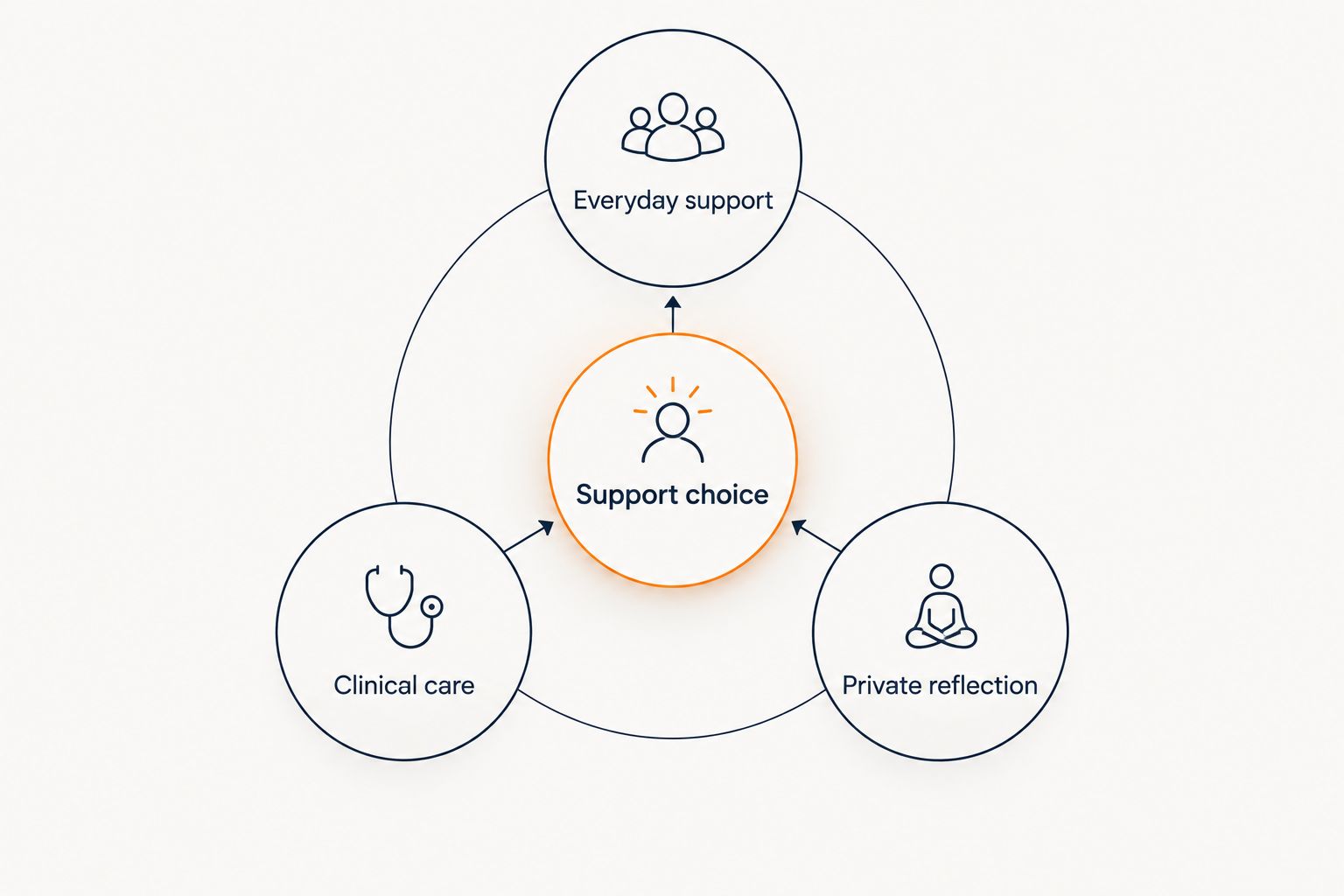 Three support choices: everyday support, clinical care, and private reflection
Choose the kind of support you need before comparing individual features.
Freudly alternatives at a glance
Use this 2026 comparison to separate the options by purpose. For Freudly, your own experience is the benchmark: keep what works and identify the specific need that remains unmet.
| Option | Best for | Main feature or approach | Decision against Freudly |
|---|---|---|---|
| Freudly | Keeping a support routine that already works for you | Your existing experience and familiarity | Stay if it meets your needs and you understand its care boundaries |
| Lovon | On-demand voice-based emotional support | Spoken conversations, coping tools, and self-reflection guidance | Consider it when voice-based support is your priority |
| Licensed therapist | Mental health assessment and treatment | Professional assessment and a treatment relationship | Choose clinical care when your needs extend beyond self-guided support |
| Private journal | Independent reflection without conversational feedback | Writing or recording your own thoughts | Choose it when you want space to reflect rather than responses |
The strongest choice is not necessarily the option with the longest feature list. It is the one whose role matches your need without encouraging you to expect care it cannot provide.
1. Lovon: best for on-demand voice support
Lovon is a mental health support app for people who want to speak rather than compose a message. You can use voice conversations to explore everyday stress, anxiety, low mood, relationship problems, or burnout. Its role is emotional support and reflection, not clinical diagnosis or treatment.
Lovon is best for people who want voice-based emotional support alongside, not instead of, licensed care. You can start with what is bothering you rather than trying to produce a polished explanation.
Where Lovon shines
- Voice conversations: You can talk through what is on your mind instead of typing it out.
- On-demand support: The app is positioned as an always-available companion for everyday struggles.
- Coping and reflection: Sessions include coping tools and guidance for thinking through your feelings.
- Clear intended role: It is described as a companion, not a replacement for licensed clinical care.
Where Lovon falls short
- It is not a licensed clinician. A conversation does not replace professional assessment or treatment.
- Voice needs a suitable setting. Speaking about personal matters is not practical when other people can overhear you.
- It is not emergency care. Do not depend on an app to keep you safe during a crisis.
Best for: Everyday emotional support when speaking feels easier than writing.
Before choosing voice support, think about where you will actually use it. A quiet room is different from a shared office or crowded home. If you need to stay silent, a spoken conversation is the wrong format for that moment, regardless of the app.
Try a 5-minute check-in as a personal comparison exercise, not a test of treatment effectiveness. Explain a manageable concern, ask for help identifying what you feel, and decide whether the response leaves you with a useful next step. Do not use a crisis or deeply distressing experience to test an unfamiliar app.
Verdict: Hold as a support option; skip it as a replacement for clinical care.
2. Licensed therapist: best for assessment and treatment
A licensed therapist offers a professional care relationship rather than an automated conversation. Therapy provides a place to discuss symptoms, history, goals, and treatment approaches with a qualified person. The exact scope depends on the professional’s credentials and practice.
Choose this route when your main question is not simply how to get through a difficult evening. If you need help understanding persistent symptoms or deciding what treatment is appropriate, clinical care is the better category to consider.
Where a licensed therapist shines
- Professional assessment: A qualified clinician can assess concerns within their scope of practice.
- Treatment planning: You can work toward goals through an ongoing professional relationship.
- Human discussion: You can raise concerns about the relationship, explain misunderstandings, and discuss how treatment is progressing.
Where a licensed therapist falls short
- Care depends on fit. Credentials alone do not tell you whether the person’s approach suits your needs.
- Sessions need coordination. You must arrange care around the professional’s scheduling and communication arrangements.
- One professional does not cover every need. Ask about relevant experience, scope, and referral arrangements.
Best for: Persistent, worsening, or disruptive symptoms, and anyone seeking assessment or treatment.
Ask a prospective therapist how they work with your concern and what happens between appointments. Confirm whether they provide the service you need rather than assuming that every mental health professional offers the same care.
For your 2026 decision, treat professional care as a different level of support—not simply another app feature. An emotional support tool can sit beside therapy without doing the same job.
Verdict: Hold as the priority route when assessment or treatment is your goal.
3. Private journal: best for reflection without responses
A private journal lets you record thoughts without having a conversation. You can use paper or a digital format, depending on how you want to store and revisit entries. It offers space to reflect, but it does not assess your wellbeing or provide professional feedback.
Where a private journal shines
- You set the direction. There is no conversational response steering your next thought.
- You choose the format. Write a few sentences, make a list, or describe a situation in your own words.
- You create a record. Previous entries give you material to revisit or discuss with a therapist.
Where a private journal falls short
- There is no outside perspective. You are responsible for noticing assumptions and deciding what to do next.
- Privacy needs attention. Paper can be found, and digital storage requires its own security decisions.
- Writing is not treatment. A journal cannot replace assessment or respond to an emergency.
Best for: People who want independent reflection rather than conversational guidance.
Set aside 2 minutes and describe what happened without trying to solve everything. Finish with 1 sentence naming what you need next. These are suggested boundaries for the exercise, not a promised formula for feeling better.
If writing turns into repeated self-criticism or leaves you more distressed, stop the exercise. Discuss that reaction with a qualified professional rather than forcing yourself to continue.
Verdict: Hold for self-reflection; skip it as your only support when you need care.
Why people consider switching from Freudly
A useful reason to switch is a specific unmet need. Changing tools without naming that need makes it harder to judge whether the replacement is actually a better fit.
These are decision criteria, not claims about Freudly’s features or performance:
- You want spoken support. Compare voice-based options if talking is the format you want to use.
- You need clinical care. Look for a licensed professional rather than expecting a different support app to provide treatment.
- You want less conversational input. A journal offers a different approach when you prefer to hear your own thinking.
- Your setting has changed. Reconsider the format if you no longer have somewhere private to speak.
- Your needs have changed. Support that suited a stressful week is not necessarily enough for persistent symptoms.
Before switching, write down the job you want the next option to do. For example, you might want to name your feelings after a disagreement, prepare questions for a therapist, or organize a concern before discussing it with someone you trust.
Keep that goal narrow. No support app should make major health or relationship decisions for you, and a reassuring response is not proof that its interpretation is correct.
What to check before sharing personal information
For any app on your 2026 shortlist, read its current privacy information before discussing sensitive experiences. Do not assume that a supportive tone tells you how your information is handled.
Check these points directly:
- Collection: What information does the service collect during a conversation?
- Storage: Does it retain recordings, transcripts, or other session information?
- Use: How does it describe using and sharing that information?
- Control: What choices does it describe for deleting information or closing an account?
- Care boundaries: What does it tell you to do when you need professional or urgent help?
Those are questions to investigate, not assurances about any product. Share only what you are comfortable sharing, and do not enter someone else’s identifying information just to explain a disagreement.
Also check your surroundings. A service’s data practices and the risk of someone overhearing you are separate privacy issues.
When staying with Freudly is the right call
Stay with Freudly if your experience is useful, its current terms are acceptable to you, and it fits the role you want it to serve. You do not need to switch simply because another option appears on a list.
A familiar routine has practical value when it helps you follow through. Judge that routine by what happens afterward: whether you understand your concern more clearly and take an appropriate next step, not whether every response feels comforting.
The boundary remains the same in 2026. If you need assessment or treatment, adding clinical care matters more than finding a more appealing support app.
If you are in the United States and experiencing a mental health crisis, call or text 988 for the Suicide & Crisis Lifeline. Call 911 for immediate danger or a medical emergency. Do not wait for an app response.
FAQ
What's the best Freudly alternative in 2026?
Lovon is a fit for on-demand voice-based emotional support; a licensed therapist is the better route for assessment and treatment. Choose according to the kind of help you need, not a universal ranking.
Is Lovon better than Freudly?
Choose Lovon when its voice-based emotional support matches what you want. A blanket claim that it is better than Freudly would not account for your existing experience, preferences, or care needs.
Can a mental health support app replace a therapist?
A mental health support app does not replace a licensed therapist. Use professional care for assessment and treatment, and treat an app as an additional source of support rather than a clinician.
What if I want to talk instead of type?
A voice-based support app is the format to consider when you want to speak instead of type. First make sure you have a setting where you can talk without being overheard.
Should I choose a journal instead of a conversational app?
Choose a journal if you want to reflect without receiving conversational responses. Choose another form of support when you need outside perspective, and seek professional care when you need assessment or treatment.
What should I check before sharing feelings with an app?
Read the service’s current privacy information and care boundaries before sharing sensitive details. Check what it collects, stores, uses, and lets you delete; do not infer those practices from its tone.
When should I seek professional help instead of switching apps?
Seek professional help when symptoms persist, worsen, disrupt daily life, or raise safety concerns. In a crisis, use crisis support or emergency services rather than waiting for an app to respond.
One last thing
You can keep a useful support tool and still need more help. Seeking a therapist does not mean your reflection routine failed, and using a journal does not prevent you from wanting a conversation later.
Before changing anything, name the unmet need in plain language. That sentence is a better starting point than another long list of apps.
Related guides
How AI Support Helps You Heal
AI emotional support isn't about replacing human connection — it's about filling the gaps. The moments when you need to talk at 2 AM, when you don't want to burden your friends again, or when you simply need someone to listen without judgment.
Here's what happens in a typical Lovon session:
You share what's on your mind
There's no script, no intake form, no waiting room. You speak or type whatever you're feeling — in your own words, at your own pace.
Lovon validates and explores
Using frameworks from CBT (Cognitive Behavioral Therapy) and motivational interviewing, Lovon acknowledges your feelings first, then gently helps you explore them. No dismissive "just move on" advice.
You build coping skills together
Lovon doesn't just listen — it actively works with you on evidence-based techniques: thought reframing, urge surfing, behavioral experiments, and more.
What a Session with Lovon Looks Like
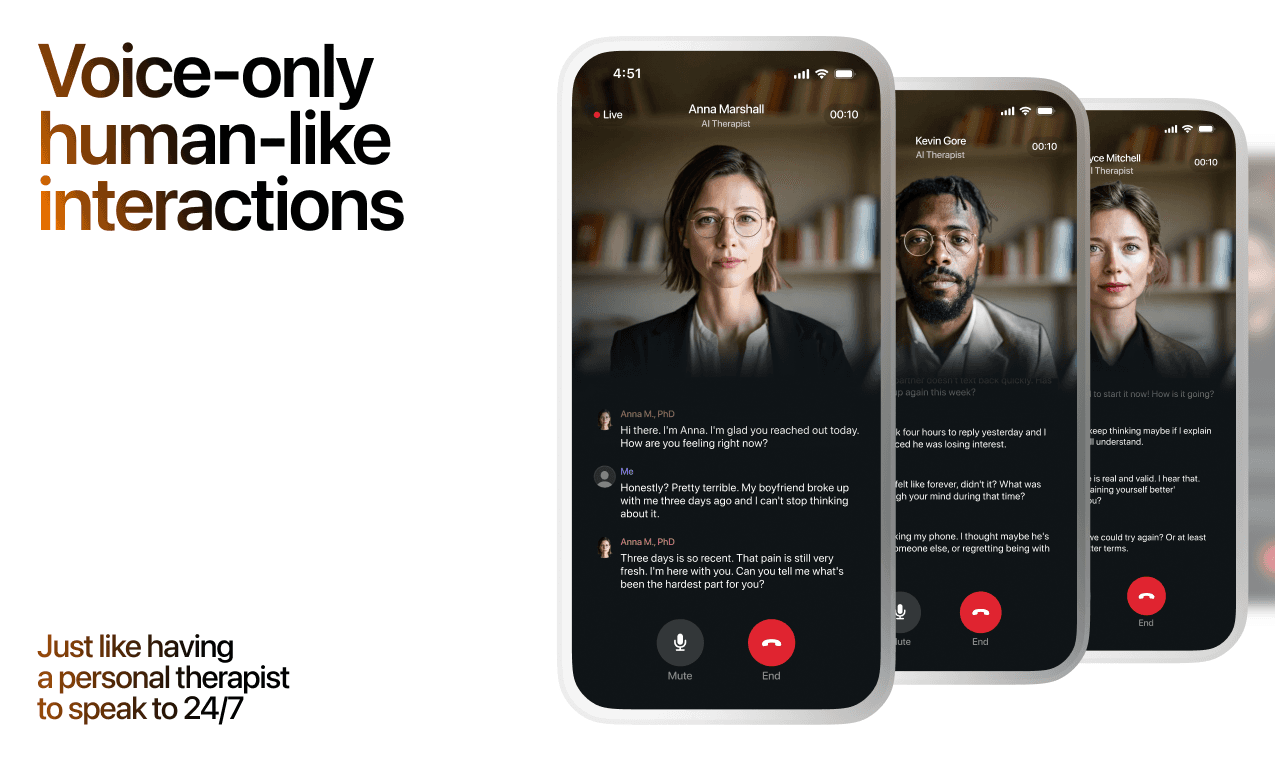
Lovon is AI support, not a replacement for professional care. If things have been hard to get through for weeks, or you are thinking about harming yourself, talk to a doctor or a licensed therapist.
Ready to Start?
Your healing journey can begin right now
A 7-day trial. No judgment. Just a safe space to process what you're going through.
Frequently Asked Questions
Is Lovon a replacement for a real therapist?
Is my conversation with Lovon AI private?
How is Lovon different from ChatGPT for emotional support?
Can I use Lovon if I'm already seeing a therapist?
Can I try Lovon before subscribing?
About the Author

The Lovon Editorial Team
Mental Health & Wellness Content Team
The Lovon Editorial Team develops mental health and wellness content designed to make psychological concepts accessible and actionable. Our goal is to bridge the gap between clinical research and everyday life - helping you understand why your mind works the way it does and what you can do about it....
Related articles
- Best BetterHelp Alternatives for Anxiety in 2026
BetterHelp alternatives for anxiety compared for 2026: Lovon wins for on-demand voice support, Talkspace for licensed…
- AI Mental Health Support 2026: What It Is & Who It Helps
AI mental health support ranges from voice therapy to chatbots in 2026. See what each format does best, who it helps…
- Best AI apps for nurse burnout in 2026
Compare the best AI apps for nurse burnout. Lovon is the voice-first pick for everyday support; review formats, privacy…
- Best vent apps for venting your feelings in 2026
Compare the best vent apps for talking, journaling, and recording feelings. Choose spoken support or a simple outlet…
See also
Quizzes
- Thin Thick Boundaries Test: Where Do Your Lines Blur?
See where your boundaries run thin, in 3 minutes.
- Self-Control Test: Where Does Your Willpower Slip?
See where your willpower slips, in 3 minutes.
Free tools
- Write a Condolence Message for This Person
Get one condolence message written for your situation instead of a list of a hundred to choose from. Tell it who died…
- Write a Letter to Someone You Lost
Tell it who they were to you and what you never got to say, and it writes the letter back in your words. No account, no…
From the wiki
- Why do I keep dreaming about the same person?
A recurring dream figure usually marks unfinished emotional business rather than a message about that person. Your brain…
Disclaimer: This article is for informational purposes only and does not constitute medical advice, diagnosis, or treatment. Always seek the advice of your physician or other qualified health provider with any questions you may have regarding a medical condition. If you are in crisis or think you may have an emergency, call 988 (Suicide & Crisis Lifeline) or go to the nearest emergency room. Outside the US? Find a crisis line in your country.