
How to Rebuild a Friendship After a Falling Out (2026)
How to rebuild a friendship after a falling out in 2026: cool down, own your part, and rebuild trust through consistent small actions, not one apology.

Key Takeaways
- Rebuilding a friendship after a falling out starts with a short, direct conversation, not a long apology text.
- Own your specific part of the conflict before you ask for anything back.
- Trust returns through small, repeated actions over weeks, not one big gesture.
- Some friendships are healthier ended than forced back together, and that's a legitimate outcome in 2026.
A falling out doesn't automatically end a friendship, but drifting back together takes more than time passing quietly. Rebuilding a friendship after a falling out means doing specific, sequenced work: cooling down, naming what actually happened, owning your part of it, and then proving through repeated behavior over weeks that something changed. The friendship that comes back rarely looks identical to the one before the fight — expect it to move slower and feel more careful at first, and it only gets stronger if both people keep showing up past the first conversation.
TL;DR
- Rebuilding a friendship after a falling out starts with a short, direct conversation, not a long apology text.
- Own your specific part of the conflict before you ask for anything back.
- Trust returns through small, repeated actions over weeks, not one big gesture.
- Some friendships are healthier ended than forced back together, and that's a legitimate outcome in 2026.
Why this matters
A friendship going cold after a fight feels smaller than a breakup, but it often isn't. Some friendships carry more shared history than romantic relationships that ended years ago, and letting one dissolve over a fight that could've been fixed with two honest conversations is a common regret people carry for years. Most falling outs don't heal by waiting them out — they heal because one person makes the first move with an actual plan instead of a vague "we should talk sometime."
The longer the silence sits, the more each person fills in the gaps with assumptions instead of facts. That's usually what makes reconciliation harder in month three than it would have been in week two.
How to rebuild a friendship after a falling out
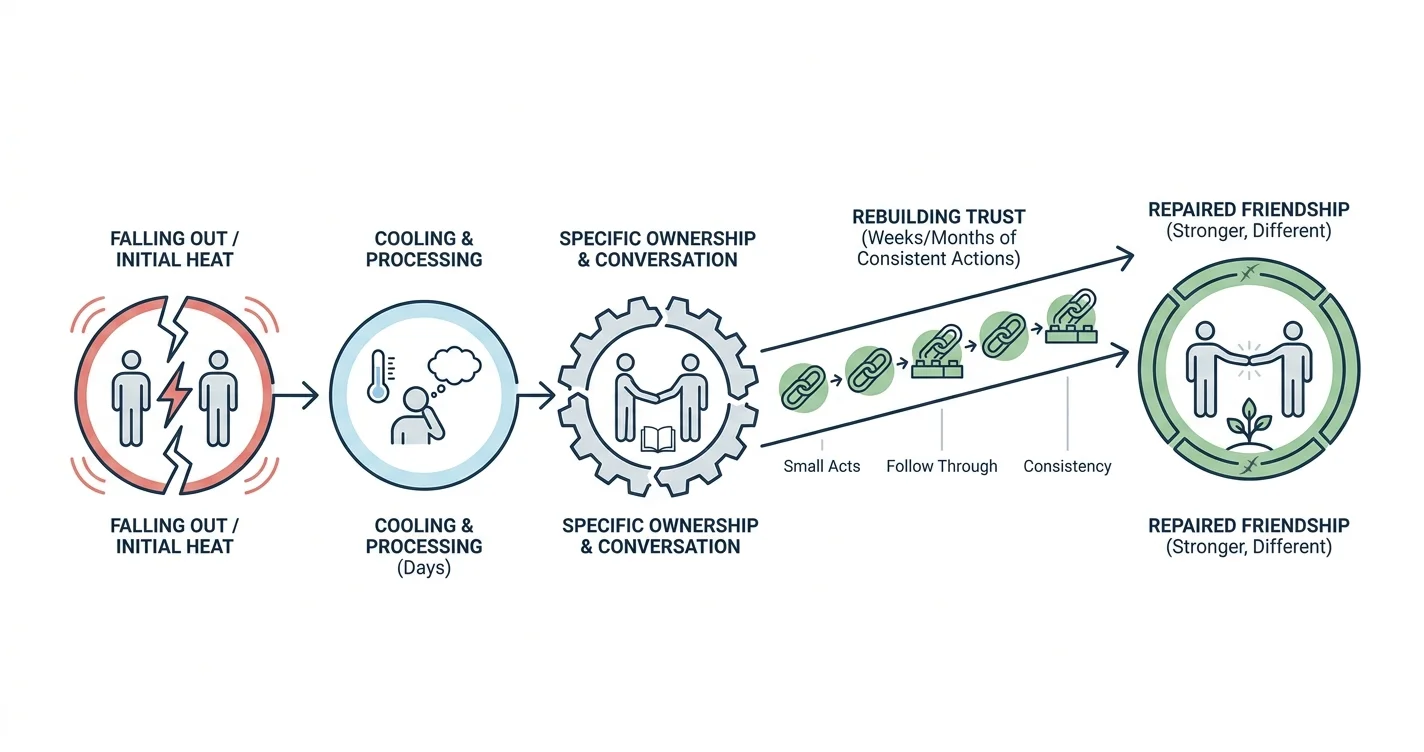
There's no shortcut around the sequence below, but skipping steps is exactly why so many reconciliation attempts stall out after one conversation.
- Let the initial heat cool for a few days. Reaching out mid-anger almost always reopens the fight instead of closing it.
- Send a short, specific message, not a wall of text. Naming the fight directly ("I've been thinking about what happened at dinner") works better than a vague "hey, miss you."
- Talk by call or in person, not over text. Tone gets lost in messages, and misread tone is what restarts most friendship arguments in the first place.
- Own your specific part first, before defending yourself or bringing up what they did. This is the step most people skip, and skipping it is why the conversation goes in circles.
- Listen without building your rebuttal while they talk. If you're reviewing your friendship communicate better in a relationship, the same listening habits that fix romantic conflict apply here.
- Agree on one or two specific changes going forward, not a general "let's be better." Specificity is what makes the agreement stick past the first good week.
- Rebuild trust through small, consistent actions over the following weeks: showing up when you say you will, following through on the small stuff, not disappearing again the next time things get tense.
Skipping step 4 is the single most common reason reconciliation attempts fail in 2026 — people apologize for "the situation" instead of the specific thing they did.
What determines whether a friendship can actually be repaired
Not every falling out is repairable, and knowing which factors matter saves you from months of trying to fix something that was already over.
- How the hurt happened — a misunderstanding repairs faster than a betrayal like lying or talking behind someone's back.
- Whether both people want it back. One-sided effort burns out within a few weeks if the other person isn't reaching back.
- How long the friendship existed before the fight. Longer histories usually survive more, but not always.
- Whether the same pattern has repeated before. A first blowup is different from the fifth version of the same argument.
- Whether either person is willing to change specific behavior, not just apologize for the outcome.
- How much unspoken resentment built up before the fight itself, since the falling out is often the release valve for something older.
When the same pattern keeps repeating across multiple friendships, it's worth checking whether the issue is this one relationship or a habit you carry into most of them — that's the kind of blind spot that's hard to see from inside the conflict. The same principle that sends people looking for guidance from a trusted mentor before a major life decision applies here: an outside perspective sees the pattern you're too close to name yourself.
Process the conflict before you reach out
Talk it through out loud with Lovon before you make the first move.
How long does it take to rebuild trust after a friendship falls out?
Rebuilding trust after a friendship falls out typically takes several weeks to a few months of consistent, low-drama contact, not one conversation. The apology conversation ends the standoff; trust comes back later, through repeated small proof points like following through on plans and not disappearing again when things get slightly tense.
Should you apologize first even if you weren't fully wrong?
Apologizing first for your specific part of the conflict, even in a fight that was mostly the other person's fault, is usually what unfreezes the situation in 2026's mostly text-first social habits. It doesn't mean taking blame for the whole fight — it means naming the one thing you'd do differently, which gives the other person room to do the same instead of staying defensive.
Is it better to end a friendship than force a repair?
Ending a friendship instead of forcing a repair is the better call when the same hurtful pattern has repeated multiple times or only one person is willing to change anything. Forced reconciliation without any real change usually produces a shakier version of the same friendship that breaks again within a year.
FAQ
How do you rebuild a friendship after a falling out?
You rebuild a friendship after a falling out by letting the initial heat cool, reaching out with a specific low-pressure message, owning your part of the conflict directly, and proving change through small consistent actions over several weeks. One apology conversation restarts contact; it doesn't rebuild trust by itself.
How long should you wait before reaching out after a friendship fight?
A few days to about a week is usually the right window before reaching out after a friendship fight. Reaching out while still angry tends to reopen the argument instead of resolving it, and waiting months lets assumptions harden into resentment.
What do you say to a friend after a falling out?
Name the specific incident directly, own your part of it first, and ask if they're open to talking rather than assuming they are. A message like "I've been thinking about what happened, and I want to own my part of it" works better than a vague "we should catch up."
Can a friendship go back to normal after a big fight?
A friendship rarely goes back to exactly how it was before a big fight, but it can become just as close, or closer, once both people show real change over time. Expect the first few weeks after reconciliation to feel more careful than the friendship used to be — that's normal, not a sign it's failing.
Is it normal to not want to be friends again after a falling out?
Yes, not wanting to reconcile after a falling out is a normal and valid response, especially when the same hurtful pattern has repeated more than once. Repair only works when both people genuinely want it; forcing it back together without real change usually leads to another break later.
How do you know if a friendship is worth saving?
A friendship is worth saving if both people want it back, the hurt was a one-time misunderstanding rather than a pattern, and each person is willing to change one specific behavior. If only you're doing the reaching out after several attempts, that's a sign the friendship may not be repairable right now.
Why do friendships fall apart over small things?
Friendships often fall apart over things that look small on the surface because the small fight is usually the release valve for older, unspoken resentment. The real issue is rarely the specific incident — it's what that incident represents about being unheard or deprioritized over time.
One last thing
The part people get backwards most often: they wait for the apology conversation to fix the friendship, when the apology only reopens the door. Trust comes back from what happens in the six weeks after that conversation, not from the conversation itself. If you handle the repair conversation well and then go quiet again for a month, the friendship reads that silence as confirmation nothing actually changed.
Related guides
How AI Support Helps You Heal
AI emotional support isn't about replacing human connection — it's about filling the gaps. The moments when you need to talk at 2 AM, when you don't want to burden your friends again, or when you simply need someone to listen without judgment.
Here's what happens in a typical Lovon session:
You share what's on your mind
There's no script, no intake form, no waiting room. You speak or type whatever you're feeling — in your own words, at your own pace.
Lovon validates and explores
Using frameworks from CBT (Cognitive Behavioral Therapy) and motivational interviewing, Lovon acknowledges your feelings first, then gently helps you explore them. No dismissive "just move on" advice.
You build coping skills together
Lovon doesn't just listen — it actively works with you on evidence-based techniques: thought reframing, urge surfing, behavioral experiments, and more.
What a Session with Lovon Looks Like

Lovon is AI support, not a replacement for professional care. If things have been hard to get through for weeks, or you are thinking about harming yourself, talk to a doctor or a licensed therapist.
Ready to Start?
Your healing journey can begin right now
A 7-day trial. No judgment. Just a safe space to process what you're going through.
Frequently Asked Questions
Is Lovon a replacement for a real therapist?
Is my conversation with Lovon AI private?
How is Lovon different from ChatGPT for emotional support?
Can I use Lovon if I'm already seeing a therapist?
Can I try Lovon before subscribing?
About the Author

The Lovon Editorial Team
Mental Health & Wellness Content Team
The Lovon Editorial Team develops mental health and wellness content designed to make psychological concepts accessible and actionable. Our goal is to bridge the gap between clinical research and everyday life - helping you understand why your mind works the way it does and what you can do about it....
Related articles
- Toxic Family Apology Dynamics: How to Navigate False Peace
Toxic family apology dynamics create a confusing emotional landscape where apologies serve to maintain control rather…
- Retroactive Jealousy: Why It Happens, How to Stop It (2026)
Retroactive jealousy explained: causes, triggers, and 8 steps to break the loop in 2026. Practical, evidence-based…
- How to Regulate Emotions After a Fight (2026 Method)
Regulate emotions after a fight with a 20-minute pause, box breathing, and grounding - the 2026 method that stops repeat…
- AI Relationship Coach for Trust Issues (2026)
Find the best AI relationship coach for trust issues in 2026. Lovon offers voice-based, personalized sessions 24/7 — no…
See also
Quizzes
- Partner Respect Test: Does Your Partner Respect You?
See how respect shows up in your partner's behavior, in 3 minutes.
- Should I Forgive Him for Cheating? 12-Question Quiz
Twelve questions on whether rebuilding is possible.
Free tools
- How to Respond to an Apology You're Not Sure About
A chat for how to respond to an apology that is sitting unanswered on your phone. Paste what they said, tell it what it…
- What to Text Your Ex (and Whether to Send It)
Not sure what to text your ex? This chat starts with why you are texting them. Say the reason, how it ended and how long…
From the wiki
- What is considered cheating?
There is no universal list, which is why the answer depends on the agreement the two of you actually have, usually one…
Disclaimer: This article is for informational purposes only and does not constitute medical advice, diagnosis, or treatment. Always seek the advice of your physician or other qualified health provider with any questions you may have regarding a medical condition. If you are in crisis or think you may have an emergency, call 988 (Suicide & Crisis Lifeline) or go to the nearest emergency room. Outside the US? Find a crisis line in your country.